easyJet Flight EZY888 Returns at Glasgow Airport After Passenger Disruption Triggers Police Intervention

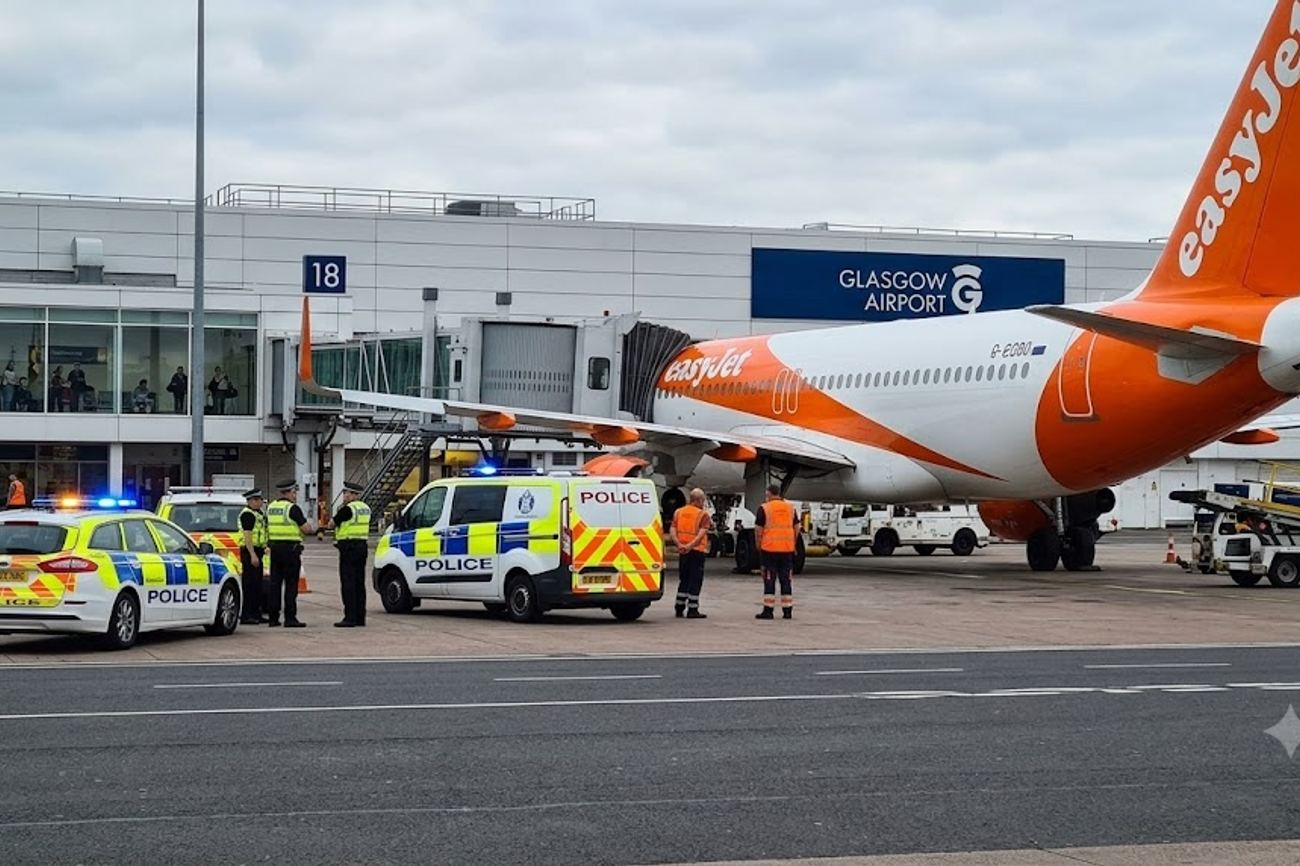
Image generated by AI
[Glasgow, September 19, 2026] — An easyJet flight bound for London Gatwick was forced to abort its taxi and return to the gate on Saturday after a passenger's disruptive behavior triggered a security intervention.
The aircraft, operating as flight EZY888, had already departed its stand and was maneuvering toward the runway at Glasgow Airport when the crew determined the situation required immediate police action. Following the return to the stand, officers from Police Scotland boarded the aircraft and removed the individual in question. The operation resulted in a 49-minute delay to the scheduled departure, with the flight eventually departing at 3:29 PM after a reported police notification at approximately 2:50 PM.
Security Breach Triggers Taxi Abort
The incident occurred during the critical window between pushback and takeoff. As flight EZY888 proceeded toward the runway, cabin crew identified a passenger whose conduct posed a potential risk to the safety and order of the flight. Under the authority of the captain and the airline's safety protocols, the decision was made to reverse course and return to the terminal.
Police Scotland confirmed that officers were dispatched to the aircraft following reports of the disruption. Upon arrival at the stand, the passenger was escorted off the plane. Despite the operational disruption, authorities confirmed that no formal complaints were filed and no arrests were made following the removal. The aircraft subsequently proceeded to its destination, arriving at London Gatwick at 4:57 PM.
Impacted Operations and Routes
The disruption was localized to a single service, but it highlighted the fragility of departure slots and the priority placed on cabin security over on-time performance.
| Detail | Specification |
|---|---|
| Airline | easyJet |
| Flight Number | EZY888 |
| Route | Glasgow Airport (GLA) $\rightarrow$ London Gatwick (LGW) |
| Incident Date | September 19, 2026 |
| Police Notification | ~2:50 PM |
| Scheduled Departure | ~2:40 PM |
| Actual Departure | 3:29 PM |
| Total Delay | 49 Minutes |
| Arrival Time | 4:57 PM |
Practical Traveler Advisory and Strategic Insights
For passengers currently booking flights or traveling through major hubs, this incident serves as a reminder that "return to gate" notifications are not always indicative of mechanical failure.
Operational Reality: When a flight returns to the stand, it may be due to a medical emergency, a technical glitch, or—as seen here—a security issue involving another passenger. Travelers should be aware that airlines like easyJet maintain a zero-tolerance policy toward disruptive behavior.
Passenger Rights: While a 49-minute delay is generally below the threshold for significant financial compensation under most aviation regulations, it can disrupt tight connections. Passengers are encouraged to check the Civil Aviation Authority (CAA) guidelines regarding passenger rights during operational delays.
Onboard Conduct: Cabin crew are legally empowered to remove any individual who threatens the safety of the flight or obstructs the crew. This authority extends to the use of physical restraint if necessary to maintain order before the aircraft enters the airspace.
Glasgow Airport’s Proactive Security Framework
The handling of EZY888 is a practical application of the broader security strategy employed by Glasgow Airport. The airport utilizes a comprehensive safety network designed to intercept problematic behavior before it reaches the aircraft cabin.
Central to this strategy is the "Campus Watch" program, which was relaunched in March 2026. This initiative creates a communication loop between more than 5,000 airport employees—including retail staff, restaurant workers, and security teams—and the central control room. By identifying signs of intoxication or aggression in the terminal, the airport aims to prevent disruptions from escalating once passengers board.
The Campus Watch system functions through several integrated layers:
- Early Detection: Staff in bars and retail areas report suspicious or aggressive behavior.
- Rapid Routing: Information is funneled to the central control room for immediate assessment.
- Police Integration: Direct lines to Police Scotland ensure that officers are positioned to intervene at the gate or on the aircraft.
- Preventative Screening: Monitoring begins at the terminal entrance and continues through security and boarding.
By prioritizing early recognition, the airport reduces the likelihood of "in-flight" emergencies, which are significantly more dangerous and costly to manage than ground-based removals.
The Hidden Cost of Passenger Disruption
While the EZY888 incident ended without arrests, the ripple effects of disruptive passengers extend beyond the individual removed. A 49-minute delay may seem marginal, but for a high-frequency route between Glasgow and London, such a gap can impact aircraft rotations for subsequent flights.
Furthermore, passengers with onward rail connections from Gatwick or timed hotel check-ins face immediate logistical challenges. The psychological impact on other passengers—who may experience anxiety when an aircraft unexpectedly turns back from the runway—is another intangible cost of such behavior.
The aviation industry continues to grapple with a rise in unruly passenger incidents globally. The decision to return to the gate, while frustrating for the remaining travelers, is viewed by regulators and airlines as the only viable option to ensure that a disruptive situation does not evolve into a mid-air emergency where options for intervention are severely limited.
FAQ: Passenger Disruptions 2026
What happens if my flight returns to the gate due to another passenger? The aircraft will return to the stand to allow security or police to remove the individual. Once the cabin is cleared and safety is verified, the flight will resume its departure process. You remain under the care of the airline during this time.
Can I be removed from a flight for behavior that occurred in the terminal? Yes. Through programs like Campus Watch, airlines and airport authorities can identify disruptive behavior in the terminal. If you are deemed a safety risk, the airline may refuse carriage before you even board the aircraft.
Who has the final say on whether a flight departs with a disruptive passenger? The Captain (Pilot in Command) has ultimate authority over the safety of the flight. If the Captain or the lead cabin crew member determines that a passenger's behavior compromises safety, they can order the aircraft to return to the gate.
Does a passenger-related delay qualify for compensation? Generally, short delays (under three hours) caused by security interventions do not trigger mandatory financial compensation, though the airline may provide basic amenities depending on the length of the wait.
Safety remains the absolute priority in the skies, regardless of the clock.
Related Travel Guides
This article is for informational purposes. Flight routes, passenger regulations, visa rules, and transit advisories are subject to change by airlines and aviation authorities. Readers are advised to verify schedules and travel documentation with relevant carriers and border agencies before departure.
Related Stories
easyJet Launches Direct Liverpool to Reykjavik Flights: Inside the North West's New Winter Gateway to Iceland

Jet Airways vs. Boeing NCLAT Battle: Why Manufacturer Litigation Offers No Quick Ticket Refunds for Indian Travel Agents