
Freight Train Derailment in South Charleston Disrupts Key Transit Corridor in August 2026
Emergency crews are managing a freight train derailment in South Charleston, causing significant road closures and rail rerouting across a critical industrial corridor.

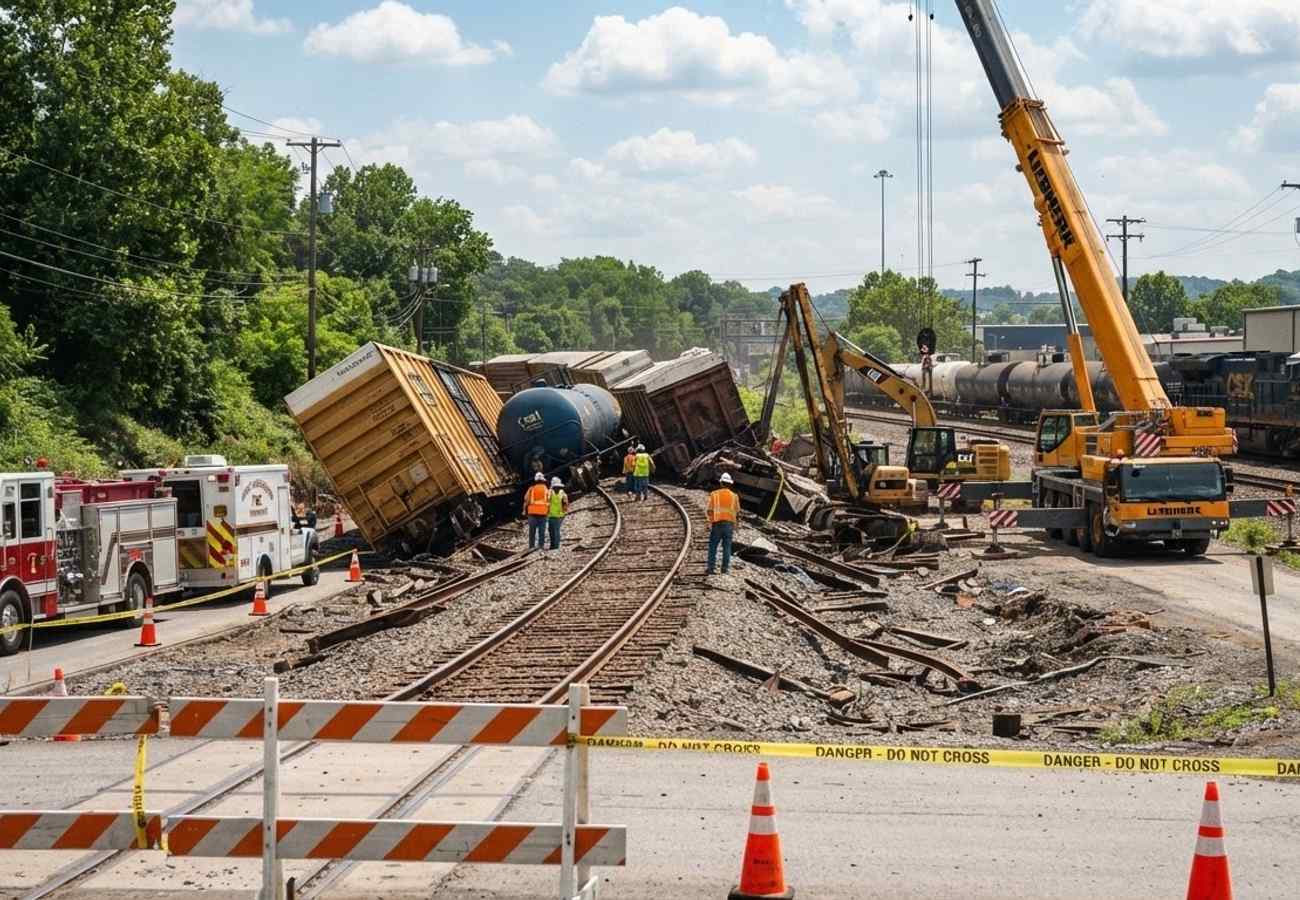
Image generated by AI
Emergency and railroad teams are currently stabilizing a freight train derailment in South Charleston that has blocked a primary roadway and halted traffic on a high-volume industrial corridor.
The incident, which occurred on Thursday, August 7, 2026, involved several rail cars leaving the tracks. While the derailment has caused significant logistical headaches for local commuters and freight operators, early reports indicate the situation is contained with no immediate threat to public safety.
Emergency Response and Site Stabilization
First responders and railroad personnel have established a secure perimeter around the derailment zone to allow heavy machinery to operate. Initial assessments show that the derailed cars remained either upright or on their sides close to the right-of-way, which helped limit the spread of debris.
Safety protocols are currently the primary focus. Hazardous materials specialists are on-site or on standby to perform the following:
- Visual inspections of tank and boxcars for structural breaches.
- Air quality sampling to detect potential chemical leaks.
- Cross-referencing physical car numbers with cargo manifests to identify contents.
- Isolating the affected track section to prevent further incidents.
No injuries have been reported. Because early checks showed no hazardous releases, evacuation zones have been limited to properties immediately bordering the tracks, though road and driveway access remains restricted.
Impact on Local Traffic and Regional Travel
The derailment has created a bottleneck at a critical crossing, forcing drivers to seek parallel routes. Local authorities have advised travelers to avoid the impacted stretch entirely while recovery efforts continue.
For those navigating the South Charleston area, the following disruptions are expected:
- Road Closures: Blocked crossings are complicating commutes to industrial sites and residential neighborhoods.
- Noise Pollution: Residents and hotel guests in the vicinity may experience overnight noise from generators, lighting towers, and heavy recovery equipment.
- Navigation Shifts: GPS and navigation apps may not immediately reflect real-time closures; manual detours are recommended.
Rail Network Disruptions and Recovery Logistics
South Charleston serves as a vital node for freight movement. Dispatch summaries indicate that trains are being held or rerouted to avoid the damaged segment. Depending on the severity of the track damage, some freight may be staged in nearby yards or diverted to alternate lines.
The recovery process involves specialized rail contractors utilizing side-boom tractors, cranes, and excavators to lift cars back onto the rails or move them onto flatbeds. This process is often prolonged if the track ballast—the stone bed supporting the rails—was displaced during the accident.
Once the cars are cleared, the focus will shift to infrastructure repair, including:
- Replacing broken rails, ties, and fasteners.
- Re-tamping the ballast.
- Running specialized measurement cars to confirm track geometry before restoring normal speeds.
Federal Investigation and Long-Term Outlook
The Federal Railroad Administration (FRA) typically mandates a detailed report for derailments of this scale. Investigators will examine crew data, train composition, weather conditions, and track integrity. Common focal points for these investigations include switch alignment, equipment failure, or pre-existing track defects.
While the physical cleanup may take a few days, the findings from the FRA often take months to finalize. This incident is expected to reignite local debates regarding the routing of hazardous materials and the impact of heavy freight on community accessibility.
Summary of Impact and Recovery
| Impact Area | Current Status | Expected Duration |
|---|---|---|
| Public Safety | No injuries; no hazardous leaks reported | Ongoing monitoring |
| Road Traffic | Significant closures at crossings | Hours to days |
| Rail Freight | Rerouted or staged in yards | Until track inspection is complete |
| Infrastructure | Damaged rails and ballast | Days for full restoration |
| Passenger Rail | Potential speed restrictions/schedule shifts | Days |
Key Takeaways
- Safety First: No injuries or hazardous leaks have been reported; the site is secured.
- Travel Warning: Avoid the immediate South Charleston crossing area; use parallel routes.
- Logistics: Heavy cranes and recovery equipment are on-site, meaning noise and congestion will persist overnight.
- Rail Outlook: Expect temporary speed restrictions even after the line reopens as a safety precaution.
Frequently Asked Questions
Are there any evacuations in South Charleston? No widespread evacuations have been ordered. Restrictions are currently limited to properties immediately bordering the tracks and specific road closures.
How will this affect passenger train schedules? While freight is the primary impact, any passenger services sharing the corridor may experience delays or speed restrictions. Travelers should check operator alerts.
When will the roads reopen? Roads typically reopen once the heavy recovery equipment has cleared the crossing and the site is deemed safe by local police and rail authorities.
Recovery efforts continue as crews work to restore one of the region's most critical transit arteries.
Related Travel Guides
Disclaimer
This article is for informational and educational purposes only. It does not constitute legal, financial, or professional advice. While we strive to provide accurate and up-to-date information, travel policies, regulations, and conditions change rapidly. Always verify information with official sources before making travel decisions. Nomad Lawyer makes no representations about the accuracy, reliability, completeness, or suitability of the information provided. Readers should consult qualified professionals for advice specific to their circumstances. The views expressed in this article are those of the author and do not necessarily reflect the views of Nomad Lawyer.
Raushan Kumar
Founder & Lead Developer
Full-stack developer with 11+ years of experience and a passionate traveller. Raushan built Nomad Lawyer from the ground up with a vision to create the best travel and law experience on the web.
Learn more about our team →