Japan Overhauls Tax-Free Shopping on 1 November 2026: New Airport Refund System, Customs Checks, and Higher Upfront Costs

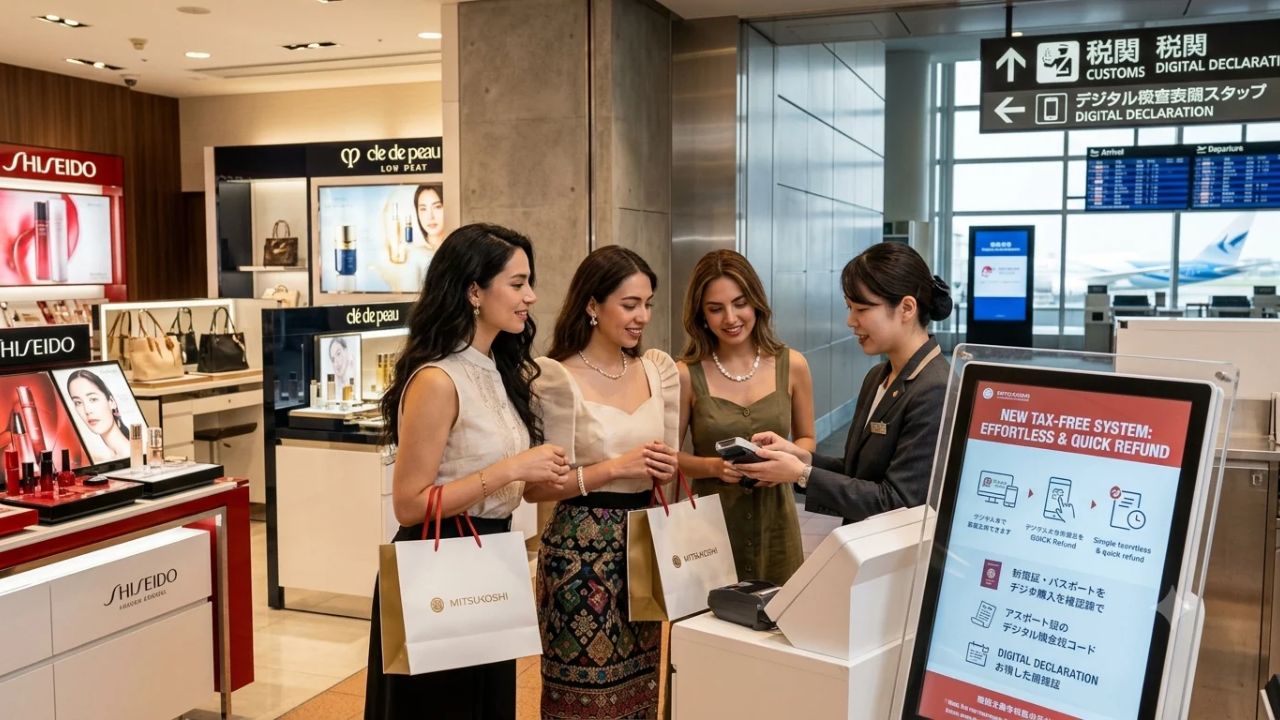
From 1 November 2026, international tourists in Japan will pay consumption tax upfront and verify purchases at airport Customs before receiving refunds
[TOKYO, Oct 30, 2026] — In the most comprehensive overhaul of its retail tourism framework in decades, Japan will officially terminate its point-of-sale tax exemption system on November 1, 2026, transitioning to an airport departure refund model that requires international tourists to pay consumption tax upfront and verify purchases with Customs before checking baggage.
[!NOTE] Regulatory Transition Snapshot: Beginning Sunday, November 1, 2026, eligible overseas visitors shopping in Tokyo, Osaka, Kyoto, and across Japan will no longer receive immediate tax-free discounts at store cash registers. Instead, shoppers will pay full tax-inclusive prices (10% standard or 8% reduced rate) and reclaim the tax after completing digital Customs verification at departure airports or seaports. The ¥5,000 daily minimum spend threshold remains, but special sealed packaging rules and the ¥500,000 consumables limit have been eliminated.
JAPAN TAX-FREE SHOPPING REFORM ARCHITECTURE (2026)
| Column 1 |
|---|
| [ PHASE 1: IN-STORE PURCHASE (DAY 1 TO DAY 90) ] |
| - Present foreign passport or approved digital verification credentials |
| - Pay full tax-inclusive price upfront (10% standard goods / 8% food & beverage) |
| - Register preferred refund channel (credit card, digital wallet, or store provider) |
| - Maintain qualifying items in unused condition; retain digital purchase transaction records |
| v |
| [ PHASE 2: AIRPORT ARRIVAL (BEFORE BAGGAGE CHECK-IN) ] |
| - Arrive at international departure airport with all qualifying goods in possession |
| - Complete digital Customs confirmation at automated kiosks or via Visit Japan Web |
| +----------------------------+-----------------------------+ |
| v [ GREEN KIOSK RESULT ] v [ RED KIOSK RESULT ] |
| - Electronic confirmation cleared - Mandatory physical examination |
| - No physical inspection required - Present goods to Customs desk |
| - Proceed directly to airline check-in - Verification of serial numbers |
| +----------------------------+-----------------------------+ |
| v |
| [ PHASE 3: REFUND DISBURSEMENT (POST-CUSTOMS CLEARANCE) ] |
| - Retailer or authorized third-party provider processes net refund to payment account |
| - Funds credited to card or digital wallet (processing times vary by provider) |
The November 1 Shift: Ending Instant Exemptions to Curb Resale Fraud
For more than a decade, Japan's tax-free shopping system operated on an immediate point-of-sale exemption model. Foreign passport holders visiting the country on temporary visitor visas could present their credentials at participating department stores, electronics megastores, and discount chains, having the consumption tax deducted immediately from their purchase total.
While this mechanism made shopping fast and convenient, it created an unintended regulatory loophole. Japan’s National Tax Agency (NTA) and Ministry of Finance discovered widespread instances where luxury goods, designer cosmetics, and high-end electronics purchased tax-free were never exported. Instead, organized domestic resale syndicates and rogue buyers resold the goods inside Japan at tax-exclusive margins, pocketing the unpaid consumption tax and costing the Japanese treasury tens of billions of yen in lost tax revenue.
Because the tax exemption was granted at the checkout counter, tax authorities had little practical recourse when individuals failed to present the goods at the airport, particularly when visitors departed without declaring their items or left the country on short notice.
To eliminate this systemic vulnerability, the Japanese Diet enacted legislative reforms as part of the fiscal 2025 tax code overhaul, formally scheduling implementation for Sunday, November 1, 2026. The new system reverses the operational sequence:
OLD SYSTEM VS. NEW NOVEMBER 2026 SYSTEM
| Column 1 |
|---|
| PREVIOUS SYSTEM (UNTIL OCT 31, 2026) NEW REVISED SYSTEM (FROM NOV 1, 2026) |
| ------------------------------------ ------------------------------------- |
| - Exemption granted instantly at store cash - Full tax-inclusive price paid at store cash |
| register; customer pays net price. register (10% or 8% added to checkout bill). |
| - Consumables sealed in tamper-evident - Special sealed plastic packaging abolished; |
| plastic bags with strict no-opening rules. items packed freely in luggage. |
| - ¥500,000 maximum purchase cap on - Consumables purchase cap completely removed; |
| consumables per store per day. spend unlimited above ¥5,000 baseline. |
| - General goods and consumables tracked - Unified spending pool: general goods and |
| in separate spending ledgers. consumables combined toward ¥5,000 threshold. |
| - Airport Customs checks largely passive - Mandatory active digital Customs confirmation |
| with minimal physical audits. terminal scan before baggage check-in. |
| - Exemption final at time of purchase. - Refund issued only after electronic export audit. |
Under this structure, legitimate foreign tourists can still enjoy full relief from Japan’s consumption tax, but the financial benefit is disbursed as a post-export refund rather than an immediate upfront discount.
Financial Mechanics: Consumption Tax Rates, Upfront Capital, and Calculations
The reform carries direct financial implications for international shoppers, particularly travelers from Southeast Asia, North America, and Europe who plan major retail excursions to Tokyo, Osaka, or Kyoto.
Japan enforces two distinct statutory consumption tax tiers:
- The Standard 10% Rate: Applies to the vast majority of taxable consumer merchandise, including consumer electronics, designer fashion, cameras, watches, cosmetics, homeware, and souvenirs.
- The Reduced 8% Rate: Applies primarily to qualifying packaged food products, confectioneries, teas, and non-alcoholic beverages intended for export.
Because shoppers must pay the full gross price at checkout, travelers must ensure their credit cards, debit cards, or cash reserves can absorb the temporary 8% to 10% premium throughout their trip.
UPFRONT CONSUMPTION TAX OUTLAY BY SPENDING TIER
| Column 1 |
|---|
| RETAIL SPEND (PRE-TAX) APPLICABLE TAX RATE UPFRONT CHECKOUT COST POTENTIAL REFUND |
| ---------------------------------------------------------------------------------------------- |
| ¥5,000 (Minimum Baseline) 10% Standard Rate ¥5,500 ¥500 |
| ¥10,000 10% Standard Rate ¥11,000 ¥1,000 |
| ¥10,000 (Food & Confections) 8% Reduced Rate ¥10,800 ¥800 |
| ¥25,000 10% Standard Rate ¥27,500 ¥2,500 |
| ¥50,000 10% Standard Rate ¥55,000 ¥5,000 |
| ¥100,000 10% Standard Rate ¥110,000 ¥10,000 |
| ¥250,000 10% Standard Rate ¥275,000 ¥25,000 |
| ¥500,000 10% Standard Rate ¥550,000 ¥50,000 |
| ¥1,000,000 (Luxury Bracket) 10% Standard Rate ¥1,100,000 ¥100,000 |
For high-volume retail categories—such as Japanese skincare products, luxury timepieces, mirrorless camera lenses, and designer apparel—the upfront capital outlay is significant:
- A visitor purchasing a camera lens priced at ¥250,000 will pay ¥275,000 at the register, tying up ¥25,000 in consumption tax until departure.
- A traveler purchasing luxury goods totaling ¥1,000,000 will pay ¥1,100,000 upfront, requiring ¥100,000 in temporary capital outlay.
International visitors must also account for foreign transaction fees and currency conversion margins imposed by their home banking institutions. When paying with international credit cards (such as Philippine Peso, US Dollar, or Euro credit cards), the initial transaction is converted at the merchant's daily bank rate, and the eventual refund may be credited days or weeks later at a slightly different foreign exchange rate, minus any administrative processing fees deducted by the retailer's third-party refund operator.
Revised Shopping Rules: Thresholds, Category Mergers, and High-Value Scrutiny
While the shift to an airport refund system adds procedural steps, the reform also introduces sensible regulatory simplifications that resolve longstanding traveler frustrations.
KEY REGULATORY EVOLUTIONS UNDER THE REVISED SYSTEM
| Column 1 |
|---|
| [ 1. ABOLITION OF CATEGORY BARRIERS ] |
| - Old Rule: "General Goods" and "Consumables" could not be combined to reach ¥5,000. |
| - New Rule: Full category merger. Clothing, makeup, matcha, and ceramics count together. |
| [ 2. ELIMINATION OF THE ¥500,000 CONSUMABLES CAP ] |
| - Old Rule: Consumables were strictly capped at ¥500,000 per store per day. |
| - New Rule: Cap eliminated. Travelers can purchase unlimited premium cosmetics or foodstuffs. |
| [ 3. DISCONTINUATION OF SPECIAL SEALED BAGS ] |
| - Old Rule: Consumables had to be sealed in bulky red-tape plastic bags that could not be opened |
| - New Rule: Sealed packaging abolished. Items can be packed cleanly into suitcases. |
| [ 4. HIGH-VALUE ASSET SCRUTINY (¥1,000,000+ ITEMS) ] |
| - Mandatory detailed ledger recording for individual items priced at or above ¥1 million. |
| - Stores must record serial numbers, production models, and high-resolution item data. |
Unifying General Goods and Consumables
Under the previous system, retail transactions were divided into two rigid legal categories: "General Goods" (clothing, electronics, footwear, bags) and "Consumables" (food, confectionery, cosmetics, medicines, beverages). A tourist who purchased a ¥3,500 shirt and ¥3,000 worth of regional snacks at the same department store failed to qualify for tax exemption because neither category reached the standalone ¥5,000 minimum threshold.
Effective November 1, 2026, this artificial barrier is eliminated. Travelers can combine any assortment of qualifying goods purchased at the same participating store on the same calendar day to satisfy the baseline ¥5,000 pre-tax threshold.
Eliminating the Consumables Cap and Tamper-Proof Packaging
Historically, foreign visitors purchasing premium skincare collections or vintage whiskies were legally restricted to a maximum purchase value of ¥500,000 per store per day for consumables, and every item had to be sealed inside heavy-duty, tamper-evident plastic bags that could not be unsealed prior to exiting Japan.
The revised system repeals the ¥500,000 daily limit, allowing travelers to buy premium beauty regimens and artisanal provisions without arbitrary caps. In addition, stores are no longer required to package items in cumbersome sealed plastic bags, allowing travelers to pack their suitcases efficiently and arrange delicate items securely in their luggage.
However, the removal of sealed packaging does not grant travelers permission to consume or use the goods inside Japan. The legal requirement that tax-free goods must be exported remains absolute. Consuming food or using cosmetics before clearing Customs constitutes a violation of the tax exemption, rendering the purchase ineligible for refund.
High-Value Asset Verification (¥1 Million Threshold)
To maintain strict oversight of luxury retail channels, Japan has established enhanced verification rules for high-value merchandise. For any individual item carrying a pre-tax unit price of ¥1,000,000 or greater (such as haute horlogerie timepieces, diamond jewelry, or designer leather luggage), the retailer must transmit detailed identifying information—including serial numbers, model references, and physical descriptions—directly to the National Tax Agency's electronic database. At departure, these high-value items are automatically flagged by Customs terminals for mandatory manual inspection.
| Parameter | Previous System (Pre-Nov 2026) | Revised System (Nov 1, 2026 Onward) | Practical Traveler Impact |
|---|---|---|---|
| Exemption Mechanism | Instant deduction at cash register | Upfront payment; refund post-Customs | Requires sufficient cash/credit limits |
| Minimum Daily Spend | ¥5,000 pre-tax per store per day | ¥5,000 pre-tax per store per day | Unchanged baseline spend threshold |
| Category Rules | General goods & consumables separated | Fully merged unified spending pool | Simpler to hit ¥5,000 threshold |
| Consumables Limit | Capped at ¥500,000 per store/day | No spending limit on consumables | High-end skincare/spirits unrestricted |
| Special Packaging | Mandatory sealed tamper-evident bags | Abolished; pack items normally | Luggage packing significantly easier |
| High-Value Scrutiny | General invoice recording | Mandatory serial tracking for ¥1M+ items | Luxury items subject to manual checks |
| Export Deadline | Indefinite / Departure date | Strict 90-day window from purchase date | Long-stay travelers must track dates |
Airport Customs Protocols: Baggage Sequence, Inspection Terminals, and Digital Kiosks
The most critical operational adjustment for international travelers occurs at Japan's departure airports and seaports. The entire validity of a tourist's tax refund hinges on completing electronic Customs confirmation before surrendering luggage to an airline.
DEPARTURE AIRPORT STEP-BY-STEP REVENUE PROTOCOL
| Column 1 |
|---|
| [ STEP 1: TERMINAL ARRIVAL WITH PACKED LUGGAGE ] |
| - Arrive at the airport 3.5 to 4 hours prior to international departure. |
| - DO NOT drop luggage at airline check-in desks before completing Customs verification. |
| v |
| [ STEP 2: TAX-FREE CONFIRMATION TERMINAL SCAN ] |
| - Locate the Tax-Free Customs Verification Kiosks in the departure concourse. |
| - Scan foreign passport and digital boarding pass or flight reservation. |
| - Connect to Visit Japan Web digital tax portal or use automated kiosk interface. |
| +----------------------------+-----------------------------+ |
| v [ GREEN RESULT ] v [ RED RESULT ] |
| - System logs digital export confirmation - Screen displays Red Alert |
| - No goods inspection required - Escort luggage to Customs Desk |
| - Proceed to airline check-in to drop bags - Officer conducts physical audit |
| - Board flight; refund processed digitally - Officer releases digital hold |
| [ STEP 3: AIRLINE BAGGAGE DROP & IMMIGRATION DEPARTURE ] |
| - Check bags containing verified merchandise with airline; clear security and immigration. |
The Inviolable Baggage Rule
Japan Customs has issued explicit instructions regarding luggage handling: travelers carrying tax-free purchases in their checked baggage must complete the tax-free confirmation procedure before checking those bags with their airline.
Once an airline accepts and tags a suitcase at the check-in counter, it enters the airport's automated baggage conveyor network and cannot be retrieved for Customs inspection. If a passenger attempts Customs verification after checking their bags and receives an automated inspection prompt, they will be unable to present the physical merchandise. In this scenario, the confirmation fails, and the refund is permanently forfeited.
Kiosk Triage: Green Screen vs. Red Screen
Automated tax-free kiosks deployed across departure terminals use risk-scoring algorithms connected to the National Tax Agency database to determine inspection requirements:
- Green Result (Pass): The traveler’s purchase history is cleared electronically. No physical examination of the items is required. The passenger is immediately free to drop their bags at the airline check-in counter and proceed through security.
- Red Result (Audit Required): The kiosk triggers an inspection directive. The traveler must transport their luggage to the adjacent Customs inspection counter, where an officer will examine the physical merchandise against the electronic purchase ledger. A red prompt does not imply wrongdoing; it represents a routine verification audit or an automatic check triggered by high-value merchandise (such as items exceeding ¥1 million).
The Single-Item Transaction Invalidation Rule
One of the strictest provisions of the revised framework concerns multi-item transactions. Customs audits are executed on a transaction-by-transaction basis (by unique digital receipt).
If a traveler purchases five cosmetic items and three boxes of confectioneries under a single recorded transaction, every item listed on that transaction must be available for inspection if audited. If even one item has been consumed, gifted to a friend in Japan, lost, or packed in an inaccessible piece of luggage, the entire transaction receipt is invalidated. The traveler cannot receive a partial refund for the remaining items on that receipt.
To mitigate this risk, travelers should maintain all purchases belonging to a specific transaction together in their luggage and decline combining personal items intended for immediate use in Japan on the same checkout receipt as goods intended for tax-free export.
Airport Timing Adjustments and Peak Season Departure Buffer
Because the Customs confirmation process adds a mandatory step prior to airline baggage drop, international travelers should re-evaluate their airport arrival schedules. Japanese airport authorities and major international airlines recommend arriving at departure terminals at least 3.5 to 4 hours before scheduled long-haul and regional international flights.
During peak travel windows—such as spring cherry blossom season, Golden Week, autumn foliage tours, and year-end holidays—queues at automated tax-free kiosk clusters can build rapidly. Travelers who receive a Red Screen audit directive must wait for a dedicated Customs officer to complete a manual physical inspection of their items. Allowing ample departure time ensures that an unexpected physical audit does not cause travelers to miss their baggage check-in deadlines or board flights under stressful conditions.
Seven Major Gateways: Visit Japan Web Digital Integration and Domestic Connections
To streamline departure flows and prevent airport congestion, the Digital Agency and Japan Customs have integrated the tax-free confirmation process into the Visit Japan Web platform.
SEVEN GATEWAYS WITH VISIT JAPAN WEB TAX INTEGRATION
| Column 1 |
|---|
| [ 1. TOKYO NARITA (NRT) ] [ 2. TOKYO HANEDA (HND) ] |
| - Terminals 1, 2, and 3 - Terminal 2 & Terminal 3 International |
| - Dedicated pre-security Wi-Fi zones - High-density automated kiosk banks |
| [ 3. KANSAI INTERNATIONAL (KIX) ] [ 4. CHUBU CENTRAIR (NGO) ] |
| - Greater Osaka, Kyoto, and Nara gateway - Nagoya and Central Japan manufacturing corridor |
| [ 5. FUKUOKA AIRPORT (FUK) ] [ 6. NEW CHITOSE AIRPORT (CTS) ] |
| - Kyushu regional departure hub - Sapporo and Hokkaido alpine tourism gateway |
| [ 7. NAHA AIRPORT (OKA) ] |
| - Okinawa subtropical resort gateway |
At these seven primary gateways, international travelers who have registered their passports and payment credentials through the Visit Japan Web service can initiate their Customs confirmation digitally. Dedicated high-speed wireless networks are installed in the pre-security departure concourses, allowing travelers to generate a unified QR code that can be scanned at express automated readers.
For travelers who do not possess smartphones or who cannot complete online registration, standard physical kiosks equipped with passport optical scanners are available alongside staffed Customs assistance counters.
Domestic-to-International Flight Connections
Travelers taking domestic flights to connect to international departures must plan their baggage logistics carefully. Under Japanese Customs law, the tax-free verification procedure must be completed at the final point of international departure from Japan.
For example, a tourist flying on an itinerary from Sapporo (New Chitose) to Tokyo (Haneda) with an onward international connection to Manila, London, or Los Angeles must complete Customs confirmation at Tokyo Haneda.
If the passenger's checked bags are tagged through from Sapporo directly to their international destination, they must coordinate with airline ground staff at Sapporo to ensure their tax-free items can be inspected, or carry their qualifying purchases as cabin baggage to present at the Haneda Customs checkpoint.
Retail Guidance: Don Quijote, BIC Camera, and Department Stores
The implementation of the new system impacts major retail chains frequented by international visitors, including Don Quijote, BIC Camera, Yodobashi Camera, and prestigious department stores like Isetan, Mitsukoshi, and Takashimaya.
RETAILER REFUND CHANNELS & SERVICE FEE AUDIT
| Column 1 |
|---|
| DON QUIJOTE (DONKI) |
| - Zero-yen consumption tax refund service fee on qualifying purchases. |
| - In-store registration via digital QR slip; automated credit back to customer's card. |
| ELECTRONICS MEGASHORES (BIC CAMERA / YODOBASHI) |
| - Automated digital receipt transmission to National Tax Agency database. |
| - Serial number capture at checkout for high-value cameras, lenses, and laptops. |
| DEPARTMENT STORES (MUKOSHI / TAKASHIMAYA / ISETAN) |
| - Often utilize third-party refund operators (e.g., Global Blue). |
| - Administrative handling fees (typically 1.5% to 3.0%) may be deducted from net refund. |
| - Tourists should confirm the exact refund percentage prior to finalizing payment. |
Under Japanese law, the responsibility for issuing the tax refund rests with the retailer, not Japan Customs. Customs simply records the digital export confirmation. Once that electronic confirmation is registered, the retailer or its appointed refund management firm releases the funds.
Refund processing terms vary across retailers:
- Service Fees: While discount retailer Don Quijote has announced a zero-yen administrative fee model under the new arrangements, many department stores contract third-party tax refund companies that deduct administrative handling fees ranging from 1.5% to 3.0% of the purchase value.
- Disbursement Timelines: Digital refunds directed to major international credit cards or mobile payment wallets generally process within 5 to 14 business days following Customs clearance. Cash refund options at airport service desks may be available for select retailers, but often involve separate service surcharges.
Practical Questions for Shoppers at Checkout
Before completing transactions at participating tax-free stores, international visitors should confirm the following details with store personnel:
- Does this store operate under the new digital refund system taking effect November 1, 2026?
- Which refund methods are supported (credit card reversal, mobile wallet, or cash)?
- Does the store or its refund provider deduct an administrative handling fee?
- How is the refund registration recorded (digital scan, paper slip, or mobile app)?
- Are all purchased items on this receipt intended for export, or should personal-use items be rung up separately?
For travelers from the Philippines and other Southeast Asian nations, shopping in Japan often involves purchasing gifts (pasalubong) for extended families and coworkers. When traveling in family groups, members frequently pool purchases together to hit spending thresholds. Under the new refund model, group travelers should designate a single primary passport holder per transaction, ensure that individual’s payment card is used for the transaction, and keep those specific goods in that individual's luggage. Mixing goods across multiple suitcases belonging to different family members complicates airport Customs inspections and risks transaction invalidation if bags are separated.
The November 1, 2026 overhaul of Japan’s tax-free shopping rules modernizes retail tourism across the country. While the transition requires travelers to budget for upfront consumption tax and allocate additional time for airport Customs confirmation, the elimination of restrictive consumables limits and cumbersome sealed plastic packaging creates a simpler packing experience for international visitors. By understanding the new procedures and planning airport arrivals carefully, tourists can continue enjoying tax-free shopping across Japan.
Frequently Asked Questions (PAA)
When do Japan’s new tax-free shopping and refund rules take effect?
Japan’s revised refund-based tax-free shopping framework takes effect on Sunday, November 1, 2026. Eligible purchases made on or after this date will be subject to the new upfront payment and airport refund procedures. Purchases made on or before October 31, 2026, remain governed by the previous point-of-sale exemption rules.
How does the new Japan tax refund system work for international tourists?
Under the new system, tourists pay the full tax-inclusive price (including the 10% standard or 8% reduced consumption tax) at store checkouts. Shoppers register their passport and refund details with the retailer, keep their purchases in their possession, and complete digital confirmation at airport Customs kiosks before checking their luggage. Once Customs confirms the export, the retailer or refund provider issues the refund.
Do tourists still need to spend ¥5,000 to qualify for tax-free shopping in Japan?
Yes. The minimum purchase threshold remains ¥5,000 before consumption tax at the same participating store on the same calendar day. However, general goods (such as clothing and electronics) and consumables (such as cosmetics and food) can now be combined together to meet the ¥5,000 minimum.
What happens if I check my luggage before completing Customs confirmation?
Customs confirmation must be completed before handing your bags to the airline at check-in. If your qualifying goods are inside checked luggage and Customs requires a physical inspection, you will be unable to present the items. Failure to present requested goods results in the permanent forfeiture of your tax refund.
Are tax-free consumable goods still sealed in plastic bags in Japan?
No. Beginning November 1, 2026, the requirement to seal consumable goods (like cosmetics, medicines, and snacks) in tamper-evident plastic bags is eliminated. However, items purchased under the tax-free procedure cannot be consumed inside Japan and must be exported within 90 days of purchase to remain eligible for a refund.
Related Travel Guides
This article is for informational purposes. Flight routes, passenger regulations, visa rules, and transit advisories are subject to change by airlines and aviation authorities. Readers are advised to verify schedules and travel documentation with relevant carriers and border agencies before departure.
Related Stories

Corporate Travel Emissions Face Global Regulatory Crackdown: Advito Debuts Carbon Pre-Audit Service Across US, EU, and Asia

New Mexico Winter Travel Guide 2026: Hotel Discounts, Ski Deals, and Lodging Rights