
Rising Oceans Threaten Global Island Tourism as Coral Reefs Drown
A Nanyang Technological University study reveals a critical 5.3mm annual sea-level rise tipping point that threatens to submerge coral reefs in Bali, Fiji, and the Maldives.

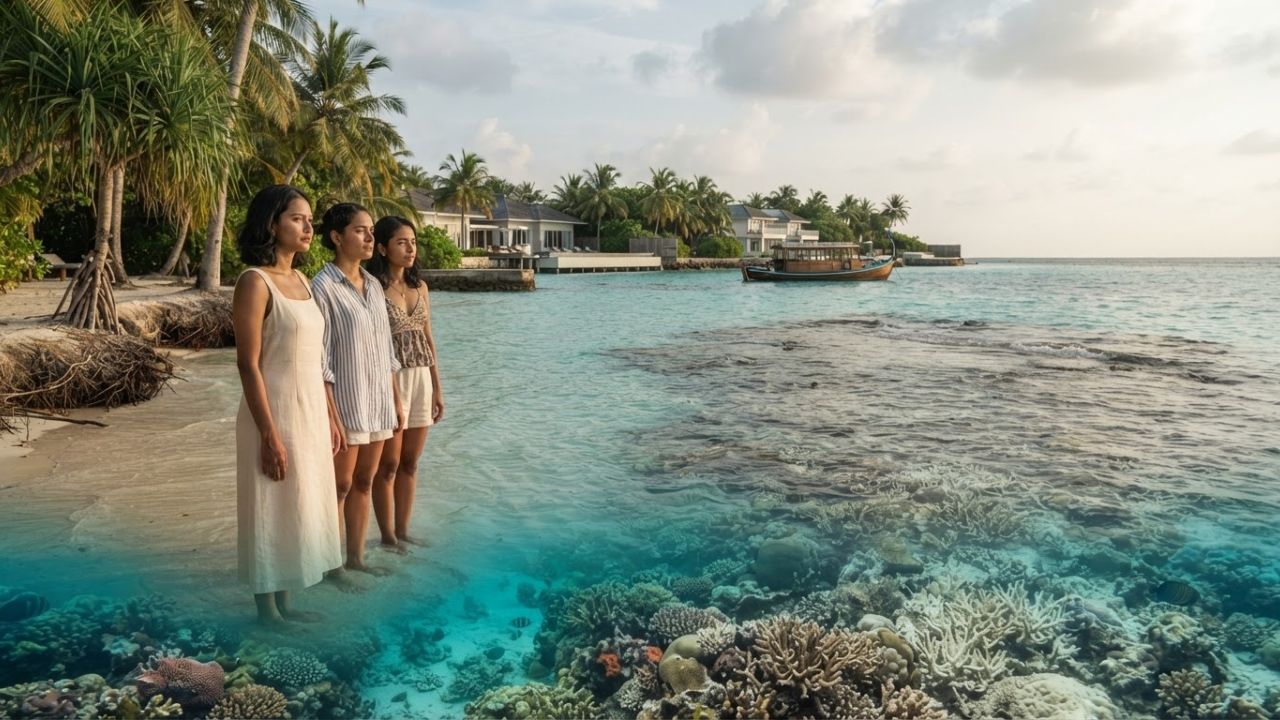
Image generated by AI
A scientific tipping point has been identified at 5.3 millimeters of relative annual sea-level rise, beyond which warm-water coral reefs in key tourism destinations like Bali, Fiji, and the Maldives are projected to drown, triggering severe beach erosion and threatening coastal resort infrastructure.
The Local Trend Revealed: Structural Coral Reef Drowning
For decades, climate threats to tropical island destinations were viewed primarily through the lens of episodic marine heatwaves and coral bleaching. However, an insidious structural crisis is unfolding beneath the ocean surface: the physical submergence and drowning of shallow warm-water coral reef systems. Coral reefs are not static geological formations; they are dynamic, living biogenic structures constructed through the continuous calcification of hard corals and crustose coralline algae.
When relative sea-level rise accelerates beyond the maximum vertical growth (accretion) rate of a reef, the physical surface of the reef sits in progressively deeper water. This depth shift initiates light starvation. Because water absorbs and scatters sunlight, deeper water cuts off the light intensity required for photosynthesis by symbiotic algae. As growth rates drop, the reef fails to keep pace, creating a compounding feedback loop that leads to structural drowning. Without the shallow reef crest acting as a wave barrier, high-energy swells pass over the submerged reefs, striking low-lying island coastlines directly.
Coral Reef Accretion States and Shoreline Impacts
| Reef Growth State | Mathematical Growth Condition | Ecological Mechanism | Shoreline & Hydrodynamic Impact | Tourism & Economic Vulnerability |
|---|---|---|---|---|
| Keep-Up Reef | Robust calcification matches sea-level rise | Dense branching framework; shallow reef flat receiving optimal sunlight. | Dissipates up to 97% of incoming ocean wave energy; stabilizes beach sand. | High destination stability; pristine snorkel conditions; low maintenance costs. |
| Catch-Up Reef | Moderate calcification lags behind rising sea | Shift toward slow-growing corals; partial light reduction slows accretion. | Reduced wave breaking efficiency; increased lagoon water depth. | Intermittent resort beach loss; higher sand replenishment and dredging costs. |
| Give-Up / Drowning Reef | Calcification deficit outpaced by ocean rise | Light starvation; dominant turf algae; skeletal breakdown. | Severe loss of wave attenuation; high-energy swells scour the coast directly. | Extreme structural hazard to beachfront resorts; uninsurable coastal assets. |
Why 5.3mm Annual Sea-Level Rise Matters for Tourism
A study conducted by scientists at Nanyang Technological University (NTU) Singapore, published in Nature Communications, has quantified the exact threshold at which tropical coral reefs fail to keep pace with rising seas. By analyzing 288 ancient reef core samples across 92 distinct geographic sites in the Indo-Pacific, the team reconstructed vertical reef growth. The data revealed that when relative sea-level rise exceeds 5.3 millimeters per year, the probability of a coral reef maintaining vertical growth drops below 10 per cent.
This tipping point is critical for the future of global marine tourism. According to global satellite altimetry records verified by NASA, global mean sea-level rise reached approximately 4.5 millimeters per year by 2023, pushed by thermal expansion and melting ice sheets. Under high greenhouse gas emission scenarios (SSP3-7.0 and SSP5-8.5), models project that global mean sea-level rise will surpass the 5.3 millimeters per year threshold by the 2060s—less than 35 years away. Furthermore, the NTU study determined that under high-emissions trajectories, 76 per cent of all coral reefs across the Indo-Pacific region are at direct risk of drowning by 2100.
Global Exposure Hotspots: Island Destinations at Risk
The economic vulnerability of island destinations depends on geographical elevation, reliance on marine tourism, mapped reef area, and coastal infrastructure density:
- Maldives (Greater Malé and Atoll Clusters): Comprising 1,192 coral islands with an average elevation of just 1.5 meters, the Maldives is highly vulnerable. Tourism generates 30 per cent of direct GDP and accounts for 63.9 per cent of total GDP when including indirect contributions. Reef drowning causes higher wave energy to enter inner lagoons, accelerating sand erosion along resort shorelines.
- Fiji (Suva and Outer Island Groups): In Fiji, 27.2 per cent of the national population lives in low-lying coastal zones (0 to 10 meters above sea level). Coastal and marine ecosystem services generate an estimated $1.2 billion annually in economic value. As protective fringing reefs submerge, storm surges breach coastal defenses in the Greater Suva Urban Area and force outer island relocations.
- Great Barrier Reef (Cairns, Australia): Australia possesses the world's second-largest mapped coral reef area, spanning 48,960 square kilometres. Cairns serves as the principal gateway to the reef, managed by the Great Barrier Reef Marine Park Authority (GBRMPA). Drowning outer reefs reduce shallow coral gardens, allowing larger swells to reach Queensland’s coast and increase beach erosion.
- Southeast Asia (Denpasar, Bali and Phuket, Thailand): Indonesia holds the largest mapped coral reef area at 51,020 square kilometres. Bali’s reefs, managed by the Bali Marine and Fisheries Agency, are under high pressure: 55 per cent remain in good condition, 30 per cent in fair condition, and 15 per cent are severely degraded. In Nusa Dua, live coral cover dropped to 15–20 per cent prior to a government recovery initiative that spent IDR 111.32 billion to restore 74.4 hectares. In Phuket, Thailand, fringing reefs along Nakalay Beach have lost vertical height, leaving beachfront resorts exposed to monsoonal storm surges.
- Belize and Seychelles: Belize, home to the largest barrier reef system in the Northern Hemisphere, and the Seychelles rely on reef barriers to protect low-lying tourism infrastructure. Both regions have utilized innovative blue bond restructuring—such as Belize's $364 million debt restructuring generating $180 million for ocean conservation—to protect 30 per cent of their marine territories.
Mapped Reef Area and Key Physical Hazards
| Destination / Hub | Mapped Reef Area | Primary Urban Centre Exposed | Tourism GDP Contribution | Core Physical Hazard from Reef Drowning |
|---|---|---|---|---|
| Indonesia | 51,020 km² | Denpasar (Bali) | ~40% regional economic output | Beach erosion along Nusa Dua and Sanur; loss of shallow snorkeling habitats. |
| Australia | 48,960 km² | Cairns (Queensland) | Multi-billion regional economy | Deepening water over outer shelf reefs; loss of light-rich dive gardens. |
| Fiji | 10,020 km² | Suva (Viti Levu) | Direct and indirect tourism driver | Inundation of coastal infrastructure; forced village relocations. |
| Maldives | High Atoll Density | Greater Malé | 63.9% total GDP contribution | Inundation of resort islands; severe shoreline scour around overwater villas. |
| Thailand | ~2,100 km² | Phuket | Dominant local service economy | Loss of fringing reef crests; monsoon surge damage to beachfront resorts. |
| Belize | ~1,200 km² | Belize City / Cayes | Over 40% national GDP | Barrier reef wave leakage; severe erosion of low-lying sandy cayes. |
Cultural & Environmental Value: Active Restoration and Blue Finance
For the traveler, the real impact of coral reef drowning is the urgent need to support destination adaptation models that prioritize active marine geo-engineering and blue finance. Traditional conservation methods like Marine Protected Areas (MPAs) are no longer enough to save these delicate biomes. Travelers can contribute directly by choosing operators aligned with the Great Barrier Reef Marine Park Authority (GBRMPA) or the Bali Marine and Fisheries Agency, and supporting nature-based tourism that helps fund restoration efforts like Indonesia's Coral Reef Garden (ICRG) program. These localized conservation initiatives help protect the coastal communities whose cultural identity and livelihoods depend on healthy reef barriers.
Coastal and marine tourism accounts for roughly 50 per cent of the global tourism market, contributing $4.6 trillion annually to global GDP. Direct coral reef tourism specifically generates $36 billion per year, with 30 per cent of the world's reefs supporting travel activities. As reef drowning progresses, its economic impacts affect scuba diving, beach resorts, cruise ports, and local seafood supply chains.
Destination Specialist Local Insider Tips
To help you explore global reef destinations safely and responsibly, travel specialists suggest the following tips:
- Choose the Dry Shoulder Season: Visit Bali from April to May, or Fiji from May to October. This timing ensures optimal water clarity and reduces exposure to heavy monsoonal runoff.
- Practice Strict Buoyancy Control: When diving or snorkeling, maintain a safe distance from the reef framework. Never touch, step on, or collect marine specimens.
- Use Reef-Safe Sunscreens: Protect marine biomes by using mineral-based sunscreens. Avoid products containing oxybenzone or octinoxate, which accelerate coral stress.
- Explore Pemuteran Biorock Reef: Visit northwest Bali to snorkel over the world's largest Biorock installation, observing how low-voltage electricity accelerates calcium carbonate growth.
- Order Sustainable Local Seafood: Support community fisheries by dining at certified slow-food restaurants that source local, sustainably caught species like mahi-mahi or mud crab.
Long-Term Outlook: Adapting to Sinking Reefs
The long-term outlook for global marine tourism depends on a rapid transition from passive preservation to active habitat restoration and hybrid coastal defense engineering. Unless global carbon emissions are reduced to stabilize sea-level rise below the critical 5.3 mm annual threshold, vertical reef drowning will alter the geography of low-lying island nations. The integration of blue bonds, debt-for-nature swaps, and strict setback laws—such as Fiji's 30-meter setback rule and the Asian Development Bank's 3,000-meter hybrid coastal defense project—represents the best pathway to protect valuable coastal assets and ensure the survival of tropical beach destinations for the next generation.
Related Travel Guides
Disclaimer
This article is for informational and educational purposes only. It does not constitute legal, financial, or professional advice. While we strive to provide accurate and up-to-date information, travel policies, regulations, and conditions change rapidly. Always verify information with official sources before making travel decisions. Nomad Lawyer makes no representations about the accuracy, reliability, completeness, or suitability of the information provided. Readers should consult qualified professionals for advice specific to their circumstances. The views expressed in this article are those of the author and do not necessarily reflect the views of Nomad Lawyer.
Kunal K Choudhary
Co-Founder & Contributor
A passionate traveller and tech enthusiast. Kunal contributes to the vision and growth of Nomad Lawyer, bringing fresh perspectives and driving the community forward.
Learn more about our team →