
China Launches Guangxi’s Massive Pinglu Canal as New River-to-Sea Route Transforms Trade and Maritime Connectivity
China Launches Guangxi’s Massive Pinglu Canal as New River-to-Sea Route Transforms Trade and Maritime Connectivity

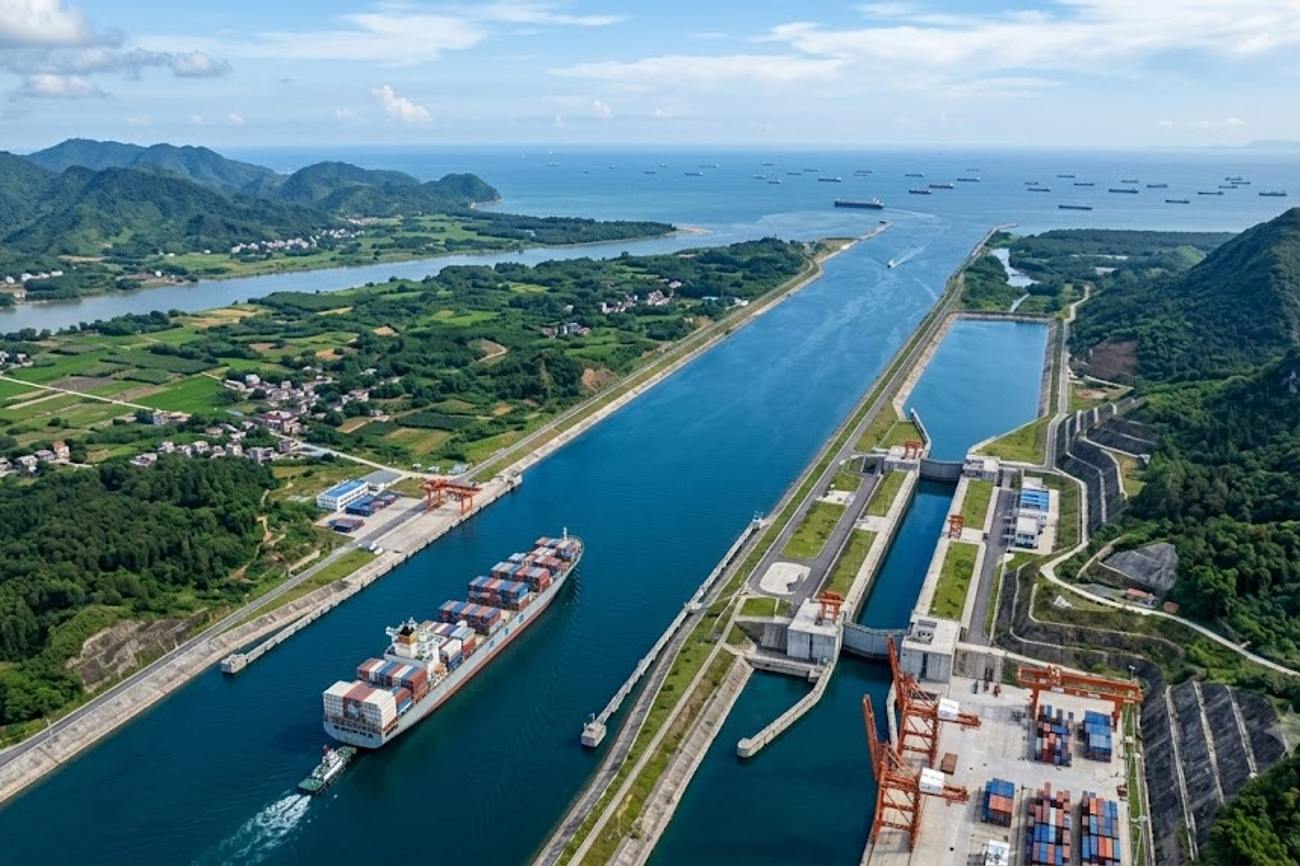
Image generated by AI
5 billion yuan in annual freight savings is the projected economic windfall resulting from the activation of the Pinglu Canal, a massive infrastructure project that fundamentally alters the logistical map of Southern China. On September 16, at precisely 10:25 a.m., the waterway officially entered commercial operation during a navigation ceremony in Qinzhou, Guangxi. The event was punctuated by the first vessel traversing the Madao Hub, signaling the birth of a critical maritime artery that bridges the gap between China's internal river networks and the open sea.
The Engineering of the Beibu Gulf Gateway
The Pinglu Canal is not merely a ditch in the earth but a sophisticated hydraulic system designed to Grade I inland navigation standards. Stretching across 134.2 kilometres, the canal originates at the Pingtang River Estuary in Hengzhou, Nanning, winds through Luwu Town in Lingshan County, Qinzhou, and ultimately terminates at the Beibu Gulf via the Qinjiang River. To manage the elevation changes of the terrain, engineers constructed three primary cascade hubs: Madao, Qishi, and Qingnian.
The Madao Hub stands as the project's architectural centerpiece, featuring inverted V-shaped lock gates that reach a height of 39.08 metres. This facility is part of a broader system that allows the canal to accommodate vessels weighing up to 5,000 tonnes. The scale of the project is evidenced by its timeline and labor force; construction began on August 28, 2022, mobilizing tens of thousands of workers and hundreds of specialized organizations to meet an aggressive delivery schedule.
According to the operational data, the canal has established four global benchmarks in maritime engineering:
- The highest navigation capacity among comparable global canals.
- The fastest ship lock operation speed for its specific design.
- The highest water head ever achieved by a water-saving ship lock.
- The largest inland river water-saving lock system currently in existence worldwide.
Logistics Data and Trade Volume
The immediate impact of the canal's opening was felt through the launch of two strategic trade corridors: an international route connecting Nanning to Can Tho, Vietnam, and a domestic route linking Nanning to Yangpu, Hainan. These routes transition the region from a land-locked logistics profile to a maritime-integrated one.
The initial navigation phase provided a snapshot of the diverse commodities that will now flow through this artery. The first wave of commercial traffic included 14 cargo vessels transporting steel, minerals, sugar, and construction materials. Simultaneously, 16 vessels carrying bauxite, iron ore, high-calcium limestone, fertilisers, and coal entered the Xijiang River Basin. This bidirectional flow demonstrates the canal's utility as both an export conduit for inland resources and an import gateway for industrial raw materials.
| Metric | Detail |
|---|---|
| Total Length | 134.2 kilometres |
| Vessel Capacity | Up to 5,000 tonnes |
| Distance Reduction | 560+ kilometres |
| Annual Cost Savings | 5 billion+ yuan |
| Primary Hubs | Madao, Qishi, Qingnian |
| Construction Start | August 28, 2022 |
Expert Analysis: The Geopolitical Shift in Southern Logistics
For the logistics professional or the corporate traveler operating in Southeast Asia, the Pinglu Canal is more than a local upgrade; it is a strategic pivot. By linking the Xijiang River system directly to the Beibu Gulf, China has effectively created a "shortcut" for southwestern provinces. The reduction of travel distances by more than 560 kilometres is a massive efficiency gain that bypasses traditional, more congested eastward shipping routes.
The Pinglu Canal serves as a strategic maritime corridor connecting the Xijiang River to the Beibu Gulf, significantly reducing shipping distances for inland trade. Travelers and investors can monitor regional infrastructure developments and trade policies through the Ministry of Transport of the People's Republic of China.
The direct consequence for regional trade is a lowering of the "barrier to entry" for inland manufacturers in Guangxi and surrounding provinces to reach the Association of Southeast Asian Nations (ASEAN) markets. When freight costs drop by billions of yuan annually, the pricing pressure shifts. We can expect a surge in the volume of low-margin, high-weight goods—such as the minerals and construction materials seen in the first shipments—moving toward Vietnamese and Thai ports.
Furthermore, the integration of passenger routes, such as the loops connecting the Xinfu Water Comprehensive Service Area to the Madao Hub and the Pingtang River Estuary, suggests that the Chinese government is leveraging this infrastructure for "industrial tourism." By creating accessible loops between the Qinzhou Water Comprehensive Service Area and the Longmen Bridge or Qingnian Hub, they are turning a logistics project into a regional draw for business tourism.
From a regulatory and systemic perspective, the canal's adherence to Grade I standards means it can integrate seamlessly with international shipping norms managed by the International Maritime Organization (IMO). This ensures that the 5,000-tonne vessels utilizing the canal are not isolated anomalies but part of a standardized global fleet. The Pinglu Canal essentially functions as a force multiplier for the Beibu Gulf, transforming it from a regional port into a primary gateway for the entire southwestern hinterland.
Key Takeaways
- Distance Efficiency: The canal reduces shipping distances to maritime gateways by over 560 kilometres, significantly cutting transit times for inland cargo.
- Economic Impact: Freight costs for connected regions are projected to decrease by more than 5 billion yuan every year.
- Capacity Specs: The waterway supports vessels up to 5,000 tonnes and utilizes the world's largest inland river water-saving lock system.
- Strategic Corridors: New two-way trade routes are now active between Nanning and Can Tho (Vietnam), as well as Nanning and Yangpu (Hainan).
- Infrastructure Scale: The project features three major hubs (Madao, Qishi, Qingnian) and was completed in roughly two years starting from August 2022.
FAQ: Pinglu Canal 2024
What is the primary purpose of the Pinglu Canal? It connects the Xijiang River system to the Beibu Gulf, providing southwestern China with a direct, shorter route to the sea for transporting goods and passengers, thereby reducing logistics costs and travel distances.
Which international routes are now available via the canal? The canal has enabled the official start of two-way commercial operations on the international route connecting Nanning, China, to Can Tho, Vietnam.
Can passenger ships use the Pinglu Canal? Yes. Four specific passenger water transport loop routes have been introduced, connecting service areas like Xinfu and Qinzhou to hubs such as Madao and Qingnian for tourism and mobility.
How does the canal impact shipping costs? By shortening the route to the coast by over 560 kilometres, the canal is expected to save connected regions more than 5 billion yuan in annual freight expenses.
The map of Southern Asian trade has just been redrawn in concrete and water.
Related Travel Guides
- China Teams Up With Sri Lanka and More Countries to Support Nepal Tourism Rebound After Bhote Koshi Floods
- Albania and Slovenia Tourism Investment Is Now on Track to Unlock More Growth and New Opportunities
- Kenya Steps Up With China To Expand Tourism Promotion, Infrastructure Development And Travel Links
Disclaimer
This article is for informational and educational purposes only. It does not constitute legal, financial, or professional advice. While we strive to provide accurate and up-to-date information, travel policies, regulations, and conditions change rapidly. Always verify information with official sources before making travel decisions. Nomad Lawyer makes no representations about the accuracy, reliability, completeness, or suitability of the information provided. Readers should consult qualified professionals for advice specific to their circumstances. The views expressed in this article are those of the author and do not necessarily reflect the views of Nomad Lawyer.
Raushan Kumar
Founder & Lead Developer
Full-stack developer with 11+ years of experience and a passionate traveller. Raushan built Nomad Lawyer from the ground up with a vision to create the best travel and law experience on the web.
Learn more about our team →