
China Aviation Chaos: Shenzhen Airlines and Air China Paralyzed as Over 1,000 Flights Face Massive Delays
A massive wave of nationwide travel disruption has hit China, with over 1,000 flights delayed or cancelled across Shenzhen, Beijing, Shanghai, and Chengdu.

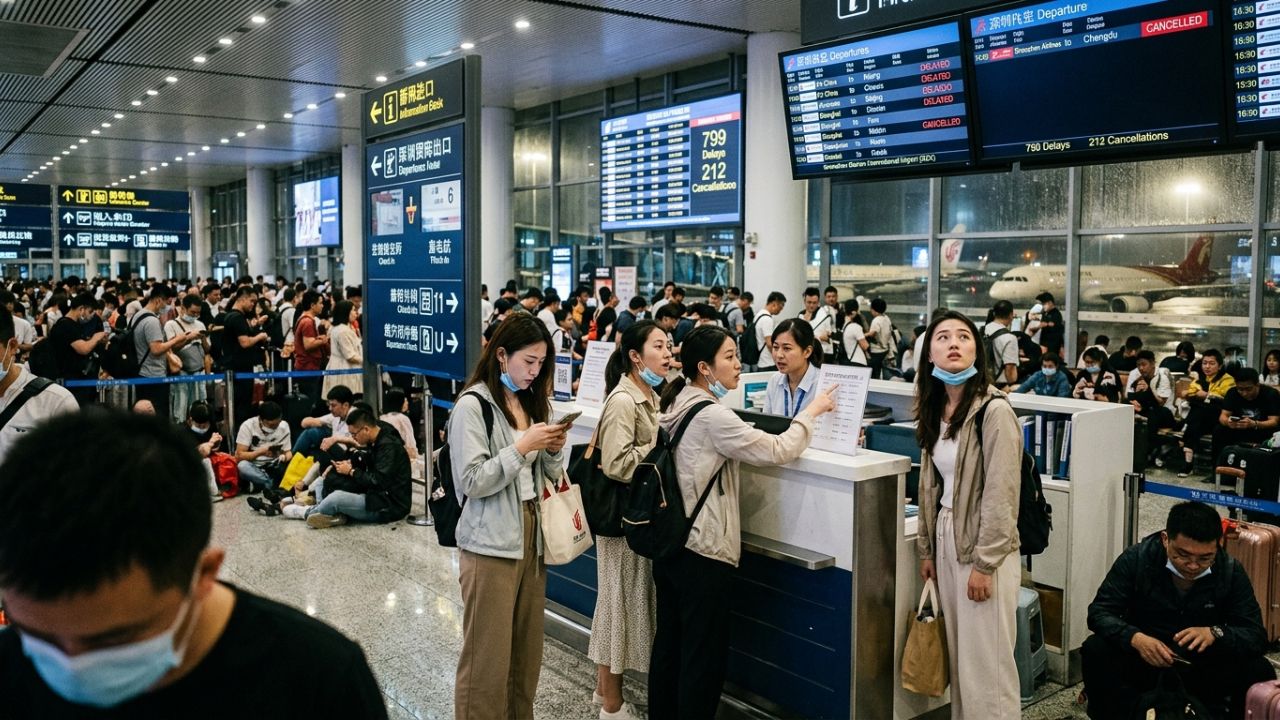
Image generated by AI
China Aviation Chaos: Shenzhen Airlines and Air China Paralyzed as Over 1,000 Flights Face Massive Delays
Published on May 13, 2026
The bustling, tightly scheduled skies over China have descended into complete and total operational gridlock today, shattering the highly anticipated travel plans of tens of thousands of passengers. In a massive wave of nationwide aviation disruption, official data confirms a staggering 799 flight delays and 212 sudden cancellations across eight of the country’s most vital aviation mega-hubs. From the high-tech economic epicenter of Shenzhen to the sprawling international terminals of Beijing, Shanghai, and Chengdu, the sudden collapse of flight schedules is causing severe logistical nightmares. Major domestic heavyweights, including Shenzhen Airlines, Air China, China Eastern, and 9 Air, are violently buckling under the immense operational pressure, leaving massive crowds of frustrated travelers completely stranded. Whether you are a corporate executive rushing to a high-stakes meeting in Guangzhou or an eager tourist embarking on an immersive cultural experience in Xi'an, today's severe airspace bottleneck serves as a brutal reminder of the incredible fragility of modern air travel. As airline customer service teams scramble to mitigate the devastating ripple effects, stranded passengers are frantically seeking emergency alternatives to salvage their ruined itineraries.
Quick Summary:
- Massive nationwide aviation disruptions have severely paralyzed China’s airspace today, heavily impacting eight primary domestic and international mega-hubs.
- Official aviation tracking data reports an astonishing 799 delayed flights and 212 outright cancellations, leaving tens of thousands of passengers stranded terminal-side.
- Shenzhen Bao’an International Airport is the absolute epicenter of the crisis, leading the entire nation with 186 massive delays and 43 cancelled flights.
- Other massive international gateways, including Beijing Capital, Shanghai Hongqiao, and Guangzhou Baiyun, are battling severe terminal overcrowding and cascading operational gridlock.
- Domestic aviation titans, notably Shenzhen Airlines, Air China, and China Eastern, have had their flight networks severely compromised by the sudden disruptions.
- Travel experts are heavily advising stranded tourists and business commuters to immediately pivot to China's world-class high-speed rail network to bypass the choked airspace and complete their journeys.
The Epicenter of the Crisis: Shenzhen Airport Buckles Under Pressure
The true scale of today’s catastrophe is most visible in the south, where Shenzhen Bao’an International Airport has completely buckled under operational strain. As a massive hub for technology, business, and tourism, the airport was hit the hardest, recording a devastating 186 delayed flights and 43 outright cancellations.
The hometown carrier, Shenzhen Airlines, took a massive operational hit, accounting for 32 of those cancellations and 53 severe delays. Because Shenzhen operates as a vital node connecting southern China to the rest of the country, the grounding of its fleet instantly severes crucial economic lifelines. High-yield corporate travelers and tourists hoping to jump from the Pearl River Delta to destinations across the mainland were left entirely stranded, their highly coordinated itineraries completely erased from the departure boards.
Beijing, Shanghai, and Guangzhou: The Golden Triangle Gridlocked
The chaos effortlessly spread to China's "Golden Triangle" of aviation, entirely paralyzing the nation's most profitable and heavily trafficked routes.
At Beijing Capital International Airport, 30 flights were suddenly scrapped and 75 were delayed, placing an immense burden on Air China, which was forced to ground 19 of its own flights originating from the capital. Concurrently, Shanghai Hongqiao International Airport reported 20 cancellations and 67 delays, heavily disrupting the meticulously planned schedules of China Eastern Airlines. Meanwhile, Guangzhou Baiyun International Airport suffered a suffocating bottleneck of 149 delayed flights and 25 cancellations. When the three largest, most vital cities in China suffer simultaneous airspace gridlock, the entire domestic aviation network effectively grinds to a devastating halt, wiping out thousands of crucial connections.
The Western and Central Hubs: Chengdu, Xi'an, and Kunming Paralyzed
The devastating ripple effect did not spare the booming central and western tourist markets. Chengdu Tianfu International Airport, the gleaming new gateway to the southwest, logged 29 flight cancellations and 87 delays, heavily impacting tourists eager to explore Sichuan's world-renowned culinary scene and panda reserves.
Similarly, the historical epicenter of Xi’an Xianyang International Airport recorded 24 cancellations and 65 delays, trapping travelers eager to witness the magnificent Terracotta Army. Further south, Kunming Changshui International Airport saw 21 cancellations and 74 delays, crippling connectivity to Yunnan Province. For the booming domestic tourism sector—which relies entirely on precision logistics to move massive tour groups seamlessly between these cultural capitals—today’s 1,000-flight disruption represents a catastrophic loss of revenue and traveler confidence.
Salvaging Your Luxury Escape: Bypassing the Aviation Meltdown
In the face of an epic aviation meltdown across eight mega-hubs, stranded travelers must instantly pivot their strategy. Staring at an unmoving, red-lit departure board in Shanghai or Beijing will not get you to your destination.
China possesses a massive, world-renowned advantage over Western nations during aviation crises: an impeccable, sprawling high-speed rail (HSR) network. For travelers whose short-to-medium haul flights (e.g., Shanghai to Beijing, or Chengdu to Xi'an) have been abruptly cancelled, the absolute best course of action is to immediately abandon the airport. By booking a ticket on a 300 km/h Fuxing bullet train, savvy tourists can bypass the airspace gridlock entirely. The rail network operates with near-perfect punctuality and is utterly immune to the air traffic control restrictions that are currently paralyzing the skies.
Guide for Travelers:
- The Digital Rebooking Hack: If your Shenzhen Airlines or China Eastern flight is officially cancelled, absolutely do not wait in the physical customer service lines. Immediately use the airline’s official WeChat mini-program or app to process an automated refund or secure a rebooking.
- Pivot to the Rail Network: If you are stranded at an airport like Beijing Capital or Shanghai Hongqiao, instantly open the 12306 app (the official Chinese railway app) or Trip.com to secure a high-speed rail ticket to your final destination before they sell out.
- Seek Premium Refuge: If you are hopelessly delayed at a massive hub like Guangzhou Baiyun, utilize airport lounges to escape the severe terminal overcrowding. If you lack elite status, paying for a day pass offers a quiet luxury escape with Wi-Fi to comfortably rethink your travel strategy.
- Document Everything: Always ensure you request and retain a digital "Flight Delay Certificate" via the airline's app. You will absolutely need this official document to quickly process your travel insurance claims for ruined hotel bookings and missed tours.
- Communicate with Hotels: If your flight into Chengdu or Kunming is delayed overnight, proactively message your luxury hotel directly. Many premium properties will gladly waive strict cancellation fees or adjust your reservation dates if you provide proof of a massive airline disruption.
Related Travel Guides
- Major Disruption in Portugal: Ryanair and TAP Delay Hundreds of Flights
- Massive US Travel Chaos: Over 2,100 Flights Delayed at Major Hubs
- Southwest Airlines Boeing 737 Diverted to Tulsa After Terrifying Windshield Crack
The staggering reality of over 1,000 delayed and cancelled flights sweeping across China today is a brutal reminder of the immense operational fragility of the modern aviation network. As severe airspace gridlock completely chokes critical mega-hubs like Shenzhen, Beijing, Shanghai, and Chengdu, the meticulously planned itineraries of thousands of eager tourists and crucial business travelers have been unceremoniously obliterated. With major industry titans like Shenzhen Airlines, Air China, and China Eastern desperately struggling to untangle the massive logistical nightmare, the absolute burden of survival falls entirely onto the traveler. By leveraging highly efficient digital rebooking tools, embracing the flawless reliability of China's high-speed rail network, and demanding world-class hospitality in the face of disruptions, savvy passengers can successfully navigate the storm. While today's massive meltdown serves as a deeply frustrating roadblock, extreme flexibility and rapid decision-making remain your absolute best weapons for securing your highly anticipated dream destination.
Disclaimer
This article is for informational and educational purposes only. It does not constitute legal, financial, or professional advice. While we strive to provide accurate and up-to-date information, travel policies, regulations, and conditions change rapidly. Always verify information with official sources before making travel decisions. Nomad Lawyer makes no representations about the accuracy, reliability, completeness, or suitability of the information provided. Readers should consult qualified professionals for advice specific to their circumstances. The views expressed in this article are those of the author and do not necessarily reflect the views of Nomad Lawyer.
Kunal K Choudhary
Co-Founder & Contributor
A passionate traveller and tech enthusiast. Kunal contributes to the vision and growth of Nomad Lawyer, bringing fresh perspectives and driving the community forward.
Learn more about our team →