China and Central Asia Accelerate Air Silk Road: Bilateral Flight Caps Surge Across Five Republics and Mega-Hub Corridors


Civil aviation between China and the five Central Asian republics—Kazakhstan, Uzbekistan, Kyrgyzstan, Tajikistan, and Turkmenistan—has entered an unprecedented era of expansion in late 2026, driven by the strategic acceleration of the "Air Silk Road." By systematically raising bilateral flight frequency ceilings, dismantling historical regulatory quotas, and investing tens of billions of dollars in airport infrastructure across Eurasia, civil aviation authorities have transformed what was once a slow, circuitous transit network into a high-frequency aviation matrix. In Kazakhstan, bilateral flight caps have expanded from 150 to 180 weekly services with direct routes added to Chengdu and Kashgar; in Uzbekistan, permitted weekly services have surged from 100 to 114 flights connecting Tashkent and Samarkand with major Chinese economic centers. Supported by the opening of mega-gateways like Hohhot Shengle International Airport (engineered for 28 million passengers and 320,000 tonnes of cargo) and western launchpads in Urumqi and Xi'an, direct flights across mountain barriers have reduced travel times to between two and four hours, unlocking vast corridors for tourism, commerce, and cross-border e-commerce.
This aviation surge marks a decisive shift in how people and goods traverse the Eurasian continent. Historically, commercial air routes between East and Central Asia were constrained by rigid bilateral air service agreements and high ticket premiums that forced business travelers and tourists through multi-stop layovers in third countries. Today, reciprocal visa-waiver agreements, expanded belly-hold cargo logistics, and secondary airport modernizations—including Almaty’s expanded international terminal, Shymkent’s second runway, and new regional airfields in Zaisan, Katonkaragay, and Kendirli—are bridging ancient Silk Road trade corridors at jet speed. As flag carriers and private airlines deploy modern widebody and narrowbody fleets across the Tian Shan and Pamir ranges, the skies of Central Asia have become an integrated corridor for economic growth and regional mobility.
========================================================================================
AIR SILK ROAD AVIATION SCORECARD: CHINA & CENTRAL ASIA (2026)
========================================================================================
Central Asian Partner Bilateral Weekly Flight Cap Key Direct Route Corridors   Strategic Aviation Focus
----------------------------------------------------------------------------------------
Kazakhstan            Expanded from 150 to 180    Almaty/Astana to Beijing,     Primary Eurasian transit hub,
                      Weekly Scheduled Flights    Shanghai, Chengdu, Kashgar    belly-hold air cargo, tourism
Uzbekistan            Expanded from 100 to 114    Tashkent/Samarkand to         Cultural heritage tourism,
                      Weekly Scheduled Flights    Beijing, Guangzhou, Urumqi    bilateral visa-free travel
Kyrgyzstan            Consolidated Capital Links  Bishkek to Beijing,           Cross-border e-commerce,
                      & High-Frequency Trunks     Bishkek to Urumqi             rapid mountain transit
Tajikistan            Direct Strategic Links      Dushanbe to Beijing,          Overcoming rugged terrain,
                      Across High Altitudes       Dushanbe to Urumqi            mining & energy diplomacy
Turkmenistan          Targeted Capital & Energy   Ashgabat to Beijing,          Strategic energy transport,
                      Trunk Corridors             Regional Transit Connections  widebody cargo logistics
========================================================================================
Chinese Hub Launchpads: Urumqi (URC), Kashgar (KHG), Chengdu (TFU), Xi'an (XIY), Hohhot (HET)
========================================================================================
The Geopolitical Architecture of the Air Silk Road
For centuries, the Silk Road was defined by overland camel caravans navigating arduous mountain passes and barren deserts over several months. Even in the modern era, rail freight corridors like the China-Europe Railway Express, while commercially successful for bulk industrial freight, require 12 to 18 days to transit Eurasian landmasses. The creation of the Air Silk Road represents the logical evolution of regional connectivity, creating an aerial express lane that compresses journeys across thousands of kilometers into a matter of hours.
Several core policy drivers have accelerated this transformation:
- Diplomatic Normalization of Air Quotas: Following the multilateral China-Central Asia Summits, civil aviation regulators agreed to systematically dismantle restrictive bilateral capacity caps. By replacing protectionist quotas with liberalized air service agreements, airlines from both sides can introduce new frequencies and explore secondary city pairings.
- Overcoming Natural Topographical Barriers: Central Asia’s topography is dominated by towering geological formations, including the Tian Shan, Pamir, and Altai mountain systems. Direct high-altitude air routes eliminate the severe weather disruptions, seasonal road closures, and border checkpoint delays that characterize overland vehicular crossings.
- Synergy with Reciprocal Visa Policies: The aviation expansion has been paired with aggressive visa liberalization. Kazakhstan and China enforce mutual 30-day visa-free travel; Uzbekistan operates visa-free access and electronic visas for Chinese nationals; and simplified business visa pathways across Kyrgyzstan and Tajikistan have removed bureaucratic hurdles for travelers.
========================================================================================
TRANSIT TIME COMPARISON: HISTORICAL OVERLAND VS AIR SILK ROAD (2026)
========================================================================================
Route Corridor         Overland Road / Rail Transit  Direct Flight Route Duration Travel Time Saved
----------------------------------------------------------------------------------------
Urumqi to Almaty       24 to 36 Hours (Road/Train)   1 Hour 45 Minutes (Air)      Over 22 to 34 Hours
Kashgar to Bishkek     18 to 28 Hours (Mountain Pass)1 Hour 15 Minutes (Air)      Over 16 to 26 Hours
Chengdu to Tashkent    5 to 7 Days (Overland Rail)   5 Hours 10 Minutes (Air)     Over 4 to 6 Days
Beijing to Dushanbe    6 to 8 Days (Multi-Modal Rail)6 Hours 30 Minutes (Air)     Over 5 to 7 Days
Xi'an to Samarkand     5 to 7 Days (Overland Rail)   5 Hours 25 Minutes (Air)     Over 4 to 6 Days
========================================================================================
China's Western Gateway Strategy: Launchpads for Eurasian Aviation
China’s civil aviation blueprint does not funnel Central Asian flights exclusively through coastal mega-cities like Beijing and Shanghai. Instead, the country has strategically cultivated a decentralized network of western and northwestern aviation launchpads designed to shorten flight distances and distribute traffic efficiently across Eurasia.
========================================================================================
CHINA'S PRIMARY CENTRAL ASIAN AVIATION GATEWAYS
========================================================================================
Airport Gateway               IATA  Annual Capacity / Design Focus   Central Asian Route Role
----------------------------------------------------------------------------------------
Hohhot Shengle International  HET   28M Passengers; 320,000t Cargo   Northern multimodal air-rail hub
Urumqi Diwopu International   URC   Comprehensive T4 Expansion       Frontline Central Asian super-hub
Kashgar Laining International KHG   Upgraded International Terminal  Direct gateway to southern Central Asia
Chengdu Tianfu International  TFU   60M Passengers (Initial Phase)   Southwestern connecting megalopolis
Xi'an Xianyang International  XIY   Comprehensive Phase III Project  Historic Silk Road origin launchpad
========================================================================================
Hohhot Shengle International Airport: The Multimodal Northern Hub
A premier centerpiece of China's modern aviation infrastructure is the newly completed Hohhot Shengle International Airport in Inner Mongolia. Engineered to handle 28 million passengers and 320,000 tonnes of cargo annually, the facility features dedicated international passenger concourses and advanced customs clearance systems. Positioned along major northern transit corridors, Shengle Airport integrates regional air services directly with overland China–Europe and China–Central Asia container rail terminals, allowing air-rail intermodal freight to transfer with remarkable speed.
Urumqi and Kashgar: The Immediate Air Bridges
Situated in the Xinjiang Uygur Autonomous Region, Urumqi Diwopu International Airport (URC) and Kashgar Laining International Airport (KHG) function as China’s frontline aerial springboards. Because of their geographic proximity, flights from Urumqi and Kashgar to capitals like Almaty, Bishkek, and Tashkent take just 60 to 120 minutes. Modern terminal expansions have transformed Urumqi into a high-capacity transfer hub where travelers from coastal Chinese metropolises connect smoothly onto flights bound for Central Asia, the Caucasus, and the Middle East.
Chengdu and Xi'an: Southwestern and Western Megahubs
Further inland, Chengdu Tianfu (TFU) and Xi'an Xianyang (XIY) channel corporate business travelers, industrial engineers, and cultural tourists from China’s densely populated southern and central provinces. Flights departing Chengdu reach Central Asian commercial capitals in four to five hours, providing an efficient alternative to congested eastern departure points.
Kazakhstan: The Primary Aviation Powerhouse Expands to 180 Flights
As Central Asia’s largest economy and China’s primary overland commercial partner, Kazakhstan anchors the northern tier of the Air Silk Road. Recent bilateral negotiations between civil aviation authorities produced major breakthroughs that expand capacity across passenger and freight sectors:
========================================================================================
KAZAKHSTAN AVIATION CAPACITY & INFRASTRUCTURE EXPANSION (2026)
========================================================================================
Operational Indicator         Previous Baseline Metric     Expanded 2026 Specification
----------------------------------------------------------------------------------------
Bilateral Flight Cap          150 Weekly Scheduled Flights 180 Weekly Scheduled Flights (+20.0%)
New Chinese Route Rights      Beijing, Shanghai, Urumqi    Added: Chengdu (TFU) & Kashgar (KHG)
Almaty Airport Modernization  Legacy Single Terminal       New International Terminal Operational
Shymkent Airport (CIT)        Single Active Runway         Construction of Second Runway Underway
Border Region Modernization   Limited Regional Access      Complete Overhaul of Urzhar Airport
New Tourism Regional Airports Under Feasibility / Planning Three New Airports: Zaisan, Katonkaragay,
                                                           and Kendirli (Caspian Sea Coast)
Air Carrier Operators         Air Astana, FlyArystan,      China Southern, Air China, Loong Air,
                              SCAT Airlines                China Eastern Airlines
========================================================================================
180 Weekly Flights and New City Corridors
The agreement to elevate permitted weekly frequencies from 150 to 180 flights represents a 20% capacity increase, unlocking daily flight pairings across multiple airline groups. Significantly, new operating permits grant direct route rights connecting Kazakh commercial centers to Chengdu in southwestern China and Kashgar in western Xinjiang, supplementing established high-frequency trunks into Beijing, Shanghai, and Urumqi.
Ground Infrastructure and Regional Tourism Airports
To accommodate the surge in flight movements, Kazakhstan has committed substantial capital to airport modernizations:
- Almaty International Airport (ALA): The commissioning of a new international terminal has dramatically expanded passenger handling capacity, reducing baggage retrieval and customs processing times for arriving international delegations.
- Shymkent Airport (CIT): Construction of a second full-length runway is expanding capacity for widebody cargo freighters and long-range passenger aircraft.
- Urzhar Airport: Situated near the Chinese border in Abai Region, the modernized airfield accommodates direct regional flights, facilitating cross-border commerce.
- Eco-Tourism Regional Airports: Kazakhstan has commenced construction on three regional airports designed to channel international ecotourists directly into pristine natural landscapes: Zaisan and Katonkaragay in the scenic Altai Mountains, and Kendirli along the warm resort shores of the Caspian Sea.
Uzbekistan: Cultural Heritage Corridors and the 114-Flight Benchmark
Uzbekistan has experienced a dramatic tourism and commercial renaissance over the past five years. Recognizing civil aviation as a catalyst for national modernization, the government in Tashkent has actively pursued open-skies policies to connect its UNESCO World Heritage cities directly with global markets.
========================================================================================
UZBEKISTAN–CHINA AIR SERVICE EXPANSION MATRIX
========================================================================================
Aviation Parameter           Historical Metric            Expanded 2026 Operational Status
----------------------------------------------------------------------------------------
Weekly Bilateral Flight Cap  100 Weekly Flights           114 Weekly Scheduled Departures
Primary Uzbek Gateways       Tashkent (TAS)               Tashkent (TAS) & Samarkand (SKD)
Chinese Destination Gateways Beijing & Urumqi             Beijing, Guangzhou, Chengdu, Urumqi
Visa Entry Framework         Standard Visa Protocol       Reciprocal 30-Day Visa-Free Policy
Key Air Carriers             Uzbekistan Airways, Qanot    China Southern Airlines, Loong Air,
                             Sharq, Air Samarkand         Air China
Primary Traveler Demographics Cultural heritage tourists,  Business investors, energy engineers,
                             Silk Road tour groups        textile traders, university students
========================================================================================
Raising Weekly Flight Ceilings to 114
Bilateral aviation consultations successfully raised the weekly flight ceiling between China and Uzbekistan from 100 to 114 flights, giving carriers the flexibility to operate high-frequency daily schedules. Flag carrier Uzbekistan Airways and private operators like Qanot Sharq and Air Samarkand have joined Chinese airlines (including China Southern and Loong Air) in establishing direct routes:
- Tashkent and Samarkand as Dual Hubs: Rather than routing all traffic through Tashkent, direct flights now connect both the capital and historic Samarkand with Beijing, Guangzhou, Chengdu, and Urumqi.
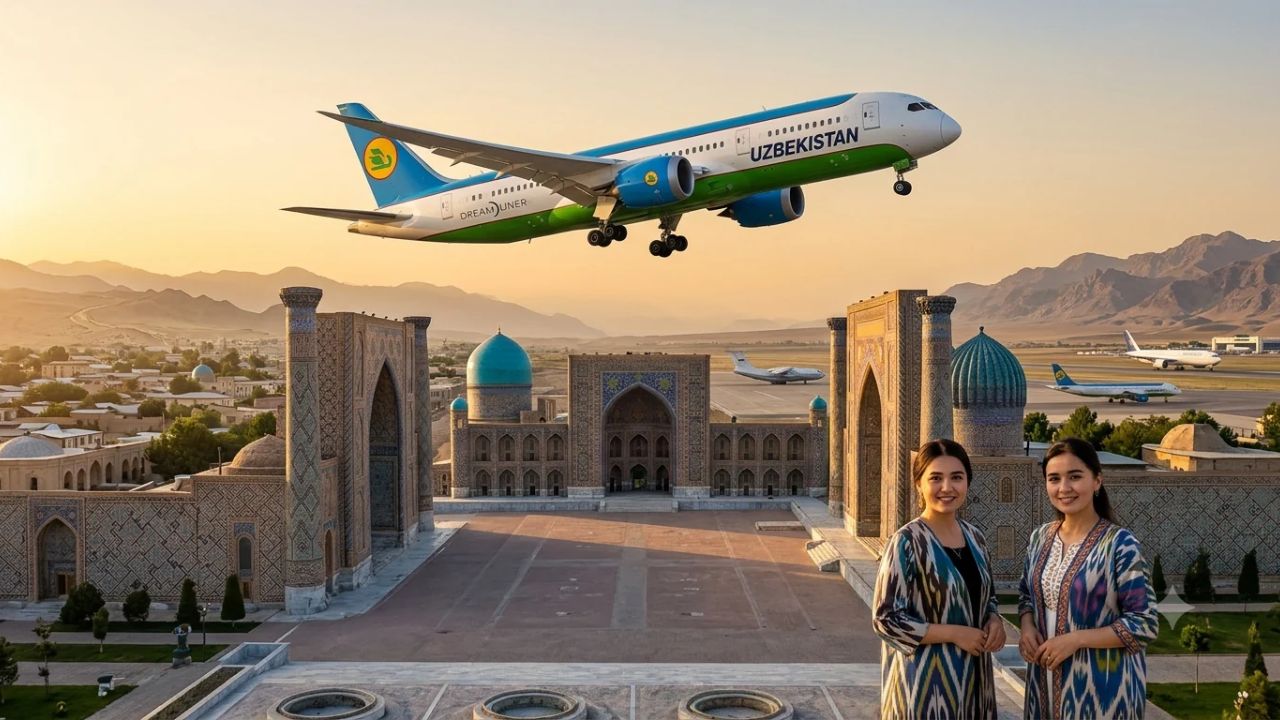
- The Visa-Free Multiplier: Paired with reciprocal visa-facilitation agreements, the flight expansion has unleashed a major surge in leisure tourism. Travelers from China and international tourists utilizing Chinese transit hubs can now fly directly into Samarkand to explore the iconic turquoise domes of Registan Square, the ancient observatories of Ulugh Beg, and the historic markets of Bukhara without visa friction.
Kyrgyzstan: High-Altitude Corridors and E-Commerce Freight
Separated from China by the formidable Tian Shan mountains, Kyrgyzstan has historically relied on two high-altitude overland passes—Torugart and Irkeshtam—for cross-border movement. In winter, these routes are frequently slowed by heavy snowstorms and complex mountain switchbacks.
The expansion of direct aviation corridors provides an essential breakthrough:
- Beijing–Bishkek Capital Link: Regular nonstop flights connecting Beijing Capital International Airport (PEK) and Manas International Airport (FRU) in Bishkek provide a direct conduit for government officials, international investors, and mining executives.
- The Urumqi–Bishkek Shuttle: Flights between Urumqi and Bishkek operate with short-haul frequency, completing the international transit in approximately 1 hour and 15 minutes. This transforms what was once a grueling multi-day road trek into a routine regional hop.
- Cross-Border E-Commerce Distribution: Kyrgyzstan has emerged as an important regional distribution clearinghouse for Chinese manufactured consumer goods and e-commerce parcels bound for Central Asia and the Eurasian Economic Union (EAEU). Expanded belly-hold cargo space aboard daily passenger flights allows high-value parcels, consumer electronics, and apparel to clear customs and reach consumers within 24 to 48 hours.
========================================================================================
CENTRAL ASIAN FLIGHT ROUTES & OPERATIONAL PROFILES
========================================================================================
Flight Corridor       Origin Hub       Destination Hub  Aircraft Type   Flight Frequency
----------------------------------------------------------------------------------------
Bishkek – Urumqi      Manas (FRU)      Diwopu (URC)     Boeing 737/A320 Daily Service
Beijing – Bishkek     Capital (PEK)    Manas (FRU)      Airbus A330     3-4x Weekly
Dushanbe – Urumqi     Dushanbe (DYU)   Diwopu (URC)     Boeing 737-800  Daily Service
Beijing – Dushanbe    Daxing (PKX)     Dushanbe (DYU)   Boeing 787/A330 3x Weekly
Ashgabat – Beijing    Ashgabat (ASB)   Capital (PEK)    Boeing 777-200LR2-3x Weekly
Almaty – Chengdu      Almaty (ALA)     Tianfu (TFU)     Airbus A321neo  4-5x Weekly
Samarkand – Guangzhou Samarkand (SKD)  Baiyun (CAN)     Airbus A330     3x Weekly
========================================================================================
Tajikistan: Overcoming Rugged Mountain Terrain by Air
For landlocked Tajikistan, where over 93% of the national territory is covered by mountains, aviation is not merely a commercial convenience—it is a vital lifeline for sovereign connectivity and economic survival.
Historically, reaching Tajikistan from East Asia required circuitous detours through Istanbul, Dubai, or Moscow. The expansion of direct air corridors into Dushanbe International Airport (DYU) fundamentally transforms this dynamic:
- Direct Urumqi and Beijing Links: Daily services connecting Dushanbe with Urumqi, alongside scheduled flights to Beijing, provide direct transit for multinational engineering teams, mining specialists, and infrastructure contractors engaged in major bilateral projects, including the modernization of the Dushanbe–Kulob–Khorugh highway and regional hydropower installations.
- Unlocking Pamir Adventure Tourism: Direct air access allows adventure travelers, mountaineers, and cultural explorers to reach the Pamir Mountains (the "Roof of the World") and ancient Silk Road settlements along the Panj River with vastly improved scheduling reliability.
Turkmenistan: Energy Transit and Widebody Operations in Ashgabat
Rounding out the five Central Asian nations, Turkmenistan maintains focused air connectivity with China anchored in long-term strategic energy partnerships and infrastructure diplomacy.
- Ashgabat–Beijing Trunk Link: Direct air services connecting Ashgabat International Airport (ASB) with Beijing serve as an indispensable bridge for energy executives, pipeline engineers, and diplomatic delegations managing the massive Central Asia–China gas pipeline network.
- Modernized Widebody Facilities: Ashgabat International Airport—distinguished by its striking falcon-shaped architectural design—features dual CAT-III runways and expansive passenger terminal infrastructure capable of accommodating long-range widebody passenger aircraft (such as Boeing 777s and Airbus A330s) and heavy commercial freighters. As regional transit corridors strengthen, Ashgabat provides valuable interline connection potential for trans-Eurasian flights.
The Economic Triad: Business Velocity, Tourism, and E-Commerce
The dramatic thickening of Central Asian air corridors is generating profound economic multiplier effects across three primary sectors:
========================================================================================
ECONOMIC IMPACT VECTORS OF THE AIR SILK ROADSurge
========================================================================================
Economic Sector       Observed Operational Mechanism          Tangible Economic Outcome
----------------------------------------------------------------------------------------
Business & Investment 48-hour executive travel loops between  Accelerated deal execution, supply
                      Chengdu/Beijing and Central Asian hubs  chain agility, mining joint ventures
Leisure & Tourism     Direct flights + reciprocal visa-free   25% to 35% reduction in average ticket
                      access to Samarkand, Almaty, & Pamirs   costs; double-digit tourist arrivals
E-Commerce Logistics  Belly-hold cargo aboard passenger jets  Parcels and high-value tech delivered
                      combined with dedicated cargo charters  in 24–48 hours instead of 2–3 weeks
========================================================================================
1. Frictionless Corporate Dealmaking
Business executives no longer lose three to four working days in transit when visiting regional manufacturing plants, agricultural facilities, or mining concessions. A business professional can depart Chengdu or Xi'an on Monday morning, conduct two full days of negotiations in Almaty or Tashkent, and return home by Wednesday evening. This speed accelerates cross-border joint ventures and contract execution.
2. A Golden Age of Silk Road Tourism
Central Asia has emerged as one of the world's most compelling travel frontiers. With direct flights bringing airfares down by 25% to 35% compared to indirect routings, travelers from across Asia and international tourists connecting via China can explore legendary historic sites:
- The architectural wonders of Samarkand, Bukhara, and Khiva in Uzbekistan.
- The mountain lakes and winter ski resorts of Shymbulak and Medeu near Almaty, Kazakhstan.
- The pristine alpine waters of Lake Issyk-Kul in Kyrgyzstan.
- The breathtaking high-altitude panoramas of the Pamir Highway in Tajikistan.
3. High-Speed E-Commerce and Freight
Modern passenger airliners carry significant belly-hold cargo capacity alongside passenger luggage. Daily scheduled flights between Chinese industrial centers and Central Asian capitals allow smartphones, high-tech electronics, pharmaceutical supplies, and time-sensitive spare parts to move from factory floors to Central Asian consumers in hours rather than the two to three weeks required by overland trucks.
Practical Passenger Logistics and Flight Planning Guide
For international travelers and corporate personnel preparing to navigate the expanding Air Silk Road network, practical logistical knowledge ensures a smooth travel experience:
========================================================================================
TRAVELER LOGISTICS & BORDER ENTRY GUIDE: CHINA & CENTRAL ASIA
========================================================================================
Country Destination   Visa Entry Policy Standard               Primary International Hubs
----------------------------------------------------------------------------------------
Kazakhstan            30-Day Visa-Free for Citizens of China,  Almaty (ALA), Astana (NQZ),
                      EU, US, UK, and 70+ Nations              Shymkent (CIT)
Uzbekistan            30-Day Visa-Free for Chinese Citizens;   Tashkent (TAS), Samarkand (SKD),
                      Visa-Free or eVisa for 85+ Nations       Bukhara (BHK)
Kyrgyzstan            60-Day Visa-Free for 60+ Nations;        Bishkek Manas (FRU), Osh (OSS)
                      Simplified Business & Tourist eVisa
Tajikistan            14-Day Visa-Free for 50+ Nations;        Dushanbe (DYU), Khujand (LBD)
                      Rapid Electronic Visa (eVisa) Available
Turkmenistan          Standard Tourist Visa Required; Letter   Ashgabat International (ASB)
                      of Invitation (LOI) Strictly Mandatory
========================================================================================
Strategic Transit Tips for Travelers
- Selecting the Optimal Chinese Transfer Hub: For travelers originating in Southeast Asia or southern China, Chengdu Tianfu (TFU) provides the most efficient connecting bank for flights to Almaty, Tashkent, and Samarkand. For travelers originating in northern or eastern China, Beijing Capital (PEK) or Xi'an (XIY) offers direct, high-frequency services. For the shortest flight times into Central Asia, book an itinerary routing through Urumqi (URC).
- Seasonal Travel Windows: The optimal period for cultural sightseeing and city exploration across Central Asia is spring (April to June) and autumn (September to November), when temperatures are pleasantly warm. Summer (July and August) is ideal for high-altitude trekking in the Tian Shan and Pamir mountains, while winter (December to March) attracts winter sports enthusiasts to Kazakhstan’s Shymbulak resort.
- Connecting Air and Rail: In Uzbekistan, high-speed Afrosiyob trains connect Tashkent, Samarkand, and Bukhara at speeds up to 250 km/h. Travelers can fly into Tashkent on a direct Chinese flight, travel between historic cities via high-speed rail, and depart directly on a return flight from Samarkand back to China.
Frequently Asked Questions
What is the "Air Silk Road" between China and Central Asia?
The Air Silk Road is a strategic civil aviation initiative that expands direct flight routes, raises bilateral flight quotas, and modernizes airport infrastructure connecting China with the five Central Asian republics: Kazakhstan, Uzbekistan, Kyrgyzstan, Tajikistan, and Turkmenistan.
How many weekly flights are now permitted between China and Kazakhstan?
Civil aviation authorities raised the bilateral weekly flight ceiling from 150 to 180 scheduled flights, representing a 20% capacity increase across passenger and cargo services.
What are the new flight routes connecting Kazakhstan and China?
In addition to established trunk routes to Beijing, Shanghai, and Urumqi, recent bilateral agreements added direct flight rights connecting Kazakh cities to Chengdu in southwestern China and Kashgar in western Xinjiang.
What is the weekly flight quota between China and Uzbekistan?
The permitted bilateral weekly flight ceiling between China and Uzbekistan was officially increased from 100 to 114 scheduled flights, connecting Tashkent and Samarkand with Beijing, Guangzhou, Chengdu, and Urumqi.
Which mega-airport in China was built to support Central Asian connectivity?
Hohhot Shengle International Airport in Inner Mongolia was engineered to handle 28 million passengers and 320,000 tonnes of cargo annually, functioning as a multimodal air-rail hub connecting China with Central Asia and Europe.
How long do flights take between western China and Central Asia?
Direct flights from western Chinese hubs like Urumqi and Kashgar to Central Asian capitals (including Almaty and Bishkek) take between 1 and 2 hours, while flights from Chengdu, Xi'an, and Beijing take between 4 and 6.5 hours.
What regional airport upgrades are underway in Kazakhstan?
Kazakhstan is modernizing Almaty’s international terminal, constructing a second runway in Shymkent, overhauling the Urzhar border airport, and constructing new regional tourism airfields in Zaisan, Katonkaragay, and Kendirli.
How does the aviation expansion support cross-border e-commerce?
Daily scheduled passenger flights provide substantial belly-hold cargo capacity, allowing high-value electronics, textiles, and e-commerce parcels from Chinese manufacturing centers to reach Central Asian distribution hubs within 24 to 48 hours.
Do international travelers need visas to visit Kazakhstan and Uzbekistan?
Kazakhstan offers 30-day visa-free entry to citizens of China, the European Union, the United States, and over 70 nations. Uzbekistan offers visa-free access to Chinese citizens and citizens of over 85 countries, alongside an accessible electronic visa (eVisa) system.
Which airlines operate flights along the Air Silk Road?
Major carriers include Air China, China Southern Airlines, China Eastern Airlines, Loong Air, Air Astana, FlyArystan, SCAT Airlines, Uzbekistan Airways, Qanot Sharq, Air Samarkand, and Somon Air.
Strategic Outlook: The Integration of the Eurasian Sky
The rapid expansion of the Air Silk Road reflects a structural realignment of Eurasian connectivity. By replacing regulatory barriers with high-capacity bilateral air agreements and modernizing airport infrastructure on both sides of the border, China and Central Asia have bridged ancient overland routes with modern aviation networks.
This aerial integration carries profound geopolitical and commercial implications. By providing rapid, affordable, and direct flight paths between major East Asian industrial centers and Central Asian capitals, the Air Silk Road creates an independent Eurasian aviation corridor that bypasses traditional transit choke points. As airlines add frequencies, open secondary city pairs, and expand air freight capacity heading into 2027, the skies above the historic Silk Road are officially wide open, ushering in a transformative era of regional mobility, commerce, and shared economic prosperity.
Related Travel Guides
- JetBlue Restores Daily Fort Lauderdale to Grand Cayman Flights: Airbus A320 Service, $99 Fares, and Caribbean Expansion
- Ghana Unveils $1 Billion Tourism Strategy: MICE Infrastructure, Luxury Hotels, and Cultural Heritage Expansion (2027–2030)
- Southeastern Unveils Landmark UK Rail Timetable: 130 Extra Weekday Trains, Elizabeth Line Links, and Hastings Express
- Thailand Foreign Tourist Arrivals Dip 4.66% as Winter Tourism Push Targets 31.5 Million Year-End Benchmark
This article is for informational purposes. Flight routes, passenger regulations, visa rules, and transit advisories are subject to change by airlines and aviation authorities. Readers are advised to verify schedules and travel documentation with relevant carriers and border agencies before departure.
Related Stories
Central Asia–China Aviation Skyrockets 303.7% as Uzbekistan and Regional Hubs Expand Silk Road Air Corridors and Cargo Fleets

JetBlue Restores Daily Fort Lauderdale to Grand Cayman Flights: Airbus A320 Service, $99 Fares, and Caribbean Expansion