
Chiang Khan Mekong Festival 2026: Thailand's Strategic Shift Toward High-Value Community Tourism
The Singha Pha Mae Thiao Festival 2026 in Chiang Khan serves as a critical test for Thailand's 'Value over Volume' tourism model, focusing on community-led economic distribution in Loei province.

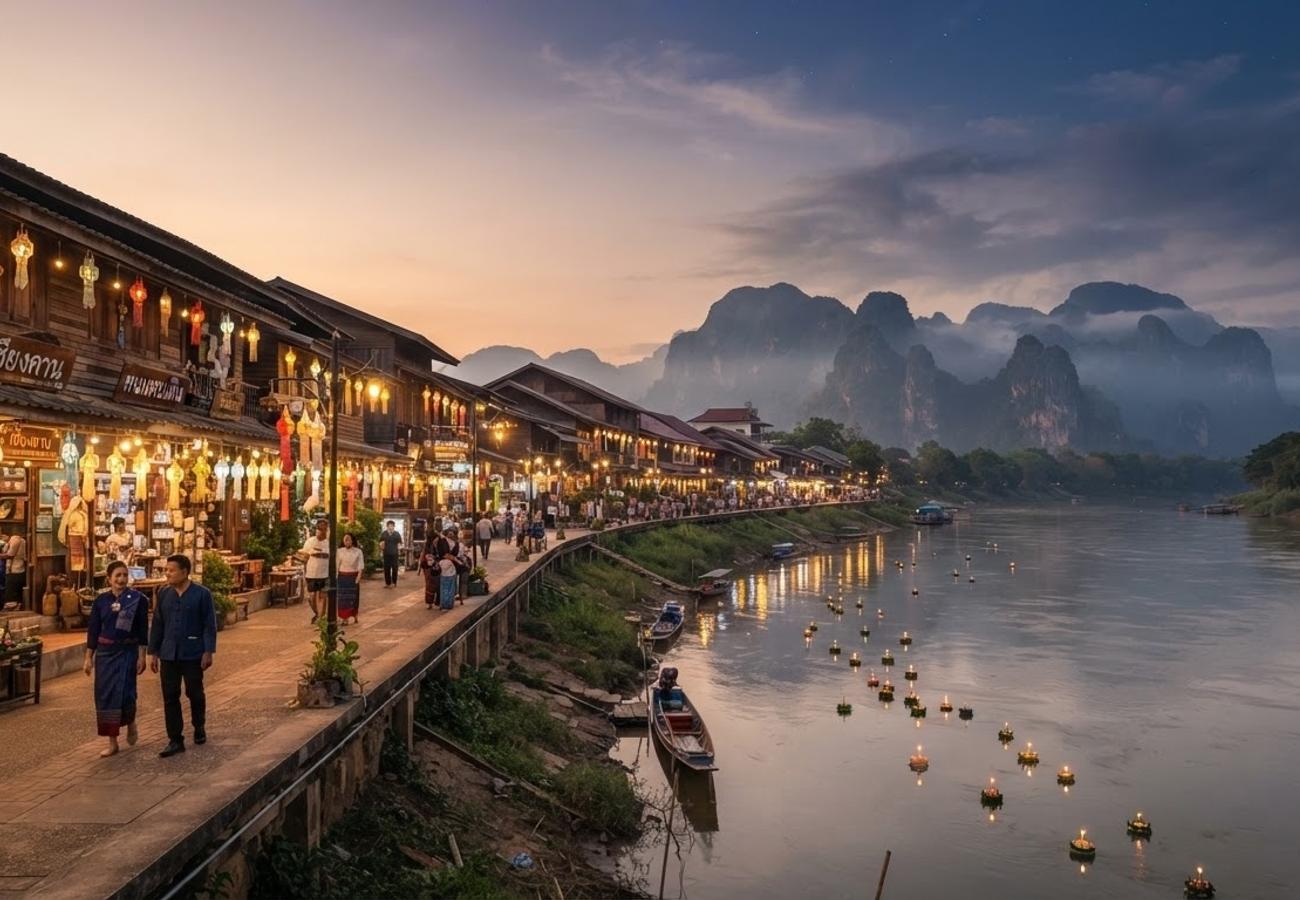
Image generated by AI
The Singha Pha Mae Thiao Festival 2026, running from 10 to 16 August along Mekong Riverside Road in Chiang Khan, Loei, is more than a local celebration. It represents a calculated experiment by the Tourism Authority of Thailand (TAT) to determine if sustainable, community-led destinations can be converted into high-value, trade-ready hubs.
This shift marks a departure from mass tourism. Thailand is now prioritizing regional balance and the distribution of income directly into local hands, using Chiang Khan as a laboratory for a "Value over Volume" economic strategy.
The Mechanics of the Chiang Khan Experiment
Unlike ticketed events that concentrate revenue in a single venue, the Singha Pha Mae Thiao Festival integrates spending into the town's existing infrastructure. By centering activities on Mekong Riverside Road, the event forces visitor expenditure across multiple layers of the local economy:
- Hospitality: Increased demand for overnight stays in locally owned guesthouses.
- Retail: Direct sales of community-produced goods and crafts.
- Gastronomy: High volume of spending at riverside food businesses.
- Cultural Services: Increased bookings for heritage tours and community activities.
This model aims to transform "day-trippers" into "overnight guests," extending the length of stay and increasing the average spend per visitor.
Loei Province: Economic Foundation and Growth
Chiang Khan does not exist in a vacuum. The broader Loei provincial economy provides a robust baseline for this experiment. According to the Loei Provincial Government, the region is already a significant domestic tourism driver.
Loei Provincial Tourism Metrics
| Indicator | Verified Figure/Direction | Strategic Implication |
|---|---|---|
| 2025 Visitors | More than 2.5 million | Substantial existing demand base |
| Year-on-Year Growth | 4–5% | Consistent provincial expansion |
| Tourism Revenue | More than 6 billion baht | High impact on local business viability |
| Primary Market | Predominantly Domestic | Opportunity to deepen established segments |
| Strategy | Year-round tourism | August events reduce high-season dependency |
From Sustainability Awards to Commercial Readiness
Chiang Khan has already secured the "green" credentials required for modern international travel. In March 2026, the entry When the Mekong Changed: A Fishing Village’s Journey Towards Sustainable Tourism won the Environment and Climate category at the Green Destinations Story Awards 2026 during ITB Berlin. This follows the town's 2024 achievement as the first ASEAN destination to receive a Silver Green Destinations Award.
However, the current focus has shifted from recognition to distribution. In July 2026, TAT launched Communities ConNext, a program linking 55 Thai community destinations with Destination Management Companies (DMCs) serving long-haul markets in Europe, the Americas, the Middle East, and Africa.
The goal is to move Chiang Khan from a domestic curiosity to a commissionable itinerary component for international tour operators.
Regional Connectivity and the Laos Border
Chiang Khan’s geographic position on the Mekong River provides a unique advantage for multi-destination product development. The town serves as a gateway to the Thai–Lao border landscape, specifically around the Hueng and Mekong rivers.
The Designated Areas for Sustainable Tourism Administration (DASTA) has integrated this into its 2020–2027 Loei development plan. This strategy involves:
- Using Chiang Khan as a primary hub to distribute visitors into 15 smaller communities across nine Loei districts.
- Developing nine specific community experiences around the Chiang Khan Skywalk area.
- Creating a seamless narrative for cross-border tourism between Thailand and Lao PDR.
Why This Matters: Industry Analysis
For travel operators and investors, the Chiang Khan model is a blueprint for the future of secondary-city tourism. Our analysis of the current data suggests that the "Value over Volume" approach is a necessity, not a luxury.
By June 2, 2026, Thailand had already welcomed over 14 million international visitors, generating approximately 679 billion baht. With a total 2026 target of 33 million arrivals and 2.65 trillion baht in combined revenue, the pressure on primary hubs (Bangkok, Phuket, Chiang Mai) is unsustainable.
The real impact of the Chiang Khan experiment is the proof of concept for "geographic dispersal." If a small town in Loei can successfully convert festival traffic into sustained, high-value community spending, TAT can replicate this model across other secondary provinces. This reduces the risk of over-tourism in hubs while stabilizing the national tourism economy against market volatility.
Forward Outlook
The success of the Singha Pha Mae Thiao Festival will be measured by the conversion rate of visitors to overnight guests. Expect to see Chiang Khan increasingly bundled into "Slow Travel" packages for European and American markets via the Communities ConNext network.
Furthermore, the integration of the 2020–2027 DAST plan suggests that Chiang Khan will soon evolve into a primary transit point for high-end, sustainable cross-border itineraries into Laos, moving beyond simple sightseeing to structured, community-led cultural exchanges.
The shift from counting heads to counting value marks the next era of Thai tourism.
Related Travel Guides
Disclaimer
This article is for informational and educational purposes only. It does not constitute legal, financial, or professional advice. While we strive to provide accurate and up-to-date information, travel policies, regulations, and conditions change rapidly. Always verify information with official sources before making travel decisions. Nomad Lawyer makes no representations about the accuracy, reliability, completeness, or suitability of the information provided. Readers should consult qualified professionals for advice specific to their circumstances. The views expressed in this article are those of the author and do not necessarily reflect the views of Nomad Lawyer.
Kunal K Choudhary
Co-Founder & Contributor
A passionate traveller and tech enthusiast. Kunal contributes to the vision and growth of Nomad Lawyer, bringing fresh perspectives and driving the community forward.
Learn more about our team →