
Global Energy Crisis and Gulf Tensions Paralyze Cairo International Airport: Lufthansa, Emirates, and EgyptAir Ground Flights Amid Severe Regional Airspace Restrictions and Mass Shipping Disruption
As the US-Iran conflict restricts vital Middle Eastern airspace, Cairo International Airport is crippled by 106 delays and a 100% cancellation rate to Dubai, sparking unprecedented travel chaos.

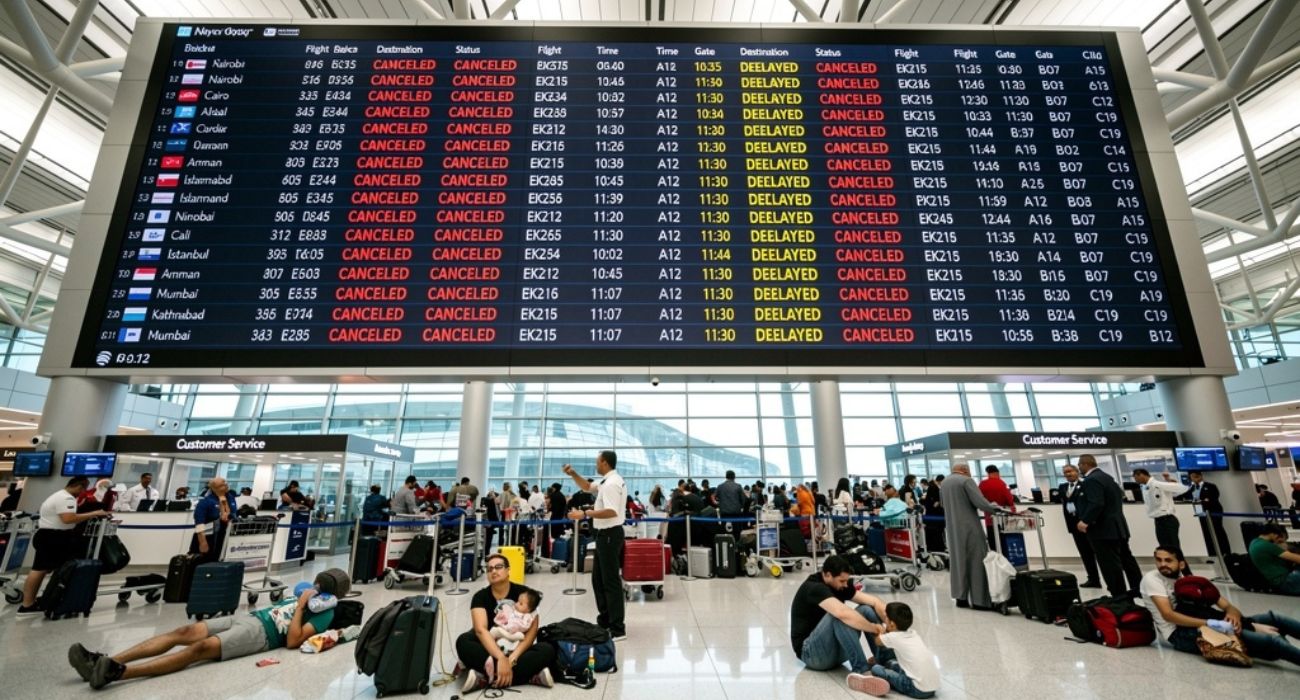
Image generated by AI
The rapidly intensifying US Iran conflict has violently spilled over from maritime trading routes directly into the skies over North Africa and the Middle East. As military posturing dictates the closure of sovereign airspace, a massive wave of travel chaos has completely paralyzed Cairo International Airport (CAI). On April 11, 2026, the Egyptian transit hub registered a staggering 106 active flight delays and 10 immediate cancellations, generating severe operational shockwaves across the global aviation network. Dominant legacy carriers, severely burdened by the broader global energy crisis and erratic airspace availability, including Lufthansa, EgyptAir, Emirates, and Flynas, are failing to maintain scheduling integrity. Consequently, international passengers bound for Frankfurt, London, Dubai, and Abu Dhabi are facing unprecedented gridlock and indefinite ground stops.
Expanded Overview: Cairo Under Extreme Stress
The raw metrics emerging from Cairo International Airport paint a picture of an infrastructure on the brink of total operational failure. While April 11 stands out as a singularly disastrous day featuring over a hundred compounded delays, this is merely the culmination of sustained, crushing logistical stress. Just days prior on April 6, the airport recorded over 150 delayed departures, temporarily halting the massive transit arteries flowing toward Doha, Frankfurt, Istanbul, and London. With zero operational breathing room, Cairo is suffocating under the weight of excessive passenger volumes, crippled regional airspace corridors, and the cascading failure of delayed aircraft unable to successfully rotate back into active service.
Geopolitical Context: The Shadow of the Strait of Hormuz
This catastrophic aviation gridlock cannot be divorced from the broader geopolitical theater. The ongoing Gulf tensions, specifically the heavily militarized standoff between American naval forces and Iranian military logistics, have functionally weaponized the airspace surrounding the Strait of Hormuz. Because vast segments of the Middle Eastern sky are currently classified as high-risk or entirely restricted due to potential kinetic military escalation, international airlines are being forcefully ordered to funnel thousands of commercial flights into narrow, heavily congested 'safe' corridors. Cairo currently sits at the intersection of these overflowing transit highways, directly absorbing the collateral damage of a proxy war it has zero control over.
Global Energy Impact: The Cost of Rerouting
The same regional conflict causing crippling shipping disruption and rocketing oil prices is financially punishing the airlines stranded on Cairo's tarmac. When active military zones force commercial jets to wildly detour away from optimal flight paths, aircraft burn exponentially more of increasingly scarce, ultra-expensive jet fuel. This violent intersection of a global energy squeeze and longer, inefficient flight times has driven carriers to preemptively cancel underperforming routes simply to conserve kerosene for their highest-yielding, non-disrupted international departures.
Shipping & Trade Impact: The Passenger Cargo Bottleneck
The logistical nightmare extends beyond basic passenger inconvenience into heavy cargo economics. Searing delays at Cairo directly translate into massive holds for belly-cargo logistics. As widebody jets bound for major European destinations are perpetually held on the tarmac, thousands of tons of time-sensitive commercial freight, mail, and vital trade goods are missing their critical European and Gulf connections, inadvertently contributing to the massive global supply chain delays already triggered by the maritime blockade of the Persian Gulf.
Regional Impact (Gulf States): Airspace Blackouts
The disruption footprint is inflicting massive economic damage upon the Gulf States, which rely absolutely on Egypt as a primary transit conduit. The current operational statistics confirm a horrific reality for Gulf-bound transit:
| Airport | Disruption Type | Official Disruption Rate |
|---|---|---|
| Dubai International (DXB) | Cancellations | 100% cancelled |
| Frankfurt International (FRA) | Cancellations / Delays | 33% cancelled, 66% delayed |
| London Heathrow (LHR) | Delays | 50% delayed |
| Mitiga International, Libya (MJI) | Cancellations | 33% cancelled |
| Abu Dhabi International (AUH) | Delays | 14% delayed |
The absolute 100% cancellation rate effectively cutting off the massively lucrative Cairo–Dubai corridor severely isolates UAE markets from North African transit routes. Furthermore, Saudi carrier Flynas is absorbing a staggering 66% delay rate, severely threatening the connectivity matrix supporting Saudi Arabia.
Industry / Expert Analysis: Legacy Carriers Buckle
Industry monitors are closely analyzing exactly which airlines are fracturing under the stress of the Egyptian bottlenecks. EgyptAir is naturally suffering the deepest domestic damage, failing to launch 55 weekly departures even before today’s massive spike. However, the international retreat is equally glaring. Acknowledging the extreme volatility in the Middle East, the Lufthansa Group has initiated massive defensive action by officially suspending vast portions of its Middle East flight schedule linearly through April 30, 2026. This defensive posture is directly responsible for the crippling 33% outright cancellation rate and 66% delay rate of Frankfurt-destined traffic departing from Cairo.
What Happens Next: Preparing for Prolonged Chaos
Aviation analysts monitoring CAI unequivocally assert that passengers must abandon any expectations of immediate stabilization. The confluence of deeply entrenched military airspace restrictions, coupled with the residual ground fallout from severe flash floods in late March that originally paralyzed the tarmac, guarantees a highly turbulent runway for the remainder of April. Legacy carriers including Air France and Emirates will continue adjusting capacity downward to insulate their broader master schedules from Cairo's intense localized volatility.
Conclusion: Mitigating the Collapse
Until the overarching geopolitical standoff driving the global energy crisis and Middle Eastern airspace closures is diplomatically subdued, Cairo International Airport remains structurally vulnerable to massive, rolling delays. Travelers dependent on this crucial North African hub must adopt a heavily defensive posture. Navigating CAI throughout the 2026 spring season requires extreme booking flexibility, constant monitoring of airline mobile alerts, and an implicit understanding that any ticket routed through the Egyptian capital is highly susceptible to immediate, unannounced grounding within a moment's notice.
Key Takeaways
- Total Chaos at Cairo: On April 11, 2026, Cairo International Airport (CAI) documented a devastating 106 flight delays and 10 outright cancellations.
- Gulf Corridor Severed: Operations tracking into Dubai International (DXB) experienced an unprecedented 100% cancellation rate, completely stranding UAE-bound travelers.
- Lufthansa's Retreat: Reacting directly to geopolitical instability, Lufthansa has suspended major Middle Eastern operations through April 30, heavily impacting Frankfurt (FRA) with a 33% flight cancellation rate.
- Geopolitical Gridlock: Massive airspace closures across the Middle East due to the ongoing military escalation have flooded open corridors above North Africa, creating an unmanageable ATC bottleneck.
- Consumer Defense: Due to skyrocketing flight cancellations, passengers must arrive extremely early, constantly monitor airline direct feeds, and leverage EC 261 guidelines for potential care and compensation protocols.
Related Travel Guides
Disclaimer
This article is for informational and educational purposes only. It does not constitute legal, financial, or professional advice. While we strive to provide accurate and up-to-date information, travel policies, regulations, and conditions change rapidly. Always verify information with official sources before making travel decisions. Nomad Lawyer makes no representations about the accuracy, reliability, completeness, or suitability of the information provided. Readers should consult qualified professionals for advice specific to their circumstances. The views expressed in this article are those of the author and do not necessarily reflect the views of Nomad Lawyer.
Raushan Kumar
Founder & Lead Developer
Full-stack developer with 11+ years of experience and a passionate traveller. Raushan built Nomad Lawyer from the ground up with a vision to create the best travel and law experience on the web.
Learn more about our team →