
Flight Chaos Erupts at Cairo International Airport: Over 100 Delays Cripple Europe, Middle East, and North Africa Routes on April 11, 2026
Cairo International Airport recorded 106 flight delays and 10 cancellations on April 11, 2026, affecting major carriers including Lufthansa, EgyptAir, Emirates, and Flynas. Disruptions ripple across Frankfurt, London, Dubai, and major European, Middle Eastern, and North African hubs.

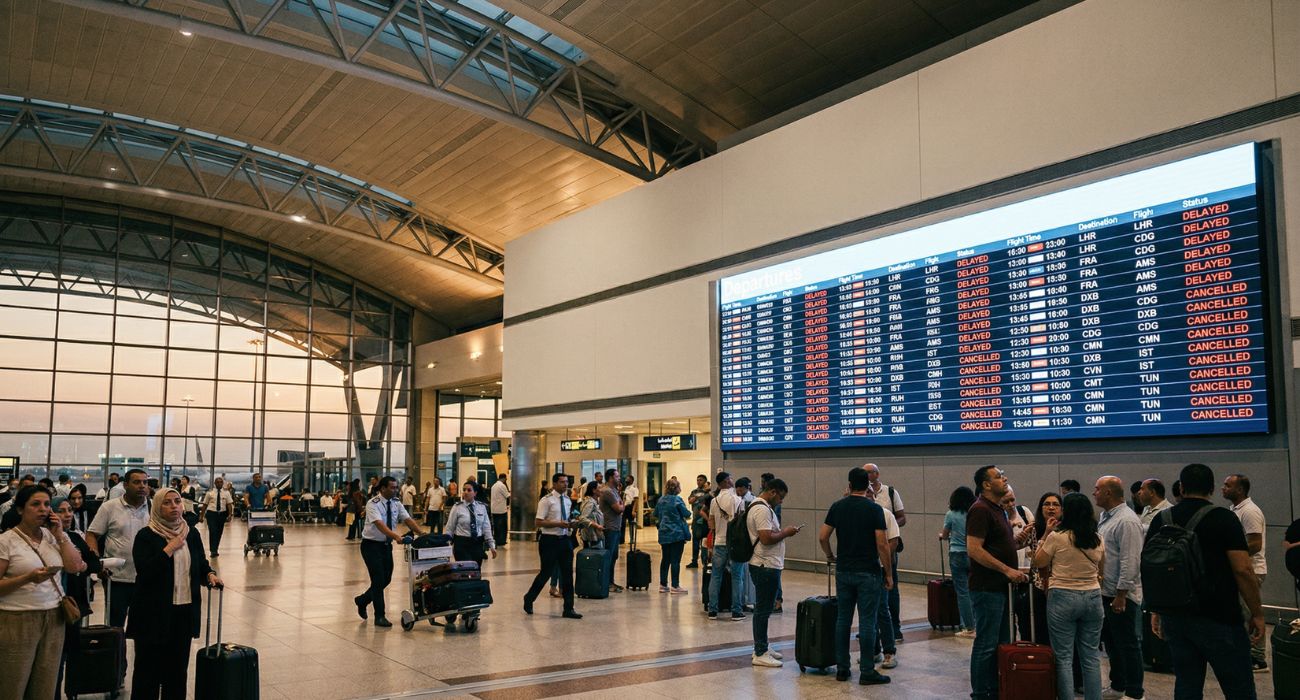
Image generated by AI
Quick Summary
- Cairo International Airport experienced 106 flight delays and 10 cancellations on April 11, 2026
- Major carriers including EgyptAir, Lufthansa, Emirates, and Flynas were severely impacted
- Frankfurt experienced 33% cancellations and 66% delays on Cairo-originating flights
- Dubai recorded 100% cancellation rate for Cairo-bound services
- Disruptions stem from regional airspace restrictions, severe weather effects, and capacity limitations
Travel Chaos Grips Cairo International Airport as 106 Delays and 10 Cancellations Disrupt Global Aviation Network
CAIRO — Cairo International Airport descended into operational crisis on April 11, 2026, recording a devastating total of 106 flight delays and 10 cancellations that sent shockwaves across European, Middle Eastern, and North African aviation networks. Major international carriers including Lufthansa, EgyptAir, Emirates, and Flynas bore the brunt of disruptions, with passengers stranded across key hubs including Frankfurt, London Heathrow, Dubai, Abu Dhabi, and numerous destinations throughout Europe, the Middle East, and North Africa. The chaos reflects escalating challenges at Cairo as a critical aviation hub, where regional instability, weather-related infrastructure strain, and capacity constraints converge to create cascading operational failures affecting hundreds of thousands of travelers.
The disruptions mark the continuation of a severe pattern that has plagued Cairo since early April 2026. On April 6 alone, the airport recorded over 150 departures delayed—a record for the year—affecting services to Dubai, Doha, Frankfurt, Istanbul, and London with extended ground stops. Today's reported 106 delays and 10 cancellations reflect an airport operating under sustained operational stress, driven by systemic challenges that show no immediate resolution.
Scale and Geographic Scope of Disruptions
Today's disruptions at Cairo International Airport extended well beyond individual flight delays, creating widespread cascading failures across three major continental regions simultaneously. The following table documents disruption rates at the most severely affected international airports:
| Airport | Disruption Type | Impact Rate |
|---|---|---|
| Frankfurt International (FRA) | Cancellations / Delays | 33% cancelled, 66% delayed |
| London Heathrow (LHR) | Delays | 50% delayed |
| Dubai International (DXB) | Cancellations | 100% cancelled |
| Abu Dhabi International (AUH) | Delays | 14% delayed |
| Mitiga International (MJI), Libya | Cancellations | 33% cancelled |
Frankfurt International—one of Europe's busiest aviation hubs and primary Lufthansa hub—experienced crippling disruption rates with 33 percent cancellations and 66 percent delays affecting Cairo-originating flights. This severity reflects Lufthansa's structural vulnerability to Middle East operational disruptions, compounded by the carrier's suspension of Middle East services through April 30, 2026.
Dubai International recorded the most severe disruption, with a complete blackout of Cairo-bound services registering 100 percent cancellation rates. This represents a functional cessation of the Cairo–Dubai corridor, a critical transit gateway for millions of annual passengers connecting across Asia, Australasia, and Middle Eastern destinations. Stranded passengers faced unlimited rebooking complexity, with alternative routing options severely constrained by capacity limitations across regional airports.
London Heathrow's 50 percent delay rate on Cairo connections reflects cascading disruptions affecting European connectivity. Abu Dhabi International, though registering lower 14 percent delay rates, still experienced significant operational friction from Cairo disruptions. Mitiga International in Libya saw 33 percent cancellations, extending disruption impacts to North African networks.
Airlines Absorbing the Disruption Impact
Multiple international and regional carriers faced severe operational stress from today's Cairo disruptions:
EgyptAir, Egypt's national carrier and primary Cairo hub operator, experienced the most comprehensive disruption, facing widespread delays across its entire domestic and international network. Prior weekly disruption tallies through early April documented 55 delays and 3 cancellations—figures today's disruption substantially exceeded. EgyptAir's operational vulnerability stems from its structural dependence on Cairo hub connectivity for Middle Eastern, European, and North African traffic flows.
Lufthansa, Europe's largest carrier, absorbed severe disruptions on Frankfurt-bound services from Cairo, reflecting a 33 percent cancellation rate and 66 percent delay rate on this corridor. Lufthansa Group's already-strained operational capacity—compressed by the carrier's suspension of Middle East flights through April 30, 2026—left minimal rebooking flexibility for stranded passengers. The carrier's network-wide vulnerability to regional instability became starkly apparent through today's disruptions.
Emirates, Dubai-based global carrier, faced complete service cessation on the Cairo–Dubai route, with 100 percent flight cancellations recorded throughout April 11. This represents a functional closure of a critical connectivity corridor that normally handles substantial passenger volumes for Asia-Pacific and Australasian connections.
Flynas, Saudi Arabia's low-cost carrier, experienced a 66 percent delay rate on Cairo operations, severely disrupting connections to Saudi Arabian destinations and onward Middle Eastern routing options. The carrier's network-wide vulnerability to regional instability reflects its structural dependence on Middle Eastern hub connectivity.
Air France, operating long-haul services through Cairo, experienced extensive delays affecting European connectivity, with cascading disruptions impacting the Paris-Cairo-Southeast Asia corridor.
Regional Impact Analysis: Europe, Middle East, and North Africa
Today's disruptions created synchronized operational challenges across three major travel regions, each experiencing distinct but interconnected consequences.
Europe: Major cities including Frankfurt, London, Amsterdam, Berlin, Brussels, and Copenhagen registered knock-on delays as Cairo-connected flights fell progressively behind schedule. Lufthansa's already-compressed Middle East operations amplified European connectivity disruptions, removing alternative routing flexibility for affected passengers. The carrier's suspension of Middle East services through April 30 left European networks with minimal redundancy when Cairo disruptions cascaded northward.
Middle East: Travelers attempting to reach Dubai and Abu Dhabi faced the most severe disruptions, with the UAE corridor effectively closed for Cairo passengers today. The Cairo–Dubai connection, normally handling approximately 45,000 monthly passengers, ground virtually to complete halt. Beirut and Mitiga International in Libya also registered significant delays, compounding strained regional networks already operating under elevated Middle East instability.
North Africa: Mohamed V International in Casablanca and Hurghada International in Egypt reported cascading delays, disrupting popular tourist corridors and charter flights connecting North African tourism markets to European destinations. Tourism operators reported widespread cancellations affecting European customers attempting to access North African beach destinations and cultural tourism experiences.
Root Causes of Operational Disruption
Three interconnected factors drove today's severe disruptions at Cairo:
Regional Airspace Restrictions: Ongoing military escalation in the broader Middle East has forced airlines to implement airspace rerouting protocols, effectively closing efficient corridor routing and forcing traffic through constrained alternative airspace. This compression creates congestion at Cairo hub, the primary remaining efficient routing point for Europe-Asia connections. Airspace uncertainty creates cascading scheduling complications, as carriers cannot implement optimized fleet positioning pending real-time airspace clearances.
Severe Weather Infrastructure Impact: Late March torrential rainfall and flash flooding created residual infrastructure strain at Cairo continuing through April. Ground operations experienced personnel shortages, extended passenger processing times, and baggage handling delays. Runway maintenance requirements resulting from water damage created periodic capacity constraints on available operational infrastructure.
Capacity Limitations: Cairo and nearby diversion airports operated at maximum capacity throughout April, preventing swift redistribution of stranded aircraft and passengers. The airport lacks surplus capacity to absorb displacement from regional disruptions, transforming isolated delays into cascading operational failures. Container shortages, ground handling bottlenecks, and crew scheduling constraints compounded fundamental capacity exhaustion.
Passenger Rights and Protective Measures
Passengers affected by today's disruptions accessed several protective mechanisms:
Free rebooking opportunities—offered by most carriers including EgyptAir, Lufthansa, and Emirates—provided complimentary rebooking onto next available services. Depending on booking terms, passengers accessed IATA-standardized care and assistance including meals, refreshments, and hotel accommodation for extended delays on covered routes.
Passengers on European Union-regulated routes (departing from EU airports) accessed compensation protections under EC 261/2004, though extraordinary circumstances exceptions applied to disruptions caused by regional airspace closures. Comprehensive travel insurance policies often covered delay and cancellation disruptions, subject to specific policy exclusions regarding regional instability or military operational impact.
Real-time monitoring via FlightRadar24 enabled passengers to track flight status changes, providing advance warning for rebooking decisions and alternative travel planning.
Practical Guidance for Affected Travelers
Passengers navigating today's disruptions implemented several protection strategies:
Continuous Airline Contact: Monitoring flight status through airline applications, websites, and customer service lines provided real-time departure time updates, enabling proactive rebooking decisions before seat inventories exhausted.
Alternative Routing Exploration: Investigating multi-leg routing through alternative hub airports—including Abu Dhabi, Doha, Istanbul, or European primary hubs—provided backup connectivity options when direct Cairo routing became unavailable.
Travel Insurance Activation: Reviewing policy documentation for delay and cancellation coverage enabled covered passengers to lodge timely claims, offsetting accommodation and meal expenses during extended disruptions.
Connection Time Expansion: Adding substantial buffers to planned connection windows—typically 3–4 hours minimum for international connections through disrupted hubs—reduced missed connection risk for passengers with ongoing itineraries.
Early Arrival Protocol: Arriving at airports 3–4 hours before scheduled departures accommodated extended security and check-in processing times during high-disruption periods.
Future Outlook and Precautionary Measures
Analysts monitoring Cairo International Airport performance expect delay levels to remain elevated throughout April 2026 as regional airspace restrictions persist and weather-related infrastructure challenges continue. Eurocontrol coordination with regional air traffic management authorities provides limited near-term relief, as fundamental airspace constraints reflect geopolitical factors outside aviation authorities' direct control.
Passengers with upcoming Cairo-connected travel throughout April should implement precautionary measures including early airport arrival, expanded connection time buffers, and comprehensive travel insurance. Flexible booking policies enabled complimentary modifications without rebooking fees, providing valuable optionality during sustained disruption periods.
Frequently Asked Questions
What caused today's 106 delays and 10 cancellations at Cairo? Regional airspace restrictions, residual weather infrastructure damage from late March flooding, and fundamental capacity limitations at Cairo created synchronized operational failures affecting hundreds of flights. These factors compound ongoing Middle East regional instability affecting aircraft routing.
Which airports are most severely impacted by Cairo disruptions? Frankfurt, London Heathrow, Dubai, and Abu Dhabi registered the most severe cascading disruptions, with Frankfurt experiencing 33% cancellations and Dubai recording 100% cancellations on Cairo-bound services.
What passenger rights apply to today's disruptions? EC 261/2004 protections apply to EU-departing flights, though extraordinary circumstances exceptions may limit compensation claims. Meals, refreshments, hotel accommodation, and complimentary rebooking apply to eligible passengers. Travel insurance coverage depends on specific policy terms.
Should I rebook my Cairo-connected flight? Consulting with your airline regarding available rebooking options through alternative routing—potentially via Abu Dhabi, Doha, or Istanbul—provides viable alternatives if delay durations exceed acceptable thresholds.
When will Cairo airport disruptions resolve? Analysts expect elevated disruption levels continuing through April 2026 pending resolution of regional airspace restrictions and weather infrastructure recovery. Monitor airport performance status through industry tracking services before confirmed travel dates.
What alternative routing options exist for Cairo-dependent passengers? Multi-leg connections through Abu Dhabi, Doha, Istanbul, or direct European routing provide viable alternatives when Cairo direct connectivity becomes disrupted. Extended travel durations require assessment against delay duration on direct routing.
Conclusion
Cairo International Airport's April 11 disruptions—recording 106 delays and 10 cancellations—represent the continuation of severe operational stress affecting this critical global aviation hub. Cascading disruptions across Europe, the Middle East, and North Africa underscore the airport's strategic importance to international connectivity and the vulnerability created when regional instability intersects with infrastructure constraints and weather-related operational challenges. Passengers with upcoming Cairo-dependent travel should implement precautionary measures including expanded connection buffers, continuous flight status monitoring, and comprehensive travel insurance protection as elevated disruption levels persist through April 2026.
Source: FlightAware
Tags: Cairo airport, flight delays, flight cancellations, EgyptAir, Lufthansa, Emirates, Flynas, Frankfurt, London Heathrow, Dubai, airline disruption
Disclaimer
This article is for informational and educational purposes only. It does not constitute legal, financial, or professional advice. While we strive to provide accurate and up-to-date information, travel policies, regulations, and conditions change rapidly. Always verify information with official sources before making travel decisions. Nomad Lawyer makes no representations about the accuracy, reliability, completeness, or suitability of the information provided. Readers should consult qualified professionals for advice specific to their circumstances. The views expressed in this article are those of the author and do not necessarily reflect the views of Nomad Lawyer.
Kunal K Choudhary
Co-Founder & Contributor
A passionate traveller and tech enthusiast. Kunal contributes to the vision and growth of Nomad Lawyer, bringing fresh perspectives and driving the community forward.
Learn more about our team →