
Travelers Stranded Across the Middle East as Air Arabia, Royal Jordanian, Lufthansa, and EgyptAir Suspend 19 Flights and Log 62 Delays at Sharjah, Amman, and Cairo International Airports in Major Travel Disruption
A wave of cancellations and delays at SHJ, AMM and CAI left passengers stranded as Air Arabia, Royal Jordanian, Lufthansa and EgyptAir suspended services and logged dozens of delays.

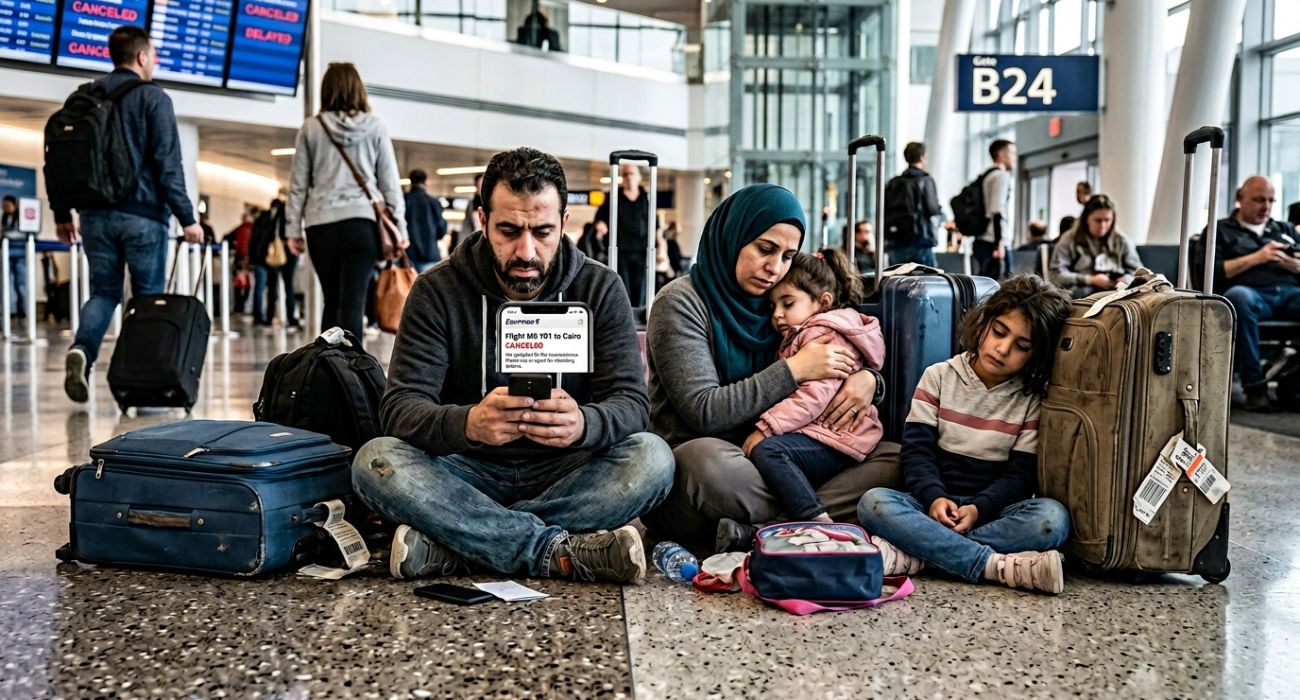
Image generated with AI
Travelers Stranded Across the Middle East as Air Arabia, Royal Jordanian, Lufthansa, and EgyptAir Suspend 19 Flights and Log 62 Delays at Sharjah, Amman, and Cairo International Airports in Major Travel Disruption
Published on April 17, 2026 Image generated with AI
A wave of severe flight disruptions has left hundreds of travelers stranded across the Middle East, after Air Arabia, Royal Jordanian, Lufthansa, and EgyptAir collectively cancelled 19 flights and recorded a combined 62 delays across three of the region's most critical aviation hubs. Sharjah International Airport (SHJ), Queen Alia International Airport (AMM) in Amman, and Cairo International Airport (CAI) have all been plunged into operational turmoil, with departure halls filling with frustrated passengers demanding answers, rebooking options, and clarity on when their disrupted journeys can resume. The scale and geographic spread of today's disruptions — touching the UAE, Jordan, and Egypt simultaneously — signal a systemic strain on Middle Eastern aviation infrastructure that authorities and airlines are scrambling to contain.
Affected Airports and Cities
The disruptions span three countries and three major international gateways, each playing a critical role in the region's broader aviation network. Sharjah International Airport (SHJ) in the UAE serves as the primary base for Air Arabia, the region's largest low-cost carrier, and handles millions of passengers annually on routes connecting the Gulf to South Asia, North Africa, and Europe. Queen Alia International Airport (AMM) is Jordan's flagship international hub and the home base of Royal Jordanian, connecting Amman to hundreds of destinations across the Middle East, Europe, and North America. Cairo International Airport (CAI) is one of Africa's busiest airports and a critical transit hub between Europe and Sub-Saharan Africa, handling carriers including Lufthansa and EgyptAir on high-frequency international routes.
The Data: Full Disruption Breakdown
The following table captures the precise scale of today's cancellations and delays across all three affected airports:
| Airport | Airline | Cancelled Flights | Delayed Flights |
|---|---|---|---|
| Sharjah Int'l (SHJ) | Air Arabia | 6 | 19 |
| Queen Alia Int'l (AMM) | Royal Jordanian | 8 | 5 |
| Cairo Int'l (CAI) | Lufthansa | 4 | 0 |
| Cairo Int'l (CAI) | EgyptAir | 1 | 38 |
Source: FlightAware
Airport-by-Airport Impact Analysis
At Sharjah International Airport (SHJ), Air Arabia cancelled 6 flights — representing 4% of its scheduled operations — while simultaneously logging 19 delays, accounting for 13% of its total departures. For an airline that operates hundreds of daily rotations out of Sharjah, these figures represent a significant operational disruption that cascaded through connecting itineraries across South Asia, North Africa, and Eastern Europe. Passengers at SHJ reported lengthy queues at Air Arabia's customer service counters as staff worked to rebook affected travelers onto the next available services.
The situation at Queen Alia International Airport (AMM) was proportionally more severe. Royal Jordanian cancelled 8 flights — equivalent to 7% of its scheduled operations — alongside 5 delays (4%). While the absolute delay count at Amman is lower than Cairo, the 7% cancellation rate is notably high for a national carrier operating its own home hub, indicating that the disruptions are not merely the result of incoming aircraft running late but reflect deeper operational or scheduling challenges within Royal Jordanian's own network.
Cairo International Airport (CAI) presents the most complex picture of the three affected hubs. Lufthansa's performance at Cairo is particularly alarming: the German flag carrier cancelled 4 flights, representing a striking 57% of its total scheduled operations at the airport — the highest cancellation rate of any airline across all three disruption zones today. This near-total suspension of Lufthansa's Cairo services will have immediate knock-on effects for European-bound passengers using CAI as a departure point for onward connections through Frankfurt and Munich. Meanwhile, EgyptAir recorded just 1 cancellation but an extraordinary 38 delays — 17% of its total operations — suggesting that Egypt's national carrier is managing to keep flights technically operational while struggling to maintain anything resembling punctuality across its network.
Root Causes: What Is Driving the Disruptions
Today's multi-airport disruption pattern across Sharjah, Amman, and Cairo does not appear to stem from a single triggering event. Instead, the simultaneous nature of the disruptions across three countries and four airlines points to a combination of overlapping pressure sources that have converged on the same travel day.
Regional airspace management challenges, driven by ongoing geopolitical instability across the broader Middle East, have forced airlines to reroute aircraft around restricted zones, adding flight time, increasing fuel costs, and compressing turnaround windows at destination airports. Lufthansa's exceptionally high 57% cancellation rate at Cairo in particular suggests that the airline has made a commercial and operational decision to consolidate or suspend certain Cairo rotations rather than operate them under severely degraded conditions. Technical and crew scheduling issues — a persistent challenge for carriers that have rebuilt their schedules aggressively following years of reduced operations — are also contributing factors across all four airlines involved.
Passenger Impact: Chaos on the Ground
Inside the terminals at Sharjah, Amman, and Cairo, the human cost of today's disruptions is playing out in real time. Departure halls that would normally flow efficiently with departing passengers have transformed into holding areas for stranded travelers, with airline service desks overwhelmed by demand for rebooking assistance, refund information, and updates on revised departure times.
For passengers with onward connections — particularly those using CAI as a transit point for European flights or AMM as a connection hub for transatlantic itineraries — the cancellations have created a cascading series of missed bookings that will take days to fully resolve. Business travelers with time-sensitive commitments, families with hotel check-ins and tour bookings, and passengers with medical appointments have all been caught in the disruption, with no simple or immediate solution available at the gate.
What Travelers Should Do Right Now
If you are among the passengers affected by today's disruptions at Sharjah, Amman, or Cairo, taking the following steps immediately will give you the best chance of minimizing the impact on your journey.
Stay updated through your airline's official app, website, or SMS alerts — departure times are changing frequently and gate assignments may shift without warning. Contact the airline directly at the airport service desk or via customer service hotline rather than waiting for automatic notification, as proactive passengers are typically processed faster for rebooking. Know your rights — passengers on cancelled flights are entitled to rebooking on the next available service at no additional cost, and in many jurisdictions including the EU, compensation may be available if the cancellation was within the airline's control. Consider alternative routing — if your airline cannot offer a suitable rebooking within a reasonable timeframe, ask specifically about partner airline options or interline agreements that may get you to your destination via a different hub. Finally, activate any travel insurance you hold and document all expenses incurred due to the disruption, including meals, accommodation, and ground transport, as these costs may be reimbursable under your policy.
The Bigger Picture for Middle East Aviation
Today's disruptions at Sharjah, Amman, and Cairo are a concentrated illustration of the pressures currently bearing down on Middle Eastern aviation as a whole. Lufthansa's near-total suspension of Cairo services — with a 57% cancellation rate — is the single most alarming data point in today's disruption picture and raises questions about the airline's short-term commercial confidence in the Cairo route. As regional tensions persist and airspace management remains complex, travelers planning journeys through Middle Eastern hubs in the coming weeks are strongly advised to monitor flight status daily, build extra connection time into their itineraries, and keep their airline contact information readily accessible.
Source: FlightAware
Tags: Amman, Cairo, Egypt, Jordan, Middle East, Air Arabia, Royal Jordanian, Lufthansa, EgyptAir, flight cancellations, flight delays, Sharjah airport, travel disruption
Disclaimer
This article is for informational and educational purposes only. It does not constitute legal, financial, or professional advice. While we strive to provide accurate and up-to-date information, travel policies, regulations, and conditions change rapidly. Always verify information with official sources before making travel decisions. Nomad Lawyer makes no representations about the accuracy, reliability, completeness, or suitability of the information provided. Readers should consult qualified professionals for advice specific to their circumstances. The views expressed in this article are those of the author and do not necessarily reflect the views of Nomad Lawyer.
Kunal K Choudhary
Co-Founder & Contributor
A passionate traveller and tech enthusiast. Kunal contributes to the vision and growth of Nomad Lawyer, bringing fresh perspectives and driving the community forward.
Learn more about our team →