Busan Triggers Historic One Trillion Won Tourism Boom Bypassing Seoul: Direct International Flights, Maritime Cruises, and Global Visitor Surge

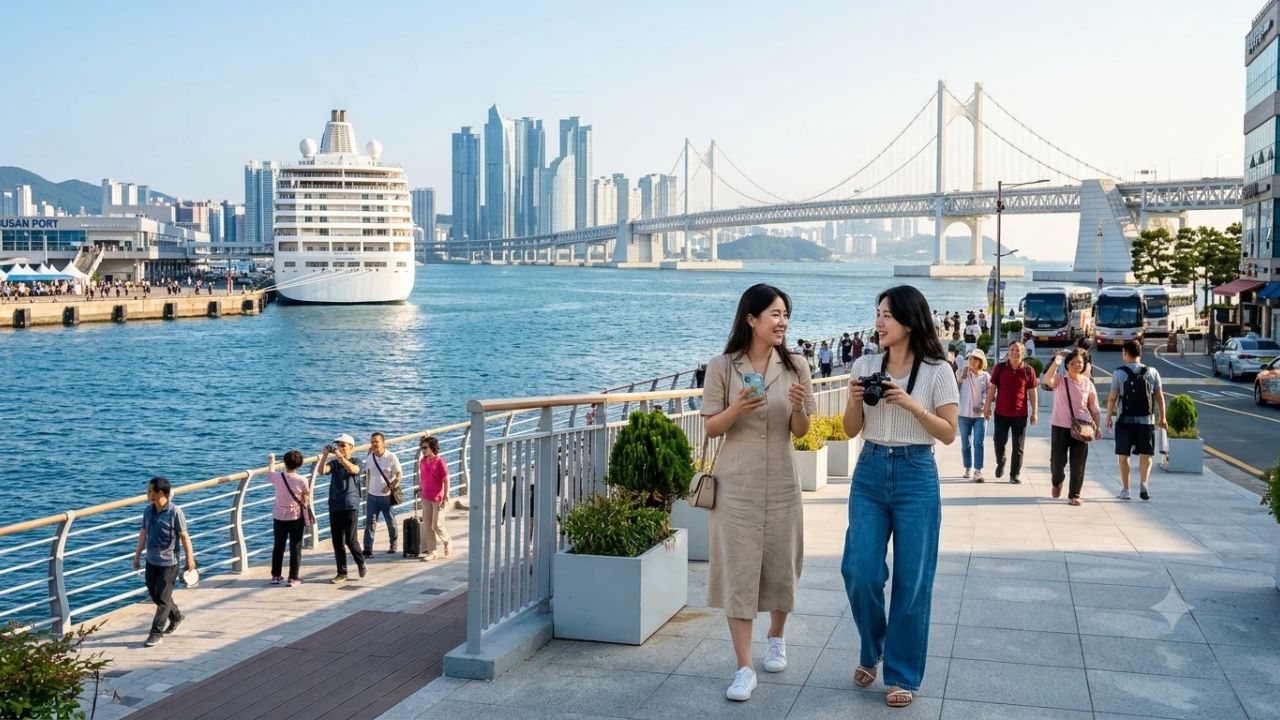
BUSAN — South Korea’s primary coastal metropolis has achieved an unprecedented economic milestone in international travel, generating over one trillion won in foreign tourist credit card expenditures while fundamentally bypassing the traditional gateway of metropolitan Seoul.
Official tourism and financial registry data compiled between January and September 2026 reveals that foreign credit card spending accumulated within Busan reached 1.0162 trillion won (approximately US$770 million), shattering previous records and establishing the southern port city as the nation’s preeminent non-capital travel powerhouse.
This landmark accomplishment was attained in September, a full three months earlier than in the prior calendar year, when the one-trillion-won threshold was barely crossed in late December.
Setting aside metropolitan Seoul, where foreign transaction values reached 8.8435 trillion won, Busan stands as the only municipal government nationwide to clear the one-trillion-won ceiling.
Across all non-capital provinces and regional cities combined, which collectively registered 1.9608 trillion won in foreign card expenditures, Busan captured an extraordinary 51.8 percent. In practical economic terms, more than half of all foreign tourism capital spent outside the greater Seoul orbit was absorbed by a single southeastern seaside metropolis.
BUSAN HISTORIC TOURISM EXPANSION: KEY PERFORMANCE METRICS
| Entity / Route | Metrics | Operational Status |
|---|---|---|
| Performance Indicator | Measured Benchmark (Jan–Sep) | Comparative Growth Dynamics |
| Foreign Card Expenditures | 1.0162 Trillion Korean Won | Cleared 3 months earlier than |
| (~US$770 Million) | previous calendar year | |
| Non-Capital Spending Share | 51.8% of All Non-Seoul Spend | Outperformed all other |
| (1.9608 Trillion Won Total) | Korean provinces combined | |
| Total Foreign Visitors | 3,934,876 International Guests | +47.0% Year-over-Year Surge |
| Hosted in Metropolitan Busan | (Double national rate of 21.5%) | |
| National Market Share | 23.0% of All Inbound Visitors | Climbed from 19.0% in 2025; |
| (Peaked at 24.3% in September) | Nearly 1 in 4 foreign tourists | |
| Direct Gateway Arrivals | 2,333,199 Direct Passengers | +52.7% YoY Rise via Gimhae |
| (Air & Maritime Entry Points) | Airport and Port Terminals |
The Decentralization Milestone: Breaking Seoul’s Historical Monopoly
For decades, international tourism to South Korea followed an entrenched, highly centralized pattern.
Foreign travelers arrived almost exclusively at Incheon International Airport or Gimpo International Airport, conducted short urban sightseeing excursions across Seoul’s historic Joseon Dynasty palaces and downtown shopping districts, and occasionally boarded high-speed KTX trains for brief day trips south before flying home.
This structural concentration concentrated tourism revenues within the capital area, leaving regional provinces dependent on seasonal domestic vacationers.
The financial data from 2026 confirms that this historical monopoly has been permanently disrupted.
Between January and September, a total of 3,934,876 foreign visitors entered Busan, representing a massive 47.0 percent surge compared to the corresponding period of the previous year.
This growth velocity is recognized as more than double the nationwide inbound tourism expansion rate of 21.5 percent, demonstrating that foreign travelers are actively seeking alternative urban narratives that combine modern metropolitan sophistication with scenic maritime leisure.
                   SOUTH KOREA INBOUND TOURISM PARADIGM SHIFT

   [ Historical Model: Seoul-Centric Funnel ]
         * International Arrival: 90%+ funnel through Incheon (ICN) / Gimpo (GMP)
         * Itinerary Pattern: 4–5 days in Seoul; brief KTX day trip to provinces
         * Economic Consequence: Capital absorbs 85%+ of foreign retail spending

   [ Emerging Model: Direct Multi-Polar Access (2026–2027) ]
         * International Arrival: Direct disembarkation at Gimhae (PUS) & Busan Port
         * Itinerary Pattern: 5–7 days along southeastern maritime coastal belt
         * Economic Consequence: Busan captures 51.8% of non-capital foreign spend
Busan’s expanding national market share reflects this structural transformation.
Across the first nine months of the year, the city hosted 23.0 percent of all international tourists visiting South Korea, up substantially from 19.0 percent during the previous year.
The regional concentration peaked even higher in September, when 24.3 percent of all foreign travelers crossing national borders spent time within the metropolitan jurisdiction.
Independent market analysts observe that this trend provides concrete evidence that regional metropolitan centers, when supported by integrated international aviation and deep-water maritime infrastructure, can compete effectively on the global stage without relying on capital-city intermediaries.
The Direct Gateway Revolution: Air and Maritime Infrastructure Synergy
The primary catalyst driving Busan’s one-trillion-won economic breakthrough is the aggressive expansion of direct international transportation links that allow travelers to reach the southern coast without ever touching Seoul.
During the initial nine months of the year, 2,333,199 international travelers arrived directly through local terminals, reflecting a sharp 52.7 percent increase from the previous year.
The proportion of direct arrivals relative to all foreign entries within the city climbed steadily from 50.4 percent in January to 62.9 percent by September.
This metric proves that the majority of foreign visitors in Busan are no longer secondary domestic transfers from Seoul; they are international travelers who planned their journeys specifically around southern destinations.
DIRECT ENTRY GATEWAYS: OPERATIONAL EXPANSION MATRIX
| Entity / Route | Metrics | Operational Status |
|---|---|---|
| Transport Gateway | Monthly Operational Volume | Growth Velocity & Strategic Impact |
| Busan International | 96,493 Sea Arrivals in September | +147.8% YoY Surge; restoration of |
| Cruise & Ferry Terminal | (Historic all-time monthly high) | mega-cruise calls and Japan routes |
| Gimhae International | 218,049 Monthly Cross-Border Entries | +48.1% YoY Increase; network hub |
| Airport (PUS) | across regional aviation network | connecting 40+ Asian destinations |
| Combined Regional | 1 out of every 2 international | Consolidates status as the leading |
| Non-Capital Dominance | travelers outside Seoul enters here | international gateway in the south |
1. The Maritime Passenger Surge
Busan’s maritime gateway documented historic activity, logging an all-time monthly high of 96,493 sea arrivals in September alone—a dramatic 147.8 percent year-over-year surge.
This maritime renaissance was propelled by two synchronized operational factors:
- International Mega-Cruise Itineraries: Coordinated deployments by major international cruise lines—including Royal Caribbean, MSC Cruises, Princess Cruises, and leading Asian luxury lines—re-established Busan as an essential port of call on East Asian circuits connecting Shanghai, Yokohama, Keelung, and Jeju Island.
- Trans-Strait High-Speed Hydrofoils and Ro-Pax Ferries: High-frequency maritime passenger ferries linking Busan Port directly to Japanese coastal gateways—such as Fukuoka (Hakata), Tsushima, and Shimonoseki—operated at near-capacity passenger loads, providing seamless, affordable international transit for short-haul leisure travelers.
2. Regional Aviation Expansion at Gimhae Airport
Simultaneously, Gimhae International Airport (PUS) reinforced its position as the primary aviation anchor of the southeastern economic zone.
Monthly international entries at the terminal expanded by 48.1 percent to reach 218,049 travelers.
Low-cost carriers (such as Air Busan and Jeju Air) alongside full-service Asian network airlines expanded scheduled flight frequencies connecting Busan directly to major population centers across Japan, Taiwan, mainland China, the Philippines, Vietnam, and Thailand. Beyond primary capital routes, carriers introduced direct connections to secondary cities such as Kaohsiung, Taichung, Kumamoto, and Matsuyama. By eliminating the three-hour KTX train transfer or domestic connecting flight from Incheon, direct air access reduces total travel time and lowers overall transit expenses for international visitors.
At the cruise terminal, modern automated clearance facilities enable arriving passengers to disembark, pass through biometric customs lanes, and access waiting tour coaches or urban subway stations within twenty minutes. This frictionless transit efficiency allows cruise excursionists to spend more time exploring coastal heritage enclaves and local commercial districts rather than enduring long queue delays at the port.
                    BUSAN DIRECT INTERNATIONAL TRANSIT FLOWS

   [ East Asian Short-Haul Source Markets ]
   (Tokyo, Osaka, Fukuoka, Taipei, Kaohsiung, Shanghai, Beijing)
                         |
                         +---> Direct Flights into Gimhae Airport (PUS)
                         +---> High-Speed Hydrofoils & Cruise Liners into Busan Port
                         |
                         v
   [ Seamless Urban Metro & Coastal Transit Grid ]
                         |
           +-------------+-------------+
           |                           |
           v                           v
   [ Haeundae & Gwangalli ]    [ Seomyeon & Nampo ]
   Beachfront luxury hotels,   Medical wellness clinics,
   fine dining, coastal walks  heritage markets, shopping
The Transition Toward High-Yield Experiential Consumption
Financial analysis of the one-trillion-won milestone reveals a profound qualitative evolution in international visitor spending patterns.
Total foreign credit card transaction volume expanded by 51.9 percent year-over-year, outpacing the 47.0 percent visitor growth rate.
This divergence indicates that foreign tourists in Busan are spending more capital per capita than in previous travel cycles, transitioning away from passive, low-margin sightseeing toward premium, service-driven experiential consumption.
FOREIGN TOURIST EXPENDITURE DISTRIBUTION (JAN–SEP 2026)
| Entity / Route | Metrics | Operational Status |
|---|---|---|
| Economic Category | Share of Total Expenditure | Primary Consumer Spending Drivers |
| Commercial Retail & | 47.8% of Aggregated Foreign Spend | Department stores, tax-free shops, |
| Souvenir Purchases | (Dominant overall category) | cosmetics, local fashion boutiques |
| Gastronomic Tourism & | 22.5% of Aggregated Foreign Spend | Fresh coastal seafood markets, |
| Specialty Dining | (Fastest-growing everyday sector) | ocean-view cafes, artisanal dining |
| Medical & Aesthetic | 12.1% of Aggregated Foreign Spend | Dermatology, aesthetic clinics, |
| Wellness Treatments | (Highest margin per-capita sector) | wellness retreats, dental care |
| Hospitality Lodging & | 17.6% of Aggregated Foreign Spend | Beachfront luxury resorts, urban |
| Regional Transportation | (High-occupancy hotel revenue) | business hotels, coastal rail |
1. Gastronomic Tourism: Coastal Flavors Driving 22.5% of Spend
Dining and specialized culinary exploration accounted for nearly a quarter of all foreign expenditures.
Travelers are increasingly prioritizing authentic, regionally distinct gastronomic encounters.
Visitors flock to iconic seafood institutions such as the historic Jagalchi Fish Market and the Millak Raw Fish Town overlooking Gwangalli Beach, where guests select live king crab, flounder, sea squirts, and abalone prepared on the spot by traditional fishmongers known as Jagalchi Ahjummas. Seasonal specialties—including winter yellowtail sashimi (daebangeo), spicy cod soup (daegutang), and charcoal-grilled eel (jangeo-gui)—drive repeat culinary visits from East Asian gourmets.
Street food exploration has also experienced an influx of international travelers. At BIFF Square in Nampo-dong, foreign travelers line up to sample freshly griddled ssiat hotteok (sweet brown sugar pancakes stuffed with toasted pine nuts, sunflower seeds, and pumpkin seeds), while Gukje Market and Bupyeong Kkangtong Market offer late-night food stalls serving regional delicacies such as Busan fishcakes (eomuk) and spicy glass noodles (bibim dangmyeon).
In addition, the city’s coastal cafe culture—stretching along the dramatic seaside cliffs of Yeongdo, Songjeong Beach, and Cheongsapo—has become an international digital media sensation, drawing travelers seeking ocean-view espresso bars and artisanal bakeries.
2. Medical and Aesthetic Wellness: High-Margin Health Tourism
Generating 12.1 percent of total foreign expenditure, medical and wellness tourism has emerged as a major economic growth driver.
Centered around the Seomyeon Medical Street—a dense urban medical district housing hundreds of government-certified cosmetic surgery, dermatology, ophthalmology, and anti-aging wellness clinics—Busan attracts high-spending health travelers from across Asia and North America.
Foreign medical tourists generate substantially higher average daily expenditures than standard leisure sightseers.
A medical traveler seeking non-invasive laser dermatological treatments or aesthetic skincare packages frequently remains in the city for seven to ten days, booking five-star accommodations in Haeundae or Seomyeon and patronizing fine-dining establishments during recovery periods.
Geographic Diversification: Balancing Asian Volume and Western Long-Haul Expansion
A key factor underpinning Busan’s economic resilience throughout September—a month traditionally characterized as a shoulder transition period across the regional leisure calendar—is the comprehensive geographic diversification of its visitor base.
In previous decades, regional South Korean tourism was acutely vulnerable to geopolitical disputes or economic contractions in single feeder markets.
Today, foot traffic is stabilized through balanced international engagement, pairing high-volume East Asian neighbors with rapidly expanding long-haul Western contingents.
INBOUND VISITOR SOURCE MARKET DYNAMICS (JAN–SEP 2026)
| Entity / Route | Metrics | Operational Status |
|---|---|---|
| Origin Country / Market | Visitor Arrivals (Jan–Sep) | YoY Growth Rate & Traveler Profile |
| Mainland China | 826,268 Visitors | +89.2% Surge; major cruise volume, |
| (Leading volume driver) | independent cultural exploration | |
| Taiwan | 819,323 Visitors | +62.3% Rise; high engagement with |
| (Second-largest overall market) | night tourism and food festivals | |
| Japan | 475,765 Visitors | Steady, consistent demand via |
| (Proximity maritime market) | daily sea ferries and air shuttles | |
| United States | 324,816 Visitors | +77.2% Expansion; dominant long- |
| (Top long-haul market) | haul market; extended hotel stays | |
| Australia | 57,089 Visitors | +47.8% Growth; attracted to marine |
| (Rapidly expanding seasonal source) | recreation, hiking, and beaches | |
| France | 43,165 Visitors | +106.5% Surge; fastest-growing |
| (Leading European demographic) | Western market; heritage tourism | |
| United Kingdom | Significant Double-Digit Volume | +29.2% Increase; driven by coastal |
| (Consistent European source) | culture and film festival exposure |
Mainland China registered 826,268 visitors—an 89.2 percent year-over-year surge—regaining its position as the top volume driver through restored cruise itineraries and independent travelers utilizing streamlined electronic visa policies.
Closely behind, Taiwan delivered 819,323 travelers (+62.3 percent), driven by high affinity for coastal night festivals and K-culture events.
Equally remarkable is the growth of long-haul Western travelers.
Arrivals from the United States climbed 77.2 percent to 324,816 visitors, establishing the US as Busan’s dominant long-haul feeder market.
American visitors, alongside travelers from France (+106.5 percent) and Australia (+47.8 percent), exhibit longer average lengths of stay (averaging 4.8 nights compared to 2.3 nights for short-haul visitors) and spend heavily on four- and five-star beachfront accommodations, guided eco-tours, and cultural heritage experiences.
                    VISITOR PROFILE: SHORT-HAUL VS. LONG-HAUL

   [ Asian Short-Haul Visitors (China, Taiwan, Japan) ]
         * Average Length of Stay: 2.0 to 3.5 Days
         * Primary Activities: Gourmet seafood, aesthetic wellness, shopping
         * Entry Route: High-speed ferries, low-cost carrier direct flights

   [ Western Long-Haul Visitors (USA, France, Australia, UK) ]
         * Average Length of Stay: 4.5 to 7.0 Days
         * Primary Activities: Coastal hiking, heritage temples, film festivals
         * Entry Route: Transpacific direct connections & multi-city Asia passes
The Southeastern Regional Tourism Belt: Connecting Ulsan, Geoje, and Tongyeong
To ensure that tourism revenues do not remain confined within city limits, municipal and central government authorities have established the Southeastern Regional Tourism Belt.
This comprehensive regional integration initiative interconnects metropolitan Busan with the surrounding coastal and manufacturing districts of Ulsan, Geoje, and Tongyeong.
                   SOUTHEASTERN REGIONAL TOURISM CORRIDOR

   [ Busan Metropolitan Core (Aviation & Maritime Hub) ]
                         |
           +-------------+-------------+
           |                           |
           v                           v
   [ Northern Industrial Gateway ]    [ Western Coastal & Island Belt ]
   Ulsan Metropolitan City            Geoje Island & Tongyeong
   * Industrial heritage tourism      * Spectacular sea cliffs & marine parks
   * Yeongnam Alps alpine hiking      * Historic naval fortresses & islands
   * Whale culture & coastal parks    * High-speed coastal catamaran links
Under this regional development framework, the Southeastern Regional Tourism Belt connects diverse heritage and natural landscapes through coordinated transport systems.
International travelers landing at Gimhae Airport or docking at Busan Port can utilize the Donghae Nambu Line commuter rail and express intercity coach networks to reach Ulsan in under thirty minutes. This high-speed connection grants immediate access to the rugged alpine trails of the Yeongnam Alps, petroglyph rock art sites at Bangudae, and industrial heritage museums showcasing the world's largest automobile assembly complexes and shipyards.
To the west, the monumental Geoga Grand Bridge highway and high-speed coastal catamaran routes link Busan directly to Geoje Island and Tongyeong. Visitors can explore dramatic maritime landscapes, including the cliffside botanical gardens of Oedo Botania and historic naval heritage landmarks associated with Admiral Yi Sun-sin, before returning to Busan for evening dining.
In addition, the high-speed KTX rail corridor links Busan to the ancient Silla kingdom capital of Gyeongju in just twenty-six minutes, allowing travelers to tour UNESCO World Heritage treasures at Bulguksa Temple and the royal Daereungwon burial tumuli without spending overnight accommodation outside the southern coast.
The entire regional network is supported by the Visit Busan Pass system. This integrated digital tourist card provides free or heavily discounted admission to more than thirty major regional attractions—including the Haeundae Blueline Park coastal sky capsules, Busan Tower, and the Songdo Marine Cable Car—alongside built-in transit card functionality accepted across regional buses and subways.
Future Infrastructure Horizons: Gadeokdo New Airport and Port Upgrades
To sustain this unprecedented expansion over the coming decade, South Korea is executing multi-billion-dollar infrastructure investments designed to cement Busan’s position as a global maritime and aviation crossroads.
LONG-TERM INFRASTRUCTURE DEVELOPMENT ROADMAP
| Entity / Route | Metrics | Operational Status |
|---|---|---|
| Infrastructure Project | Project Description & Scope | Projected Operational Impact |
| Gadeokdo New Airport | 24-Hour offshore international | Unlocks long-haul non-stop flights |
| (Target Opening ~2029) | airport built on offshore landform | to North America and Western Europe |
| Busan New Port Cruise | Deep-water mega-berths capable of | Accommodates 220,000+ gross ton |
| Terminal Expansion | docking two Oasis-class liners | international luxury mega-ships |
| Urban High-Speed Maglev | Next-generation urban transit linking | Reduces transit from airport to |
| & Express Rail Lines | Gadeokdo directly to Haeundae Beach | premier beachfronts to 15 minutes |
The flagship project is the construction of Gadeokdo New Airport, an ambitious offshore international aviation gateway situated on an island off the city's southwestern coast.
Unlike the existing Gimhae Airport—which operates under nighttime curfew restrictions due to nearby mountain terrain and residential noise regulations—Gadeokdo will operate twenty-four hours a day without operational curfew.
The offshore airport will feature a full-length 3,500-meter runway capable of handling fully loaded widebody Boeing 777X and Airbus A350 aircraft, enabling direct, non-stop long-haul passenger flights connecting Busan to major hubs in the United States, Europe, and the Middle East.
Simultaneously, the Busan Port Authority is completing terminal deepening and shore-power electrification projects at its international cruise docks.
These enhancements allow the world’s largest luxury mega-ships to connect directly to the municipal green electrical grid, eliminating dockside exhaust emissions while processing up to 10,000 international cruise passengers simultaneously through advanced biometric customs clearance lanes.
Consumer Protections, Tax Refunds, and Foreign Traveler Rights
Navigating a foreign metropolitan economy is made seamless by South Korea’s statutory consumer protection frameworks and international tax incentive systems.
                     FOREIGN TRAVELER LEGAL & CONSUMER RIGHTS

   [ Immediate Tax Refund Scheme (VAT Rebates) ]
         * Instant 5% to 10% VAT deduction at point-of-sale in certified shops
         * On-site tax refunds available up to 5,000,000 Korean Won per journey
         * Dedicated airport & ferry terminal automated refund kiosks

   [ Medical Tourism Dispute Safeguards ]
         * Statutory malpractice mediation through Korea Medical Dispute Mediation Agency
         * Mandatory insurance requirements for all registered foreign patient clinics

   [ 1330 Korea Travel Helpline & Fair-Pricing Oversight ]
         * 24/7 multilingual telephone and live-chat emergency assistance
         * Strict municipal enforcement against seasonal hotel and taxi overcharging
1. Instant Value Added Tax (VAT) Refunds
Foreign tourists shopping in Busan can take advantage of South Korea's Immediate Tax Refund System.
At certified retail shops, department stores, and cosmetics boutiques displaying the "Tax Free" emblem, travelers presenting their foreign passport receive an instant refund of the ten percent Value Added Tax directly at the cash register for purchases over 15,000 won.
For major healthcare spending, foreign medical tourists can claim VAT refunds on aesthetic and dermatological procedures at participating clinics, submitting digital clinic receipts at Gimhae Airport or Busan Port tax refund kiosks before departure.
2. Fair-Pricing Protections and the 1330 Helpline
During peak festival windows—such as the world-renowned Busan International Film Festival (BIFF) in October and the massive Busan Fireworks Festival at Gwangalli Beach in November—the Busan Metropolitan Government enacts strict consumer protection monitoring.
Municipal inspection teams conduct regular audits of beachfront hotels, guest houses, and seafood restaurants to prevent illegal price-gouging or unfair cancellation penalties.
Foreign travelers encountering billing discrepancies, taxi meter refusals, or service disputes can dial 1330, the Korea Tourism Organization’s free, twenty-four-hour multilingual helpline, which provides instant translation, dispute mediation, and direct referral to local regulatory authorities.
Practical Traveler's Playbook: Navigating Busan Directly
For international travelers planning an independent journey to South Korea’s southern coastal capital, strategic planning ensures a seamless and enriching experience.
BUSAN EXPEDITION PLANNING ACTION PLAYBOOK
| Entity / Route | Metrics | Operational Status |
|---|---|---|
| Planning Step | Recommended Action | Strategic Travel Advantage |
| 1. Gateway Arrival | Book direct flights to Gimhae (PUS) | Saves 4 hours transit time and |
| or ferry from Fukuoka to Busan Port | ~$80 KTX fare compared to Seoul | |
| 2. Transit Pass Choice | Purchase 24h or 48h Visit Busan | Provides free access to 30+ top |
| Pass with preloaded transit balance | sights plus unlimited subway use | |
| 3. Neighborhood Base | Stay in Haeundae for beach resorts, | Optimizes daily sightseeing and |
| or Seomyeon for central metro links | minimizes crosstown travel time | |
| 4. Seafood Etiquette | Negotiate fish price on ground floor | Guarantees freshest market price |
| of Jagalchi; pay small cooking fee | with authentic second-floor meal |
Step 1: Optimize Direct Entry Gateways
Whenever possible, book flights directly into Gimhae International Airport (PUS) connecting through Asian hubs such as Tokyo Narita, Osaka Kansai, Taipei Taoyuan, or Shanghai Pudong.
If traveling from western Japan, consider booking the high-speed hydrofoil ferry from Hakata Port in Fukuoka, which crosses the Korea Strait in just three hours and forty minutes, depositing passengers directly into the heart of downtown Busan at the Busan Port International Passenger Terminal.
Step 2: Leverage the Visit Busan Pass
The Visit Busan Pass is available in 24-hour, 48-hour, or flexible Big 3/Big 5 attraction packages.
The digital card can be loaded directly onto a smartphone and covers premier attractions including the Haeundae Blueline Park coastal sky capsules, the Songdo Marine Cable Car soaring over the ocean, Lotte World Adventure Busan, and traditional Korean jjimjilbang bathhouses like Club D Oasis.
The physical card version doubles as a reloadable transit card (Loca Mobility / T-money) accepted across all metropolitan subways, city buses, and local taxis.
Step 3: Choose Your Coastal Neighborhood Hub
Busan’s metropolitan geography stretches across dozens of miles of undulating coastline and mountain ridges. Selecting the right lodging base is essential:
- Haeundae & Marine City: Ideal for luxury leisure seekers, couples, and conference delegates. Home to five-star international hotels (including the Signiel Busan, Westin Josun, and Grand Josun), upscale dining, and clean sand beaches.
- Gwangalli: Best for younger travelers and cafe enthusiasts. Offers boutique ocean-view hotels, microbreweries, and front-row views of the illuminated Gwangan Diamond Bridge.
- Seomyeon: The central transit interchange of Busan, perfect for shopping, nightlife, and visitors accessing specialized clinics along the Seomyeon Medical Street.
- Nampo-dong & Yeongdo: The historic maritime heart of the city, adjacent to Jagalchi Market, Gukje Market, the colorful hillside houses of Gamcheon Culture Village, and creative cliffside cafes.
Strategic Horizons: The Global Blueprint for Secondary City Tourism
Busan’s historic one-trillion-won foreign tourism breakthrough provides a compelling global case study in regional economic empowerment.
For decades, national tourism policies around the world have struggled to divert international visitor spending away from overcrowded capital cities.
Overtourism in primary metropolises like Tokyo, Paris, London, and Seoul has strained local transit infrastructure, driven up residential housing costs, and created friction with local communities, while regional provinces languished in economic stagnation.
Busan has successfully demonstrated that decentralization cannot be achieved through passive marketing campaigns alone; it requires substantial, coordinated investment in direct international infrastructure.
By building modern international airport facilities, developing world-class cruise terminals, nurturing distinctive gastronomic and medical wellness ecosystems, and providing seamless multilingual digital transit tools, the city has transformed itself from a secondary stopover into a primary international destination.
As international travelers continue to seek authentic, nature-connected, and culturally immersive travel experiences, the southern coast of South Korea stands ready.
With Gadeokdo New Airport on the horizon and the Southeastern Regional Tourism Belt expanding, Busan is not merely sharing in South Korea’s tourism success; it is pioneering the nation’s travel future, proving that true global allure extends far beyond the borders of the capital city.
Related Travel Guides
- Princess Cruises Launches Blue Friday 2026 Campaign with 50% Fare Cuts, US$400 Instant Savings, and Complimentary Guests
- UAE and Global Destinations Face Compounding Travel Strain as International Visitor Arrivals Decelerate
- Hyatt Relaunches Hyatt Leverage with Spotnana: Cloud-Native SME Corporate Travel Platform Unifies Booking and Spend
- New Zealand Reopens Wairere Falls Track After 16-Month Safety Overhaul: Complete Waikato Hiking and Summer Trail Guide
- Singapore Airlines Unveils S$2 Billion Cabin Revolution with Private First Class Suites and Sliding Business Doors
This article is for informational purposes. Flight routes, passenger regulations, visa rules, and transit advisories are subject to change by airlines and aviation authorities. Readers are advised to verify schedules and travel documentation with relevant carriers and border agencies before departure.
Related Stories
UAE and Global Destinations Face Compounding Travel Strain as International Visitor Arrivals Decelerate Across the Middle East and Asia
US International Tourism 2026: Overseas Arrivals Drop 7% as Mexico and Canada Drive 50% of Traffic