Gyeonggi Province Elevates South Korean Family Tourism: Six Autumn Nature and Heritage Day Trips Beyond Seoul Revealed

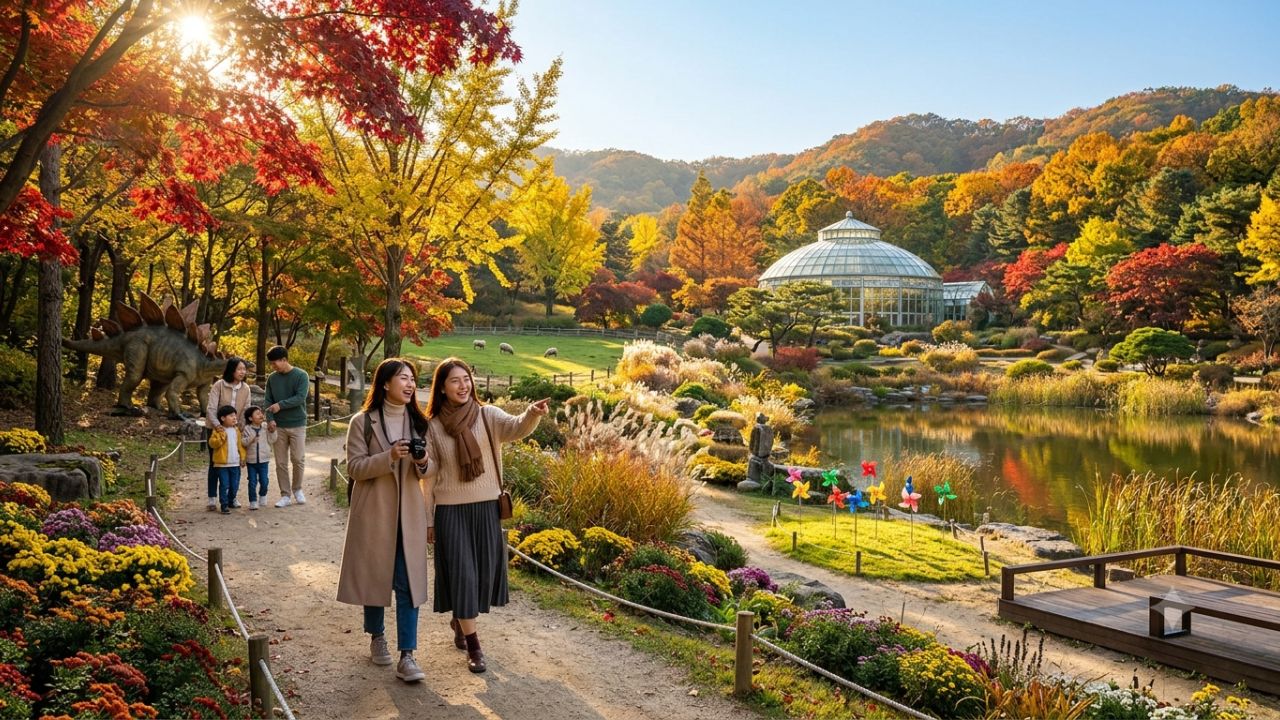
SUWON, South Korea — In a strategic campaign to decentralize family tourism from the dense urban core of Seoul, the Gyeonggi Tourism Organization has designated six premier autumn destinations across Gyeonggi Province.
Formally announced on 2 November 2026, the provincial tourism framework highlights six accessible, nature-based leisure hubs situated across Anseong, Icheon, Ansan, Uiwang, Gwacheon, and Paju.
The initiative is designed to provide domestic households and international travelers with affordable outdoor alternatives to capital city commercial districts, capitalizing on peak autumn foliage and unseasonably mild November weather.
The strategic centerpiece of the announcement is the official grand reopening of Seoul Grand Park's landmark botanical exhibition greenhouse on 6 November 2026, following extensive structural, environmental, and waterproofing renovations.
By pairing municipal conservation reserves with agricultural theme parks, animatronic paleontology forests, coastal arboretums, lakeside rail biking, and historic borderland peace parks, Gyeonggi Province is presenting an integrated model of family-centered leisure that combines natural sciences, physical recreation, and modern Korean history.
GYEONGGI PROVINCE AUTUMN FAMILY DESTINATION MATRIX
| Entity / Facility | Delays | Cancellations | Details |
|---|---|---|---|
| Destination Complex | District / City | Primary Attraction Focus | Admission Cost & Mechanics |
| Anseong Farmland | Anseong-si | Agricultural Theme Park | KRW 15,000 Adult / 13,000 Ch |
| Dinosaur Arboretum | Icheon-si | Forest Animatronic Displays | KRW 11,000 - 13,000 Day Rate |
| Sea Scent Arboretum | Ansan-si | Maritime Ecology & Dunes | Free Entry (Parking Applies) |
| Wangsong Lake Park | Uiwang-si | 4.3km Scenic Rail Biking | KRW 28,000 - 36,000 per Bike |
| Seoul Grand Park | Gwacheon-si | Zoo & Reopened Greenhouse | KRW 5,000 Adult / 2,000 Ch |
| Peace Nuri Park | Paju-si | Hill of Wind Pinwheels & DMZ | Free Public Entry (ID Req) |
The Regional Tourism Rebalance: Decentralizing Family Travel Beyond the Capital Grid
For decades, international leisure travel to South Korea has suffered from severe spatial concentration.
The overwhelming majority of foreign holidaymakers rarely venture beyond Seoul's central commercial corridors of Myeongdong, Hongdae, and Gangnam, leaving the rich geographic variety of surrounding provincial landscapes underutilized.
Recognizing this imbalance, the Gyeonggi Provincial Government and its promotional agency, the Gyeonggi Tourism Organization (GTO), have systematically expanded regional leisure infrastructure.
Gyeonggi Province, which entirely encircles the national capital and borders North Korea along the Demilitarized Zone (DMZ), contains nearly 14 million residents across 31 municipal districts and cities.
Its autumn appeal is defined by the phenomenon of danpung—the seasonal turning of maple, ginkgo, and oak canopies into vivid scarlet and ochre hues between late October and mid-November.
The provincial initiative addresses the economic realities of contemporary family travel.
As inflation places upward pressure on hotel tariffs, fine dining, and indoor entertainment complexes within downtown Seoul, middle-class households are actively seeking high-value day-trip itineraries that minimize travel expenses while providing expansive natural spaces for children.
By linking accessible suburban destinations directly to the Seoul Metropolitan Subway system, Gyeonggi Province enables seamless, budget-friendly excursions that stimulate regional small businesses, rural farmers' cooperatives, and local transport operators.
                               REGIONAL TOURISM DECENTRALIZATION MODEL

   +---------------------------------------------------------------------------------+
   | SEOUL URBAN CORE: High hotel rates, crowded pavements, commercial attractions  |
   +---------------------------------------------------------------------------------+
                                           |
                                           v [Seoul Subway Lines 1, 4, Gyeongui-Jungang]
   +---------------------------------------------------------------------------------+
   | GYEONGGI PROVINCIAL RING: 6 Selected Family Hubs across 6 Distinct Cities       |
   +---------------------------------------------------------------------------------+
          |                     |                      |                     |
          v                     v                      v                     v
   [Anseong Farmland]    [Icheon Dinosaurs]     [Ansan Sea Scent]    [Gwacheon Grand Park]
   (Agro-Tourism)        (Paleontology)         (Coastal Botany)     (Zoo & Greenhouse)
Anseong Farmland: Agricultural Immersion and Countryside Leisure
Located in Gongdo-eup in the southern reaches of Gyeonggi Province, Anseong Farmland represents an expansive model of agro-tourism that connects urban youth with Korea's rural heritage.
Operated under the auspices of the National Agricultural Cooperative Federation (NongHyup), the 1.2-million-square-meter complex transforms pastoral agriculture into an engaging educational environment.
Young visitors can observe, touch, and feed a diverse assembly of domestic farm animals, including Korean native cattle (Hanwoo), sheep, dairy cows, goats, rabbits, and miniature horses.
Supervised feeding programs teach children about livestock nutrition, animal husbandry, and organic agricultural cycles in an open, pastoral setting.
Beyond livestock encounters, the property is famous for its rolling meadow landscapes.
During autumn, vast hillside pastures are transformed into blooming carpets of pink muhly grass, sulfur cosmos, and silver miscanthus reeds, creating scenic backdrops for family photography.
Families can explore the terrain on multi-passenger pedal carriages, participate in beginner horseback riding sessions, or rent electric family bicycles to traverse the expansive farm perimeter.
Standard admission is priced accessibly at KRW 15,000 for adults and KRW 13,000 for children, establishing the property as an exceptional southern day-trip destination easily accessible via express buses from Seoul Express Bus Terminal.
ANSEONG FARMLAND OPERATIONAL PROFILE
| Operational Dimension | Facility Specification | Practical Traveler Insight |
|---|---|---|
| Geographic Location | 28 Daedong-gil, Gongdo-eup, Anseong-si | Southern Gyeonggi Province |
| Total Land Area | Approx. 1,200,000 Square Meters | Expansive agricultural pastures |
| Primary Experiences | Hanwoo cattle feeding, sheep pens | Direct child-animal interaction |
| Autumn Flora Display | Pink muhly grass, cosmos, silver reeds | Premier seasonal photography |
| Mobility Options | Multi-person family bikes, horses | Separate fees for riding trails |
| Standard Admission | KRW 15,000 (Adults) / KRW 13,000 (Kids) | Concessions for seniors/toddlers |
Deokpyeong Dinosaur Arboretum: Prehistoric Paleontology in Icheon's Forests
Situated in Majang-myeon within Icheon—a city historically celebrated for traditional ceramics and premium rice production—Deokpyeong Dinosaur Arboretum delivers an imaginative outdoor adventure for young children.
Covering roughly 250,000 square meters of densely wooded terrain across the slopes of Dongmaegsan Mountain, the park blends natural forest conservation with prehistoric paleontology.
As families navigate the winding woodland walking trails beneath brilliant yellow ginkgo canopies, they encounter dozens of life-size, animatronic dinosaur models strategically nestled among pine groves and rock formations.
Replicas of Tyrannosaurus Rex, Brachiosaurus, Triceratops, and Velociraptor feature electronic sensors that trigger realistic movements, jaw articulations, and roaring sound effects as visitors approach, providing an engaging, multisensory woodland hike.
The complex balances outdoor adventure with climate-controlled indoor education.
The indoor paleontology pavilion showcases authentic fossil specimens, dinosaur skeletal reconstructions, and an extensive entomological gallery featuring exotic beetles and butterflies from around the world.
Adjacent botanical greenhouses shelter tropical flora, succulent gardens, and small domestic animal feeding enclosures where children can interact with rabbits and guinea pigs.
Adult admission ranges from KRW 11,000 to KRW 13,000 depending on the day of the week, with comfortable walking shoes strongly recommended for negotiating the forested mountain paths.
                               DEOKPYEONG DINOSAUR ARBORETUM LAYOUT

   +---------------------------------------------------------------------------------+
   | WOODLAND CANOPY TRAILS: Life-Size Animatronic Dinosaurs with Motion & Sound     |
   +---------------------------------------------------------------------------------+
                                           |
                                           v
   +---------------------------------------------------------------------------------+
   | INDOOR SCIENCE EXHIBITIONS: Fossil Pavilions, Entomology Galleries, Minerals     |
   +---------------------------------------------------------------------------------+
                                           |
                                           v
   +---------------------------------------------------------------------------------+
   | BOTANICAL GREENHOUSE & PETTING ZOO: Succulents, Tropical Flora, Small Mammals   |
   +---------------------------------------------------------------------------------+
Sea Scent Arboretum: Maritime Ecology and the 1,004 Wind Chimes of Ansan
Positioned along the rugged coastline of Seongamdo Island within the Daebudo archipelago in Ansan, the Sea Scent Arboretum (Bada Hyanggi Sumokwon) offers a unique intersection of maritime botany and coastal topography.
Covering approximately 1.01 million square meters of reclaimed coastal land and natural hillsides, the provincial arboretum protects more than 1,000 distinct temperate and maritime plant species.
Unlike conventional inland botanical gardens, Sea Scent Arboretum is explicitly designed around the unique ecology of the Yellow Sea (West Sea).
The facility features curated sand-dune gardens, coastal saline wetland exhibits, and specialized rock terraces planted with salt-tolerant shrubs and ornamental grasses.
Broad, gently graded timber boardwalks wind across tidal marshes, allowing parents with strollers and elderly family members to walk comfortably amidst ocean breezes.
The architectural and symbolic highlight of the arboretum is the Imagination Observatory, situated at the park's highest elevation.
The summit installation features an artistic wind sculpture composed of exactly 1,004 polished wind chimes, designed to catch the offshore breezes and produce gentle, melodic chimes that resonate across the hilltop.
From the observation platform, visitors can take in panoramic views encompassing the West Sea, the tidal flats of Daebudo, and passing coastal cargo vessels.
Remarkably, admission to the arboretum is entirely free of charge, with modest municipal parking fees applied, making it one of the most cost-effective coastal family excursions in the capital region.
During November, the park operates from 09:00 to 17:00, remaining closed on Mondays.
SEA SCENT ARBORETUM OPERATIONAL METRICS
| Metric Indicator | Facility Parameter | Visitor Significance |
|---|---|---|
| Municipal Jurisdiction | Seongamdo Island, Ansan-si | Daebudo Coastal Ecotourism |
| Total Conservation Area | 1,010,000 Square Meters | Extensive coastal habitat |
| Botanical Collection Depth | > 1,000 Species | Halophytes & coastal flora |
| Architectural Centerpiece | Imagination Observatory | 360-degree West Sea vista |
| Artistic Sound Installation | 1,004 Suspended Wind Chimes | Melodic acoustic experience |
| Standard Admission Fee | Free of Charge (KRW 0) | Exceptionally cost-effective |
| Operating Hours (November) | 09:00 - 17:00 (Closed Mondays) | Last admission at 16:00 |
Uiwang Wangsong Lake: Lakeside Rail Biking and Wetland Conservation
Situated immediately south of Anyang in the city of Uiwang, Wangsong Lake and the adjacent Lesole Park showcase a successful municipal initiative that transformed an agricultural reservoir into a thriving wetland sanctuary and family recreation hub.
The lake is recognized as one of the premier bird-watching sanctuaries in the Seoul metropolitan fringe, serving as a seasonal resting habitat for migratory wildfowl, herons, egrets, and rare white-tailed sea eagles.
The signature family experience at Wangsong Lake is the Uiwang Rail Bike.
Operating on a dedicated track that circumnavigates the entire 4.3-kilometer perimeter of the lake, the four-person and two-person human-powered rail cycles allow passengers to pedal along the shoreline at an easy pace.
The route meanders past dense reed beds, lotus ponds, and open water reflections, offering panoramic views of autumn foliage blanketing the surrounding hills.
For young children, the rail bike journey incorporates thematic resting zones, misting tunnels, and photo stations along the lake's eastern shore.
Adjacent to the launch depot, Lesole Park provides wide public lawns, natural stream splash channels, an ecological learning pavilion, and an observation tower equipped with high-powered spotting scopes for observing waterfowl.
Weekday rail bike fares begin at KRW 28,000 for a two-person cycle and KRW 36,000 for a four-person cycle, with slightly higher pricing applied during peak weekend windows.
Because the attraction is located within an easy 15-minute walk from Uiwang Station on Seoul Subway Line 1, it represents one of the most accessible suburban rail trips from central Seoul.
UIWANG WANGSONG LAKE RAIL BIKE GUIDE
| Entity / Route | Metrics | Operational Status |
|---|---|---|
| Feature Category | Operational Details | Practical Guidance |
| Track Circuit Length | 4.3 Kilometers (Full Loop) | Takes approx. 40 to 50 minutes |
| Transit Proximity | Uiwang Station (Seoul Subway Line 1) | 15-minute walk or 5-minute taxi |
| Ecological Highlight | Wangsong Wetland Sanctuary | Superb waterfowl observation |
| Park Amenities | Lesole Park, Observation Tower, Lawns | Free public park access |
Seoul Grand Park's Botanical Reopening: Modernizing Gwacheon's Green Giant
Occupying a sprawling valley in Gwacheon at the foot of Cheonggyesan Mountain, Seoul Grand Park is South Korea's premier municipal leisure complex.
Easily reached in under 30 minutes from downtown Seoul via Seoul Subway Line 4, the vast estate encompasses Seoul Zoo, Seoul Land amusement park, the National Museum of Modern and Contemporary Art (MMCA), and extensive botanical gardens.
The major news event anchoring GTO's autumn tourism announcement is the official grand reopening of Seoul Grand Park's botanical exhibition greenhouse on 6 November 2026.
The complex had been temporarily closed to the public while undergoing extensive engineering modernizations aimed at enhancing visitor safety, structural durability, and climatic precision.
                               BOTANICAL GREENHOUSE MODERNIZATION SCOPE

   +---------------------------------------------------------------------------------+
   | STRUCTURAL RETROFITTING: Re-engineered glass panes & anti-corrosion frameworks  |
   +---------------------------------------------------------------------------------+
                                           |
                                           v
   +---------------------------------------------------------------------------------+
   | WATERPROOFING OVERHAUL: Advanced membrane sealing preventing thermal leakage    |
   +---------------------------------------------------------------------------------+
                                           |
                                           v
   +---------------------------------------------------------------------------------+
   | CLIMATE & VENTILATION AUTOMATION: Smart HVAC humidity & airflow controls        |
   +---------------------------------------------------------------------------------+
                                           |
                                           v
   +---------------------------------------------------------------------------------+
   | CURATED LIVING COLLECTIONS: Desert Cacti, Tropical Palms, Rare Korean Flora     |
   +---------------------------------------------------------------------------------+
The completed upgrades included comprehensive waterproofing across the multi-story glass dome, structural reinforcements to withstand severe winter snow loads, and the installation of automated climate and ventilation systems designed to replicate tropical, subtropical, and desert biomes.
Visitors stepping into the restored greenhouse can explore towering palm canopies, rare desert succulents, carnivorous plants, and indigenous Korean flora, providing a warm, educational indoor sanctuary when chilly autumn winds sweep down from the mountains.
Outside the greenhouse, Seoul Zoo remains the largest zoological institution in South Korea, caring for more than 2,200 animals across 240 species, including endangered Siberian tigers, lowland gorillas, Asian elephants, and red pandas.
The facility is globally accredited by the Association of Zoos and Aquariums (AZA), underscoring its commitment to international animal welfare standards and biological conservation.
Admission represents exceptional civic value, costing just KRW 5,000 for adults, KRW 3,000 for youths, and KRW 2,000 for children, ensuring that world-class wildlife education remains universally accessible.
Operating hours during November run from 09:00 to 17:00 daily.
SEOUL GRAND PARK REVENUE AND ACCESS PROFILE
| Component Facility | Admission Pricing | Operational Highlights |
|---|---|---|
| Seoul Zoo Main Grounds | KRW 5,000 Adult / 2,000 Child | Over 2,200 animals / AZA acc |
| Botanical Exhibition Greenhouse | Included in Park / Garden Adm | Fully restored Nov 6, 2026 |
| Elephant Train Shuttle | KRW 1,500 Adult / 1,000 Child | Convenient circulator link |
| Sky Lift Cable Car | KRW 7,000 per Single Ride | Aerial view of autumn canopy |
| Rapid Transit Connection | Seoul Grand Park Station | Direct access on Subway L4 |
Paju Peace Nuri Park: Geopolitical Memory, Wind Chimes, and DMZ Borderland Tourism
Located at the northern terminus of the South Korean rail network within Imjingak, Paju, Peace Nuri Park provides an emotional and visually striking encounter with modern history.
Situated along the banks of the Imjin River only a few kilometers south of the Demilitarized Zone, the park was established in 2005 as a cultural and recreational landscape dedicated to peace, reconciliation, and the eventual reunification of the divided Korean Peninsula.
The visual signature of Peace Nuri Park is the world-renowned Hill of Wind (Baramui Eondeok).
Across an expansive, undulating grassy meadow, artists and civic organizations have installed more than 3,000 brightly colored pinwheels that spin continuously in the river breeze.
The spinning pinwheels symbolize the collective prayers of millions of separated family members hoping for peaceful cross-border union.
The rolling grassy amphitheater provides open spaces for children to run freely, fly kites, and picnic amidst autumn sunshine, transforming a historically fortified border zone into a place of youthful optimism.
                                 IMJINGAK BORDERLAND COMPLEX ARCHITECTURE

   +---------------------------------------------------------------------------------+
   | PEACE NURI PARK: Hill of Wind with 3,000 Colorful Pinwheels & Grassy Meadows     |
   +---------------------------------------------------------------------------------+
                                           |
                                           v
   +---------------------------------------------------------------------------------+
   | HISTORIC SITES: Freedom Bridge, Dokgae Bridge Pierced by War Shrapnel           |
   +---------------------------------------------------------------------------------+
                                           |
                                           v
   +---------------------------------------------------------------------------------+
   | IMJINGAK PEACE GONDOLA: Cable Car Crossing the Imjin River to DMZ Civilian Zone |
   +---------------------------------------------------------------------------------+
Surrounding Peace Nuri Park are deeply significant historical monuments that provide vital educational context for older children.
Visitors can walk onto the historic Freedom Bridge, where nearly 13,000 liberated prisoners of war crossed following the 1953 armistice, and view the preserved Dokgae Bridge, whose remaining pier pilings still bear hundreds of bullet and artillery shrapnel scars from the Korean War.
For an immersive cross-river perspective, families can board the Imjingak Peace Gondola, a modern aerial cable car that spans the Imjin River, carrying passengers into the restricted Civilian Control Zone on the northern bank.
Because the gondola enters a sensitive military security perimeter, every passenger must present a valid passport or national identification card and complete a brief security checkpoint form prior to boarding.
Admission to Peace Nuri Park itself is entirely free, creating a democratized civic space where recreation and solemn historical education naturally converge.
PAJU IMJINGAK PEACE NURI PARK TRAVEL GUIDE
| Entity / Route | Metrics | Operational Status |
|---|---|---|
| Site Feature | Admission & Access Conditions | Historical & Visitor Meaning |
| Hill of Wind Meadow | Free Public Access | 3,000 spinning pinwheels |
| Dokgae Bridge Skywalk | KRW 2,000 Adult / 1,000 Child | Preserved wartime bridge |
| Imjingak Peace Gondola | KRW 11,000 Adult / 9,000 Child | Passport mandatory for entry |
| DMZ Steam Locomotive Memorial | Free Viewing | Pierced by 1,020 bullets |
| Transit Access | Imjingak Bus / DMZ Peace Train | Route 7300 or Gyeongui Line |
The Affordability Equation: Budget-Conscious Family Travel in an Inflationary Era
A compelling analytical dimension of GTO's 2026 autumn recommendations is the emphasis on economic accessibility.
As global airfares, urban hotel rates, and commercial theme park admissions escalate, family vacation budgets are facing unprecedented pressure.
A single day for a family of four at a major commercial theme park in Seoul can easily exceed KRW 250,000 in entry fees alone, before factoring in dining and transportation.
In contrast, Gyeonggi Province's six featured attractions present a remarkably balanced fiscal structure:
Three of the featured destinations—Peace Nuri Park in Paju, Sea Scent Arboretum in Ansan, and Lesole Park in Uiwang—charge zero general admission fees, allowing families to access high-quality landscapes, botanical collections, and historical landmarks without ticketing friction.
Seoul Grand Park delivers extraordinary civic value by maintaining a zoo entry tariff of just KRW 5,000 for adults and KRW 2,000 for children, with complimentary access to the newly modernized botanical greenhouse.
Even the specialized commercial venues—Anseong Farmland (KRW 15,000) and Deokpyeong Dinosaur Arboretum (KRW 11,000 to 13,000)—maintain moderate admission rates that include comprehensive access to animal husbandry exhibits, live demonstrations, and nature trails.
FAMILY BUDGET COMPARISON: COMMERCIAL SEOUL VS GYEONGGI PROVINCE
| Entity / Route | Metrics | Operational Status |
|---|---|---|
| Expense Category | Major Seoul Theme Park (Family) | Gyeonggi Ecotourism Day Trip |
| Admission Fees (2 Adults + 2 Kids) | KRW 220,000 - 280,000 | KRW 0 - 56,000 |
| Internal Mobility / Ride Attractions | KRW 40,000 - 80,000 | KRW 10,000 - 36,000 (Bikes) |
| Family Lunch / Dining | KRW 70,000 - 120,000 | KRW 40,000 - 60,000 (Local) |
| Public Transport / Transit | KRW 10,000 (Metro) | KRW 12,000 - 18,000 (Subway) |
| Estimated Total Daily Outlay | KRW 340,000 - 490,000 | KRW 62,000 - 170,000 |
| Relative Budget Savings | Baseline Benchmark | 60% to 80% Cost Reduction |
This affordability equation democratizes family leisure.
It ensures that children from diverse socio-economic backgrounds can participate in nature-based outdoor exploration, interact with animals, learn about prehistoric life, and engage with national history without placing unreasonable burdens on household finances.
The International Family's Strategic Day-Trip Field Guide: Logistics, Transit, and Apps
For foreign tourists traveling with children, venturing outside Seoul into Gyeonggi Province can initially seem daunting due to language barriers and unfamiliar transit routes.
However, with South Korea's world-class public infrastructure and digital navigation tools, executing these day trips is straightforward and rewarding.
TRANSIT MOBILITY PLAYBOOK FOR GYEONGGI DAY TRIPS
| Entity / Route | Metrics | Operational Status |
|---|---|---|
| Destination | Recommended Public Transit Route | Total Travel Time from Seoul Stn |
| Seoul Grand Park | Subway Line 4 to Seoul Grand Park Stn | Approx. 25 - 30 Minutes |
| Uiwang Wangsong Lake | Subway Line 1 to Uiwang Station | Approx. 40 - 45 Minutes |
| Paju Peace Nuri Park | Gyeongui-Jungang Line to Munsan / Bus | Approx. 60 - 75 Minutes |
| Ansan Sea Scent | Line 4 to Oido Station + Bus 123 to Isle | Approx. 80 - 90 Minutes |
| Deokpyeong Dinosaur | Express Bus to Icheon Terminal + Taxi | Approx. 70 - 80 Minutes |
| Anseong Farmland | Express Bus to Anseong + Feeder Bus/Cab | Approx. 75 - 85 Minutes |
Step 1: Master Local Navigation Apps Over Google Maps
Due to South Korean national security regulations regarding local mapping data, Google Maps does not provide reliable pedestrian walking routes, public transit timetables, or live driving directions within the country.
Before departing Seoul, international travelers should download Naver Map or KakaoMap, both of which provide full English-language interfaces, live subway and bus arrival countdowns, fare calculations, and platform transfer recommendations.
Equip every family member with a rechargeable T-money transit card, which provides seamless tap-and-go access across all subway lines, regional city buses, and metered taxis.
Step 2: Prepare for Sharp Autumn Temperature Swings
November weather in Gyeonggi Province is characterized by crisp autumn sunshine during midday, with temperatures averaging between 12 and 16 degrees Celsius.
However, temperatures drop rapidly after 16:30 as the sun dips below mountain ridgelines, frequently falling to between 2 and 5 degrees Celsius by evening.
Dress children in layered clothing—incorporating fleece jackets, thermal base layers, and windbreakers—especially when visiting open coastal plains like Ansan or riverfront parks like Paju where stiff winds prevail.
Step 3: Observe Border Security Protocols at Paju
If traveling to Paju Peace Nuri Park and planning to ride the Imjingak Peace Gondola across the Imjin River, every adult traveler must carry their original physical passport (digital smartphone photos are strictly rejected by military guards), while children must have passports or birth certificates.
Respect all military photography restrictions posted around barbed wire fences, observation towers, and border guard posts.
Strategic Horizons: The Evolution of South Korea's Decentralized Ecotourism Network
The Gyeonggi Tourism Organization's strategic positioning of these six autumn attractions reflects a mature, forward-looking approach to national tourism development.
Rather than chasing superficial visitor volume or building expensive, generic commercial developments, the province is leveraging its inherent strengths: preserved agricultural landscapes, pristine coastal ecosystems, municipal scientific institutions, and poignant geopolitical heritage.
By modernizing critical civic assets like Seoul Grand Park's botanical greenhouse and pairing them with free, open-access public spaces, Gyeonggi Province demonstrates how regional governments can promote family well-being, support child development, and disperse tourism revenue equitably into satellite communities.
As autumn leaves carpet South Korea's countryside, these six destinations offer a compelling invitation for families to look beyond the skyline of Seoul and discover the natural warmth, rich history, and seasonal beauty of Gyeonggi Province.
Related Travel Guides
- Spain Smashes All-Time Tourism Records with 80.5M Visitors and €114.4B in Spending: Historic 100M Milestone
- Vietnam Unveils Bold Green Island Vision for Con Dao: Mangrove Restoration and Coral Nurseries in 2050 Master Plan
- The Mall Group Injects 600 Million Baht into Bangkok Festive Tourism: Mr. Men Campaign Targets 20% Surge
- Mogadishu Tourism Bets on TikTok to Convert Social Scrolls into Travel Bookings: Diaspora Demand and Logistics
- Surabaya Autumn Tourism 2026 Surges as Gen Z Travelers Drive Booking Boom Across East Java
This article is for informational purposes. Flight routes, passenger regulations, visa rules, and transit advisories are subject to change by airlines and aviation authorities. Readers are advised to verify schedules and travel documentation with relevant carriers and border agencies before departure.
Related Stories
Thailand Cultural Tourism Boom Accelerates as Grab Unveils TASTE Digital Framework and 15 Billion Baht Economic Impact
Spain Smashes All-Time Tourism Records with 80.5M Visitors and €114.4B in Spending: Historic 100 Million Milestone Looms in 2026