Bahrain Joins Qatar and Other Gulf Destinations as Airlines Rebuild Capacity After 2026 Travel Disruption

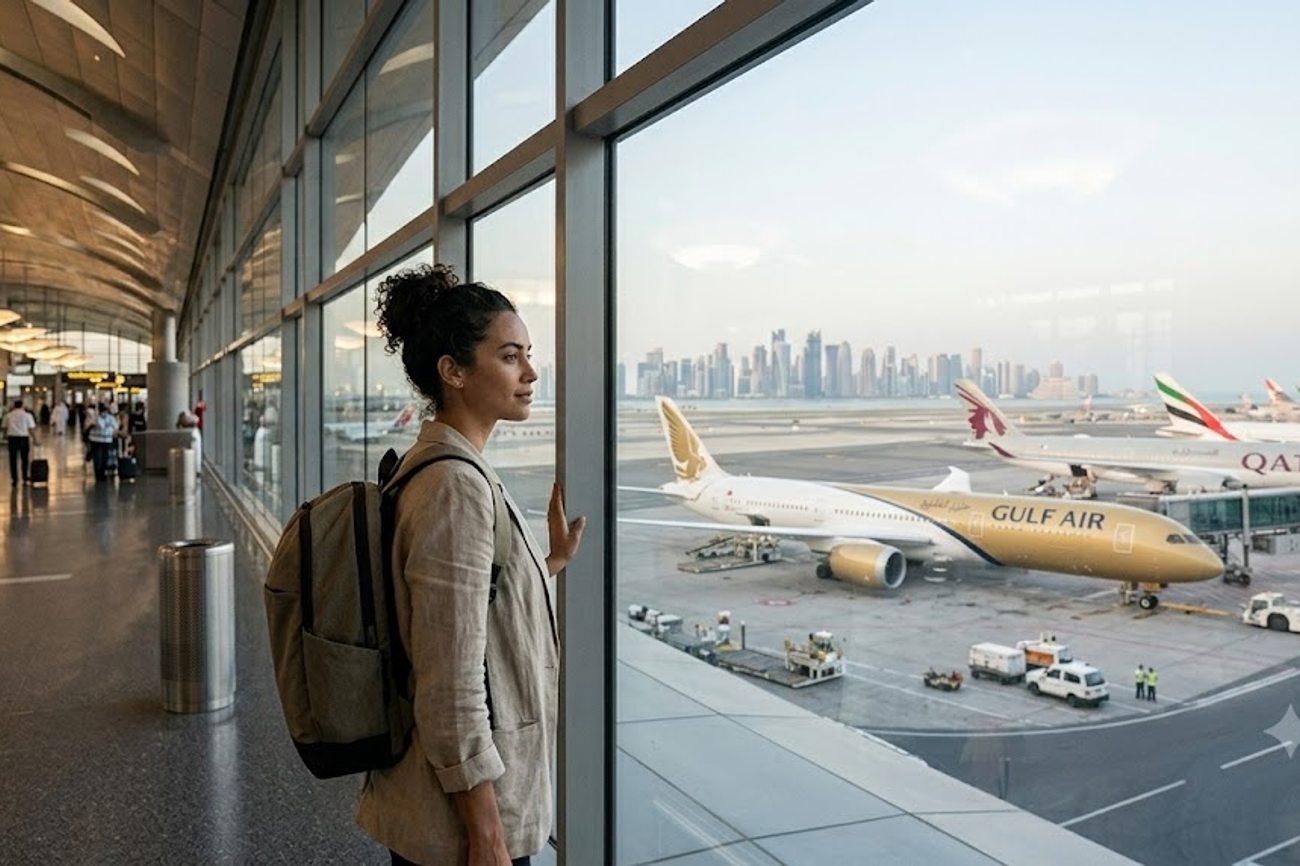
Image generated by AI
[Manama, August 2026] — Aviation capacity across the Gulf region has officially surpassed pre-disruption levels, with daily flight operations recording a 4% increase as of August 22, 2026. This recovery follows a catastrophic collapse in air traffic during the first quarter of the year, signaling a full restoration of the "air bridge" connecting Asia, Africa, and Europe through the Middle East's primary financial and commercial hubs.
The rebound is the result of a coordinated capacity rebuild by national carriers in Bahrain, Qatar, the United Arab Emirates, and Kuwait. According to data from UN Tourism and Flightradar24, the region's aviation sector plummeted to a near-total standstill on March 1, 2026, when daily flights dropped by 99% compared to the February average. Over the following five months, a phased restoration of schedules allowed the region to reclaim its position as the central nexus of global transit.
The 2026 Systemic Collapse
The disruption triggered a vertical drop in operational capacity that effectively severed the Middle East from the global aviation network. The collapse was most acute at the start of March, creating a vacuum in international travel that impacted millions of passengers and disrupted global supply chains.
The recovery trajectory was gradual but consistent:
- March 1, 2026: Operations hit a nadir of -99% against the pre-conflict baseline.
- April 2, 2026: Capacity recovered to -48%, indicating a cautious return of regional flights.
- May 3, 2026: Daily services improved to -30% as confidence in airspace safety returned.
- June 5, 2026: The deficit narrowed to -21%.
- July 3, 2026: The sector reached near-parity with pre-disruption levels at -1%.
- August 22, 2026: Capacity officially exceeded previous norms, reaching +4%.
Market Impact and Carrier Roles
The restoration of connectivity was driven by a tiered approach, with global giants focusing on long-haul transit and regional carriers stabilizing short-haul flows.
| Country | Primary Carrier(s) | Strategic Role in Recovery |
|---|---|---|
| Bahrain | Gulf Air | Regional stability and hub connectivity via Bahrain International Airport |
| Qatar | Qatar Airways | Restoration of the global transfer network through Doha |
| UAE | Emirates, Etihad, Flydubai, Air Arabia | High-volume international hub operations (Dubai/Abu Dhabi/Sharjah) |
| Kuwait | Kuwait Airways | Re-establishing Gulf-state and international accessibility |
The UAE provided the heaviest lift in the recovery effort. Emirates and Etihad Airways focused on restoring long-haul corridors, while Flydubai and Air Arabia filled the gaps in regional and low-cost connectivity. This multi-carrier strategy ensured that both luxury and budget travelers could return to the region simultaneously.
In Qatar, the recovery of Qatar Airways was essential for the global tourism market. As Doha serves as one of the world's most critical transit points, the restoration of its schedules directly impacted the ability of passengers to move between the Americas, Europe, and Asia. Similarly, Gulf Air's return to full operations in Bahrain strengthened the regional flow, leveraging Bahrain's geographic position to support travel across the Arabian Gulf.
Practical Traveler Advisory and Strategic Insights
For passengers booking travel in the latter half of 2026, the "recovery phase" has transitioned into an "expansion phase." The 4% increase over previous levels suggests that airlines are not merely returning to old schedules but are adding new capacity to clear the backlog of demand.
Direct Impacts:
- Increased Frequency: Travelers will find more daily options between Gulf hubs and international capitals than were available in early 2026.
- Stabilized Pricing: The return of low-cost carriers like Air Arabia and Flydubai is mitigating the price spikes seen during the April-June scarcity period.
- Reliable Transit: The "air bridge" is fully operational, meaning transit times through Doha, Dubai, and Manama have returned to standard durations.
- Restored Confidence: The collective commitment of these carriers indicates that the airspace instability that caused the March 1 collapse has been mitigated.
The Road Toward 2027
The rapid ascent from a 99% loss to a 4% gain in under six months is being viewed by industry analysts as a testament to the resilience of Gulf aviation infrastructure. The focus now shifts from "recovery" to "optimization."
Airlines are expected to leverage the current surplus in capacity to capture market share from other global hubs. With the International Air Transport Association (IATA) monitoring the stability of these routes, the Gulf states are positioning themselves to lead the next phase of international tourism growth. The ability of Bahrain, Qatar, the UAE, and Kuwait to synchronize their recovery has prevented a permanent shift in global traffic patterns, ensuring that the Middle East remains the primary gateway for intercontinental travel.
FAQ: Gulf Aviation Recovery 2026
Are flights currently operating at normal levels in the Gulf? Yes. As of August 22, 2026, daily flights are operating at 4% above the levels recorded before the March disruption. All major carriers, including Emirates and Qatar Airways, have restored their schedules.
Which airlines were most critical to the recovery? The recovery relied on a mix of global hubs (Emirates, Qatar Airways, Etihad) for long-haul travel and regional specialists (Gulf Air, Kuwait Airways, Flydubai, Air Arabia) for intra-Gulf connectivity.
Was the disruption limited to only one country? No. The disruption was regional, affecting Bahrain, Qatar, the UAE, and Kuwait. All four nations saw a synchronized decline in traffic on March 1, 2026, followed by a synchronized recovery.
Is it safe to book transit flights through Doha or Dubai now? Yes. The restoration of capacity to +4% indicates that airlines and airport authorities have full confidence in the operational stability and safety of these hubs.
The Gulf's aviation sector has not just recovered; it has recalibrated for a new era of global transit.
Related Travel Guides
This article is for informational purposes. Flight routes, passenger regulations, visa rules, and transit advisories are subject to change by airlines and aviation authorities. Readers are advised to verify schedules and travel documentation with relevant carriers and border agencies before departure.
Related Stories

Tunisia Tourism Revenue Hits $2.38 Billion in 2026 as Russian Flight Capacity Doubles

Quebec City Tops 2026 Global Festive Travel Rankings Beating New York City and Aspen