Asia’s Luxury Hotels Transform Artisan Procurement as Philippine Tourism and More Drive the B2B Craft Revolution

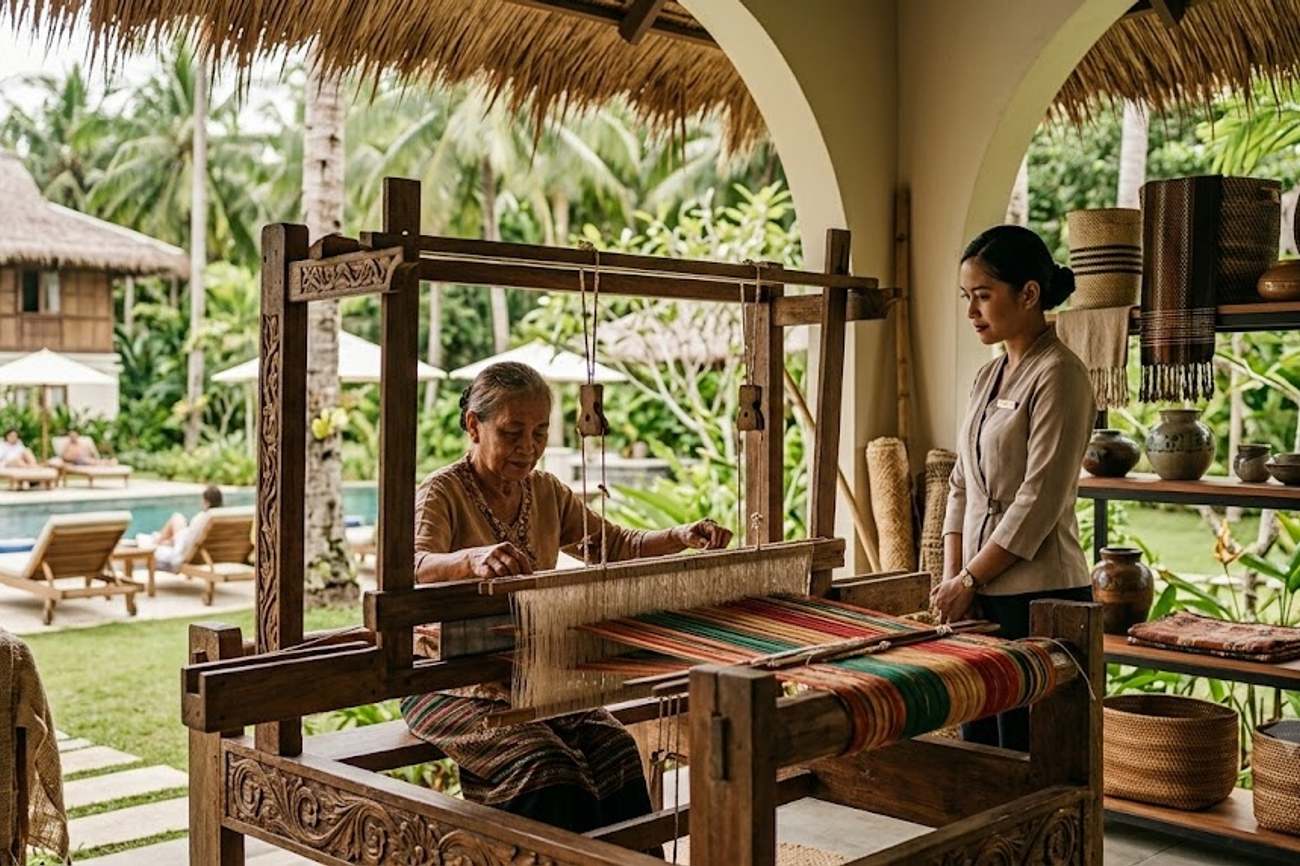
Image generated by AI
In the entire Asian continent, the luxury hotel and resort industry is changing the ways that indigenous craft making gets included into the international tourism economy through the shift from souvenirs sales to more systematic B2B procurement. Luxury hotels and resorts from the Philippines, Thailand, Indonesia, Vietnam, and China are building business relationships with rural artisan groups through institutionalized procurement of textiles, natural fibers, woodworking, pottery, and environmentally-friendly guest amenities. The new trend allows micro-artisans to gain access to higher volumes of orders, guaranteed demand, technical assistance, and higher visibility within the market environment, whereas hospitality providers have an opportunity to source materials and conserve culture.
The Paradigm Shift: Transitioning from Souvenirs to B2B Procurement
For decades, the intersection of international tourism and indigenous craftsmanship was confined to the informal retail economy. Micro-artisans operated almost exclusively as producers of informal souvenirs sold at roadside stalls, night markets, or hotel gift shops. This legacy framework exposed rural producers to intense seasonal fluctuations, extreme intermediary price markups, and unpredictable sales volumes that failed to yield long-term financial security.
In response to evolving luxury travel expectations, international hotel operators are executing a structural overhaul of their procurement pipelines. Rather than treating indigenous crafts as casual retail additions, global hospitality brands are integrating community-crafted heritage goods directly into their central Furniture, Fixtures, and Equipment (FF&E) and Operating Supplies and Equipment (OS&E) budgets. Standardised commercial line items—such as synthetic guest slippers, plastic amenity trays, uniform textiles, and mass-manufactured wall art—are being systematically phased out. In their place, luxury operators are commissioning batch-produced, verified artisanal alternatives made from native organic fibers, traditional weaves, and hand-carved natural woods.
This procurement realignment converts standard hotel capital expenditure into catalytic, long-term investments for rural communities. By shifting from retail transactions to institutional Business-to-Business (B2B) supply contracts, luxury hotels provide rural artisan cooperatives with predictable order volumes, advance capital access, and multi-year income stability. Concurrently, hospitality groups satisfy institutional requirements for supply chain transparency, regional cultural heritage preservation, and environmental impact reduction.
To contextualise how trade flows between major urban administrative hubs and regional production corridors across Asia, corporate decision-making centers serve as distribution and showcase gateways for rural artisan goods:
Shanghai and Beijing (China): Function as institutional trade links and regional display gateways where regional artisanal goods enter corporate hospitality procurement pipelines through entities like trade investment centers and regional mercantile exchanges. Manila and Cebu City (Philippines): Serve as primary corporate hubs drawing from social welfare craft initiatives, including Inaul tapestries, abaca fiber goods, and hand-carved woodcrafts. Bangkok and Chiang Mai (Thailand): Link urban corporate offices with northern hill-tribe weaving networks, traditional silk looms, and celadon ceramics corridors.
The luxury hotel industry in Asia is undergoing a significant transformation in artisan procurement, driven by the growing demand for unique and authentic experiences. According to the Philippine Department of Tourism, the country's tourism sector is expected to continue its upward trend, with a focus on showcasing local crafts and artisans. This shift is creating new opportunities for small-scale producers and communities to supply luxury hotels with high-quality, handmade products. Denpasar and Ubud (Indonesia): Connect luxury eco-resorts with natural dye handloom weaving villages and teak carving communities. Hanoi and Huế (Vietnam): Coordinate historical boutique hotel restorations utilizing imperial silk looms, natural indigo dyeing workshops, and bamboo-rattan weaving hubs. Quantifying the Procurement Pivot: B2B Contracts versus Traditional Retail
The operational mechanics of institutional B2B procurement differ fundamentally from traditional craft retail across volume metrics, pricing structures, and logistical requirements. A boutique 100-room luxury resort requires an initial baseline inventory of several thousand hand-woven amenity pouches, coasters, throw pillow covers, and slipper shells, with ongoing quarterly replenishment orders. Larger 500-room urban convention properties or integrated cruise lines demand scale orders reaching 10,000 to 50,000 units annually for guest room accessories and corporate gifting programs.
The table below contrasts the commercial parameters of traditional retail souvenir sales against institutional micro-artisan procurement integrated into hotel operational pipelines:
Commercial Parameter Traditional Souvenir Retail Institutional B2B Hotel Procurement Order Scale & Volume Micro-batches (1–50 pieces per transaction) Bulk commercial orders (1,000–50,000 units per contract)
As passenger traffic increases in major Asian hubs, airlines and airports are investing in infrastructure and services to support the growth of tourism. For example, Changi Airport Group has introduced initiatives to enhance the passenger experience, including the showcase of local artisans and crafts at its terminals. This not only adds to the airport's ambiance but also provides an opportunity for travelers to discover unique products and support local communities. Demand Predictability Highly seasonal, volatile, weather-dependent Scheduled quarterly or annual purchase orders Capital & Cash Flow Post-sale retail payment; self-funded production Upfront deposits, seed capital grants, scheduled milestone payouts Quality Control & Standards Variable, non-standardised sizing and dyes Strict technical specifications, tensile tests, colorfastness standards Economic Beneficiaries Intermediary agents, gift shop concessionaires Direct rural weaving cooperatives, social enterprises, micro-artisans Hospitality Budget Source Guest discretionary spending Corporate FF&E, OS&E, and ESG development budgets Traceability & Governance Minimal origin verification Formal fair-trade audit trails, GSTC alignment, Scope 3 verification
The B2B craft revolution in Asia's luxury hotel sector is also driven by the need for sustainable and responsible sourcing practices. The International Air Transport Association (IATA) emphasizes the importance of environmentally friendly and socially responsible practices in the tourism industry, including the procurement of local and artisanal products. By partnering with local artisans and suppliers, luxury hotels can reduce their carbon footprint while supporting the preservation of traditional crafts and communities.
Transitioning to institutional hospitality procurement strategies provides craft communities with financial predictability, allowing local cooperatives to secure raw materials in bulk, invest in improved production equipment, and offer stable local employment.
The Philippine Livelihood-to-Lobby Pipeline
The Philippines serves as a prime case study of institutional integration, where state social welfare mechanisms and trade promotion agencies collaborate to bridge the gap between isolated rural craft producers and international luxury markets. At the center of this structural pipeline is the Department of Social Welfare and Development’s Sustainable Livelihood Program (DSWD-SLP). Operating through a Community-Driven Enterprise Development (CDED) model, the DSWD-SLP organizes marginalized households into formal Self-employment Assistance-Kaunlaran Associations (SKAs). The program provides targeted interventions, including the Seed Capital Fund for raw materials and equipment, alongside the Cash-for-Building-Livelihood Assets (CBLA) Fund to establish community production facilities.
Through strategic inter-agency coordination with the Department of Trade and Industry (DTI) and the Department of Science and Technology’s Philippine Textile Research Institute (DOST-PTRI), DSWD-SLP micro-enterprises are systematically upgraded to meet commercial hospitality standards. For example, DOST-PTRI has deployed modernized equipment—such as 45-inch HL Mach 4.0 modified handloom weaving machines—to weaving communities in Ilocos Norte, including the Nagbacalan Loomweavers Multi-Purpose Cooperative. This technological support elevates output uniformity, increases production velocity, and maintains traditional structural integrity.
The Philippine artisan supply corridor follows a clear institutional trajectory:
Micro-Enterprise Formation: Rural artisans and marginalized households receive initial organizational support, training, and Seed Capital Funds through the DSWD Sustainable Livelihood Program. Technical Modernization: Technical agencies such as DOST-PTRI introduce modified handlooms, yarn-blending technologies, and quality standardization workshops to improve product consistency. Certification and Branding: The Department of Trade and
FAQ: Asia’s Luxury Hotels Transform Artisan Procurement 2026
What drives the B2B craft revolution in Asia? Philippine tourism and luxury hotels boost demand for local artisans.
How do luxury hotels support artisans? They provide training, resources, and market access to local craftsmen.
What benefits do travelers gain from this trend? Unique, authentic experiences and high-quality, handmade products.
Where can travelers find these artisanal products? In luxury hotels, local markets, and specialty shops throughout Asia.
Related Travel Guides
- Sandals South Coast and Many Other Hotels Are Under Renovation with Upgraded Accommodation and Guest Facilities in Jamaica
- NoMad Hilton Singapore Opens in 2026 as Asia Pacific Debut With Luxury Design and Heritage Experiences
- Hilton Introduces Zero Emission Hotel Prototype to Drive Greener Future for US Hospitality Sector
This article is for informational purposes. Flight routes, passenger regulations, visa rules, and transit advisories are subject to change by airlines and aviation authorities. Readers are advised to verify schedules and travel documentation with relevant carriers and border agencies before departure.
Related Stories

EU Probes Booking.com Under Digital Services Act Over Fake Hotel Listings, Hijacked Reservations, and Search Ranking Transparency