Asia-Pacific Aviation Turmoil as 5,414 Flight Delays and 472 Cancellations Strand Passengers Across Shanghai, Jakarta, Tokyo, and Bangkok: Crisis Report

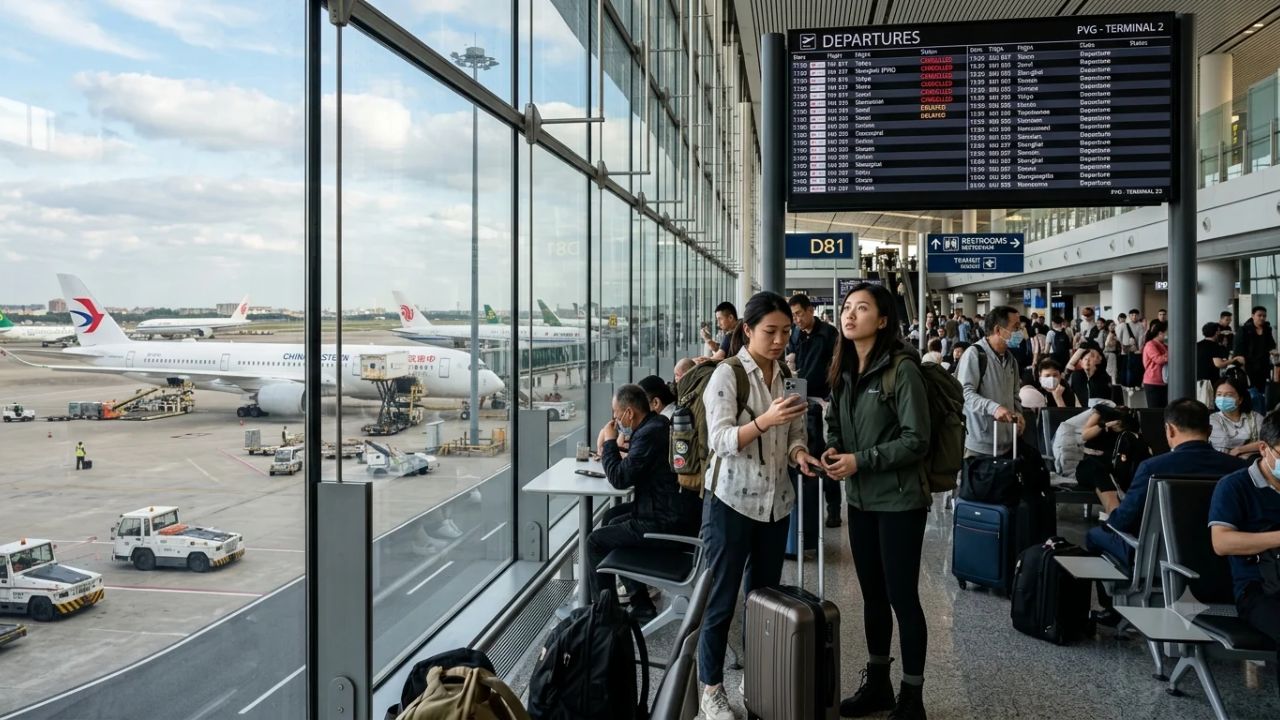
Image generated by AI
Commercial air travel across the Asia-Pacific region and connecting Middle Eastern corridors has entered acute operational distress as 5,414 flight delays and 472 cancellations cascade across major aviation hubs in China, Indonesia, Japan, Thailand, India, and the Gulf. An unprecedented convergence of severe meteorological hazards—including toxic wildfire haze grounding aircraft across Indonesia, early-season frost and blizzards in northern China, and monsoon cloudbursts in Bangkok—paired with military airspace restrictions surrounding Saudi Arabia has overwhelmed airline dispatch networks. Tens of thousands of transit passengers face missed long-haul connections, multi-day rebooking queues, and extensive terminal ground stops from Shanghai Pudong and Beijing Capital to Jakarta Soekarno-Hatta and Tokyo Haneda.
[!NOTE] Quick Summary: Key Developments at a Glance
- Massive Regional Disruption: FlightAware real-time tracking compiled on 20 October 2026 at 4:22 pm US Eastern Time (21 October at 12:22 am GST) confirms 5,414 flight delays and 472 cancellations across Asian commercial air corridors.
- Chinese Megahubs Crippled by Winter Weather: Chinese airports recorded staggering delay figures, led by Tianshan in Urumqi (341 delays), Shanghai Pudong (293 delays, 11 cancellations), Beijing Capital (212 delays, 8 cancellations), Beijing Daxing (192 delays), and Guangzhou Baiyun (165 delays).
- Indonesian Haze Emergency: Hazardous smoke from peatland and forest fires prompted Indonesia's Ministry of Transportation to confirm 2,604 domestic flights disrupted between 11 August and 19 October 2026, driving 211 delays and 39 cancellations at Jakarta Soekarno-Hatta in the current dataset.
- Carrier Cancellations Peak in India and Indonesia: Akasa Air (30 cancellations, 12%) and Batik Air (28 cancellations, 9%) recorded the highest commercial cancellation rates, while China Eastern logged 46 cancellations and 386 delays (16%).
- Middle East Cross-Border Ripple Effect: Geopolitical tensions and Saudi aviation restrictions contributed to 43 cancellations in Riyadh, 24 in Dubai, 18 in Abu Dhabi, and 16 in Jeddah, disrupting trans-Asian flight rotations.
[SINGAPORE/SHANGHAI, Oct 21, 2026] — Global aviation networks traversing the Asia-Pacific basin have suffered widespread schedule collapse as severe autumn weather systems and regional geopolitical flashpoints simultaneously impacted primary flight routes. Real-time aviation tracking snapshots captured on the night of 20 October 2026 document that flight schedule disruptions have expanded across both short-haul domestic trunk routes and critical intercontinental trunk lines connecting East Asia with Europe, Australasia, and North America.
Aviation operational planners describe the event as a multi-vector crisis. In East Asia, rapid cold fronts sweeping across northern China have triggered widespread visibility drops, icing, and de-icing ground delays. In Southeast Asia, agricultural forest fires in Sumatra and Kalimantan have blanketed air corridors in dense particulate smog, forcing air traffic controllers to double spacing intervals between arriving airliners.
Concurrently, persistent military restrictions and flight authorization mandates across Saudi Arabian airspace following earlier strikes near King Khalid International Airport have left Gulf carriers short of airframes, causing schedule disruptions to spill directly into South and Southeast Asian operations.
Chinese Aviation Gridlock: Shanghai, Beijing, and Provincial Hubs Squeezed
China’s civil aviation network accounted for the single largest share of delayed services in the tracking dataset, with major hub airports struggling against early-winter meteorological hazards and tight airspace management restrictions.
The Civil Aviation Administration of China (CAAC) issued an urgent nationwide aviation meteorological alert identifying persistent low-cloud ceilings, heavy fog, and icing risks across southern and southwestern provinces, accompanied by severe ground frost across northern, eastern, and northwestern sectors, and active snowfall across Xinjiang and the northeast.
At Shanghai Pudong International Airport (PVG)—the primary international aviation gateway to mainland China—ground crews managed 293 delayed departures and arrivals alongside 11 cancellations. Shanghai Hongqiao International Airport (SHA), handling dense domestic business shuttle routes, recorded 120 delays and 7 cancellations.
In the capital, Beijing Capital International Airport (PEK) registered 212 delays and 8 cancellations, while its sister hub, Beijing Daxing International Airport (PKX), logged 192 delays and 5 cancellations.
In the far northwest, Urumqi Tianshan International Airport (URC) recorded the highest individual airport delay count in China, suffering 341 delays and 5 cancellations due to freezing ground temperatures and alpine snow systems.
| Chinese Airport (Code) | Recorded Delays | Recorded Cancellations | Primary Operational Constraint |
|---|---|---|---|
| Urumqi Tianshan (URC) | 341 delays | 5 cancellations | Sub-zero blizzard conditions, runway de-icing backlogs |
| Shanghai Pudong (PVG) | 293 delays | 11 cancellations | Low cloud ceilings, maritime fog, flow-control sequencing |
| Beijing Capital (PEK) | 212 delays | 8 cancellations | Northern cold front, surface frost, extended departure queues |
| Beijing Daxing (PKX) | 192 delays | 5 cancellations | Reduced visibility and regional sector flow management |
| Guangzhou Baiyun (CAN) | 165 delays | 4 cancellations | Airspace slot restrictions and thunderstorm activity |
| Xi'an Xianyang (XIY) | 132 delays | 9 cancellations | Surface frost, fog, and regional connecting delays |
| Shanghai Hongqiao (SHA) | 120 delays | 7 cancellations | Dense domestic rotation delays and gate hold-backs |
The concentration of triple-digit delays across China's major hubs severely degraded domestic fleet rotations. When an aircraft scheduled to operate four daily domestic sectors is delayed by 90 minutes on its first morning leg out of Urumqi or Beijing, subsequent afternoon and evening rotations inevitably collapse into late-night cancellations.
Southeast Asian Weather and Haze: Indonesia, Thailand, and the Philippines
Across Southeast Asia, flight operations encountered severe atmospheric disruptions stemming from both environmental fires and intense tropical downpours.
Indonesia experienced substantial disruption, with Jakarta’s Soekarno-Hatta International Airport (CGK) emerging as one of the most cancellation-impacted facilities in Asia, recording 211 delays and 39 cancellations.
The crisis is directly linked to an escalating environmental disaster. Indonesia’s Ministry of Transportation confirmed that toxic forest-fire smoke and peatland burning have disrupted 2,604 domestic flights between 11 August and 19 October 2026.
The official ministerial record documents:
- 1,129 flight delays across haze-affected regional airports;
- 1,420 flight cancellations or indefinite postponements;
- 23 airborne diversions to alternate airfields;
- 6 emergency air turnbacks returning to origin airports due to zero-visibility conditions.
Reduced surface visibility has particularly paralyzed regional hubs such as Sultan Mahmud Badaruddin II Airport in Palembang, alongside Sultan Hasanuddin Airport in Makassar (UPG: 82 delays, 7 cancellations) and Bali’s Ngurah Rai International Airport in Denpasar (DPS: 76 delays, 6 cancellations).
In Thailand, Bangkok’s Suvarnabhumi Airport (BKK) recorded 264 delays and 3 cancellations. The Thai Meteorological Department issued an emergency aviation weather advisory active through 25 October, warning of persistent torrential monsoon rain, isolated squalls, and severe wind shear across the central basin, creating safety spacing buffers that halved hourly runway acceptance rates.
| Southeast Asian Airport (Code) | Recorded Delays | Recorded Cancellations | Core Contributing Factors |
|---|---|---|---|
| Bangkok Suvarnabhumi (BKK) | 264 delays | 3 cancellations | Severe monsoon rainfall, thunderstorm holding patterns |
| Jakarta Soekarno-Hatta (CGK) | 211 delays | 39 cancellations | Regional wildfire haze, reduced visibility, schedule thinning |
| Manila Ninoy Aquino (MNL) | 121 delays | 3 cancellations | Runway capacity congestion, regional feeder delays |
| Sultan Hasanuddin, Makassar (UPG) | 82 delays | 7 cancellations | Trans-Indonesian domestic connection bottlenecks |
| Bali Ngurah Rai, Denpasar (DPS) | 76 delays | 6 cancellations | Aircraft rotation delays from Java and Sumatra outstations |
In Vietnam, Hanoi's Noi Bai International Airport (HAN) logged 133 delays and 6 cancellations, while Da Nang International Airport (DAD) documented 51 delays and 6 cancellations, as convective weather and coastal cloud layers impacted approach paths.
Japanese Precision Tested: Tokyo Haneda’s 284 Delays
Japan’s civil aviation sector managed to avert high cancellation rates through disciplined operations, but suffered immense schedule friction.
Tokyo Haneda Airport (HND)—one of the world’s busiest domestic and international hubs—registered 284 flight delays, despite recording only a single cancellation.
Because Haneda operates at near 100% runway capacity during peak morning and evening travel banks, minor air traffic management spacing adjustments across incoming North American and European routes caused delay cascades to ripple across domestic trunk services connecting Tokyo with Sapporo, Fukuoka, and Okinawa.
South Asian Hubs: India’s Infrastructure and Carrier Bottlenecks
In India, flight disruptions were concentrated across primary metro airports and emerging regional infrastructure, with carriers facing ground handling constraints and fleet availability hurdles.
Delhi’s Indira Gandhi International Airport (DEL) logged 101 delays and 7 cancellations, driven by seasonal autumn temperature drops, localized ground haze, and connecting delays on routes arriving from the Gulf.
Bengaluru’s Kempegowda International Airport (BLR) recorded 61 delays and 10 cancellations, while the newly operational Navi Mumbai International Airport (NMI) recorded 5 delays and 12 cancellations, reflecting significant launch-phase schedule consolidation by domestic budget operators.
| Indian Airport (Code) | Recorded Delays | Recorded Cancellations | Primary Operational Trigger |
|---|---|---|---|
| Delhi Indira Gandhi (DEL) | 101 delays | 7 cancellations | Early-morning visibility constraints, Gulf rotation delays |
| Bengaluru Kempegowda (BLR) | 61 delays | 10 cancellations | Peak morning departure congestion, carrier fleet re-allocations |
| Navi Mumbai International (NMI) | 5 delays | 12 cancellations | Early-stage operational balancing and airline schedule thinning |
Trans-Regional Cross-Border Impacts: The Middle East Air Corridor
Aviation disruptions across East and South Asia cannot be viewed in isolation from the geopolitical crisis in the Middle East. Major Asian flag carriers operate complex daily banks linking East Asia through the Gulf to Europe and Africa.
Airports in the United Arab Emirates and Saudi Arabia documented substantial operational distress:
- Dubai International (DXB): 173 delays and 24 cancellations;
- Abu Dhabi Zayed International (AUH): 116 delays and 18 cancellations;
- Riyadh King Khalid International (RUH): 5 delays and 43 cancellations;
- Jeddah King Abdulaziz International (JED): 120 delays and 16 cancellations;
- Bahrain International (BAH): 17 delays and 7 cancellations.
The primary operational trigger remains heightened security alerts and strict flight authorization procedures imposed following attacks targeting Riyadh’s King Khalid International Airport earlier in October.
International carriers—including Air India, IndiGo, Etihad Airways, Qatar Airways, Lufthansa Group, and Philippine Airlines—have implemented schedule suspensions or extended flight cancellations into Saudi Arabia, with restrictions stretching into November.
Because aircraft and aircrews deployed on these sectors are tied into multi-leg rotations connecting India, the Philippines, and Southeast Asia, Middle Eastern airport restrictions directly triggered cancellations and aircraft shortages across Asian departure gates.
Comprehensive Airline Disruption Matrix: Carrier Performance
The operational impact varied sharply across commercial airline business models. State-owned network carriers absorption capacities differed markedly from point-to-point low-cost operators operating tight 30-minute turnarounds.
| Operating Airline | Nationality | Recorded Cancellations | % of Schedule Cancelled | Recorded Delays | % of Schedule Delayed |
|---|---|---|---|---|---|
| China Eastern Airlines | China | 46 | 1% | 386 | 16% |
| China Southern Airlines | China | 3 | 0% (rd.) | 302 | 13% |
| Air China | China | 25 | 1% | 199 | 11% |
| China Express Airlines | China | 6 | 1% | 159 | 36% |
| Tianjin Airlines | China | 14 | 4% | 73 | 22% |
| VietJet Air | Vietnam | 1 | 0% (rd.) | 150 | 43% |
| Batik Air | Indonesia | 28 | 9% | 62 | 21% |
| Citilink | Indonesia | 14 | 5% | 29 | 10% |
| Garuda Indonesia | Indonesia | 3 | 1% | 47 | 19% |
| Akasa Air | India | 30 | 12% | 7 | 2% |
| SpiceJet | India | 6 | 6% | 32 | 36% |
| Air India Express | India | 1 | 0% (rd.) | 52 | 11% |
| Air India | India | 2 | 0% (rd.) | 29 | 5% |
| All Nippon Airways (ANA) | Japan | 1 | 0% (rd.) | 98 | 17% |
| Air Do | Japan | 2 | 3% | 20 | 30% |
| Vietnam Airlines | Vietnam | 6 | 1% | 44 | 11% |
| AirAsia | Malaysia | 4 | 0% (rd.) | 76 | 16% |
| Malindo Air (Batik Malaysia) | Malaysia | 2 | 1% | 73 | 45% |
| PAL Express | Philippines | 3 | 1% | 62 | 38% |
| Philippine Airlines | Philippines | 2 | 1% | 24 | 19% |
| FlyDubai | UAE | 20 | 7% | 53 | 18% |
| Etihad Airways | UAE | 18 | 5% | 88 | 25% |
| Saudia | Saudi Arabia | 16 | 2% | 60 | 11% |
| Air Arabia | UAE | 8 | 3% | 51 | 21% |
| Gulf Air | Bahrain | 5 | 3% | 10 | 7% |
In mainland China, China Eastern Airlines absorbed the heaviest single disruption footprint, cancelling 46 flights while delaying 386 services (16% of operations). China Southern delayed 302 flights, while regional carrier China Express saw 36% of its tracked schedule delayed (159 flights).
In India, budget operator Akasa Air recorded the highest proportional cancellation rate in the region, eliminating 30 flights (12% of its scheduled operations) while maintaining an exceptional on-time rate on its remaining operations (only 7 delays, or 2%). SpiceJet delayed 36% of its schedule (32 flights) while cancelling 6% (6 flights).
In Indonesia, Lion Air Group affiliate Batik Air suffered 28 cancellations (9%) and 62 delays (21%), while Garuda subsidiary Citilink eliminated 14 flights (5%).
In Vietnam, budget carrier VietJet Air maintained scheduled departures with only 1 cancellation, but suffered massive schedule drag, logging 150 delays (43% of tracked operations).
Actionable Passenger Guidance: Managing Asian Air Disruption
With air traffic control slots constrained and meteorological conditions continuing to fluctuate, travelers across Asian commercial hubs must implement a structured travel protocol:
- Verify Flight Operations Prior to Airport Transit: Monitor airline smartphone applications rather than generic flight aggregation websites. Airlines update internal departure sequences, gate changes, and aircraft tail swaps on proprietary apps before feeds propagate to public airport flight display boards.
- Buffer Multi-Leg Intercontinental Transfers: If transiting through high-risk disruption hubs such as Shanghai Pudong, Beijing Capital, Bangkok Suvarnabhumi, Jakarta Soekarno-Hatta, or Dubai International, avoid tight connections. Ensure your itinerary provides a minimum connection buffer of three to four hours.
- Understand Rebooking Protections by Jurisdiction:
- In India: DGCA civil aviation requirements mandate that passengers facing cancellations informed less than 24 hours prior to departure are entitled to alternative flights or a full refund, alongside meal refreshments for prolonged delays.
- In China: CAAC regulations require airlines to provide free rebooking, accommodation, and meals when delays or cancellations stem from airline operational reasons, while assisting with lodging arrangements (often at passenger expense) during weather-induced force majeure events.
- In Indonesia: Ministry of Transportation Regulation PM 89/2015 establishes structured compensation tiers for airline-caused delays, though natural force majeure events like volcanic ash or wildfire haze exempt carriers from statutory cash compensation while preserving rebooking rights.
- Preserve Expense Documentation: Retain all physical boarding passes, meal receipts, taxi vouchers, and airline SMS cancellation notices to support comprehensive travel insurance claims.
- Carry Essential Medications and Documents in Cabin Bags: Never place critical prescription medications, travel visas, cash, or electronics in checked baggage. When flights are diverted or held on remote taxiways for hours, checked luggage is inaccessible.
Frequently Asked Questions (PAA)
Why are so many flights being cancelled and delayed across Asia right now?
The regional aviation gridlock is caused by a compounding mixture of extreme weather and geopolitical constraints: hazardous agricultural wildfire haze in Indonesia, sub-zero frost, fog, and snow in northern China, heavy monsoon rainfall and wind shear in Thailand, and ongoing airspace security restrictions surrounding Saudi Arabia.
Which Asian airports are experiencing the highest delays?
Urumqi Tianshan in China recorded the highest delay count (341 delays), followed by Shanghai Pudong (293 delays), Tokyo Haneda in Japan (284 delays), Bangkok Suvarnabhumi in Thailand (264 delays), and Beijing Capital (212 delays).
Which airlines have cancelled the most flights in Asia?
China Eastern Airlines recorded the highest absolute cancellation volume (46 cancellations), followed by Indian budget carrier Akasa Air (30 cancellations, 12% of its schedule), Indonesian operator Batik Air (28 cancellations, 9%), Air China (25 cancellations), and FlyDubai (20 cancellations).
What rights do passengers have if their flight in Asia is delayed by haze or weather?
Weather and environmental wildfire haze are generally classified as force majeure safety events, exempting airlines from paying statutory cash compensation. However, carriers remain legally obligated to offer complimentary rebooking on the next available flight, route re-crediting, or a full refund of unused ticket coupons. Most full-service carriers also provide basic airport meal vouchers during extended delays.
Are flights to the Middle East from Asia operating normally?
No. Flights connecting Asia with the Middle East face residual delays and extended cancellations. Following security incidents at Riyadh’s King Khalid International Airport, several international airlines—including Air India, IndiGo, and Philippine Airlines—have suspended or curtailed services into Saudi Arabia, while Gulf carriers face congestion and airspace rerouting delays.
Related Travel Guides
This article is for informational purposes. Flight routes, passenger regulations, visa rules, and transit advisories are subject to change by airlines and aviation authorities. Readers are advised to verify schedules and travel documentation with relevant carriers and border agencies before departure.
Related Stories

Middle East Flight Disruptions: Over 880 Delays and 70 Cancellations Hit Dubai, Doha, and Saudi Airports