Asia Flight Gridlock: Over 4,700 Delays and 640 Cancellations Hit Bangkok, Mumbai, and Makassar

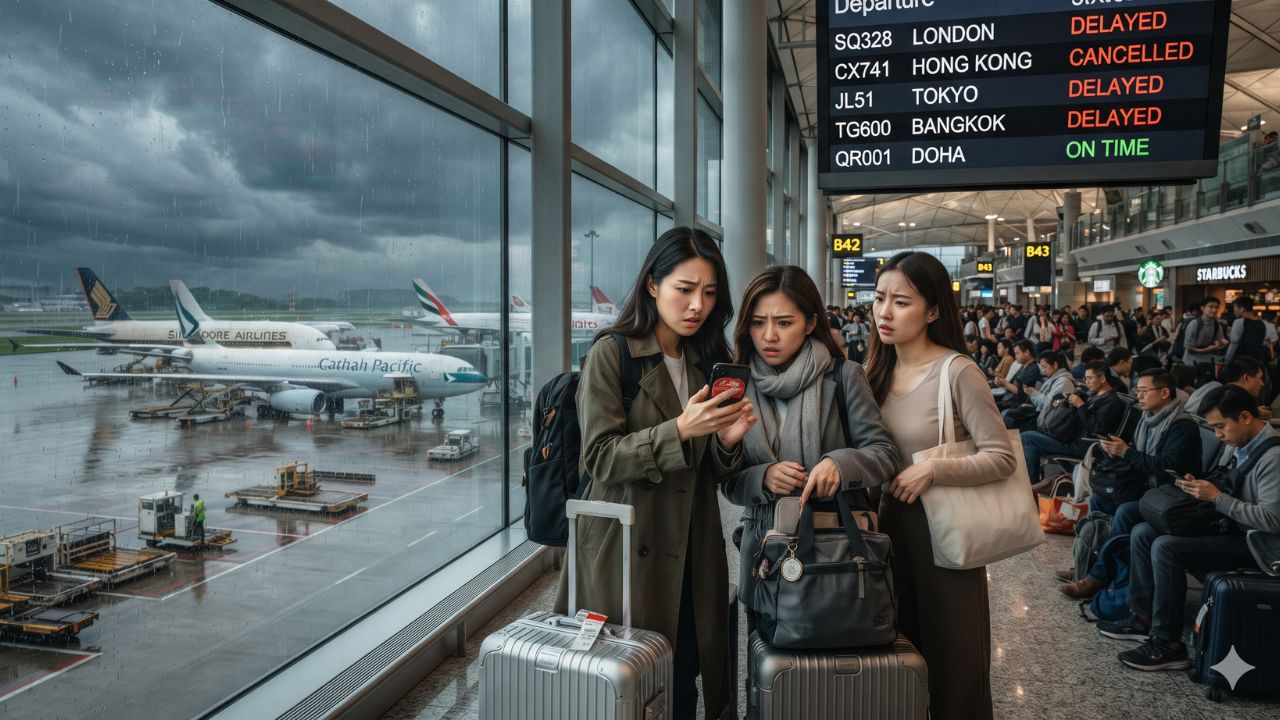
While tropical Cyclone Murasu roared ashore along the Andhra Pradesh coastline near Ongole with sustained winds reaching 110 km/h and gusts peaking at 120 km/h, the meteorological shockwave extended thousands of miles across Asia, triggering a staggering 4,721 flight delays and 644 cancellations. From the packed transit piers of Bangkok Suvarnabhumi to eastern Indonesia’s archipelagic gateway at Makassar Sultan Hasanuddin Airport, travelers endured severe schedule disruptions as cyclonic downpours merged with Middle Eastern airspace reroutings and apron congestion, monitored continuously by the India Meteorological Department.
Aviation tracking figures recorded on 3 November at 2:06 pm ET (4 November, 2:06 am GMT+7) by FlightAware confirmed that flight schedules collapsed across South Asia, Southeast Asia, and China. In India, low-cost carrier IndiGo logged 502 delayed flights—representing 22 percent of its daily schedule—while budget airline Akasa Air saw 14 percent of its flights cancelled. Simultaneously, international transit passengers bound for holiday destinations endorsed by the Tourism Authority of Thailand encountered rolling holding patterns across Indochina and the Indonesian archipelago.
Cyclone Murasu and Middle East Airspace: The Catalysts Behind 4,700 Delays
The widespread aviation backlog developed through two primary operational bottlenecks. In southern India, Cyclone Murasu made landfall near Ongole during the early hours of 3 November 2026, forcing airport authorities to suspend regional operations and ground aircraft in coastal Andhra Pradesh and Tamil Nadu. Precautionary flight cancellations had already paralyzed Chennai International Airport (MAA) and Vijayawada Airport (VGA) on 2 November as torrential rains threatened runway braking friction. The India Meteorological Department extended red and orange weather warnings across the Coromandel coast into 4 November, preventing airlines from repositioning aircraft back into primary network rotations.
Concurrently, restrictive airspace directives across the Middle East added severe friction to transcontinental corridors. Ongoing airspace safety restrictions in Saudi Arabia produced 66 cancellations across four primary hubs: Riyadh (33 cancellations), Jeddah (24 cancellations), Dammam (6 cancellations), and Medina (3 cancellations). Long-haul flights connecting Gulf hubs with India, Southeast Asia, and Europe were forced into narrow, circuitous detour routes, causing international widebody jets to arrive hours behind schedule at major Asian connection points.
| Major Asian & Gulf Hub | Airport Code / Country | Confirmed Cancellations | Confirmed Flight Delays | Dominant Disruptive Factor |
|---|---|---|---|---|
| Mumbai Chhatrapati Shivaji | BOM / India | 13 | 367 | Inbound rotation delays & airspace congestion |
| Bangkok Suvarnabhumi | BKK / Thailand | 7 | 356 | Peak terminal congestion & weather detours |
| Delhi Indira Gandhi | DEL / India | 14 | 272 | Flow control restrictions & apron queues |
| Shanghai Pudong | PVG / China | 16 | 187 | Flow management across eastern corridors |
| Jakarta Soekarno-Hatta | CGK / Indonesia | 33 | 173 | Heavy domestic turnaround delays |
| Shenzhen Bao’an | SZX / China | 37 | 141 | Highest airport cancellations in East Asia |
| Guangzhou Baiyun | CAN / China | 22 | 140 | Southern China airspace flow control |
| Bengaluru Kempegowda | BLR / India | 14 | 137 | Regional weather diversions from Chennai |
| Ho Chi Minh City Tan Son Nhat | SGN / Vietnam | 4 | 137 | Apron capacity limits and international holding |
| Hanoi Noi Bai | HAN / Vietnam | 8 | 124 | Aircraft turnaround sequencing delays |
| Chengdu Tianfu | TFU / China | 12 | 103 | Western China connecting bank delays |
| Shanghai Hongqiao | SHA / China | 22 | 88 | Regional domestic schedule adjustments |
| Riyadh King Khalid | RUH / Saudi Arabia | 33 | Regional delays | Middle East airspace security restrictions |
| Bali I Gusti Ngurah Rai | DPS / Indonesia | 5 | 57 | Island holiday arrivals held on apron |
| Makassar Sultan Hasanuddin | UPG / Indonesia | 8 | 52 | Inter-island eastern transit bottleneck |
| Jeddah King Abdulaziz | JED / Saudi Arabia | 24 | Regional delays | Airspace rerouting & transit restrictions |
Regional Airport Breakdown: India, China, and Southeast Asia Hubs
Across India, schedule disruptions paralyzed metro gateways. Mumbai’s Chhatrapati Shivaji Maharaj International Airport recorded 367 delays and 13 cancellations, while Delhi’s Indira Gandhi International Airport logged 272 delays and 14 cancellations. In the south, Bengaluru registered 137 delays and 14 cancellations as regional aircraft diverted away from Cyclone Murasu’s coastal storm track. Hyderabad logged 72 delays, Chennai registered 61 delays, Ahmedabad recorded 60 delays, Pune noted 51 delays, and the newly developing Navi Mumbai airport posted 25 delays alongside 8 cancellations.
In China, disruptions concentrated heavily in the southern manufacturing and export heartland. Shenzhen Bao’an International Airport recorded 37 cancellations—the highest terminal cancellation total in Asia—alongside 141 delays. Neighboring Guangzhou Baiyun logged 140 delays and 22 cancellations, while Shanghai’s twin airports (Pudong and Hongqiao) accumulated 275 delays and 38 cancellations. Further inland, Xi’an recorded 25 cancellations and 67 delays, Chengdu Tianfu posted 103 delays, and Beijing Capital logged 75 delays.
Southeast Asian transit hubs suffered matching delays. Bangkok Suvarnabhumi emerged as one of the hardest-hit facilities on the continent, accumulating 356 delays and 7 cancellations. In Indonesia, Jakarta’s Soekarno-Hatta registered 173 delays and 33 cancellations, while the archipelagic crossroads of Makassar Sultan Hasanuddin Airport recorded 52 delays and 8 cancellations, stranding travelers heading toward the dive sites and cultural valleys celebrated by Indonesia Tourism. Bali’s international airport logged 57 delays, and Surabaya reported 28 delays. In Vietnam, Ho Chi Minh City, Hanoi, and Da Nang accumulated a combined 313 delays.
Airline Operational Matrix: IndiGo’s 500 Delays vs. Akasa Air’s 14% Cancellation Rate
Carrier performance data highlighted stark contrasts between fleet sizes and network adaptability. India’s largest airline, IndiGo, maintained flight operations by keeping cancellations to just 10 flights, but accumulated 502 delayed sectors—affecting 22 percent of its total schedule. China Eastern Airlines recorded 219 delays and 62 cancellations, while regional operator Shenzhen Airlines posted 57 cancellations.
Budget carriers operating leaner aircraft reserves were forced into high cancellation ratios. Indian carrier Akasa Air suffered a 14 percent cancellation rate (37 flights grounded) and a 16 percent delay rate. In Thailand, Thai Vietjet Air recorded an alarming 44 percent delay rate across its daily operations, leaving nearly half of its passengers behind schedule.
| Airline Operator | Country / Network Base | Cancellations | Cancellation Rate (%) | Total Delays | Delay Rate (%) |
|---|---|---|---|---|---|
| IndiGo | India (Domestic & International) | 10 | 0% | 502 | 22% |
| China Eastern Airlines | China (Mainline Fleet) | 62 | 2% | 219 | 9% |
| China Express Airlines | China (Regional Feeder) | 5 | 1% | 147 | 34% |
| Air India | India (Flag Carrier) | 2 | 0% | 128 | 20% |
| Air China | China (Flag Carrier) | 18 | 1% | 87 | 5% |
| Thai Vietjet Air | Thailand (Low-Cost) | 4 | 2% | 68 | 44% |
| Shenzhen Airlines | China (Domestic Trunk) | 57 | 8% | 59 | 8% |
| Batik Air | Indonesia (Full-Service) | 18 | 6% | 56 | 19% |
| Vietnam Airlines | Vietnam (Flag Carrier) | 8 | 2% | 53 | 13% |
| Hainan Airlines | China (Mainline Fleet) | 27 | 3% | 49 | 7% |
| Akasa Air | India (Low-Cost) | 37 | 14% | 44 | 16% |
| Citilink | Indonesia (Low-Cost) | 28 | 10% | 21 | 7% |
Visitor Insider Tips: Surviving Major Airport Delays Across Asia
- Navigate Makassar Airport Transit Comfortably: If delayed at Makassar’s Sultan Hasanuddin International Airport (UPG) on a connection to Raja Ampat or Toraja, do not remain in the crowded second-floor gate corridors. Head to the landside concourse restaurants to order an authentic bowl of coto Makassar—a rich, slow-simmered beef soup seasoned with crushed peanuts, galangal, and shallots, served with woven rice cakes (ketupat).
- Use Bangkok’s Airport Rail Link During Gridlock: If your arrival into Bangkok Suvarnabhumi (BKK) is delayed into evening rush hours, avoid expressway taxis which can remain trapped in Bang Na-Trat gridlock for two hours. Take the Airport Rail Link from the basement level directly to Phaya Thai station in 26 minutes for 45 Thai baht, connecting directly to the BTS Skytrain.
- Secure Meal Vouchers Early in Indian Terminals: Under Directorate General of Civil Aviation (DGCA) passenger charters in India, airlines must provide free refreshments and meals if a flight is delayed beyond two to three hours depending on sector distance. Approach your operating carrier's customer desk in Mumbai or Delhi immediately upon a delay notification to request meal coupons for terminal dining outlets before concession supplies dwindle.
- Carry Offline Boarding Passes and Transit Visas: When schedule disruptions require unexpected re-routing through secondary hubs like Jakarta, Chengdu, or Riyadh, terminal Wi-Fi networks can become overloaded. Keep offline screenshots of your e-tickets, passport photos, and hotel vouchers stored in your smartphone's secure folder.
- Monitor Real-Time Meteorological Advisories: If traveling through southern India or the Bay of Bengal between October and December, monitor the India Meteorological Department’s regional cyclone bulletins directly to anticipate airline ground stops before reaching the airport.
Cultural and Environmental Context: Monsoon Resiliency and Island Supply Chains
The cascading disruptions triggered by Cyclone Murasu underscore the deep ecological vulnerabilities governing Asian transport infrastructure. Across South and Southeast Asia, aviation is not simply a business convenience; it functions as a lifesaver for island communities and regional economies. When archipelagic gateways like Makassar or island resorts like Bali experience simultaneous flight cancellations, local supply chains for fresh food, medicine, and tourism livelihoods immediately stall.
At the same time, coastal aviation authorities face rising pressure to enhance climate adaptation measures. Tropical cyclones across the Indian Ocean and typhoons across the South China Sea are intensifying in frequency and precipitation volume due to warming sea surface temperatures. Major airport operators across India, Thailand, and Indonesia are investing in high-capacity stormwater catchment basins, grooved runway asphalt to prevent hydroplaning, and real-time terminal flood barriers to maintain vital transport links during severe monsoonal events.
FAQ: Asia Flight Cancellations & Cyclone Murasu 2026
What caused the massive flight cancellations across Asia on 3–4 November 2026?
Disruptions were caused by tropical Cyclone Murasu making landfall in Andhra Pradesh, combined with Middle East airspace security restrictions and severe terminal congestion across hubs in India, China, and Thailand.
Which Asian airline experienced the highest number of delays?
India's IndiGo recorded the highest number of delayed flights, logging 502 delayed sectors that represented 22 percent of its scheduled daily operations.
Which airport reported the most flight cancellations?
Shenzhen Bao'an International Airport in China reported the highest cancellation count in East Asia with 37 cancellations, followed by Riyadh with 33 and Jakarta with 33.
What should passengers do if their flight across Asia is delayed or cancelled?
Check flight status directly via the airline's mobile app before leaving home, request mandatory meal vouchers under local civil aviation rules for multi-hour delays, and verify connecting itineraries.
[From the storm-battered shores of Ongole to the equatorial transit halls of Makassar, patience and local know-how remain the ultimate essentials for navigating Asian skies.]
Related Travel Guides
This article is for informational purposes. Flight routes, passenger regulations, visa rules, and transit advisories are subject to change by airlines and aviation authorities. Readers are advised to verify schedules and travel documentation with relevant carriers and border agencies before departure.
Related Stories
Asia Air Travel Hit by 193 Cancellations and 1,573 Delays: Mumbai, Jeddah, and Manila Lead Flight Gridlock
Asia Flight Cancellations and Delays Hit Riyadh, Bali, and India: Cyclone Murasu and Regional Air Alert