
American Airlines Flight 791 Lands With Blown Tires at Chicago O’Hare Airport in 2026
American Airlines Flight 791 from Miami experienced a landing gear failure involving blown tires at Chicago O'Hare, triggering an emergency response and taxiway deplaning.

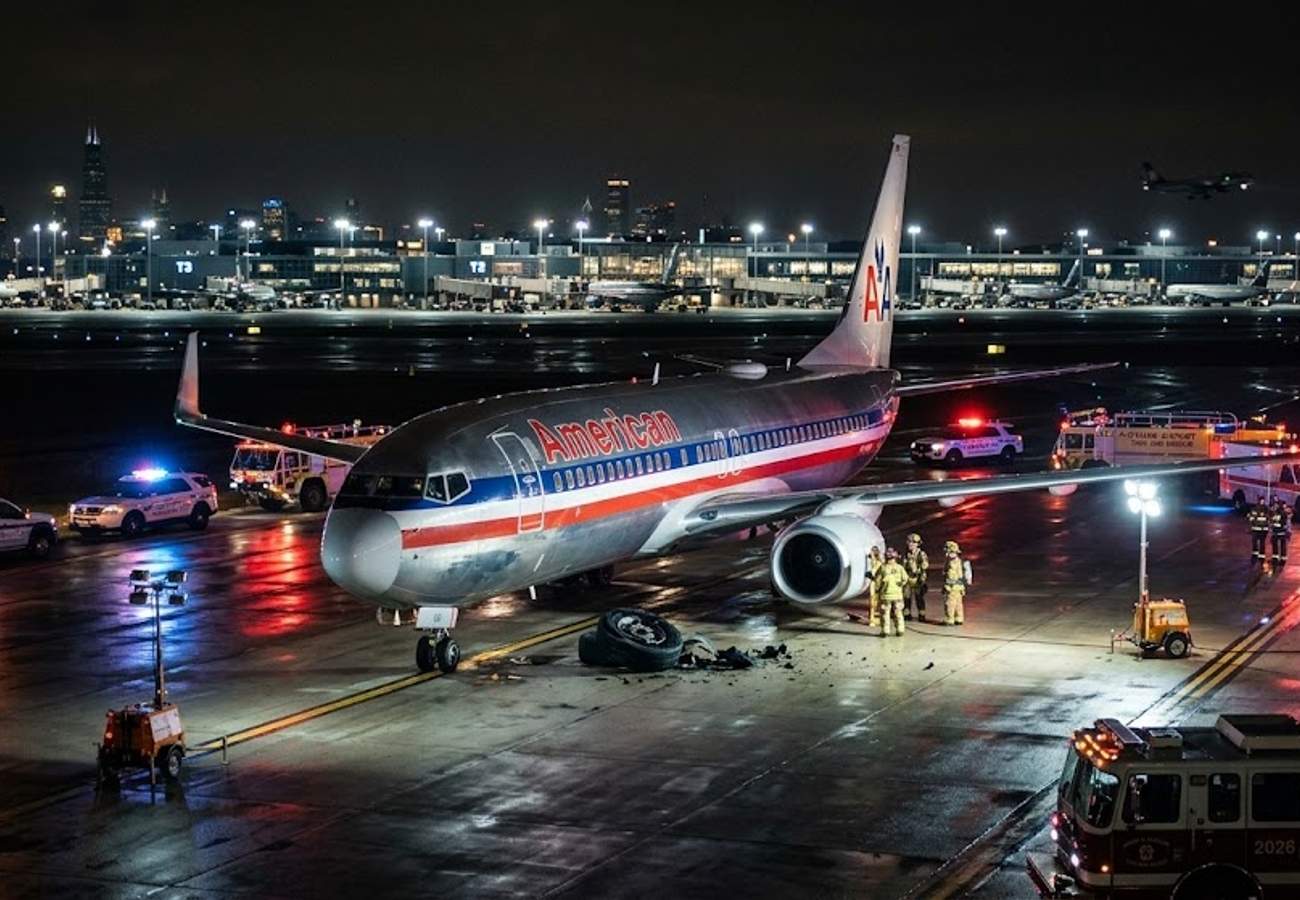
Image generated by AI
A Boeing 737 operating as American Airlines Flight 791 triggered a massive emergency response at Chicago O’Hare International Airport on Tuesday night after landing with two blown main-gear tires. While the incident left passengers stranded on a taxiway for nearly two hours, no injuries were reported among the crew or travelers.
The event occurred during a scheduled flight from Miami International Airport to Chicago. According to flight tracking data and local reports, the aircraft touched down at approximately 10:30 p.m. local time. While the initial landing was described as routine, the tire failures became evident during the rollout or subsequent taxiing phase, rendering the aircraft unable to reach the terminal gate under its own power.
Emergency Response and Taxiway Deplaning at O'Hare
The failure of at least two main-gear tires forced the jet to come to a complete halt on a taxiway. This triggered standard aviation safety protocols, resulting in a high-visibility deployment of airport emergency services. Local broadcasters captured footage of emergency lighting and multiple response vehicles surrounding the aircraft as a precautionary measure.
Passengers faced significant delays, with some reporting they remained on board for nearly two hours while ground crews assessed the situation. Because the aircraft could not be safely towed to a gate immediately, airport personnel utilized portable stairs to evacuate the cabin directly onto the taxiway. From there, travelers were transported to the terminal via shuttle buses.
Despite the presence of Chicago police and emergency teams, official statements from city agencies and the airline confirmed that there were no fires, fuel leaks, or smoke associated with the tire blowouts.
Maintenance Inspections and FAA Review of Flight 791
American Airlines has classified the event as a tire-related issue that manifested after a normal landing. The carrier confirmed that the aircraft was immediately removed from active service to allow maintenance teams to perform a comprehensive mechanical inspection.
The Federal Aviation Administration (FAA) has initiated a routine review of the incident. In cases involving landing gear or tire failures, the FAA typically examines several key variables:
- The maintenance history of the specific Boeing 737 aircraft.
- The physical condition of the tires prior to the flight.
- Runway performance data and braking loads during the rollout.
- Communications between the cockpit and ground control.
Industry standards for such failures involve a deep dive into whether the speed of landing or specific runway conditions contributed to the stress on the tires. These findings are typically integrated into broader airline maintenance programs to prevent recurrence.
Engineering Safeguards Against Landing Gear Failure
While a tire blowout on a commercial jet appears alarming to passengers, aviation engineers design landing gear to handle such contingencies. Modern airliners utilize multi-wheel assemblies that distribute weight and provide redundancy. This design ensures that even if one or more tires lose pressure, the aircraft remains controllable and can be brought to a safe stop without departing the paved surface.
In the case of Flight 791, the aircraft remained on the taxiway and did not require an emergency evacuation—a process reserved for life-threatening scenarios like cabin fires. The use of mobile stairs and buses indicates a managed operational recovery rather than a crisis evacuation.
Operational Impact at Chicago O'Hare International Airport
As one of the world's most congested aviation hubs, Chicago O’Hare operates under strict safety scrutiny. Any incident on the active airfield typically results in immediate attention due to the volume of traffic. However, reports indicate that this specific event caused minimal disruption to the broader American Airlines flight schedule.
Runways remained open for other traffic, with delays limited only to the specific taxiway area required to secure the disabled Boeing 737. This rapid mobilization of airport services reflects the highly rehearsed nature of O'Hare's emergency protocols.
Why This Matters: The Passenger and Legal Perspective
For the traveler, an incident like this highlights the gap between "operational safety" and "passenger experience." While the aircraft functioned as designed—stopping safely despite mechanical failure—the resulting two-hour wait on a taxiway creates significant stress and logistical frustration.
From a logistical standpoint, this incident underscores the importance of "redundancy" in aviation. The fact that a Boeing 737 can suffer multiple tire blowouts and still remain stationary and safe is a testament to current engineering. However, for those on board, the experience serves as a reminder that safety protocols (such as waiting for portable stairs) often prioritize caution over speed, leading to longer delays during "non-critical" emergencies.
Legally and operationally, the FAA's routine review ensures that this is not a systemic issue with a specific batch of tires or a maintenance lapse. For passengers, such events usually result in claims for inconvenience, but the primary takeaway is the efficacy of the ground response in preventing a mechanical failure from becoming a safety catastrophe.
The investigation into Flight 791 continues as maintenance teams analyze the worn components.
Related Travel Guides
Disclaimer
This article is for informational and educational purposes only. It does not constitute legal, financial, or professional advice. While we strive to provide accurate and up-to-date information, travel policies, regulations, and conditions change rapidly. Always verify information with official sources before making travel decisions. Nomad Lawyer makes no representations about the accuracy, reliability, completeness, or suitability of the information provided. Readers should consult qualified professionals for advice specific to their circumstances. The views expressed in this article are those of the author and do not necessarily reflect the views of Nomad Lawyer.
Kunal K Choudhary
Co-Founder & Contributor
A passionate traveller and tech enthusiast. Kunal contributes to the vision and growth of Nomad Lawyer, bringing fresh perspectives and driving the community forward.
Learn more about our team →