
American Airlines Jet Suffers Dual Tire Blowout During Landing at Chicago O'Hare Airport in 2026
An American Airlines flight experienced a dual main-gear tire failure upon touchdown at Chicago O'Hare, causing runway closures and evening flight disruptions.

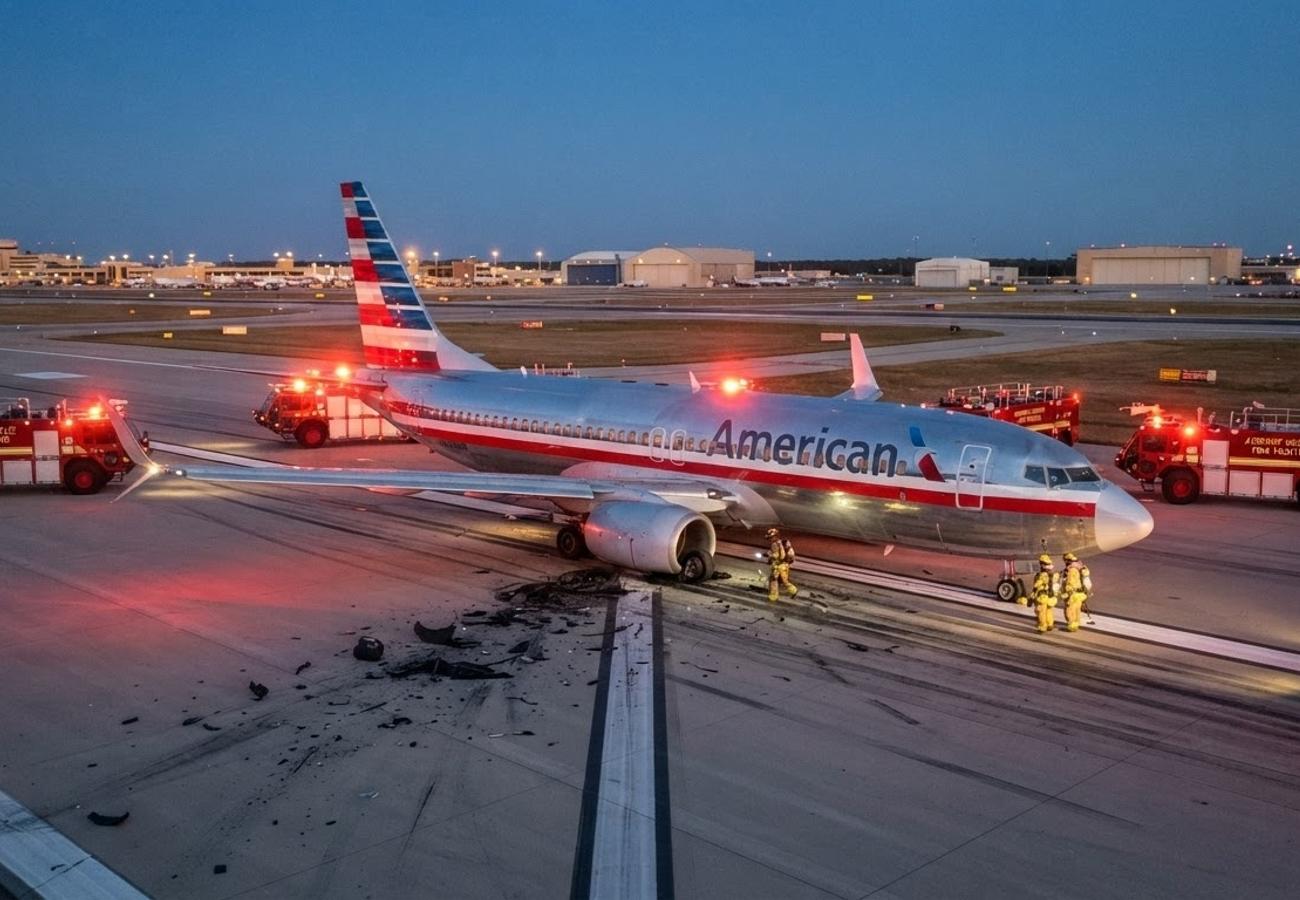
Image generated by AI
A dual tire failure on an American Airlines jet forced the emergency closure of a runway at Chicago O'Hare International Airport on August 18, 2026. While no injuries were reported, the incident triggered a cascade of evening delays at one of the world's busiest aviation hubs.
The incident occurred during the deceleration phase after touchdown. Two tires on the aircraft's main landing gear failed, leaving the jet disabled on the runway and necessitating an immediate response from airport rescue and firefighting (ARFF) teams.
Emergency Response and Runway Disruptions
As the aircraft came to a halt, emergency vehicles surrounded the jet to conduct safety assessments. Airport controllers were forced to suspend operations on the affected runway to allow crews to inspect the pavement for damage and clear rubber debris, which poses a significant risk to subsequent arrivals.
The impact on O'Hare's network was immediate. Flight-tracking data and dispatch alerts from the evening of August 18 indicate:
- Implementation of short ground stops.
- Rapid changes to runway configurations.
- Multiple arriving flights diverted into holding patterns or vectored to alternate runways.
Despite the disruption, the aircraft remained upright on the paved surface. There were no reports of fire or structural damage beyond the landing gear assembly.
Passenger Experience and Evacuation
Travelers on board described a landing that felt firm but routine, followed by a noticeably extended rollout. Some passengers reported a strong vibration or shudder at the moment of failure, while others remained unaware of the technical issue until the aircraft stopped and was surrounded by emergency flashing lights.
Cabin and flight crews maintained order, keeping passengers seated while emergency services performed an external security check. Once the aircraft was deemed secure, passengers were transported to the terminal via buses and ground vehicles.
While some travelers reported missing onward connections due to the delay, reports highlight the professionalism of the crew during the deplaning process. Crucially, there were no reports of smoke in the cabin, and evacuation slides were not deployed, indicating the situation was contained.
Technical Analysis of the Failure
While the specific tail number was not immediately released, the flight involved a standard domestic narrowbody aircraft, likely from the Boeing 737 or Airbus A320 families, which form the bulk of American Airlines' evening operations into O'Hare.
Landing gear systems are engineered to withstand extreme stress, as domestic jets typically touch down at speeds exceeding 130 miles per hour. A dual tire failure often produces loud bangs, sparks, and heavy vibration. In this instance, the landing gear remained aligned, allowing the pilot to maintain directional control and stop the aircraft safely.
Ground crews focused their immediate assessment on three critical safety vectors:
- Wheel Stability: Ensuring the assemblies were secure.
- Thermal Management: Checking for "hot brakes" that could ignite.
- Fluid Leaks: Scanning for hydraulic failures or fuel spills.
Safety Context and Future Investigation
Tire failures are statistically rare given the volume of traffic at Chicago O'Hare. However, they remain a known risk factor caused by internal flaws, foreign object debris (FOD) on the runway, or excessive load during touchdown.
Investigators are expected to analyze the following data points to determine the root cause:
- Maintenance Logs: Reviewing the replacement cycle and total landing cycles of the failed tires.
- Runway Surface Analysis: Checking for gouges or debris that may have triggered the blowout.
- Flight Data Recorder (FDR): Analyzing touchdown speed and braking inputs.
The incident serves as a reminder of the critical role of rapid-response infrastructure in preventing minor mechanical failures from becoming major aviation accidents.
Incident Summary: American Airlines at ORD
| Detail | Status/Data |
|---|---|
| Date of Incident | August 18, 2026 |
| Location | Chicago O'Hare International Airport (ORD) |
| Airline | American Airlines |
| Failure Type | Dual main-gear tire blowout |
| Injuries | None Reported |
| Operational Impact | Temporary runway closure & ground stops |
| Aircraft Type | Narrowbody (Boeing 737 or Airbus A320 family) |
| Passenger Outcome | Bus transfer to terminal |
Key Takeaways
- Safety Systems Worked: The aircraft remained controllable despite the loss of two main tires, proving the resilience of landing gear design.
- Operational Fragility: A single mechanical failure on a runway can disrupt an entire hub's schedule, leading to missed connections for numerous passengers.
- Rapid Response: The presence of ARFF vehicles and the immediate shift in runway configuration minimized the duration of the outage.
FAQ
Were there any injuries during the American Airlines tire blowout? No, initial reports and passenger accounts confirm there were no injuries to passengers or crew.
Why did the runway have to close? Runways must be closed following a tire failure to remove rubber debris and fragments, which could be sucked into the engines of following aircraft (Foreign Object Debris).
How are aircraft tires maintained to prevent this? Airlines follow strict maintenance schedules based on the number of takeoff and landing cycles and visual inspections for wear and tear.
Related Travel Guides
Disclaimer
This article is for informational and educational purposes only. It does not constitute legal, financial, or professional advice. While we strive to provide accurate and up-to-date information, travel policies, regulations, and conditions change rapidly. Always verify information with official sources before making travel decisions. Nomad Lawyer makes no representations about the accuracy, reliability, completeness, or suitability of the information provided. Readers should consult qualified professionals for advice specific to their circumstances. The views expressed in this article are those of the author and do not necessarily reflect the views of Nomad Lawyer.
Raushan Kumar
Founder & Lead Developer
Full-stack developer with 11+ years of experience and a passionate traveller. Raushan built Nomad Lawyer from the ground up with a vision to create the best travel and law experience on the web.
Learn more about our team →