Albania’s Historic Castle Town of Krujë Pivots to Slow Travel as Overnight Stays Replace Day-Trip Crowds

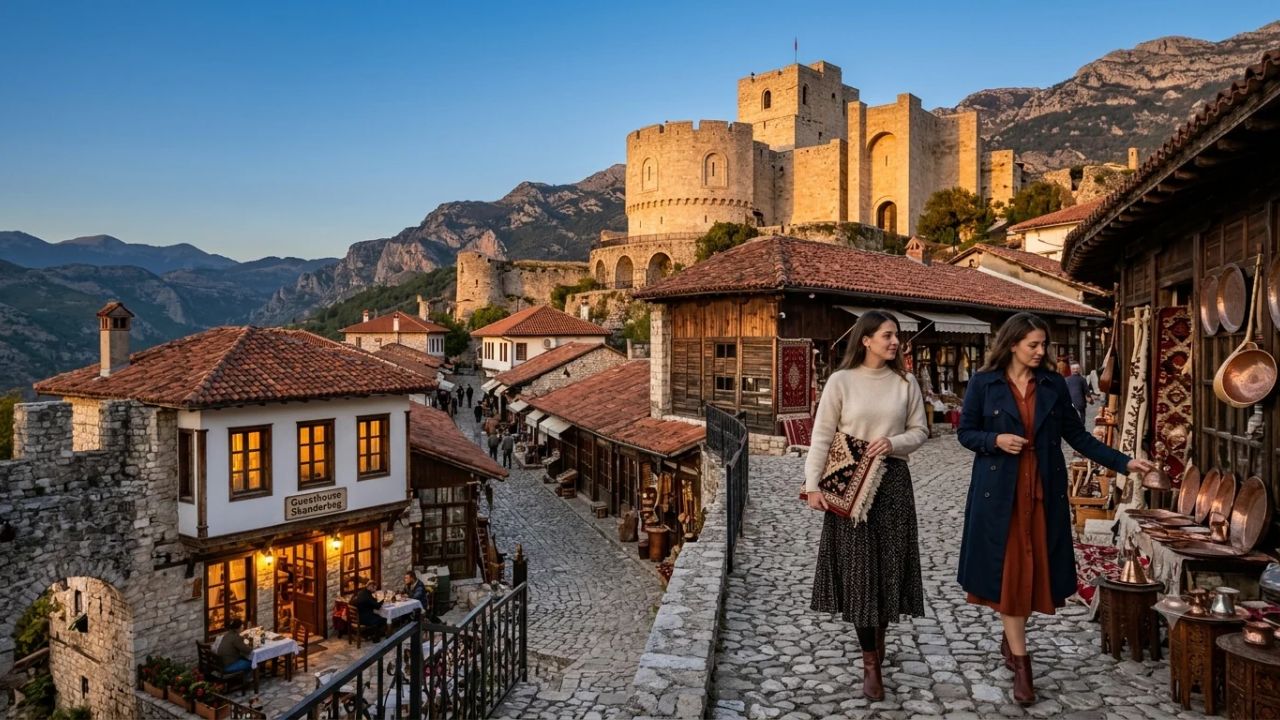
KRUJË, Albania — Perched high on the rugged limestone cliffs of Mount Krujë overlooking the coastal plains of the Adriatic Sea, Albania’s historic fortress citadel is pioneering a strategic transition from a hurried day-trip excursion into an overnight slow travel sanctuary.
Situated approximately 31 kilometers north of the capital city of Tirana, Krujë holds legendary status in the Albanian national consciousness as the 15th-century stronghold of Gjergj Kastrioti Skanderbeg, who successfully defended the mountain citadel against multiple Ottoman imperial sieges.
In autumn 2026, the case for extending visits beyond a brief afternoon tour gained powerful momentum. Official data released by the Ministry of Tourism, Culture and Sports recorded 104,128 visits to the Skanderbeg Museum between January and August 2026 alone.
Concurrently, the reopening of the 18th-century Toptani family residence as the fully restored Ethnographic Museum—following an €850,000 post-earthquake restoration funded by the European Union—has added substantial cultural depth to the town.
However, the defining challenge confronting Krujë’s municipal leadership and independent hospitality businesses is turning high daytime visitor headcounts into sustained economic yield. By promoting boutique guesthouse accommodations beneath the ancient castle walls, evening dining at family-run tavernas, and quiet morning explorations of the 400-year-old Old Bazaar, Krujë is actively redefining its visitor economy around the principles of authentic, unhurried heritage travel.
+----------------------------------------------------------------------------------------------------+ | KRUJË HERITAGE & SLOW TRAVEL SCORECARD: AUTUMN 2026 | +----------------------------------------------------------------------------------------------------+ | Fortress Location | Krujë, Durrës County, Albania (31 km North of Tirana) | | Elevation & Setting | Mount Krujë Cliffs (600 Meters Above Sea Level; Overlooking Plains) | | Anchor Fortress Monument | Krujë Castle (5th–6th Century Citadel Foundations) | | Primary National Museum | National Museum "Gjergj Kastrioti Skënderbeu" (104,128 Visits) | | Restored Heritage Asset | Ethnographic Museum (1764 Toptani Mansion; €850,000 EU Restoration) | | Artisan Market Corridor | Old Bazaar (Pazari i Vjetër: Qilim Carpets, Copperwork, Woodcarving)| | National Cultural Attendance | 1,062,067 Tracked Cultural Site Visits Nationwide (Jan–Aug 2026) | | National Accommodation Boom | Overnight Guests Nationwide Up 10.3% Year-on-Year (August 2026) | | National Tourism Receipts | €5.72 Billion in 2025 (+15% YoY; 12.4 Million Foreign Arrivals) | | Aviation Infrastructure Link | Tirana International Airport Runway Upgrades; Wizz Air 9M Seats 2027| +----------------------------------------------------------------------------------------------------+
The Day-Trip Dilemma: Moving Beyond Transitory Sightseeing
For decades, Krujë has operated under the shadow of the classic European "day-trip trap." Located less than an hour's drive from central Tirana and the Adriatic port of Durrës, the mountain town has served as an easy excursion destination for large tour buses.
Under this transitory travel pattern, large tourist groups arrive in convoy around 11:00 AM, climb the paved cobblestones to the castle, walk quickly through the Skanderbeg Museum, browse the Old Bazaar for 45 minutes, and depart by 2:30 PM to return to their Tirana hotels.
THE STRUCTURAL ECONOMIC DIVIDE IN KRUJË TOURISM
=============================================================================================
THE TRADITIONAL DAY-TRIP EXCURSION              THE EMERGING SLOW TRAVEL OVERNIGHT MODEL
* 3-Hour Compressed Afternoon Visit             * 24- to 36-Hour Immersive Heritage Stay
* Tour Bus Exhaust & Pedestrian Chokepoints     * Peaceful Strolls in Empty Morning & Evening Hours
* Economic Yield: €5 Museum Ticket & Coffee     * Multi-Meal Dining, Hotel Room & Artisan Purchases
* Zero Interaction with Local Community         * Deep Dialogues with Master Weavers & Coppersmiths
* Visitors Return to Capital for Sleep & Dinner * Direct Revenue Kept Within Municipal Mountain Economy
=============================================================================================
This compressed model created substantial distortions within the local economy:
- Severe Peak Congestion: Narrow medieval alleys and the single winding mountain access road suffered acute vehicular gridlock during midday hours, degrading the atmosphere for visitors and residents alike.
- Minimal Local Economic Retention: Day-trippers generated minimal financial return for the local community. A single ticket purchase at the museum entrance and a quick espresso left virtually no capital with family-run restaurants, boutique accommodations, or traditional artisans.
- Evening Desertion: By 4:00 PM, as the tour buses departed down the mountain, the historic citadel emptied out completely. Castle terraces and atmospheric stone squares stood deserted, leaving local hoteliers and restaurant owners with high overhead and empty tables.
To counteract this dynamic, the Municipality of Krujë, in partnership with national tourism bodies, is championing the "Second Morning" concept. By encouraging travelers to check into converted stone guesthouses and stay overnight, visitors experience the town's true character: the atmospheric quiet of twilight over the Adriatic, traditional mountain dining beneath illuminated medieval ramparts, and the chance to visit world-class museums in peaceful morning light before day-tour groups arrive.
Dual Fortified Heritage: The Skanderbeg Epic and the Restored Toptani Residence
The physical layout of Krujë Castle encompasses two completely different, complementary chapters of Albanian history within a single walled compound. Positioned on an elliptical rocky promontory, the citadel brings military resistance and aristocratic domestic life into direct visual dialogue.
THE DUAL HERITAGE AXIS OF KRUJË CITADEL
=============================================================================================
THE MILITARY CITADEL (SKANDERBEG MUSEUM)        THE DOMESTIC RESIDENCE (ETHNOGRAPHIC MUSEUM)
[Gjergj Kastrioti Skënderbeu Epic (1443–1468)]  [The Historic Toptani Family Mansion (1764)]
* Medieval Defensive Walls & Stone Watchtower   * Classic Ottoman-Balkan Vernacular Architecture
* Epic Historical Murals, Armor & Battle Maps   * Restored 18th-Century Household Domesticity
* 104,128 Documented Visits (Jan–Aug 2026)      * Olive Oil Presses, Raki Stills & Wool Looms
* National Symbol of European Christian Defense * Daily Domestic Crafts, Dowry Rooms & Hamam Baths
                      \                                         /
                       \                                       /
                        v                                     v
             +---------------------------------------------------------+
             |         THE COMPLETE TWO-DAY IMMERSIVE ITINERARY        |
             | Dedicate Afternoon to Skanderbeg's Medieval Defense     |
             | Spend Evening Dining on Mountain Delicacies in Citadel  |
             | Dedicate Morning to Toptani Ethnographic Discoveries    |
             +---------------------------------------------------------+
The National Museum "Gjergj Kastrioti Skënderbeu"
Designed by renowned architects Pranvera Hoxha and Pirro Vaso and inaugurated inside the castle walls in 1982, the Skanderbeg Museum is one of the most visited cultural monuments in the Balkans. The monumental stone structure blends modern brutalist castle architecture with authentic medieval masonry.
Inside, the exhibits trace the life, military campaigns, and diplomatic alliances of Gjergj Kastrioti Skanderbeg (1405–1468). Leading the League of Lezhë, Skanderbeg united rival Albanian clans to withstand the full might of the Ottoman Empire for twenty-five years, repelling massive imperial sieges in 1450, 1466, and 1467.
The museum houses dramatic painted murals, original stone cannonballs excavated from the ramparts, replicas of Skanderbeg's iconic goat-head helmet and dual-edged sword (the originals reside in the Kunsthistorisches Museum in Vienna), and detailed architectural models of 15th-century Balkan fortifications.
The Restored Ethnographic Museum: An €850,000 Renaissance
Just a short walk down a stone pathway within the castle walls lies the Ethnographic Museum of Krujë, situated within the historic private mansion of the aristocratic Toptani family. Built in 1764, this magnificent two-story structure is recognized as one of the finest surviving examples of Ottoman-Balkan residential architecture in Southeast Europe.
In November 2019, a catastrophic 6.4-magnitude earthquake struck central Albania, causing severe structural fractures across the historic house. Recognizing the site's immense cultural significance, the European Union financed a comprehensive €850,000 restoration project, executed by the United Nations Office for Project Services (UNOPS) through the EU4Culture program in close partnership with the Albanian Ministry of Economy, Culture and Innovation.
Reopened to the public in July 2024, the restored museum offers a fascinating glimpse into pre-industrial Albanian domestic self-sufficiency:
- Ground-Floor Agricultural Workshops: Displays authentic 18th-century stone olive oil presses, flour mills, traditional copper alembic stills for distilling wild plum and grape raki, and stone storage cisterns.
- The Living Quarters: The upper floor features intricately carved wooden ceilings, open-hearth kitchens, the men's formal reception chamber (oda e burrave), and a private Turkish bath (hamam) equipped with an ingenious subterranean ceramic heating system.
- Interactive Multimedia Integration: The restoration integrated subtle touch-screen displays and audio stations, allowing visitors to hear regional folk melodies and learn how wool from local mountain sheep was sheared, carded, dyed with walnut husks, and woven into thick felt garments.
By splitting museum visits across two days—visiting Skanderbeg in the late afternoon and the Toptani mansion the following morning—travelers can absorb both historical accounts without fatigue.
The 400-Year-Old Old Bazaar: Handloom Weavers and Authentic Copper Artisans
Descending from the castle gate along a steep stone-paved pathway leads into the Old Bazaar (Pazari i Vjetër), one of the oldest operating marketplaces in Albania. Dating back to the 16th century, the bazaar consists of a single curved pedestrian street flanked on both sides by single-story wooden shops with broad overhanging eaves, cobbled gutters, and carved wooden shutters.
TRADITIONAL ARTISAN CRAFTS OF THE KRUJË OLD BAZAAR
| Column 1 |
|---|
| 1. HANDWOVEN QILIM CARPETS & TEXTILES |
| - Woven by local women on traditional wooden floor looms using pure indigenous wool. |
| - Features geometric Illyrian and Balkan patterns dyed with natural onion and pomegranate |
| extracts; takes weeks to complete a single medium rug. |
| 2. HAMMERED COPPERWARE & FILIGREE SILVER |
| - Master coppersmiths shaping traditional cezve Turkish coffee pots, serving platters, |
| and water jugs by hand in open-front workshops. |
| - Delicate filigree jewelry crafted from fine silver wire, continuing Shkodra and Krujë |
| goldsmith traditions. |
| 3. TRADITIONAL FELT-MAKING (QELISHE CRAFT) |
| - Production of the white conical felt cap (plis or qeleshe) worn by northern Albanian |
| men, shaped from unspun wool using hot water, soap, and manual wooden presses. |
| 4. OLIVE WOOD CARVING & ANTIQUE FOLK INSTRUMENTS |
| - Hand-carved kitchenware fashioned from ancient olive root trunks. |
| - Traditional two-stringed folk lutes (çifteli) hand-carved from seasoned walnut wood. |
Navigating Craft Authenticity
In an era where international tourism markets are frequently flooded with mass-produced imported souvenirs, Krujë's Old Bazaar maintains a dedicated guild of authentic artisans. Travelers can step directly into the workshops behind the display stalls, where master weavers sit at wooden looms threading intricate wool patterns, and coppersmiths hammer rhythmic patterns into warm metal.
The Albanian National Tourism Agency (AKT) actively advises visitors to engage directly with makers. Inquiring about where an item was produced, inspecting the reverse side of hand-knotted rugs for natural yarn irregularities, and watching an artisan shape a traditional wool qeleshe cap transforms shopping from a commercial transaction into a memorable cultural exchange.
Albania’s Macroeconomic Tourism Boom: 12.4 Million Visitors and Infrastructure Expansion
The revitalization of Krujë takes place against the backdrop of an extraordinary nationwide tourism boom that has established Albania as one of Europe's fastest-growing holiday destinations.
Official macroeconomic indicators compiled by the Ministry of Tourism, Culture and Sports and the Institute of Statistics (INSTAT) document rapid multi-year growth:
ALBANIA NATIONAL TOURISM MACROECONOMIC BENCHMARKS
=============================================================================================
INDICATOR                     OFFICIAL REPORTED METRIC          ANNUAL PERFORMANCE TREND
---------------------------------------------------------------------------------------------
Foreign Visitor Arrivals      12.4 Million International Guests Full-Year 2025 Milestone
National Tourism Receipts     €5.72 Billion Gross Inflow        +15.0% Year-on-Year Growth (2025)
Tracked Cultural Site Visits  1,062,067 Documented Visits       +5.0% YoY (January–August 2026)
Skanderbeg Museum Visits      104,128 Confirmed Entrances       Primary Cultural Site in Region
Nationwide Hotel Guests       INSTAT Monthly Tracking           +10.3% YoY Growth (August 2026)
=============================================================================================
In 2025, Albania welcomed 12.4 million foreign visitors, generating an unprecedented €5.72 billion in tourism revenue, an increase of 15 percent over the previous year. Through August 2026, tracked visits to national cultural sites surpassed one million, while nationwide accommodation guest numbers expanded by 10.3 percent year-on-year.
Aviation Infrastructure Upgrades at Tirana International Airport
To accommodate this sustained expansion, Tirana International Airport (TIA / Nënë Tereza)—located just 20 kilometers south of Krujë—is executing major airside infrastructure modernizations:
- Runway and Taxiway Upgrades: TIA scheduled runway resurfacing, LED lighting overhauls, and taxiway expansions between November 9 and November 26, 2026, executing selected overnight closures to prepare for the peak 2027 season.
- Low-Cost Airline Expansion: On November 6, 2026, ultra-low-cost carrier Wizz Air announced plans to base a 15th aircraft at Tirana, expanding its available seat capacity to nine million seats in Albania for 2027, an announced 11 percent increase over 2026.
These expanded air links, connecting Tirana with dozens of direct European cities across the United Kingdom, Germany, Italy, and Scandinavia, provide an uninterrupted pipeline of international travelers seeking authentic heritage experiences within an hour of landing.
The National Tourism Strategy 2030
The development of Krujë aligns directly with the Albanian Government’s National Tourism Strategy 2030.
Recognizing that international tourism was becoming dangerously over-concentrated along southern beach strips like Saranda, Ksamil, and Vlora during July and August, the statutory strategy establishes six distinct regional tourism development zones. The central inland heritage zone, anchored by Krujë, Berat, and Gjirokastër, is tasked with expanding year-round cultural touring, ensuring tourism wealth circulates into mountain communities outside the peak summer beach months.
Krujë Heritage Metrics and Albania National Tourism Indicators
The following matrix provides a clear, quantitative overview of Krujë's cultural assets in relation to national economic indicators:
| Performance Indicator | Reporting Entity | Measurement Window | Official Quantified Metric | Strategic Significance |
|---|---|---|---|---|
| Skanderbeg Museum Attendance | Ministry of Tourism, Culture & Sports | Jan – Aug 2026 | 104,128 Entrances | Anchors northern cultural day-trips and school heritage visits |
| Tracked Cultural Sites Nationwide | Ministry of Tourism, Culture & Sports | Jan – Aug 2026 | 1,062,067 Entrances | Reflects steady 5% YoY growth in historical and museum tourism |
| Accommodation Establishment Guests | INSTAT (Statistical Institute) | August 2026 | +10.3% YoY Increase | Confirms expanding demand for multi-night hotel lodging across Albania |
| National Gross Tourism Receipts | Ministry of Tourism, Culture & Sports | Full-Year 2025 | €5.72 Billion | Contributes over 20% of Albania's national Gross Domestic Product |
| International Foreign Arrivals | Ministry of Tourism, Culture & Sports | Full-Year 2025 | 12.4 Million Visitors | Establishes Albania as the fastest-growing Balkan travel destination |
| Ethnographic Museum Restoration | European Union / UNOPS / EU4Culture | Completed July 2024 | €850,000 Investment | Restored 1764 Toptani mansion following 2019 earthquake damage |
| Airport Fleet Deployment | Wizz Air Corporate Bulletin | 2027 Projection | 15 Aircraft / 9M Seats | Guarantees low-cost international passenger feed into Tirana gateway |
The Traditional Hospitality Model: Converted Mansions and Mountain Gastronomy
The shift toward overnight stays has sparked a quiet renaissance in Krujë’s hospitality sector. Rather than constructing disruptive, large-scale modern hotels, local entrepreneurs are restoring traditional Ottoman-era stone towers and family residences within the citadel perimeter.
THE OVERNIGHT CITADEL EXPERIENCE IN KRUJË
=============================================================================================
AUTHENTIC HERITAGE ACCOMMODATION                REGIONAL HIGHLAND GASTRONOMY
* Converted stone houses (e.g., Rooms Merlika)  * Tavë Dheu: Slow-cooked veal & fermented curd
* Hand-carved wooden ceilings & stone fireplaces* Tavë Kosi: Tender baked lamb, rice & baked yogurt
* Private balconies facing illuminated towers   * Qofte: Spiced minced beef patties grilled on charcoal
* Quiet evening breezes after tour buses depart * Local mountain honey with walnuts & warm mountain tea
                      \                                         /
                       \                                       /
                        v                                     v
             +---------------------------------------------------------+
             |         EVENING MAGIC BENEATH CASTLE WALLS              |
             | Watch the sunset turn the Adriatic horizon to crimson   |
             | Sip chilled Raki Rrushi beside centuries-old ramparts   |
             | Sleep in complete mountain tranquility away from cities |
             +---------------------------------------------------------+
Properties like Rooms Merlika, built directly into the original stone walls of the castle, allow guests to sleep inside the fortress itself. In the quiet evening hours, hotel terraces provide sweeping, panoramic views across the valley toward the twinkling lights of Tirana and the distant Adriatic coastline.
Highland Culinary Heritage
Dining in Krujë introduces travelers to central Albania’s hearty mountain cuisine:
- Tavë Dheu (Earth Pot Stew): A comforting local staple prepared with tender chunks of veal, liver, onions, and local fermented cottage cheese (gjizë), baked in an earthenware clay dish until bubbling and caramelized.
- Tavë Kosi: Albania's national dish, featuring baked lamb layered with seasoned rice and covered in a thick, custardy sauce made from sour sheep's milk yogurt and eggs.
- Kabuni: A rare, ancient dessert prepared for special celebrations, made from rice cooked in meat broth with caramelized sugar, butter, raisins, and aromatic cloves.
- Walnut Raki: Traditional twice-distilled grape raki infused with green walnuts harvested from the slopes of Mount Krujë.
Dining at an open-air castle restaurant like Hotel Panorama or Taverna Kastra after the daytime crowds have dispersed allows travelers to savor these dishes at a relaxed pace, accompanied by traditional acoustic folk music played on the two-stringed çifteli.
Transit and Mobility Logistics: Connecting Tirana to the Mountain Citadel
Planning a seamless overnight trip to Krujë requires an understanding of regional transit options:
TRANSIT & MOBILITY LOGISTICS: GETTING TO KRUJË
| Column 1 |
|---|
| 1. DIRECT REGIONAL BUS / FURGON (PUBLIC TRANSIT) |
| - Departs from Tirana’s Northern and Southern Bus Terminal (Terminali Lindor/Veriut). |
| - Direct minibuses (furgons) depart every 30 to 45 minutes directly to central Krujë. |
| - Travel Time: 45 to 60 minutes; Fare: Approximately 150 to 200 Albanian Lek (€1.50–€2). |
| 2. THE FUSHË-KRUJË INTERCHANGE (SECONDARY ROUTE) |
| - Frequent buses operate from Tirana to Fushë-Krujë (the lower commercial town on the |
| plain). From Fushë-Krujë, local shuttle vans ascend the steep mountain road (10 km) |
| up to historic Krujë every 15 minutes. |
| 3. PRIVATE VEHICLE & RENTAL CAR ACCESS |
| - Take national highway SH1 north from Tirana toward Fushë-Krujë, then turn onto SH38, |
| a well-paved, winding mountain road ascending the limestone cliffs. |
| - Parking: Paid municipal parking areas are available near the entrance of the Old Bazaar |
| and beneath the castle gates. Driving inside the historic pedestrian citadel is banned. |
| 4. ACCESSIBILITY ADVICE FOR TRAVELERS WITH REDUCED MOBILITY |
| - Krujë is a vertical medieval settlement. The Old Bazaar and castle paths are paved with |
| smooth, polished river stones that can be slick when wet. |
| - The Skanderbeg Museum features multiple internal stone staircases without elevators. |
| - The Ethnographic Museum has limited wheelchair accessibility due to historic thresholds. |
Actionable 36-Hour Krujë Slow Travel Itinerary
To experience the full historical and cultural breadth of Krujë, independent travelers should follow this curated 36-hour slow travel itinerary:
THE DEFINITIVE 36-HOUR KRUJË SLOW TRAVEL BLUEPRINT
| Column 1 |
|---|
| DAY 1: ARRIVAL, CASTLE WALLS & CITADEL SUNSET |
| - 14:00: Arrive in Krujë via private cab or regional bus; check into a stone guesthouse. |
| - 15:30: Enter Krujë Castle; explore the Skanderbeg Museum as afternoon crowds thin out. |
| - 17:30: Walk to the edge of the castle ramparts to admire the Ottoman clock tower. |
| - 18:30: Watch the sunset turn the Adriatic coastal plains from gold to deep crimson. |
| - 20:00: Dinner at an authentic citadel taverna: bubbling Tavë Dheu and local red Kallmet |
| wine beneath the illuminated fortress walls. |
| DAY 2: THE SECOND MORNING, BAZAAR ARTISANS & MOUNT KRUJË |
| - 08:30: Traditional highland breakfast: fresh sheep's milk cheese, mountain honey, |
| warm petulla (fried dough balls), and rich Turkish coffee on a panoramic terrace. |
| - 09:30: Private, unhurried visit to the restored 1764 Toptani Ethnographic Museum. |
| - 11:30: Descend into the Old Bazaar; observe master weavers at work on wooden looms. |
| - 13:00: Light lunch of fresh grilled qofte and wild mountain greens at a bazaar cafe. |
| - 14:30: Take a 20-minute drive or hike up to the sacred Bektashi shrine of Sari Salltik |
| near the summit of Mount Krujë, enjoying panoramic views across all of northern Albania |
| - 17:00: Depart relaxed for Tirana or onward journeys toward Shkodra and the Alps. |
Essential Practical Advice for Visitors
- Footwear Matters: Wear sturdy walking shoes or hiking boots with high-traction rubber soles. The smooth, centuries-old cobblestones of the Old Bazaar and the steep ramparts inside the castle can become slippery, especially during early morning dew or after autumn rains.
- Cash for the Bazaar: While hotels and larger restaurants accept Visa and Mastercard, independent artisans in the Old Bazaar prefer cash in Albanian Lek (ALL) or Euros (€). ATMs are located in the lower commercial square just outside the bazaar entrance.
- Respecting Bektashi Traditions: If visiting the holy cave shrine of Sari Salltik on Mount Krujë, dress modestly (shoulders and knees covered) and remove shoes before entering the interior prayer chambers.
As Albania's tourism sector continues its record-breaking expansion, Krujë demonstrates that a destination's true worth is measured not by how quickly travelers can pass through its gates, but by how deeply they are moved to stay. Beneath the ancient stone ramparts of Skanderbeg's citadel, the second morning awaits those who choose to slow down.
Related Travel Guides
- Albania Travel Masterclass: Exploring Tirana, Historic Castles, and the Accursed Mountains
- Slow Travel in the Balkans: Historic Towns, Ottoman Architecture, and Mountain Villages
- Berat and Gjirokastër: Navigating Albania’s UNESCO Ottoman Museum Cities
- Balkan Heritage Crafts: Preserving Handloom Weaving, Filigree, and Coppersmithing
This article is for informational purposes. Flight routes, passenger regulations, visa rules, and transit advisories are subject to change by airlines and aviation authorities. Readers are advised to verify schedules and travel documentation with relevant carriers and border agencies before departure.
Related Stories
Hanoi Opens 12 Old Quarter Heritage Sites for Creative Design Festival as Vietnam Accelerates High-Yield City Breaks
Canada Budget 2026 Unveils Nearly $30 Billion Ten-Year Plan to Tackle Homelessness and Revitalize Urban Destination Hubs