Alaska and North Dakota Wilderness Guide 2026: Glaciers, Badlands, and Frontier Towns

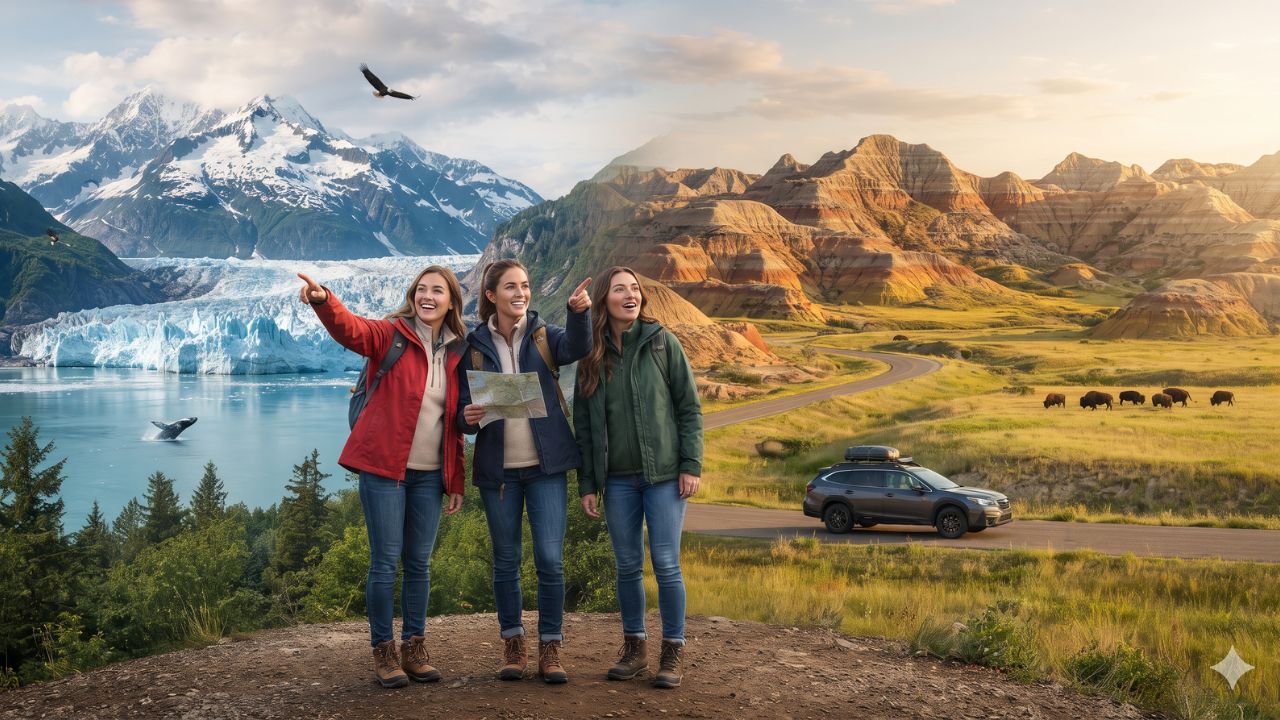
Alaska's capital of Juneau remains completely marooned from the continental highway grid—a modern state capital accessible only by passenger aircraft or maritime ferry along the Gastineau Channel. Meanwhile, fifteen hundred miles to the southeast across the Great Plains, North Dakota guards the layered canyons of Theodore Roosevelt National Park, where thousands of free-roaming wild bison graze beneath painted sandstone buttes. While Alaska drew approximately 3.08 million visitors between May 2024 and April 2025, both states represent America's most unvarnished frontier corridors, offering silent tundra, calving tidewater glaciers, and prairie skies far removed from mass tourism circuits.
For independent travelers seeking authentic encounters with North American wildlife, Indigenous history, and raw geography, pairing the subarctic expanse of Alaska with the quiet badlands of North Dakota delivers an unforgettable exploration of America's extremes.
Two Frontiers Compared: Coastal Fjords vs. Rolling Grasslands
Understanding the geographic divergence between these two northern states helps travelers structure realistic transit timelines and gear choices:
| Travel Dimension | Alaska (Subarctic & Coastal) | North Dakota (Plains & Badlands) |
|---|---|---|
| Character | Glacial fjords, subarctic tundra & mountains | Prairie potholes, badlands & river coulees |
| Visitor Volume | ~3.08 million visitors (May 2024 – April 2025) | Lower-density domestic road trips |
| Key Transit | Marine Highway ferries, bush planes & rail | Interstate 94, US Highway 2 & backroads |
| National Parks | Denali, Glacier Bay & Kenai Fjords | Theodore Roosevelt National Park |
| Key Wildlife | Grizzly bears, moose, caribou, Dall sheep | Free-roaming bison, prairie dogs & elk |
| Heritage Hubs | Alaska Native Heritage Center & Museum of the North | North Dakota Heritage Center, Medora & Minot |
| Best Season | June to August (midnight sun) or winter (aurora) | May to October for road trips and wildlife |
Alaska: The Subarctic Wilderness Frontier
Occupying one-fifth the land area of the contiguous United States, Alaska’s scale requires targeted exploration through distinct regional hubs:
Anchorage and the Chugach Foothills
Anchorage functions as Alaska’s urban hub. At the Alaska Native Heritage Center, life-sized dwellings surrounding Lake Tiulana introduce eleven major cultural groups, including Athabascan, Inupiaq, and Tlingit traditions. The Anchorage Museum anchors downtown, while cyclists trace the eleven-mile Tony Knowles Coastal Trail. Bordering the city, Chugach State Park protects half a million acres of alpine trails.
Denali: Subarctic Giants and Taiga Plains
Spanning six million acres, Denali National Park and Preserve surrounds the 20,310-foot summit of North America’s highest peak. Park transit buses navigate the gravel park road through tundra, where visitors observe grizzly bears, caribou herds, Dall sheep on rocky bluffs, and moose in willow marshes.
Juneau and Glacier Bay: Maritime Wilderness
In Southeast Alaska, Juneau provides access to Mendenhall Glacier, where ice walls calve into Mendenhall Lake. The Alaska State Museum documents Russian colonization and Indigenous trade, while the Mount Roberts Tramway rises through coastal rainforest. Further northwest, Glacier Bay National Park and Preserve preserves marine fjords where humpback whales, harbor seals, and puffins feed beneath tidewater ice.
Fairbanks and the Interior Aurora
Positioned beneath the Auroral Oval, Fairbanks serves as a premier aurora observation center between late August and April. In winter, travelers soak in mineral waters at Chena Hot Springs. Cultural highlights include the University of Alaska Museum of the North and Pioneer Park’s gold rush cabins.
Seward and Kenai Fjords
Sitting on Resurrection Bay, Seward is the gateway to Kenai Fjords National Park. Marine catamarans navigate past sea otters toward active glaciers. On land, the Alaska SeaLife Center leads cold-water rehabilitation, while hikers access Exit Glacier (road access is subject to winter closures).
North Dakota: The Unbroken Prairie Badlands
North Dakota delivers open horizons, historic river valleys, and national park wilderness:
Medora and the Theodore Roosevelt Badlands
Medora serves as the gateway to the South Unit of Theodore Roosevelt National Park. The town features the Chateau de Morès State Historic Site, the North Dakota Cowboy Hall of Fame, and the open-air Medora Musical. The national park protects carved ravines along the Little Missouri River, where wild bison graze alongside prairie dog towns. Travelers explore the South Unit, the quieter North Unit, Painted Canyon, and Roosevelt’s Elkhorn Ranch Unit.
Bismarck and Mandan: Missouri River Heritage
On the Missouri River, Bismarck features the State Capitol and the North Dakota Heritage Center and State Museum, showcasing dinosaur fossils and Native American artifacts. Across the river in Mandan, Fort Abraham Lincoln State Park preserves reconstructed Mandan earth lodges and frontier history.
Fargo: Contemporary Prairie Culture
Along the eastern border, Fargo blends rail history with arts. The Plains Art Museum exhibits regional contemporary works, the Fargo Air Museum explores aviation history, and Bonanzaville preserves thirty-six historic frontier buildings across twelve acres.
Minot and Dunseith: Nordic Heritage and Peace Gardens
In northern North Dakota, Minot’s Scandinavian Heritage Park celebrates Nordic roots with a replica of Norway’s Gol Stave Church and a Swedish Dala horse. Near Dunseith, the International Peace Garden spans 2,339 acres across the border with Manitoba, featuring formal floral grounds and shared paths.
Visitor Insider Tips: Remote Travel Logistics
- Reserve Denali and Kenai Excursions Months Ahead: Park transit buses inside Denali and marine glacier cruises out of Seward operate at strict capacity limits. Secure reservations at least three to four months before summer travel.
- Carry Passports for Dunseith: Visiting the International Peace Garden in Dunseith involves entering an international border zone with Canada. Ensure all party members carry valid passports for smooth border reentry.
- Respect Wildlife Safety Distances: In Theodore Roosevelt National Park, bison can run 35 miles per hour and charge unexpectedly; maintain at least 25 yards of distance. In Alaska, carry EPA-approved bear spray on all hikes.
- Prepare for Sudden Road Closures: Exit Glacier Road in Seward closes to vehicles after heavy snowfalls, and badland clay tracks in North Dakota turn into impassable gumbo mud following heavy rain. Verify road status locally before driving off major highways.
Environmental Stewardship and Indigenous Heritage
Both Alaska and North Dakota showcase delicate ecosystems undergoing rapid climatic transformation. In Alaska, retreating glaciers at Mendenhall and Exit Glacier serve as visible indicators of warming temperatures, prompting local authorities to invest in electric tour buses and trail rerouting.
Similarly, in North Dakota, preserving native prairie grasslands and managing the genetic diversity of wild bison herds demands close cooperation between park biologists and regional tribal nations. Travelers honor these shared lands by staying on designated paths, packing out all waste, and patronizing Native-owned art cooperatives in communities like Juneau, Anchorage, and Bismarck.
Plan travel details through Travel Alaska and explore regional itineraries on North Dakota Tourism.
FAQ: Visiting Alaska and North Dakota 2026
What is the best month to explore both states?
July and August offer optimal weather, open park roads, active wildlife viewing, and long daylight hours across both Alaska and North Dakota.
Can tourists drive directly into Juneau, Alaska?
No. Juneau is not connected to any external highway system. Visitors must arrive via commercial air carriers or Alaska Marine Highway ferries.
Do I need a four-wheel-drive vehicle in North Dakota?
Standard passenger vehicles handle paved scenic loops in Theodore Roosevelt National Park. However, exploring unpaved Badlands backcountry roads requires high-clearance vehicles.
Where can I see wild bison in North Dakota?
Theodore Roosevelt National Park's South and North Units support hundreds of free-roaming wild bison, frequently spotted along the main park roads and Painted Canyon overlooks.
Venturing into the untamed frontiers of Alaska and North Dakota connects travelers with the enduring wilderness soul of North America.
Related Travel Guides
This article is for informational purposes. Flight routes, passenger regulations, visa rules, and transit advisories are subject to change by airlines and aviation authorities. Readers are advised to verify schedules and travel documentation with relevant carriers and border agencies before departure.
Related Stories
New Jersey Hidden Gems Guide 2026: Eight Towns for Historic and Nature Road Trips
Alabama Road Trip Guide 2026: Cullman and Seven Underrated Mountain and Heritage Towns