
Crossroads Above the South China Sea: What AirAsia’s Domestic Realignment Means for Exploring Malaysia
With AirAsia commanding 60% of domestic flights amid RM18.4 billion in liabilities and government contingency talks with Malaysia Airlines and Batik Air, independent travelers must rethink how they cross the peninsula and reach Borneo’s rainforests.

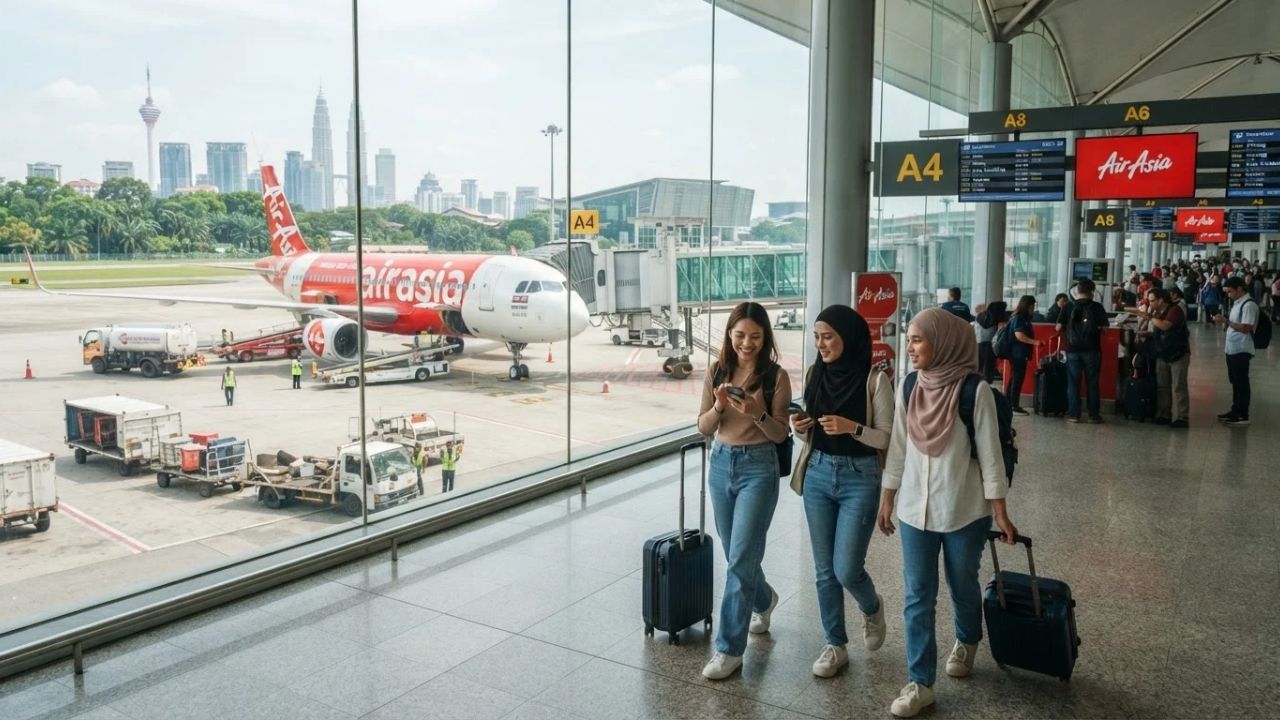
As Malaysia’s aviation authorities review domestic route contingencies, travelers reassess aerial corridors connecting Peninsular Malaysia with Sabah and Sarawak
In a nation physically divided by more than six hundred kilometers of open ocean, a single low-cost carrier operates roughly 60 percent of all domestic flights and commands approximately 40 percent of the overall aviation market. Yet beneath that commanding presence across terminal departure boards, AirAsia is navigating immense financial headwinds: RM18.4 billion in current liabilities as of June 30, an RM830.5 million second-quarter net loss weighed down by an average jet-fuel price of US$183 per barrel and RM331 million in foreign-exchange deficits, and at least RM500 million in deferred dues owed to national airport operator Malaysia Airports Holdings Berhad (MAHB).
With Malaysia’s Ministry of Finance and MAHB actively conducting scenario-planning discussions with rival carriers Malaysia Airlines and Batik Air to evaluate organic capacity absorption if required, the situation carries profound consequences for travelers. Flying across Malaysia is not an optional luxury or a simple business convenience. It is the indispensable physical link tying together Peninsular Malaysia's historic trading ports with the ancient, river-threaded rainforests of Sabah and Sarawak on Borneo.
The Sovereign Balancing Act: Contingency Talks and Flight Network Resilience
The government discussions reported on September 16 reflect proactive risk management rather than an impending operational collapse. Farouk Kamal, deputy group CEO of AirAsia Group, has stressed that the carrier remains focused on operational stability and business continuity, pledging to disclose material corporate and fleet adjustments through official regulatory channels. In the second quarter, the group generated RM5.1 billion in revenue, maintaining top-line stability even as capacity contracted by 11 percent, while generating a positive EBITDA of RM442.6 million despite a 56 percent year-on-year drop.
The core challenge stems from extraordinary cost inflation. Jet-fuel prices jumped 66 percent quarter-on-quarter to reach US$183 per barrel, driving total fuel expenses up 58 percent year-on-year. Excluding the RM331 million currency translation loss, AirAsia’s operational net loss stood at RM499.6 million. With cash and bank balances at RM954 million against RM18.4 billion in current liabilities, the airline is pursuing up to US$1 billion in international debt financing and RM700 million in local credit facilities to consolidate debt and extend maturities, building upon a US$300 million capital raise completed in March 2026. While external market analysts cited by Reuters suggest the carrier could require at least US$3 billion to completely stabilize its balance sheet, AirAsia maintains that its targeted funding package will suffice.
Crucially for travelers, the airline has already taken decisive operational steps. It has returned 25 older aircraft to lessors, renegotiated commercial contracts, and trimmed underperforming long-haul routes. While short-haul operations in Thailand, Indonesia, and the Philippines have faced varying degrees of pressure, AirAsia’s domestic core operations in Malaysia and Cambodia remain profitable.
Meanwhile, national passenger traffic recorded by the Malaysian Aviation Commission (MAVCOM) shows robust demand. In January 2025 alone, 9.2 million travelers passed through Malaysian airports—a 6.9 percent monthly rise and a 28.2 percent increase over the prior year. Domestic traffic reached 4.4 million passengers (surging 32.7 percent year-on-year), while international traffic hit 4.8 million. This rapid rebound from the pandemic era—when total passenger traffic plummeted from 59.9 million in 2019 to 15.65 million in 2020 and just 5.31 million in 2021, before tracking toward annual projections of 105.8 million to 112.9 million—means that keeping domestic seat supply stable is vital for national mobility.
What Makes Malaysia’s Domestic Corridors Different
Understanding the stakes of this aviation dialogue requires looking at Malaysia's distinct geography. Peninsular Malaysia forms the southern tip of mainland Southeast Asia, while Malaysian Borneo—comprising the states of Sabah and Sarawak—stretches across northern Borneo hundreds of kilometers away. There are no overland highways, rail bridges, or passenger ferries connecting the two halves of the country.
Over the past two decades, AirAsia revolutionized travel across this expanse under its populist banner, making inter-island flights accessible to university students, rural families, and budget-conscious backpackers. The airline established high-frequency corridors linking Kuala Lumpur International Airport with regional capitals: George Town in Penang, Kota Bharu, Johor Bahru, and across the sea to Kuching and Kota Kinabalu.
These air corridors provide essential access to extraordinary cultural and natural heritage. In Peninsular Malaysia, travelers land in Penang to explore the historic shophouses, clan jetties, and street murals of George Town, recognized by the UNESCO World Heritage Centre. Flying eastward into Borneo unlocks access to Gunung Mulu National Park in Sarawak—famed for its vast limestone cavern networks and millions of bats spiraling into twilight skies—as well as Kinabalu Park in Sabah, home to Southeast Asia’s highest peak between the Himalayas and New Guinea.
If route frequencies on these trunk lines fluctuate, independent travelers must adapt their logistics, balancing budget flights with alternative ground transport and full-service carriers.
Visitor Insider Tips
To navigate potential domestic flight adjustments and travel smoothly across Malaysia, follow these localized strategies:
- The Peninsular Train Alternative: When traveling between Kuala Lumpur, Ipoh, and Penang, skip airport security lines entirely. Board the Keretapi Tanah Melayu (KTM) ETS electric express train from KL Sentral directly to Butterworth Station. The journey takes under four hours in air-conditioned comfort, costs less than an airline ticket plus taxi fares, and drops you footsteps from the passenger ferry crossing into central George Town.
- Terminal Logistics at Kuala Lumpur International Airport: AirAsia operates exclusively from KLIA Terminal 2, whereas Malaysia Airlines and Batik Air operate primarily from KLIA Terminal 1. If booking self-connected itineraries across different airlines, allow at least three hours between flights to collect luggage, clear domestic arrivals, and ride the three-minute KLIA Ekspres train connecting the two terminals.
- Borneo Flight Booking Caution: When arranging flights to nature gateways like Sandakan, Tawau (for Sipadan scuba diving), or Miri, book flights well in advance and monitor your email for schedule notifications. Keep flexible buffer days between domestic regional flights and international departures out of Kuala Lumpur.
- Authentic Culinary Waypoints: In Penang, skip hotel breakfasts and head to traditional kopitiams along Carnarvon Street for charcoal-toasted kaya toast, soft-boiled eggs, and aromatic kopi O. In Kuching, visit open-air coffee shops near Carpenter Street for a morning bowl of authentic Sarawak laksa, flavored with aromatic galangal, lemongrass, coconut broth, and spicy sambal belacan.
- Strict Carry-On Compliance: AirAsia strictly enforces a combined 7-kilogram limit for two pieces of cabin baggage at terminal boarding gates. Ensure your daypack and carry-on suitcase are weighed beforehand, or pre-purchase checked baggage online at least twenty-four hours before departure to avoid hefty airport gate penalties.
Cultural and Environmental Context
In East Malaysia, air links represent a lifeline for indigenous Dayak, Iban, and Kadazan-Dusun communities living along remote river networks. Community-based ecotourism projects in the Danum Valley and along the Kinabatangan River rely on steady, affordable visitor arrivals to support local anti-poaching rangers, river guides, and wildlife conservation programs championed by Tourism Malaysia.
When air access becomes constrained or ticket prices climb unpredictably, rural homestays and indigenous cultural cooperatives feel the economic pinch immediately. Affordable domestic connectivity ensures that tourism expenditures flow beyond international luxury hotel chains and directly into village economies.
At the same time, the potential consolidation of peninsular routes provides an environmental silver lining by encouraging travelers to utilize low-carbon electric rail along the West Coast corridor. Choosing the electric train over a 45-minute short-haul flight between Kuala Lumpur and Penang reduces per-passenger carbon emissions while fostering a slower, more immersive appreciation of peninsular towns.
FAQ: Traveling in Malaysia 2026
Are AirAsia domestic flights in Malaysia operating normally? Yes. Flights are operating as scheduled across domestic routes. Current government discussions with rival airlines are contingency scenario planning and do not indicate immediate flight cancellations.
Can I travel overland between Kuala Lumpur and Penang without flying? Yes. The KTM ETS electric train runs multiple daily departures between KL Sentral and Butterworth (Penang), taking roughly three hours and forty minutes directly into the ferry terminal area.
Do I need a passport or border clearance to fly from Kuala Lumpur to Borneo? Yes. While traveling domestically, Sabah and Sarawak maintain distinct immigration autonomy. All travelers, including Malaysian citizens and international visitors, must pass through immigration control upon arrival in Borneo.
What is the best way to travel between KLIA Terminal 1 and Terminal 2? The KLIA Ekspres or KLIA Transit train runs frequently between Terminal 1 and Terminal 2, taking approximately three minutes for a fare of RM2. Free airport shuttle buses also operate between the terminals.
When flight paths across the sea face unpredictable headwinds, the seasoned traveler looks down at the rails, slows the pace, and finds the true pulse of the land.
Related Travel Guides
- Bypassing the Kansai Crush: How Trinity Airways’ Daily Incheon–Kobe Route Unlocks Japan’s Secret Port City
- Mastering the Roaring Forties: How Air New Zealand’s August Reliability Surge Unlocks Aotearoa’s Wildest Corners
- Direct to the Cultural Gulf: How the Return of Chandigarh–Sharjah Flights Connects Modernist India With Historic Arabia
Disclaimer
This article is for informational and educational purposes only. It does not constitute legal, financial, or professional advice. While we strive to provide accurate and up-to-date information, travel policies, regulations, and conditions change rapidly. Always verify information with official sources before making travel decisions. Nomad Lawyer makes no representations about the accuracy, reliability, completeness, or suitability of the information provided. Readers should consult qualified professionals for advice specific to their circumstances. The views expressed in this article are those of the author and do not necessarily reflect the views of Nomad Lawyer.
Raushan Kumar
Founder & Lead Developer
Full-stack developer with 11+ years of experience and a passionate traveller. Raushan built Nomad Lawyer from the ground up with a vision to create the best travel and law experience on the web.
Learn more about our team →