
Air Force One's In-Flight Refueling Capability Remains Largely Unused Despite Advanced Technology
Breaking airline news and aviation industry updates for 2026.

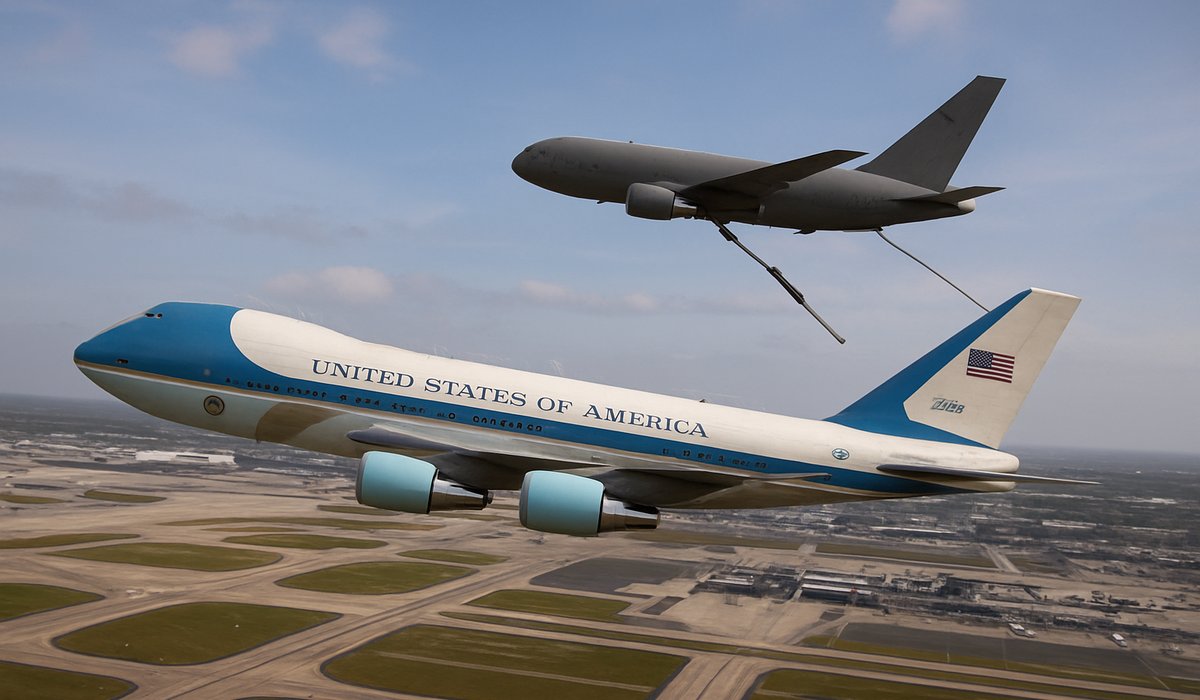
Image generated by AI
Air Force One's In-Flight Refueling Capability Remains Largely Unused Despite Advanced Technology
The presidential Boeing 747 possesses cutting-edge aerial refueling systems, yet operational protocols and security concerns keep the feature grounded
A Technological Marvel Built Into Presidential Aviation
The United States Air Force operates what may be the world's most sophisticated Boeing 747 variant, designated the VC-25A and instantly recognizable by its callsign Air Force One when carrying the sitting President. The aircraft represents decades of aerospace engineering advancement, incorporating systems that extend far beyond civilian aviation specifications. Among its most remarkable—yet underutilized—capabilities is the ability to receive fuel mid-flight from the USAF's extensive fleet of aerial tanker aircraft.
This sophisticated refueling infrastructure, standard across military aviation operations, theoretically grants Air Force One virtually unlimited range and flight endurance. Yet despite possessing this technological advantage, the presidential aircraft almost never engages in mid-air refueling operations. More strikingly, aviation records suggest the aircraft has never performed this maneuver while the President has been aboard.
Why Advanced Capability Goes Largely Unused
The disconnect between capability and practical application stems from multiple operational and security considerations. Presidential flight protocols prioritize redundancy, predictability, and controlled environments—factors that aerial refueling inherently complicates. Rather than relying on mid-air fuel transfers, Air Force One operates under strict flight plans that ensure adequate fuel reserves and predetermined landing slots at military or civilian airports equipped to handle the aircraft's specialized requirements.
Security represents another critical factor. Aerial refueling requires precise coordination with designated tanker aircraft, creating additional exposure windows and complex choreography that security planners seek to minimize. The presidential aircraft's operations demand maximum control over flight parameters and variables—something mid-air refueling introduces unnecessary complexity to achieve.
Operational Priorities Over Technological Capability
Air Force One's actual operations reflect a philosophy prioritizing reliability and controlled conditions over maximum technical capability. The aircraft maintains sufficient fuel capacity for intercontinental missions without refueling, and flight routes are carefully planned to leverage established military and commercial airport infrastructure. This approach eliminates dependency on aerial tanker coordination while maintaining full operational flexibility.
The USAF's broader tanker fleet—including Boeing KC-135 Stratotankers and newer KC-46A Pegasus aircraft—performs extensive mid-air refueling missions supporting military operations globally. However, the presidential aircraft operates under distinct parameters where mission certainty and security considerations outweigh the tactical advantages of aerial refueling.
This dynamic illustrates a fundamental principle in high-security aviation: possessing advanced capabilities does not necessarily mean deploying them operationally when alternative methods provide equivalent or superior outcomes within established security protocols.
Frequently Asked Questions
Does Air Force One actually use mid-air refueling? Despite possessing fully functional aerial refueling systems, Air Force One rarely engages in this operation, and historical records indicate it has never done so with a President aboard.
Why doesn't Air Force One use refueling if it has the capability? Security protocols, operational predictability, and controlled flight planning take precedence. The aircraft's fuel capacity suffices for all standard routes, eliminating the operational need.
How far can Air Force One fly without refueling? The VC-25A can operate intercontinental routes without mid-air refueling, though exact range specifications remain classified for security reasons.
What aircraft can refuel Air Force One? USAF KC-135 Stratotankers and the newer KC-46A Pegasus are equipped to provide aerial refueling to compatible aircraft, though this capability remains unused for the presidential plane.
How does Air Force One compare to commercial Boeing 747s? The VC-25A incorporates military-grade systems, specialized communications equipment, enhanced security features, and aerial refueling capability far beyond standard commercial 747 specifications.
Related Travel Guides
Flight Delay Compensation Guide 2026
Understanding Airline Route Changes
Airport Security Process Updated (2026)
External Resources
Disclaimer
This article is for informational and educational purposes only. It does not constitute legal, financial, or professional advice. While we strive to provide accurate and up-to-date information, travel policies, regulations, and conditions change rapidly. Always verify information with official sources before making travel decisions. Nomad Lawyer makes no representations about the accuracy, reliability, completeness, or suitability of the information provided. Readers should consult qualified professionals for advice specific to their circumstances. The views expressed in this article are those of the author and do not necessarily reflect the views of Nomad Lawyer.
Raushan Kumar
Founder & Lead Developer
Full-stack developer with 11+ years of experience and a passionate traveller. Raushan built Nomad Lawyer from the ground up with a vision to create the best travel and law experience on the web.
Learn more about our team →