
Zayed International Airport U.S. Preclearance Guide: Navigating Terminal A for Abu Dhabi Flights 2026
Master the U.S. border preclearance process at Abu Dhabi's Zayed International Airport Terminal A to land as a domestic passenger and skip long immigration queues in the USA.

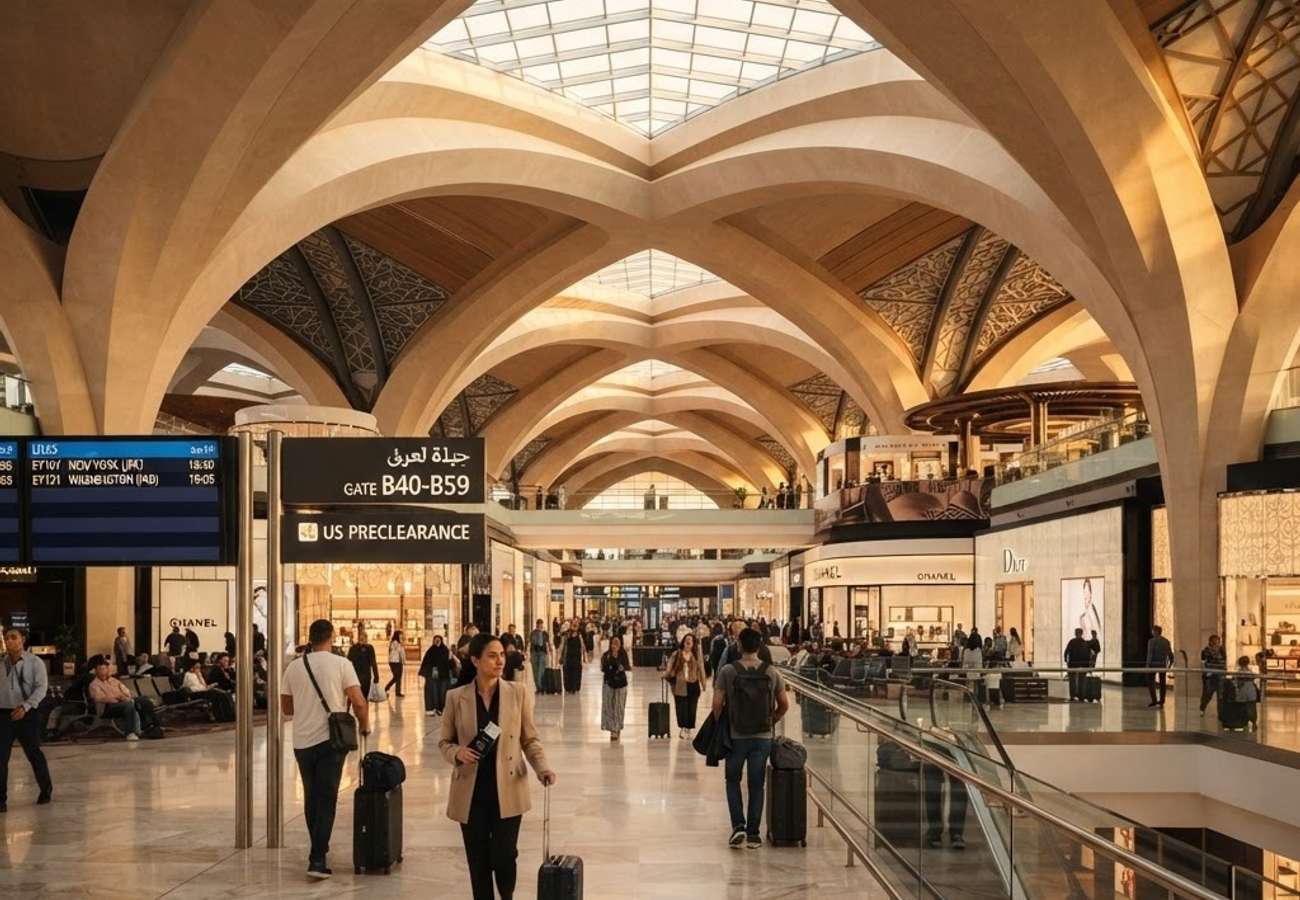
Image generated by AI
Landing in the U.S. as a domestic passenger allows you to bypass the grueling immigration lines at JFK, O'Hare, or Dulles. Abu Dhabi's Zayed International Airport is the only Middle Eastern hub offering this strategic advantage.
Understanding the U.S. Preclearance Mechanism
U.S. border preclearance effectively shifts the immigration and customs process from the destination airport to the point of departure. In Abu Dhabi, this means interacting with U.S. Customs and Border Protection (CBP) officers within Terminal A before your aircraft ever leaves the ground.
Once you successfully clear the CBP checkpoint, you board your flight as a "pre-cleared" passenger. Upon arrival in the United States, you do not need to queue for immigration control. Instead, you exit through a domestic arrivals corridor, providing a seamless transition to connecting flights or ground transport.
This facility primarily serves eligible Etihad Airways routes, including high-traffic gateways such as:
- New York (JFK)
- Chicago (O’Hare)
- Washington (Dulles)
- Select seasonal or secondary U.S. destinations
Note: As of July 2026, some operations have faced temporary suspensions or reduced schedules. It is imperative to verify your flight's preclearance status via Etihad's "Manage Booking" portal or official airport notifications before departure.
Navigating Terminal A to Find the CBP Facility
All commercial operations are now centralized in Terminal A. The U.S. preclearance zone is a secure, segregated area located beyond the main security checkpoints and the primary retail district.
Locating the Checkpoint
Passengers should look for signage marked "USCBP Pre-Clearance" or "U.S. Preclearance" in both English and Arabic. Flight information display screens (FIDS) often provide specific instructions; for instance, an Etihad flight like EY101 to New York may explicitly instruct passengers to proceed to U.S. immigration two hours before departure.
Transit and Walking Times
For those arriving on a connecting flight, the journey involves passing through standard transit security before entering the main departures level.
- Walking Duration: It typically takes 10 to 15 minutes to walk from the central duty-free atrium to the preclearance queue.
- Accessibility: Travelers with mobility challenges or families with young children are encouraged to request wheelchair assistance in advance.
Strategic Planning for Amenities
The preclearance zone is treated as a secure U.S. departures area. Consequently, facilities inside are significantly more limited than in the main terminal. While small kiosks and basic seating exist, full-service dining, luxury boutiques, and major airline lounges are located before the CBP checkpoint. Passengers should complete all shopping and dining before entering the preclearance queue.
Essential Timing and Connection Logistics
The additional layer of immigration requires a more conservative approach to airport arrival times than standard long-haul flights.
Arrival Recommendations
Etihad generally advises passengers starting their journey in Abu Dhabi to arrive four hours before departure. A typical time allocation for economy passengers is as follows:
| Process Stage | Estimated Time |
|---|---|
| Check-in & Baggage Drop | 30 – 45 Minutes |
| Outbound Security | 15 – 30 Minutes |
| U.S. Preclearance Processing | 30 – 60 Minutes |
| Walking to Gate & Boarding | 15 – 20 Minutes |
Connection Windows for Transit Passengers
For those connecting through Abu Dhabi, the margin for error is tighter. A passenger with a 2 hour 15 minute connection to Washington Dulles must account for deplaning (20 mins), walking to the facility (10-15 mins), and CBP processing (20-45 mins).
If you are booking separate tickets (self-transfer) rather than a single through-ticket, a minimum connection window of 3.5 to 4 hours is strongly recommended to account for potential flight delays or extended questioning at the border.
Required Documentation and Compliance
Because the facility is an extension of U.S. soil, all standard U.S. entry requirements apply. Passengers must present:
- A valid passport.
- A valid U.S. visa or an approved ESTA (Electronic System for Travel Authorization).
The process mirrors the arrival experience at a U.S. hub: you will provide fingerprints, have a photograph taken, and answer questions regarding the purpose and duration of your visit. Checked baggage is not collected in Abu Dhabi; it is retrieved upon arrival at the final U.S. destination.
Travelers should treat published airline recommendations as a minimum. During peak periods—specifically late December and early January—it is advisable to arrive at the preclearance area 30 minutes earlier than suggested.
Efficiently navigating the Abu Dhabi preclearance process is the difference between a stressful arrival and a seamless transition into the United States.
Related Travel Guides
Disclaimer
This article is for informational and educational purposes only. It does not constitute legal, financial, or professional advice. While we strive to provide accurate and up-to-date information, travel policies, regulations, and conditions change rapidly. Always verify information with official sources before making travel decisions. Nomad Lawyer makes no representations about the accuracy, reliability, completeness, or suitability of the information provided. Readers should consult qualified professionals for advice specific to their circumstances. The views expressed in this article are those of the author and do not necessarily reflect the views of Nomad Lawyer.
Kunal K Choudhary
Co-Founder & Contributor
A passionate traveller and tech enthusiast. Kunal contributes to the vision and growth of Nomad Lawyer, bringing fresh perspectives and driving the community forward.
Learn more about our team →