
Wizz Routes Link Tri-Border Hub to European Network in 2026
Wizz Air launches multiple new routes from the Maastricht-Aachen-Eindhoven corridor in March 2026, reshaping regional air travel and offering passengers alternatives to congested major hubs.

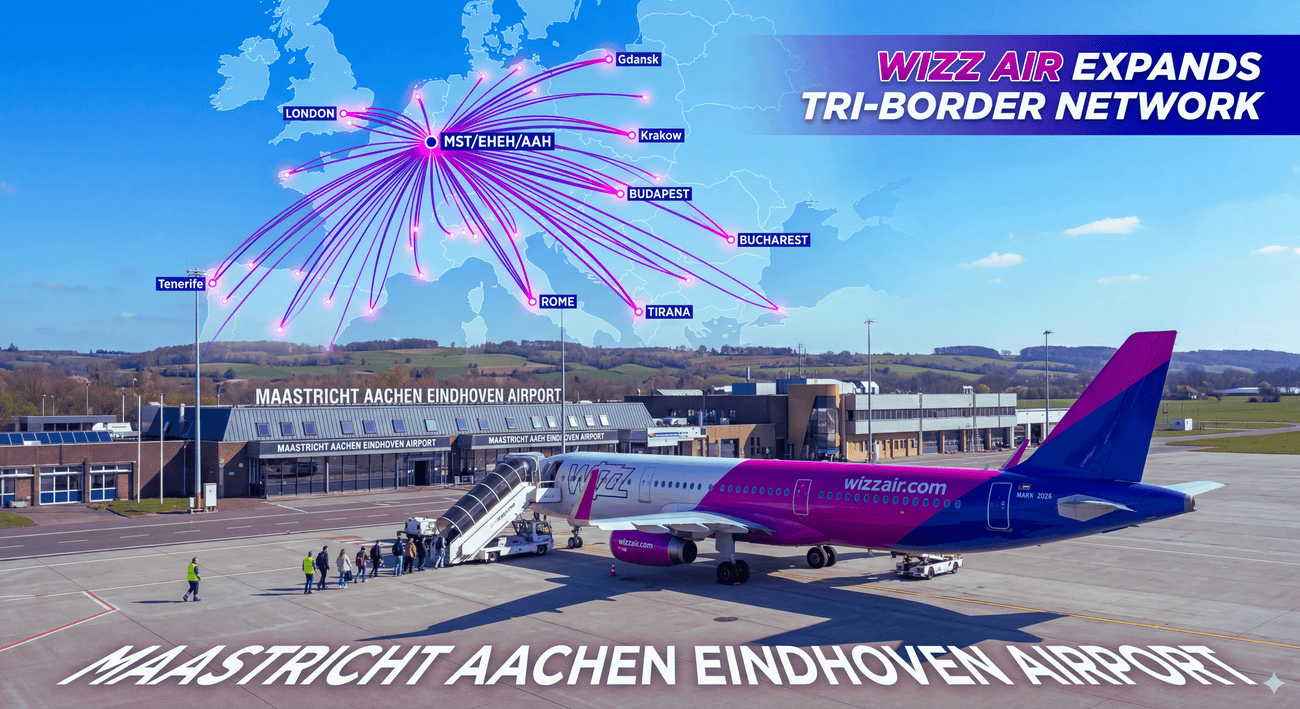
Image generated by AI
**> Quick Summary
- Wizz Air is expanding its network from the Maastricht-Aachen-Eindhoven airport serving the Benelux tri-border region
- Multiple new routes connect the secondary hub to destinations across Europe, reducing reliance on Frankfurt, Amsterdam, and Brussels
- This expansion reflects a broader industry trend toward secondary cities as capacity constraints grip major European airports
- Passengers gain competitive pricing and alternative travel options for regional and long-haul connections**
Why Secondary European Hubs Are Attracting Major Carriers
Europe's aviation landscape is undergoing a fundamental shift. Major airports in Frankfurt, Paris, Amsterdam, and London are operating near or at maximum capacity, creating bottlenecks that ripple across the continent. According to Eurocontrol, European airspace handled record passenger volumes in 2025, with congestion costs climbing into the billions annually.
Low-cost carriers have seized this opportunity. Rather than competing for scarce slots at overloaded hubs, airlines like Wizz Air are strategically positioning themselves at smaller regional airports where infrastructure capacity remains available and slot fees are considerably lower. The Maastricht-Aachen-Eindhoven corridor—a tri-border facility serving the Netherlands, Belgium, and Germany—has emerged as a natural alternative for this strategy.
The economics are compelling. Secondary hubs operate with leaner cost structures, faster turnaround times, and growing passenger catchment areas. As IATA noted in its 2026 aviation forecasts, European air traffic growth will increasingly concentrate at tier-two and tier-three airports rather than traditional megahubs. This dispersion benefits passengers through lower fares and more frequent departures, while enabling airlines to optimize fleet utilization and reduce operational strain.
Wizz Air's Strategic Expansion From the Maastricht-Aachen-Eindhoven Corridor
Wizz Air's move into the Maastricht-Aachen-Eindhoven market represents a calculated expansion of its European footprint. The low-cost carrier, which operates over 800 routes across Europe and beyond, has identified the tri-border region as a high-potential node for both point-to-point travel and connecting passengers seeking alternatives to congested major hubs.
The expansion announcement comes as airlines face mounting pressure to manage operating costs. Rising fuel prices, labor negotiations in key markets, and energy alternatives emerging as a strategic response to Middle East conflict disruptions, have forced carriers to optimize every aspect of their networks. Wizz Air's focus on lean operations and secondary locations allows the airline to maintain competitive fares while expanding capacity.
The Maastricht-Aachen-Eindhoven facility benefits from its strategic geography. Located within a 90-minute drive of major population centers across the Benelux, Germany, and northern France, the airport serves approximately 25 million people within a 200-kilometer radius. This catchment area supports both leisure and business travel demand without the congestion premiums that plague Amsterdam Schiphol or Brussels-Zaventem.
Wizz Air's commitment to the corridor reflects confidence in regional demand recovery. The carrier has historically used secondary hubs as launching pads for network expansion, particularly in Eastern European routes where competition from legacy carriers remains limited.
Route Details and Passenger Impact
The new routes from the Maastricht-Aachen-Eindhoven corridor extend Wizz Air's reach across multiple European destinations. Using FlightRadar24 data, passengers can track these flights in real-time, monitoring schedules and aircraft movements as the network matures.
While specific route details are being rolled out through the first half of 2026, the expansion encompasses both short-haul regional connections and medium-range international destinations. This dual approach serves multiple passenger segments: business travelers seeking quick connections to secondary cities, leisure passengers booking point-to-point flights at budget fares, and connecting passengers who benefit from lower transfer fees compared to traditional megahubs.
The passenger impact extends beyond ticket pricing. Reduced travel time to secondary airports appeals to time-conscious travelers in surrounding regions. Someone traveling from Cologne, Liège, or Aachen itself now has a convenient alternative to crowded Frankfurt or Brussels routes. For residents of the tri-border region, the airport becomes a genuine competitor to larger facilities rather than a secondary option.
Frequency enhancements across the network also improve accessibility. More daily departures mean greater scheduling flexibility, reduced minimum connection times for transfers, and better accommodation for business meetings that require same-day or next-day travel.
Route Details and Network Connectivity
The expansion capitalizes on Wizz Air's broader European strategy. The carrier has built a reputation for identifying underutilized airports with growth potential, investing in marketing and capacity to build passenger volumes. Maastricht-Aachen-Eindhoven represents a natural fit: a modern facility with strong ground infrastructure, favorable operating terms, and a geography that benefits both the airline and surrounding communities.
Connectivity improvements matter significantly for passenger experience. Previously, travelers from the tri-border region often faced limited options when booking connecting flights. With Wizz Air's expanded presence, options multiply. A passenger connecting from a regional departure to a distant European city now enjoys multiple schedule choices and competitive pricing.
The timing also reflects European aviation policy evolution. Recent developments, including Spain's historic decision to close airspace to US warplanes in 2026, signal shifting regulatory frameworks across the continent. Airlines are responding by repositioning networks to align with evolving geopolitical and environmental policies. Maastricht-Aachen-Eindhoven's location and operational flexibility position it well within this changing landscape.
What This Means for European Air Traffic
This expansion signals a broader restructuring of European aviation networks. The centralized hub-and-spoke model that dominated the industry for decades is giving way to a multi-hub approach, with traffic distributing across secondary facilities.
For passengers, competition intensifies at regional level. Instead of choosing between Wizz Air at one megahub and legacy carriers at another, travelers now compare options across multiple airports with varying cost structures and service levels. This competition should pressure all carriers toward more competitive pricing and improved service reliability.
For airport operators, the expansion validates investment in secondary facilities. Maastricht-Aachen-Eindhoven has undergone significant infrastructure improvements over recent years, including expanded terminal capacity and enhanced ground transportation connections. Wizz Air's commitment provides validation that these investments were justified.
For European air traffic management systems, the network rebalancing offers tangible benefits. When passenger loads distribute more evenly across multiple airports rather than concentrating at a few overloaded hubs, the entire system operates more efficiently. Flight delays decrease, fuel consumption optimizes, and environmental impacts of holding patterns and congestion-related inefficiencies diminish.
From a business perspective, this represents calculated risk-taking by Wizz Air. Secondary airports offer lower costs but also smaller captive markets. Success depends on stimulating new demand rather than simply capturing existing passengers from nearby major airports. Wizz Air's track record suggests the
Disclaimer
This article is for informational and educational purposes only. It does not constitute legal, financial, or professional advice. While we strive to provide accurate and up-to-date information, travel policies, regulations, and conditions change rapidly. Always verify information with official sources before making travel decisions. Nomad Lawyer makes no representations about the accuracy, reliability, completeness, or suitability of the information provided. Readers should consult qualified professionals for advice specific to their circumstances. The views expressed in this article are those of the author and do not necessarily reflect the views of Nomad Lawyer.
Raushan Kumar
Founder & Lead Developer
Full-stack developer with 11+ years of experience and a passionate traveller. Raushan built Nomad Lawyer from the ground up with a vision to create the best travel and law experience on the web.
Learn more about our team →