
US, France, and UK Launch Emergency Consular Coalition to Evacuate Stranded Expats Amid Saudi Airspace and Riyadh Airport Shutdown
The US, France, and UK deploy emergency consular support and overland transit routes for stranded expats as Riyadh Airport (RUH) suspends operations through 17 Oct.

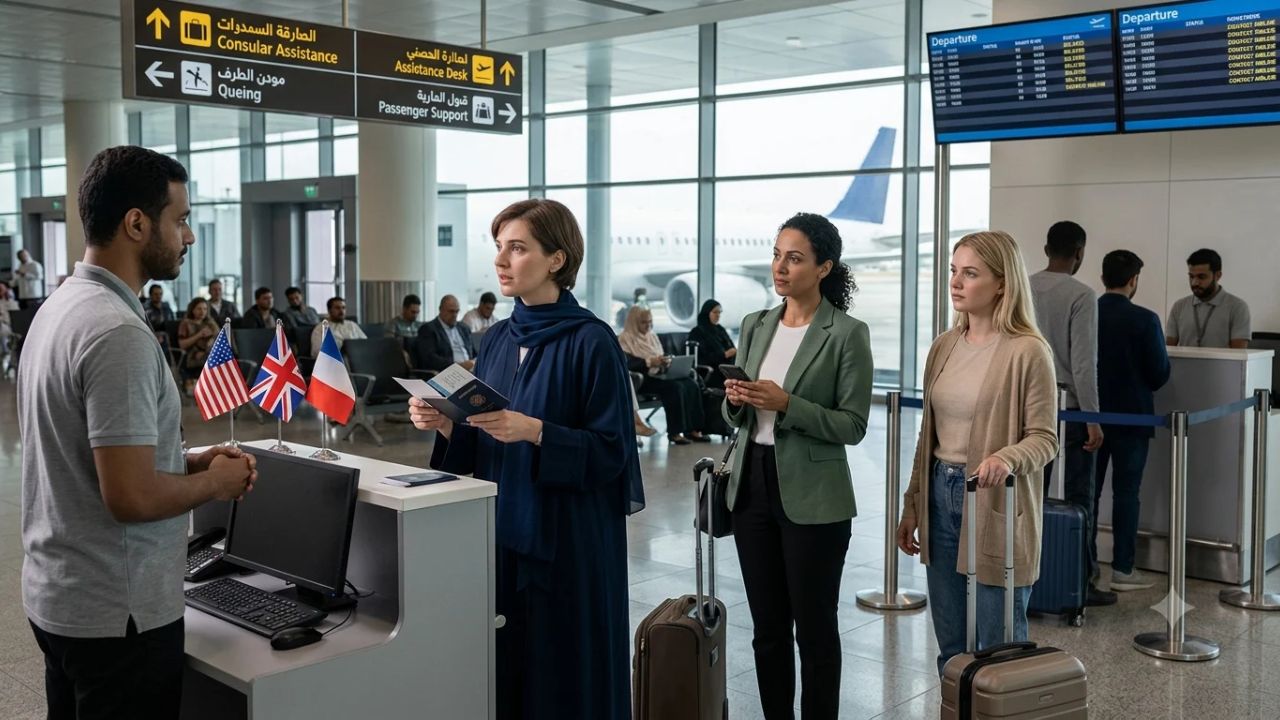
Diplomatic missions from the United States, France, and the United Kingdom have mobilized a coordinated multi-nation crisis coalition to provide 24/7 emergency authorization, consular relief, and overland evacuation routes for hundreds of thousands of foreign expatriates, contract workers, and stranded tourists following the shutdown of King Khalid International Airport (RUH) in Riyadh.
The extraordinary international consular operation follows an official directive from Saudi Arabia's General Authority of Civil Aviation (GACA) extending the operational suspension of Riyadh's primary gateway through at least 17 October 2026.
With regional airspace closures severely restricting outbound flight paths and secondary international gateways in Jeddah and Dammam facing cascading cancellations, Western, Asian, and Gulf Cooperation Council (GCC) embassies are deploying rapid-response teams to facilitate overland transit across neighboring borders.
===================================================================================
     SAUDI ARABIA CRISIS DIPLOMATIC & AIRSPACE SUSPENSION MATRIX 2026
===================================================================================
 [PRIMARY AIRPORT STATUS & OPERATIONAL DISRUPTIONS]
  * King Khalid International Airport (RUH), Riyadh: Fully suspended through 17 October.
  * King Abdulaziz International Airport (JED), Jeddah: Open with severe rolling delays.
  * King Fahd International Airport (DMM), Dammam: Open with severe congestion & cancellations.
  * Regional Airspace Status: Civil aviation corridors restricted under GACA safety orders.

 [CHIEF OF MISSION "SPECIAL AUTHORIZATION" MANDATES]
  * US Government Personnel: Mandatory Chief of Mission clearance before using any airport.
  * Red-Line Exclusion Zones: Travel prohibited within 20 miles (32 km) of the Yemen border.
  * High-Risk Restricted Provinces: Prior approval required for Jizan, Asir, and Najran,
    as well as municipal districts in Qatif, Yanbu, and Taif.
  * Civilian Support Mandate: 24/7 emergency passports, border waivers, and overland corridors.

 [NEIGHBORING OPERATIONAL RE-ROUTING HUBS]
  * Bahrain International (BAH), Dubai (DXB), Abu Dhabi (AUH), Doha (DOH), Amman (AMM).
===================================================================================
The Core Crisis: Airspace Restrictions and Kingdom-Wide Airport Suspensions
The current travel crisis escalated following aerial security incidents across the Arabian Peninsula that prompted Saudi aviation regulators to seal key flight sectors.
The indefinite operational pause at King Khalid International Airport in Riyadh—the central aviation hub for the Kingdom's corporate, diplomatic, and governmental sectors—has severed direct air links for millions of foreign residents.
SAUDI ARABIA PRIMARY INTERNATIONAL AIRPORT STATUS
| AIRPORT NAME & LOCATION | IATA CODE | OPERATIONAL STATUS | PASSENGER IMPACT |
|---|---|---|---|
| King Khalid Intl, Riyadh | RUH | SUSPENDED | Operations halted |
| through 17 October | through Saturday | ||
| King Abdulaziz, Jeddah | JED | OPEN (Severe | Backlogs; long-haul |
| Disruptions) | re-routings to Europe | ||
| King Fahd, Dammam | DMM | OPEN (Severe | Congested; Gulf feeder |
| Disruptions) | flight delays | ||
| Prince Mohammad, Medina | MED | LIMITED | Priority domestic & |
| (Restricted) | religious charter flow |
While secondary gateways like King Abdulaziz International Airport in Jeddah and King Fahd International Airport in Dammam continue to operate, they are dealing with intense terminal gridlock.
Airlines from Europe, North America, and East Asia have diverted or canceled scheduled services due to shifting airspace advisories, leaving travelers unable to secure outbound commercial tickets.
Clarifying "Special Authorization" Mandates for Diplomatic and Civilian Personnel
To safeguard personnel operating within high-threat environments, the U.S. Mission to Saudi Arabia issued an official security directive establishing strict internal movement controls while defining assistance channels for private citizens.
U.S. CHIEF OF MISSION TRAVEL RESTRICTIONS & SCOPE
| Entity / Route | Metrics | Operational Status |
|---|---|---|
| DIRECTIVE CATEGORY | MANDATORY PROTOCOL | APPLICABLE POPULATION |
| Airport Departure Vetting | Explicit Chief of Mission | Official U.S. Mission |
| authorization required prior to | employees and direct- | |
| booking or boarding flights | hire dependents | |
| Southern Border | Strict travel ban within | All U.S. government |
| Exclusion Zone | 20 miles (32 km) of Yemen | personnel and military |
| international frontier | liaisons | |
| Restricted Administrative | Mandatory prior clearance for | Official personnel; |
| Districts | Jizan, Asir, Najran provinces, | private citizens |
| and Qatif, Yanbu, and Taif | urged to avoid | |
| Private Citizen Support | 24/7 emergency passports, | U.S. private citizens, |
| ("All-Time" Assistance) | legal guidance, and overland | expatriates, dual- |
| evacuation coordination | nationals, and tourists |
Distinguishing Official Clearances from Civilian Support
Confusion arose among expatriate communities regarding whether private travelers require "special authorization" to exit Saudi Arabia. Consular officials clarified the policy:
- Official Personnel: U.S. government employees, military attaches, and diplomatic dependents are legally barred from boarding flights at any Saudi airport without case-by-case clearance signed by the Chief of Mission.
- Private Citizens and Expatriates: Civilian travelers do not need Chief of Mission clearance to travel or depart. Instead, diplomatic missions are providing round-the-clock ("all-time") consular services, including issuing same-day emergency passports, arranging cross-border transit documents, and coordinating escorted road convoys to neighboring GCC territories.
Multi-Nation Consular Taskforces: Country-by-Country Relief Operations
Recognizing the logistical scale of assisting millions of foreign nationals residing across the Kingdom, allied governments have formed coordinated emergency taskforces.
===================================================================================
     GLOBAL EMBASSY EMERGENCY RESPONSE TASKFORCES IN SAUDI ARABIA
===================================================================================
 [UNITED STATES: EMBASSY RIYADH & CONSULATES JEDDAH / DHAHRAN]
  * American Citizen Services (ACS) 24/7 Hotline: +966 11 510 3731.
  * Smart Traveler Enrollment Program (STEP): Broadcasts encrypted security updates.
  * Core Deliverables: Instant biometric emergency passport issuance, legal monitoring
    for detained nationals, and direct logistical coordination for overland exits.

 [UNITED KINGDOM & EUROPEAN UNION PARTNERS: FRANCE, GERMANY, ITALY]
  * 24/7 Rapid-Deployment Consular Desks: Stationed at major hotel clusters in Riyadh.
  * Emergency Travel Documents (ETD): Fast-tracked for citizens whose original passports
    are held by sponsors or expired during terminal shutdowns.
  * Regional Rerouting: Guiding Europeans toward rail links connecting to Bahrain and UAE.

 [INDIA: EMBASSY RIYADH & CONSULATE GENERAL JEDDAH]
  * 24/7 Emergency Helpline: Toll-Free 8002471234 / WhatsApp: +966 536216082.
  * Hospital & Airport Liaison Officers: On-ground personnel assisting blue-collar
    workers, issuing emergency certificates (white passports), and arranging food aid.
  * Community Shelter Networks: Partnering with Indian community welfare organizations.

 [GCC ALLIANCE: UAE, BAHRAIN, QATAR, OMAN, JORDAN]
  * Open Transit Hubs: Bahrain (BAH), Dubai (DXB), Abu Dhabi (AUH), Doha (DOH), Amman (AMM).
  * Fast-Track Border Protocols: Expedited visa issuance at land frontier posts.

 [SOUTHEAST ASIA: PHILIPPINES, BANGLADESH, PAKISTAN]
  * Ministry of Interior Visa Extensions: Direct liaison with the General Directorate
    of Passports (Jawazat) to waive overstay penalties for cancelled flight tickets.
===================================================================================
EMBASSY EMERGENCY CONTACTS & OPERATIONAL DIRECTORY
| Entity / Route | Metrics | Operational Status |
|---|---|---|
| MISSION / ALLIANCE | PRIMARY 24/7 EMERGENCY CONTACT | SPECIALIZED ASSISTANCE |
| United States Mission | Phone: +966 11 510 3731 | Chief of Mission travel |
| [email protected] | vetting; emergency PPT | |
| British Embassy Riyadh | Phone: +966 11 481 9100 | Emergency travel docs; |
| [email protected] | overland transit advice | |
| French Embassy Riyadh | Phone: +966 11 434 4100 | European repatriation |
| admin-francais.riyad-amba@mae | desk; medical triage | |
| Indian Embassy Riyadh | Toll-Free: 8002471234 | 24/7 WhatsApp desk; |
| WhatsApp: +966 536216082 | Jawazat exit clearance | |
| Philippines Embassy | Hotline: +966 56 907 3342 | Overseas worker shelter |
| Dedicated POLO Emergency Desk | food & ticket waivers |
Structured Overland Transit Corridors: Rail, Bus, and Border Exit Routes
With air operations out of Riyadh halted through 17 October, diplomatic missions are advising foreign nationals to utilize structured ground transportation corridors to reach open international aviation hubs in Eastern Saudi Arabia or neighboring GCC nations.
STRUCTURED OVERLAND TRANSIT CORRIDORS OUT OF RIYADH
| CORRIDOR ROUTE | OPERATING CARRIERS | TRANSIT TIME & BORDER |
|---|---|---|
| Corridor 1: Riyadh to | Saudi Arabia Railways (SAR) | 3.5 hours rail to |
| Eastern Province & | + Taxi across King Fahd | Dammam; 1 hour road to |
| Bahrain | Causeway | Manama (BAH Airport) |
| Corridor 2: Riyadh to | SAPTCO / SAT Regional Express | 5.5 hours road to Al |
| United Arab Emirates | Coaches to Al Batha Border | Ghuwaifat; direct to |
| Abu Dhabi & Dubai | ||
| Corridor 3: Riyadh to | SAPTCO Intercity Coaches | 4.5 hours road to |
| Qatar via Salwa | to Salwa Border Post | Salwa; direct transit |
| to Doha (DOH Airport) | ||
| Corridor 4: Riyadh to | SAR High-Speed to Jeddah; | 4.5 hours rail; |
| Red Sea Gateways | Domestic coach connections | departures via JED |
===================================================================================
      OVERLAND STEP-BY-STEP EVACUATION PROTOCOL VIA KING FAHD CAUSEWAY
===================================================================================
 [STAGE 1: HIGH-SPEED RAIL DEPARTURE FROM RIYADH]
  * Book passenger tickets on Saudi Arabia Railways (SAR) departing from Riyadh
    Railway Station to Dammam or Hofuf.
  * High-speed passenger trains operate multiple daily services (journey: ~3h 30m).

 [STAGE 2: ROAD CONNECTION ACROSS THE CAUSEWAY TO BAHRAIN]
  * From Dammam or Al Khobar, arrange an authorized cross-border taxi or SAPTCO
    cross-causeway coach across the 25-kilometre King Fahd Causeway.
  * Ensure all passengers have valid passports, electronic transit visas, or GCC
    residence permits to enter the Kingdom of Bahrain.

 [STAGE 3: ONWARD INTERNATIONAL FLIGHT CONNECTIONS]
  * Arrive at Bahrain International Airport (BAH) in Manama.
  * Major international carriers—including Gulf Air, British Airways, Emirates,
    Lufthansa, and Air India—continue normal flight operations from Bahrain.
===================================================================================
High-Speed Rail Integration via Saudi Arabia Railways (SAR)
Saudi Arabia Railways (SAR) continues operating full passenger services along the North-South and East-West corridors.
The eastern mainline provides reliable high-speed rail transit connecting central Riyadh directly with Al Hofuf and Dammam.
From Dammam, passengers can transfer directly by authorized cross-border coaches across the King Fahd Causeway into Bahrain in approximately 60 minutes.
Road Transit Providers: SAPTCO and SAT Operations
For long-distance highway travel toward the UAE or Qatar, intercity bus networks operated by the Saudi Public Transport Company (SAPTCO) and SAT Transportation remain in active service.
Daily scheduled express coaches depart from Riyadh’s Aziziya central station to the Al Batha border post (for transit into the UAE toward Abu Dhabi and Dubai) and the Salwa border crossing (for onward travel to Doha, Qatar).
Mandatory Local Security Protocols and Legal Restrictions
All diplomatic missions emphasize that foreign nationals must strictly adhere to Saudi legal statutes and defense instructions while navigating travel disruptions:
CRITICAL SECURITY DIRECTIVES FOR FOREIGN NATIONALS
| Column 1 |
|---|
| 1. STRICT PROHIBITION ON DEFENSE & MILITARY PHOTOGRAPHY |
| * The Ministry of Interior strictly prohibits photographing, filming, or |
| publishing imagery of military equipment, missile defense batteries (e.g., |
| Patriot surface-to-air systems), defense personnel, government buildings, |
| or debris impact zones. |
| * PENALTY: Violators face immediate arrest, prolonged detention, and prosecution |
| under strict anti-cybercrime and state security laws. Several foreign |
| citizens have already been detained for taking unauthorized smartphone photos. |
| 2. FOLLOW CIVIL DEFENSE EMERGENCY BROADCASTS |
| * Keep smartphones active to receive national emergency broadcasts transmitted |
| by the General Directorate of Civil Defense. |
| * If sirens sound, seek shelter in reinforced interior rooms or basements away |
| from exterior windows and glass facades. |
| 3. VERIFY FLIGHTS DIRECTLY BEFORE TRAVELING TO AIRPORTS |
| * Do NOT travel to King Khalid International Airport (RUH) in Riyadh. |
| * For flights departing Jeddah (JED) or Dammam (DMM), obtain direct digital |
| confirmation from operating airlines before heading to passenger terminals. |
Emergency Visa Extension and Legal Compliance for Trapped Expats
Tens of thousands of foreign tourists, business travelers, and contract workers face the imminent expiration of their standard tourist visas, single-entry business permits, or final exit visas (Khuruj Nihai) due to flight suspensions.
Under normal regulations, overstaying an authorized exit visa incurs daily financial penalties and administrative deportation bans.
However, through diplomatic coordination between foreign embassies and the Saudi Ministry of Interior, the General Directorate of Passports (Jawazat) has implemented an emergency relief mechanism:
JAWAZAT EMERGENCY VISA EXTENSION WORKFLOW
| Entity / Route | Metrics | Operational Status |
|---|---|---|
| APPLICABLE CATEGORY | REGULATORY EXTENSION PROCEDURE | DOCUMENTATION REQUIRED |
| Tourist Visa Holders | Automatic online extension via | Expired visa copy; |
| (eVisa / VoA) | the Absher individual platform | cancelled flight proof |
| Final Exit Visa Workers | Employer / sponsor must apply | Letter from sponsor; |
| (Khuruj Nihai) | through the Muqeem portal for | airline cancellation |
| a temporary 14-day grace slip | certificate | |
| Business Visit Visas | Embassy consular note submitted | Official note verbale; |
| directly to Ministry of Foreign | passport copy; valid | |
| Affairs (MOFA) protocol desk | commercial registry |
Foreign nationals facing expired permits should request written cancellation certificates from their booked airlines.
These certificates protect travelers against overstay fines at border inspection posts when departing by road through the King Fahd Causeway or Al Batha.
Frequently Asked Questions
Why did the US, UK, and France issue special alerts for Saudi Arabia?
Allied diplomatic missions mobilized following the shutdown of King Khalid International Airport (RUH) in Riyadh through 17 October 2026, airspace restrictions, and airport congestion, leaving foreign expatriates and tourists in need of consular assistance and overland evacuation routes.
Do private citizens need "Special Authorization" from the Chief of Mission to leave?
No. Chief of Mission special authorization is an internal mandatory directive applying strictly to official U.S. government personnel. Private citizens, contractors, and tourists do not require Chief of Mission approval to travel or depart Saudi Arabia.
How can travelers stranded in Riyadh exit the country while flights are suspended?
Travelers can utilize high-speed rail via Saudi Arabia Railways (SAR) from Riyadh to Dammam, followed by road transit across the King Fahd Causeway into Bahrain to catch onward international flights from Bahrain International Airport (BAH), or take coaches to the UAE and Qatar.
What are the legal penalties for filming military operations or defense systems?
Filming, photographing, or publishing images of air defense systems, military installations, or impact sites is strictly prohibited under Saudi anti-cybercrime and state security laws. Violators face immediate detention, criminal prosecution, and deportation.
Related Travel Guides
Disclaimer
This article is for informational and educational purposes only. It does not constitute legal, financial, or professional advice. While we strive to provide accurate and up-to-date information, travel policies, regulations, and conditions change rapidly. Always verify information with official sources before making travel decisions. Nomad Lawyer makes no representations about the accuracy, reliability, completeness, or suitability of the information provided. Readers should consult qualified professionals for advice specific to their circumstances. The views expressed in this article are those of the author and do not necessarily reflect the views of Nomad Lawyer.
Raushan Kumar
Founder & Lead Developer
Full-stack developer with 11+ years of experience and a passionate traveller. Raushan built Nomad Lawyer from the ground up with a vision to create the best travel and law experience on the web.
Learn more about our team →