US Aviation Squeeze: 1,685 Delays and 84 Cancellations Hit Chicago O’Hare, Los Angeles, and Phoenix

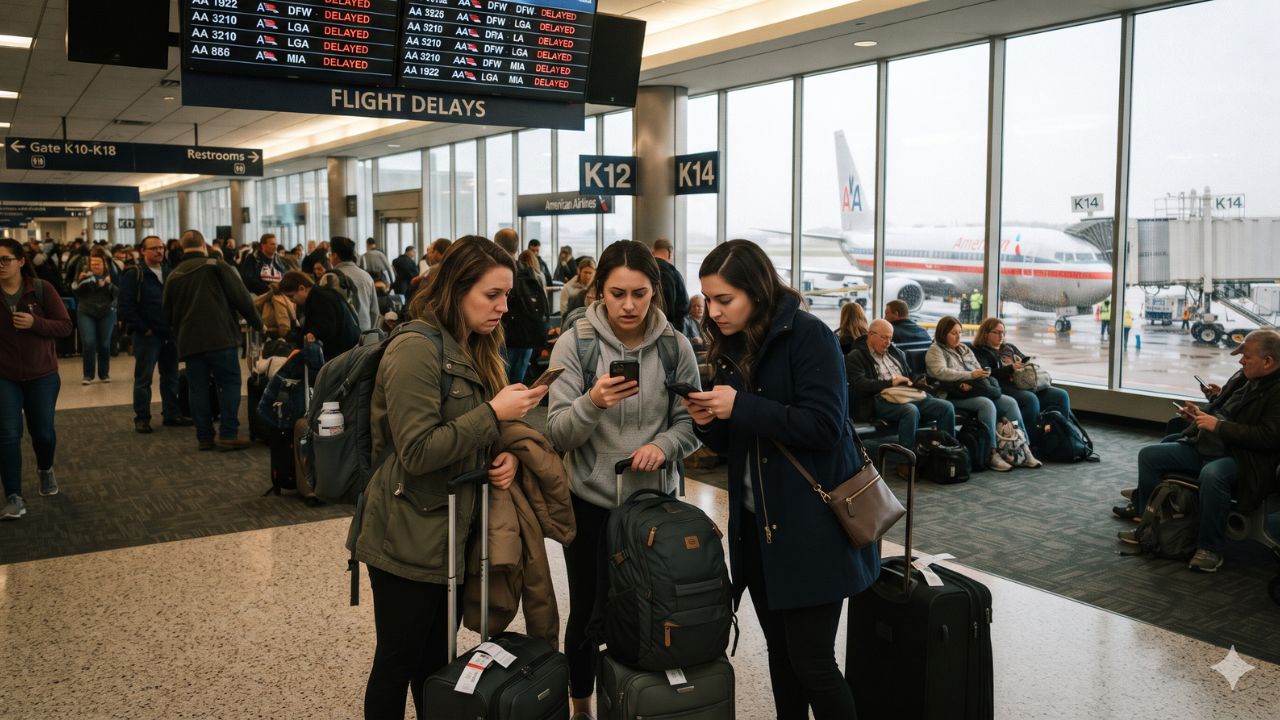
Image generated by AI
While air travelers typically blame winter blizzards or severe summer thunderstorms for nationwide gridlock, autumn aviation bottlenecks across the United States are increasingly sparked by air traffic control staffing shortages inside key control towers. On 28 October 2026, real-time FlightAware tracking evaluated at 5:20 pm ET logged 1,685 flight delays and 84 cancellations across the national airspace system. Rather than severe regional weather fronts, friction built around federal air traffic control staffing triggers that prompted formal ground stops at Newark Liberty International Airport (EWR) and Teterboro Airport (TEB) in northern New Jersey. The resulting hold orders rippled west across primary connecting crossroads in Chicago, Los Angeles, and Phoenix, leaving thousands of domestic and international travelers managing missed connections, stranded luggage, and multi-hour concourse waits.
Cascading Holds: How East Coast Ground Stops Snarl Transcontinental Flights
The domino effect of East Coast airspace management was visible across major hubs from the Great Lakes to the Pacific coast. When the Federal Aviation Administration issued staffing-related ground stops for Newark and Teterboro—two critical nodes in the crowded New York metropolitan airspace—inbound aircraft were held at departure gates nationwide. This immediate metering of departures trapped long-haul planes at gate bridges, depriving downstream airports of incoming equipment and flight crews.
Chicago O’Hare International Airport (ORD) logged the highest delay volume of any American airport, reporting 134 delayed flights, accompanied by a 4% departure delay rate and a 5% arrival delay rate. As the primary dual-carrier connecting hub for United Airlines and American Airlines, delayed arrivals in Chicago severed tight forty-minute regional connections, stranding passengers bound for smaller secondary cities across the Upper Midwest. On the West Coast, Los Angeles International Airport (LAX) registered 100 delays alongside a 5% departure delay rate and a 6% arrival delay rate, as transcontinental widebodies arriving late from the Atlantic seaboard held up international Pacific rotations. In the Southwest, Phoenix Sky Harbor International Airport (PHX) recorded 92 delays, noting a 6% departure delay rate and a 5% arrival delay rate. Secondary regional hubs registered parallel friction: Anchorage International (ANC) logged 49 delays; San Diego International (SAN) recorded 47 delays; Tampa International (TPA) registered 34 delays; and Milwaukee Mitchell (MKE) reported 12 delays.
Among domestic airline operators, Southwest Airlines absorbed the heaviest operational hit, recording 319 delays across its point-to-point network. Because Southwest’s fleet operates rapid thirty-minute gate turns without traditional hub-and-spoke buffers, mid-morning ground holds quickly compounded across multiple subsequent legs. American Airlines followed with 279 delays, while United Airlines recorded 117 delays. Regional feeder SkyWest Airlines registered 96 delays, and Pacific Northwest specialist Alaska Airlines logged 58 delays.
Contrasting Gateways: O’Hare Crossings, Pacific Terminals, and Desert Corridors
Experiencing extended flight delays exposes the distinctive geographic character and operational pace of America's primary transit gateways.
Chicago O’Hare represents the quintessential American industrial transit factory. Spanning four vast domestic and international terminal complexes, O’Hare’s subterranean passenger tunnels—illuminated by the iconic neon kinetic light sculpture between Concourses B and C—echo with continuous boarding announcements and rolling luggage wheels. When flights freeze, travelers congregate around local culinary institutions, seeking out classic Chicago tavern-style thin-crust pizza or Italian beef sandwiches steeped in savory au jus, taking in the architectural spirit championed by Choose Chicago.
Los Angeles International (LAX) offers a completely contrasting coastal environment. Set directly beside the Pacific surf of Dockweiler Beach, LAX’s historic Theme Building overlooks a horseshoe of nine individual terminals connected by congested exterior access roadways. Facing three-hour layover delays here means watching transpacific Boeing 777s and Airbus A350s lift off into coastal marine haze while enjoying fresh California avocado bowls, taking advantage of the diverse coastal culture celebrated by Discover Los Angeles.
Phoenix Sky Harbor (PHX), situated in the Salt River Valley, operates with desert efficiency. Its open, sundrenched terminals feature native desert stone finishes, giant saguaro cactus displays, and panoramic views of Camelback Mountain. The dry desert air and bright light provide a calming antidote to travel stress, with passengers savoring green-chile tamales and prickly pear iced teas at local concession stands supported by Visit Phoenix.
Detailed Disruption Metrics: Impacted Airports and Airline Carriers
The operational figures below summarize the verified delay distribution recorded across United States airports and commercial carriers on 28 October 2026:
| Airport Facility | Metropolitan Area | Flight Delays | Departure Delay Rate | Arrival Delay Rate |
|---|---|---|---|---|
| Chicago O’Hare (ORD) | Chicago, Illinois | 134 | 4% | 5% |
| Los Angeles International (LAX) | Los Angeles, California | 100 | 5% | 6% |
| Phoenix Sky Harbor (PHX) | Phoenix, Arizona | 92 | 6% | 5% |
| Anchorage International (ANC) | Anchorage, Alaska | 49 | Moderate holds | Sub-arctic connections |
| San Diego International (SAN) | San Diego, California | 47 | Coastal slot control | Pacific arrivals hold |
| Tampa International (TPA) | Tampa, Florida | 34 | Gulf Coast feeders | Eastern corridor holds |
| Milwaukee Mitchell (MKE) | Milwaukee, Wisconsin | 12 | Regional delays | Midwest satellite hub |
Airlines managing the largest volume of delayed passenger operations included:
| Airline Operator | Flight Delays Recorded | Operational Model | Key Impact Region |
|---|---|---|---|
| Southwest Airlines | 319 | Point-to-point network | Systemwide rolling turn holds |
| American Airlines | 279 | Hub-and-spoke system | Chicago, Charlotte, and Dallas hubs |
| United Airlines | 117 | Transcontinental trunk routes | Newark, O'Hare, and Denver hubs |
| SkyWest Airlines | 96 | Regional feeder carrier | Midwest and Western affiliate flights |
| Alaska Airlines | 58 | West Coast trunk carrier | Seattle, Anchorage, and California routes |
Visitor Insider Tips for Navigating Chicago, Los Angeles, and Phoenix During Delays
Seasoned travelers know that enduring long domestic delays requires proactive strategies to escape crowded terminal seating:
- Chicago O’Hare Layover Escapes via the Blue Line: If your connecting flight at O’Hare is delayed by four hours or more, do not stay trapped in Terminal 1 or 3 gate holding areas. Walk down to the lower level of the main parking garage and board the Chicago Transit Authority (CTA) Blue Line train. In roughly thirty minutes for five dollars, you can reach the Logan Square or Wicker Park neighborhoods, where you can browse independent bookstores and order authentic handmade pierogi in the historic Polish Triangle before taking the train back.
- Escaping the LAX Horseshoe: Avoid hiring rideshares that get trapped in the infamous "LAX-it" vehicular bottleneck. If you have an extended layover, take the free shuttle to the Sepulveda Boulevard hotel corridor, or walk fifteen minutes to the In-N-Out Burger on West 92nd Street. Here, you can sit on the outdoor patio directly beneath landing widebodies on Runway 24R, turning a stressful delay into world-class aviation spotting.
- Phoenix Sky Train to Downtown Light Rail: At Phoenix Sky Harbor, take the automated, free PHX Sky Train directly from Terminal 3 or 4 to the 44th Street transit station. Transfer immediately to the Valley Metro Light Rail, which brings you into Downtown Phoenix in fifteen minutes. Walk along Roosevelt Row to explore local street murals, specialty coffee roasters, and craft breweries, avoiding overpriced terminal food courts completely.
- Newark and Teterboro Airspace Monitoring: When flying into or out of the New York metropolitan region, monitor the official Federal Aviation Administration operational status dashboard directly on your smartphone. Ground stops due to staffing constraints are frequently published online thirty to sixty minutes before airlines update their internal gate monitors, giving you a valuable head start on phone rebooking lines.
Cultural and Environmental Context: Air Traffic Staffing and Megacity Infrastructure Pressures
The recurring vulnerability of American commercial aviation to staffing constraints highlights structural pressures within national transit infrastructure. Following pandemic-era early retirements, federal training academies face long training cycles to certify radar controllers for complex terminal radar approach control (TRACON) sectors, particularly in crowded regional airspaces like New York and Northern California. When a single facility experiences temporary staffing shortages, safety protocols mandate widening aircraft spacing intervals, triggering immediate ground holds across the continent.
Simultaneously, idling passenger aircraft generate substantial environmental footprints. Hundreds of airliners burning jet fuel while taxiing on holding pads at O'Hare, Newark, and LAX elevate localized carbon monoxide and nitrogen oxide emissions around neighboring residential areas. Modernizing air traffic infrastructure through satellite-based NextGen routing and implementing sustainable surface management tools remain essential national priorities to prevent routine operational friction from paralyzing continental mobility.
FAQ: Managing US Flight Delays and Ground Stops 2026
What compensation is legally required for domestic US flight delays? Unlike Europe, US Department of Transportation rules do not mandate cash compensation for domestic flight delays. However, major US airlines commit to providing meal vouchers for delays over three hours and hotel accommodation for controllable overnight delays.
How do FAA staffing ground stops affect passenger flights? When the FAA issues staffing ground stops at hubs like Newark, aircraft bound for that airport are held on the ground at their departure cities, causing rolling delays across downstream flight legs nationwide.
What is the fastest way to rebook a delayed connection? Use the airline’s mobile smartphone application or self-service airport kiosks instead of waiting in customer service queues. Alternatively, message the airline’s official customer support channels on social platforms or call international helpline desks for faster pickup times.
Can passengers leave the airport during domestic layover delays? Yes. For domestic US flights, travelers can exit through security at any time. Ensure you carry your boarding pass and government ID, and allow ample time to clear TSA screening upon returning.
From the icy lake breezes off Michigan Avenue to the warm dusk descending over the Sonoran Desert, navigating nationwide travel delays is all about local timing, cool patience, and knowing when to step beyond the terminal doors.
Related Travel Guides
Middle East Aviation Shockwave: 108 Cancellations and 1,056 Delays Hit Jeddah, Dubai, and Gulf Hubs
The 10 Best Things to Do Near Chicago O'Hare During a Layover, According To Reddit
This article is for informational purposes. Flight routes, passenger regulations, visa rules, and transit advisories are subject to change by airlines and aviation authorities. Readers are advised to verify schedules and travel documentation with relevant carriers and border agencies before departure.
Related Stories
American Airlines Issues Profit Warning as Fuel Costs Surge: What It Means for 2027 International Travelers
Air Canada Retracts Five US Routes in Summer 2027 Network Rebalancing Across Toronto, Montréal, and Vancouver