US Airport Construction Guide: Road Closures, Pickups, and Shuttles at LAX, JFK, Denver, and Houston

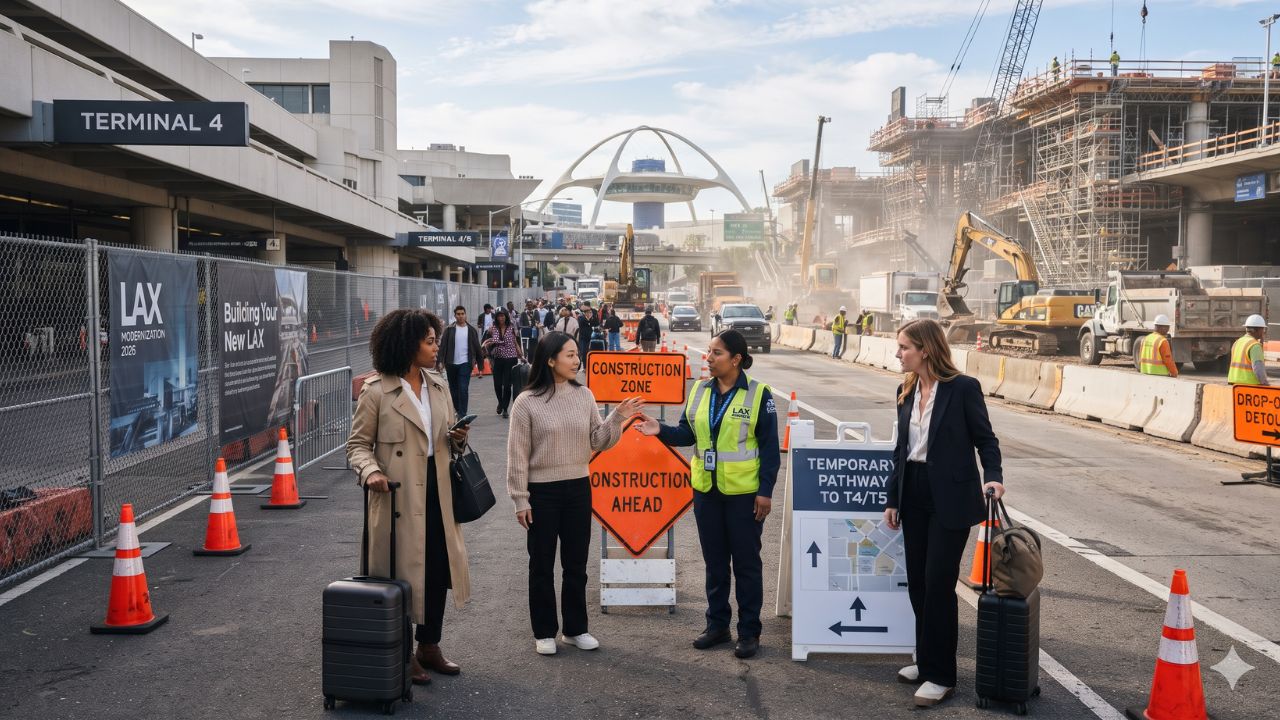
While catching a flight at New York’s JFK or Houston Intercontinental historically meant pulling up directly to the departures curb, multi-billion-dollar infrastructure redevelopments across the United States now require arriving passengers at JFK Terminals 5 and 7 to take the AirTrain to Howard Beach just to meet their rideshare driver. From nocturnal lane closures along Century Boulevard outside Los Angeles International Airport to reconfigured drop-off bridges at Denver’s Jeppesen Terminal, travelers across the country face modified terminal entrances, relocated pickup lots, and altered airline check-in lobbies, detailed in real-time transit bulletins published by Los Angeles World Airports.
Across the United States, airport authorities are modernizing mid-century facilities to accommodate historic passenger volumes. However, these multi-year engineering projects are creating temporary ground transportation obstacles. Travelers who arrive assuming standard drop-off routines remain intact risk missing flight departures due to closed curbside lanes, detoured shuttles, and remote passenger collection points.
The Modernization Crunch: Why America's Busiest Gateways Are Under Construction
The widespread ground-side disruptions stem from necessary infrastructure modernization programs. Across major aviation hubs, aging road networks designed in the 1960s cannot support modern rideshare volumes, delivery fleets, and public transit connections. Airports are overhauling elevated roadways, constructing automated people mover train corridors, expanding central terminal lobbies, and replacing obsolete terminals with expansive unified concourses.
Because these busy gateways cannot halt flight operations during construction, airport engineers must execute complex phased traffic diversions. Roadway modifications range from nocturnal lane shutdowns to permanent relocations of taxi and app-based pickup zones. Understanding whether an airport requires a monorail transfer, an off-site shuttle bus, or an alternative terminal check-in counter is now essential before setting foot in a vehicle.
| Airport Gateway | Infrastructure Project | Primary Roadway & Passenger Impact | Shuttle & Transfer Requirements | Project Status & Operating Window |
|---|---|---|---|---|
| Los Angeles International (LAX) | Central Terminal Area departures-level modernization | Phased curb, lane, and ramp restrictions on upper level | Free LAX Budget Parking shuttle; no universal passenger shuttle | Autumn 2026 through late 2027 |
| John F. Kennedy International (JFK) | Multi-terminal overhaul (New Terminal One & Terminal 6) | Reconfigured roadway access to Terminals 1 and 4 | Terminals 5 & 7 rideshares relocated to Howard Beach via AirTrain | Phased openings beginning in 2026 |
| Denver International (DEN) | Jeppesen Terminal Great Hall renovation | South Level 6 departures curb and pedestrian bridge closed | Passengers must use airline-side drop-off; no replacement bus | South Level 6 bridge reopens before Thanksgiving 2026 |
| George Bush Intercontinental (IAH) | Terminal B redevelopment & modernization | Terminal B ticketing lobby closed; check-in at Terminal C | Terminal transit via Skyway; optional United terminal shuttle | Terminal B lobby closure continues through late 2026 |
| Hartsfield-Jackson Atlanta (ATL) | South Deck parking construction | South upper-level roadway merged into single exit lane | Relocated lower-level shuttle zones for ParkATL and off-airport lots | Initial restrictions scheduled March 2026 |
| San Francisco International (SFO) | West Field Road & international roof projects | Nighttime road closures and temporary AirTrain Red Line interruption | Past replacement shuttle operated to Garage G/BART | AirTrain resumed 3 Oct; road reopened 10 Oct 2026 |
| Charlotte Douglas (CLT) | Terminal lobby expansion & roadway reconfiguration | Realigned upper-level departures and lower-level commercial lanes | On-site parking shuttles use designated departures-level lanes | Operational arrangements active since late 2024 |
Terminal-by-Terminal Breakdown: Navigating LAX, JFK, Denver, and Houston
At Los Angeles International Airport (LAX), roadway modernization focuses on the inner Central Terminal Area (CTA) departures loop. Phased construction on upper-level curbs, drop-off sidewalks, and access ramps introduces intermittent lane restrictions through late 2027. Outside the airport perimeter, nocturnal westbound closures along Century Boulevard between Jetway Boulevard and Vicksburg Avenue were scheduled from 21 September through 13 November 2026, creating detours for evening travelers approaching from the 405 Freeway.
At New York's JFK Airport, the multi-billion-dollar construction of the New Terminal One and Terminal 6 has reshaped airport roadways. Beginning 6 January 2026, motorists approaching from Long Island and eastern routes encountered altered lane configurations for Terminals 1 and 4. Arriving passengers utilizing Uber, Lyft, or traditional car services from Terminals 5 and 7 must board the free AirTrain to the Howard Beach Station lot to meet their drivers, while an alternative pickup zone operates at Lefferts Boulevard.
At Denver International Airport, the multi-year Jeppesen Terminal Great Hall renovation has temporarily blocked southern sections of the Level 6 departures curbside. Certain exterior doors, escalators, and connecting corridors remain walled off. The airport's south Level 6 pedestrian bridge was scheduled to reopen ahead of Thanksgiving 2026, but until completion, departing passengers must ensure drivers drop them on the correct East or West side matching their ticketed airline.
In Texas, Houston George Bush Intercontinental Airport presents an operational check-in relocation during its Terminal B redevelopment. With the Terminal B ticketing lobby closed through late 2026, departing United Airlines passengers ticketed out of Terminal B must complete check-in, baggage drop, and security screening inside Terminal C. After clearing security, passengers ride the automated Skyway train to their departure gates in Terminal B, or utilize optional inter-terminal shuttles operated by United.
Rideshare and Shuttle Adjustments: Howard Beach, Remote Lots, and Inter-Terminal Skyways
Managing airport ground transportation requires distinguishing between airport-operated people movers, airline shuttles, and parking buses. At JFK, taking the AirTrain to Howard Beach or Lefferts Boulevard is a mandatory operational requirement for standard app-based pickups at specific terminals, though accessible transit arrangements provide curbside accommodations for passengers with mobility limitations.
At LAX, off-site parking operators such as LAX Budget Parking provide dedicated shuttle buses connecting remote lots with the Central Terminal Area. However, travelers should not mistake parking shuttles for compulsory terminal transfers. At Houston Intercontinental, the elevated Skyway people mover operates inside security, while an underground subway connects terminals landside; United Airlines provides additional bus transfers between Terminals B, C, and E for eligible passengers seeking an alternative to walking.
| Airport Ground Hub | Ground Transport Mechanism | Access Point & Routing | Passenger Usage Guidelines |
|---|---|---|---|
| JFK Airport (New York) | AirTrain JFK (Howard Beach Line) | Stations at T5 and T7 to Howard Beach Lot | Required for app-based rideshare pickups from T5 and T7 |
| LAX Airport (Los Angeles) | Dedicated Terminal Shuttle Buses | Lower-level arrival islands to remote lots | Connects remote economy and budget parking lots |
| Denver Airport (Colorado) | Terminal Curbside Signage | Level 6 Departures (East vs. West) | Separate airline clusters; avoid closed southern bridge |
| Houston Airport (Texas) | Elevated Skyway Automated Train | Airside stations connecting Terminals A, B, C, D | Connects Terminal C security screening to Terminal B gates |
Visitor Insider Tips: How to Bypass Airport Road Gridlock Like a Local
- Take Rail Transit Straight to Terminal Check-in: The most dependable way to avoid airport road construction is avoiding roads altogether. At Denver, take the Regional Transportation District (RTD) A Line commuter train from Denver Union Station straight to the terminal transit center in 37 minutes for $10.50. At JFK, ride the Long Island Rail Road (LIRR) from Grand Central Madison or Penn Station to Jamaica Station in 20 minutes, then transfer to the AirTrain.
- Utilize the LAX FlyAway Bus: Skip the crowded Central Terminal Area roadway loop by boarding the LAX FlyAway express bus from Union Station in Downtown Los Angeles or Van Nuys in the San Fernando Valley. FlyAway buses utilize dedicated high-occupancy transit lanes, dropping passengers directly at upper-level departure doors for $9.75.
- Verify Airline Terminal Sides at Denver Before Driving: Denver’s Jeppesen Terminal is divided into East and West sides. United Airlines, Frontier, and Great Lakes occupy the East Terminal; Southwest, American, Delta, and international carriers occupy the West Terminal. Telling your driver the correct side prevents long walks across closed interior construction zones.
- Check Boarding Passes Against Actual Check-in Lobbies in Houston: If flying United Express from Houston (IAH), your mobile boarding pass may list a Terminal B gate. Do not attempt to drop bags at Terminal B; direct your driver to Terminal C, where United has centralized check-in and automated bag-drop kiosks.
- Budget an Extra 45 Minutes for Departures: When traveling through LAX, JFK, Denver, or Houston during peak departure hours (6:00 AM to 9:00 AM and 4:00 PM to 7:00 PM), add 45 minutes of buffer time to your standard arrival window to accommodate re-routed access roads and distant drop-off walks.
Cultural and Environmental Context: Aging Infrastructure and the Transit Shift
The construction initiatives unfolding across American airports mirror an evolutionary turning point in urban transportation. For over half a century, American aviation design prioritized private automobile convenience, dedicating vast acreage to multi-level parking decks and expansive curbside arrival roadways. As metropolitan populations expand and carbon reduction mandates take effect, major cities are realigning airport infrastructure around electrified mass transit.
Projects like the Automated People Mover at LAX and terminal AirTrain expansions at JFK directly reduce ground-level vehicle emissions by removing tens of thousands of private car, taxi, and shuttle trips from airport access corridors each day. Additionally, modern terminal architectures—such as Denver's Great Hall and JFK's New Terminal One—incorporate energy-efficient glass envelopes, rainwater harvesting systems, and solar array canopies. While road detours present immediate travel headaches, these capital investments are establishing more sustainable, transit-integrated gateways for the next generation of global travelers.
FAQ: US Airport Construction & Road Access 2026–2027
Why do JFK Terminal 5 and 7 passengers have to take the AirTrain for rideshares?
To manage construction traffic during the New Terminal One and Terminal 6 rebuild, standard Uber and Lyft pickups for Terminals 5 and 7 have been relocated to the Howard Beach Station lot.
What is the construction schedule for roadwork outside LAX?
Nocturnal westbound Century Boulevard lane closures run through 13 November 2026, while broader Central Terminal Area departures-level curb and ramp renovations continue through late 2027.
Where do United Airlines passengers check in at Houston Intercontinental?
Departing United passengers departing from Terminal B must check in and clear security screening at Terminal C, connecting to Terminal B departure gates via the automated Skyway train.
When will the Level 6 south bridge at Denver Airport reopen?
According to Denver International Airport’s published Great Hall construction schedule, the south Level 6 pedestrian bridge is expected to reopen before Thanksgiving 2026.
[Behind every orange detour sign and temporary airport barricade lies the blueprint for a faster, smarter way to travel.]
Related Travel Guides
This article is for informational purposes. Flight routes, passenger regulations, visa rules, and transit advisories are subject to change by airlines and aviation authorities. Readers are advised to verify schedules and travel documentation with relevant carriers and border agencies before departure.
Related Stories

America's Most Surprising Airport Amenities: SFO, Chattanooga, and Denver Travel Guide 2026–2027
Miami-Based Airport Transportation Expands Across Five Continents: Global Airport Transfer Guide 2026–2027