United States Joins Canada And More Cities As New York Advances Greener Park Avenue Travel

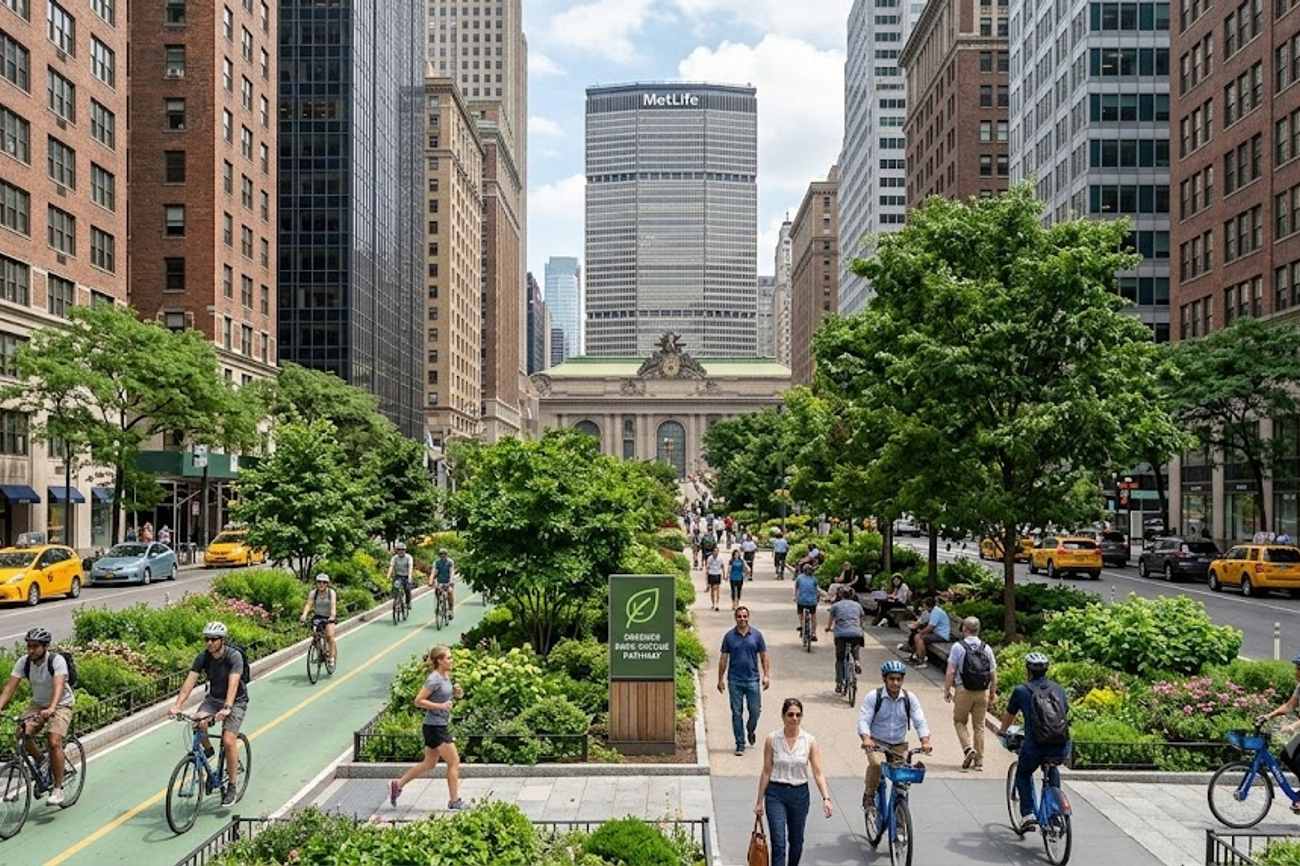
Image generated by AI
[New York City, October 2023] — New York City is overhaulng a critical eleven-block stretch of Park Avenue in Midtown Manhattan to prioritize pedestrians and cyclists over vehicular traffic. The updated redesign transforms one of the world's most famous thoroughfares by slashing vehicle lanes to make room for expanded green medians, protected cycling infrastructure, and enhanced walking paths.
The project targets the corridor between East 46th Street and East 57th Street. Spearheaded by Mayor Mamdani and the New York City Department of Transportation (NYC DOT), the revised proposal follows extensive public feedback and aims to shift the urban balance away from a vehicle-centric model toward a sustainable, multi-modal public space. This surface-level transformation is being synchronized with a massive underground infrastructure project to minimize long-term disruption to one of the city's densest commercial and tourism hubs.
The Grand Central Catalyst
The immediate trigger for this redesign is a massive structural necessity occurring beneath the pavement. Metro-North is currently executing a $1.7 billion rehabilitation of the Grand Central Terminal train shed. This project involves the replacement of thousands of corroded steel beams that support the surface of the avenue.
City planners recognized that the scale of the underground work provided a unique window to rethink the surface roadway. By aligning the streetscape redesign with the Metro-North Railroad rehabilitation, the city avoids the need for two separate, disruptive construction phases. The result is a coordinated effort to modernize both the invisible structural supports of the city and the visible experience of the street.
Affected Travelers, Airlines and Logistics
The redesign focuses on a high-traffic zone where business travel, luxury shopping, and global tourism intersect. The following groups and logistics will see immediate changes:
- Motorists: Vehicle capacity is being significantly reduced. The current three-lane configuration in each direction will be replaced by two northbound lanes and only one southbound lane.
- Cyclists: The removal of one southbound vehicle lane allows for the installation of a protected two-way cycle lane, providing a dedicated, barrier-separated route through Midtown.
- Pedestrians and Tourists: Visitors navigating between Midtown hotels and cultural venues will have access to wider walking paths, new crosswalks, and increased public seating.
- Local Businesses: Parking lanes are being retained to ensure that deliveries and local access for commercial tenants remain viable.
- Commuters: Those utilizing Grand Central Terminal will encounter a different surface environment upon exiting the station, with more greenery and reorganized traffic flow.
Practical Traveler Advisory and Strategic Insights
For the millions of visitors who traverse Midtown Manhattan annually, this is not merely a landscaping project but a fundamental change in how they move through the city.
Walking and Sightseeing: The expanded center medians transform the avenue from a transit corridor into a destination. Travelers can expect more vegetation, integrated seating, and "public programming" spaces designed for temporary art installations. This reduces the "concrete canyon" effect and provides resting points for tourists walking between major attractions.
Transportation Logistics: Ride-share users and taxi passengers should anticipate slower transit times and potential congestion on Park Avenue due to the reduction in southbound lanes. However, the improved pedestrian connectivity means that walking between East 46th and East 57th Streets will be safer and more intuitive.
Cycling Options: For the growing number of tourists using bike-share programs, the protected two-way lane removes the danger of navigating heavy Midtown traffic, making the area more accessible for non-professional cyclists.
The New Midtown Layout
The following table outlines the specific structural shifts proposed in the updated plan:
| Feature | Current State | Proposed Redesign | Impact on Movement |
|---|---|---|---|
| Northbound Traffic | 3 Lanes | 2 Lanes | Reduced vehicle throughput |
| Southbound Traffic | 3 Lanes | 1 Lane | Significant reduction in car capacity |
| Cycling Access | Unprotected/Mixed | Protected Two-Way Lane | Increased safety and dedicated flow |
| Center Medians | Standard/Narrow | Expanded Green Space | More greenery and pedestrian paths |
| Pedestrian Paths | Standard Sidewalks | Expanded Paths & Crosswalks | Improved accessibility and safety |
| Public Amenities | Minimal | New Seating & Art Spaces | Enhanced recreational utility |
| Local Access | Standard Parking | Retained Parking Lanes | Maintained delivery/loading capacity |
Future Timeline and Implementation
The project remains in the progression phase, with final implementation dependent on the synchronization with the $1.7 billion Grand Central Terminal shed work. While the City of New York has presented these updated plans as a response to public demand for more green space, the actual execution will require precise coordination between the DOT and transit authorities.
The long-term goal is to create a blueprint for other Midtown corridors, proving that high-density business districts can maintain functionality while reclaiming road space for public health and environmental sustainability. The success of the project will be measured by pedestrian circulation rates and the ability of the reduced lane configuration to handle existing traffic volumes without paralyzing adjacent streets.
FAQ: Park Avenue Redesign 2023
Will cars still be able to drive on Park Avenue? Yes. Vehicle access is not being eliminated. However, the number of lanes is being reduced to two for northbound traffic and one for southbound traffic to accommodate cyclists and pedestrians.
Is the project currently causing traffic delays? Yes, delays are expected as the city coordinates surface changes with the $1.7 billion rehabilitation of the Grand Central Terminal train shed occurring beneath the roadway.
Will there still be parking for deliveries and local business? Yes. The current proposal specifically retains parking lanes to ensure that local businesses can continue to receive deliveries and provide essential access.
What is the exact area of the redesign? The project covers an eleven-block section of Park Avenue in Midtown Manhattan, specifically between East 46th Street and East 57th Street.
Midtown is trading asphalt for oxygen in a bold bet on pedestrian-first urbanism.
Related Travel Guides
This article is for informational purposes. Flight routes, passenger regulations, visa rules, and transit advisories are subject to change by airlines and aviation authorities. Readers are advised to verify schedules and travel documentation with relevant carriers and border agencies before departure.
Related Stories

European Mass Protests Disrupt Travel Across France, Italy, Belgium, and Turkey in 2026
Alabama Tourism Surge: 29.22 Million Visitors Drive $24.87 Billion in State Spending for 2026