
Aviation Updates: Massive United Airlines Starlink Expansion Provides Critical Digital Lifeline to Passengers Battling Severe Travel Chaos
As severe travel chaos and rolling flight cancellations threaten global connectivity, United Airlines aggressively deploys Starlink Wi-Fi across 1,000 aircraft to rescue stranded passengers.
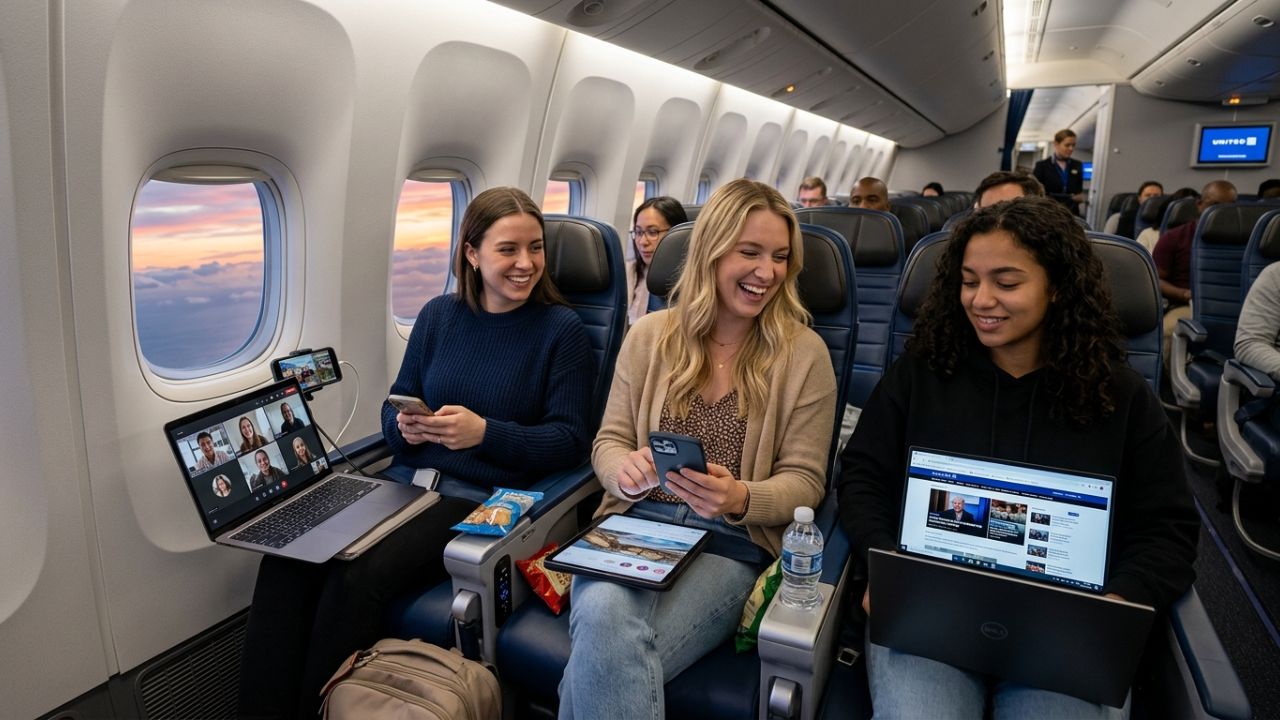
Image generated by AI
Aviation Updates: Massive United Airlines Starlink Expansion Provides Critical Digital Lifeline to Passengers Battling Severe Travel Chaos
As incredibly severe terminal gridlock and massive legacy airline network failures completely suffocate primary aviation gateways, tens of thousands of deeply exhausted international passengers are actively utilizing United Airlines' explosive new Starlink deployment as a critical digital lifeline to combat terrifying travel chaos and rebook connections mid-flight.
While incredibly exhausted domestic and international passengers desperately navigate an incredibly brutal peak travel season defined by rolling flight cancellations and severe, localized airport disruptions, a massive, highly strategic shift in onboard connectivity is actively stabilizing the absolute highest levels of American commercial aviation. According to the absolute latest breaking airline news and official corporate metrics, United Airlines is aggressively launching a massive rollout of Starlink Wi-Fi across its fleet. Desperate to ensure that severe, localized regional air gridlock and mid-air holding patterns do not completely destroy the productivity and emotional stability of premium travelers, the carrier has explicitly supercharged its digital infrastructure. At the time of reporting, real-time aviation analysts confirm that United successfully operated its first widebody customer flight with Starlink on United 14 from Newark/New York to London, utilizing a Boeing 777-200. This highly anticipated deployment completely alters the transcontinental transit map, allowing exhausted professionals to bypass the terrifying unpredictability of legacy terminal communications by securing reliable, high-speed connectivity at 35,000 feet.
This highly critical capacity deployment explicitly exposes the domestic aviation network not just as a vital transit feed, but as a heavily congested, deeply fragile capacity zone prone to sudden, catastrophic communication failures during rolling delays. By violently overwhelming terminal Wi-Fi networks and ground handling customer service desks during massive travel chaos, travelers frequently find themselves stranded in the dark regarding their itineraries. Because traditional transit nodes frequently suffer from severe tarmac congestion leading to massive, unannounced communication breakdowns, United’s aggressive new Starlink routing serves as an absolute survival tactic. It completely bypasses the terrifying logistical nightmares of landing without a confirmed connection, representing a highly structural corporate intervention that allows passengers to instantly track flight cancellations and coordinate rebookings while still airborne, explicitly rewarding travelers who refuse to be victimized by standard operational gridlock.
Aviation Updates: The Massive Fleetwide Starlink Expansion
This massive, highly structural shift in regional network capacity perfectly illustrates the intense, incredibly fragile nature of modern corporate mobility.
According to highly detailed, official aviation updates, this strategic expansion is not a limited trial. United plans to aggressively equip nearly 60 widebody aircraft with Starlink by the absolute end of this year and explicitly expects to have its entire widebody fleet ready by next summer. For travelers brutally conditioned to accept patchy, unreliable inflight Wi-Fi, this signals a massive paradigm shift. United has already successfully installed Starlink on more than 400 aircraft and aims to approach a massive 1,000 Starlink-equipped planes by the end of the year. This pace reflects an incredibly aggressive installation program refined alongside Starlink’s technical teams, allowing the airline to retrofit aircraft quickly while minimizing the downtime that leads to further airport disruptions. The rollout now extends from narrowbody domestic jets into widebody workhorses operating the most critical, delay-prone international routes across the Atlantic and Pacific.
Section-Wise Breakdown: Navigating the Connected Escape Routes
The sudden, massive evolution of these critical transit communication models actively impacts several incredibly distinct, highly sensitive operational dynamics spanning multiple massive technology hubs.
The Transatlantic Digital Corridor
At the absolute core of this massive operational pivot is United's intense, aggressive takeover of the transatlantic market. As the largest airline across both the Atlantic and Pacific, United's partnership with Starlink’s low-Earth orbit satellite network is a monumental disruption to the status quo. Instead of heavily depending on ground-based towers or deeply fragile older satellite systems, Starlink delivers low-latency broadband coverage over oceans, polar routes, and remote regions. Travelers can now expect Starlink-enabled widebodies on critical services linking United hubs in Newark/New York, Washington D.C., Houston, and San Francisco with key destinations such as London, Frankfurt, Zurich, Paris, Amsterdam, Buenos Aires, and Tokyo. This completely insulates passengers from the terrifying isolation of oceanic flights during periods of global travel chaos.
The MileagePlus Survival Advantage
For travelers originating in deeply congested hubs, securing this connectivity is a massive logistical advantage. One of the absolute most notable aspects of United’s approach is that Starlink connectivity is completely free for MileagePlus members on equipped flights. Instead of violently battling data caps or expensive access passes, members can instantly log in and use the connection to monitor developing flight cancellations across multiple devices. Since the airline introduced Starlink service last spring, an astonishing 18 million passengers have already flown on Starlink-equipped aircraft, proving that this digital lifeline is desperately required to survive the modern transit landscape.
The Evolution of the Smart Cabin
The ultimate execution of this massive transit shift heavily targets the integration of onboard hardware. United already operates more than 167,000 seatback screens installed across nearly 900 aircraft and aggressively plans to roughly double that footprint as new jets arrive. Starlink becomes the absolute connectivity backbone that powers these screens, transforming them from static entertainment portals into massive, smart interfaces tied into the broader digital ecosystem. This combination of robust hardware and high-capacity satellite bandwidth completely destroys the concept of the airplane as an isolated metal tube, allowing passengers to effortlessly stream entertainment or execute grocery orders while trapped in agonizing airborne holding patterns.
The Operational Crew Bypass
Simultaneously protecting the airline's internal network, a massive, reliable inflight network opens critical new possibilities for how flight and cabin crews operate during severe airport disruptions. With a stable data pipe, crews receive real-time operational updates, coordinating far more efficiently with ground teams. This translates into drastically smoother handling of massive disruptions, allowing flight attendants to instantly process rebookings and communicate exact connecting gate statuses while the aircraft is still in the air, completely neutralizing the panic that traditionally follows severe delays.
Flight Details and Verified Expansion Impact Matrix
To fully understand the exact structural parameters of this massive performance upgrade and how airlines are desperately attempting to navigate complex communication demands, the following matrix explicitly details the capacity metrics directly recorded by industry trackers.
Confirmed United Airlines Starlink Rollout Matrix
| Operational Metric | Confirmed United Starlink Data |
|---|---|
| First Widebody Flight | United 14 (Newark to London) |
| Aircraft Type | Boeing 777-200 |
| Current Installations | Over 400 Aircraft |
| End of Year Target | Nearly 1,000 Aircraft (~60 Widebodies) |
| Passenger Access | Free for MileagePlus Members |
| Seatback Screens | >167,000 across ~900 Aircraft |
Data explicitly reflects the massive, highly structural capacity deployment currently allowing United Airlines to provide a digital lifeline against severe transit congestion.
Passenger Impact: The Financial and Emotional Relief
For the highly demanding passengers actively engaged in this massive domestic mobility crisis, traditional, highly anticipated corporate travel is currently viewed as a high-stakes battle against infrastructure limits.
The immediate consequence of this massive tactical shift is measured in the profound emotional relief experienced by incredibly exhausted professionals. Passengers fleeing the threat of massive flight cancellations by utilizing Starlink can instantly join real-time work collaboration tools, effectively neutralizing the financial damage caused by missed meetings. Long-haul flight time becomes completely flexible and highly productive. Travelers who previously scheduled entirely around offline hours are now incredibly comfortable working on board, ensuring that even if their arrival is delayed by severe weather, their professional obligations are completely met.
Industry Analysis: The Economics of Tactical Connectivity
Aviation structural analysts strictly point out that this massive, multi-national operational shift perfectly illustrates the extreme, highly vital importance of unbroken digital communication models.
Economic data explicitly indicates that massive carrier networks are absolutely desperate to secure rapid schedule recoveries. In a brutal competitive landscape where many airlines merely tout new cabin colors or minor menu changes, truly reliable inflight connectivity is actively emerging as the absolute primary differentiator for surviving travel chaos. United’s massive financial commitment to bringing Starlink to nearly a thousand aircraft—and making it free for MileagePlus members—permanently raises the bar for what customers expect as standard on transatlantic routes, completely crippling competitors who still rely on archaic, paid Wi-Fi portals.
Conclusion: A Highly Optimized Connected Future
The massively evolving pricing and capacity dynamics directly defining the integration of high-volume digital demand into the United network violently reflect a much broader, highly critical structural transformation currently dominating how American commercial aviation is physically managed in 2026.
Rather than violently forcing massive domestic tech traffic to suffer through agonizing communication blackouts during severe delays, United is actively giving travelers the ability to reclaim their schedules. As the airline aggressively deploys advanced Starlink hardware across its Boeing 777-200 fleet, travelers actively navigating the incredibly busy sector must absolutely remain highly vigilant. To actively survive potential travel chaos this season, passengers must aggressively monitor all breaking aviation updates, shift all corporate travel to connected, Starlink-enabled routing whenever possible, and perfectly understand that escaping modern airport disruptions fundamentally requires extreme digital intelligence and an absolute refusal to fly offline.
Key Takeaways
- Bypassing Communication Gridlock: United Airlines aggressively rolls out Starlink Wi-Fi across its fleet, successfully operating United 14 from Newark to London on a Boeing 777-200.
- Massive Fleet Expansion: United has already installed Starlink on over 400 aircraft, targeting nearly 1,000 planes by the end of the year.
- Free Passenger Access: The high-speed, low-latency connection is entirely free for MileagePlus members, supporting simultaneous device usage.
- Operational Lifeline: Crews use the stable network to manage massive airport disruptions and rebook passengers while still airborne.
- Passenger Survival Strategy: Corporate travelers are aggressively urged to strictly utilize Starlink-equipped aircraft to completely bypass the agonizing threat of isolation during regional travel chaos.
Related Travel Guides
Massive UAE Visa Bombshell: Strict New 30-Day Escape Window Announced
Travel Chaos Cripples Spain as Iberia and Ryanair Suffer 1,079 Delays
Global Flight Cancellation and Compensation Guide 2026
Disclaimer: This article is strictly for informational purposes only. Massive airline scheduling algorithms, highly localized digital retrofitting timelines, and complex corporate Wi-Fi procedures change rapidly based on operational demand and real-time infrastructure capacity limits. Always carefully verify your specific itinerary and aggressively monitor real-time connectivity statuses directly via your respective operator's platform before attempting to secure travel.
Disclaimer
This article is for informational and educational purposes only. It does not constitute legal, financial, or professional advice. While we strive to provide accurate and up-to-date information, travel policies, regulations, and conditions change rapidly. Always verify information with official sources before making travel decisions. Nomad Lawyer makes no representations about the accuracy, reliability, completeness, or suitability of the information provided. Readers should consult qualified professionals for advice specific to their circumstances. The views expressed in this article are those of the author and do not necessarily reflect the views of Nomad Lawyer.