
UK National Rail Crisis 2026: Power Failure at Manchester Operating Centre Paralyzes Midlands and North
A critical power outage at the Manchester Rail Operating Centre has triggered massive disruptions across the UK Midlands and North West, stranding thousands of travelers.

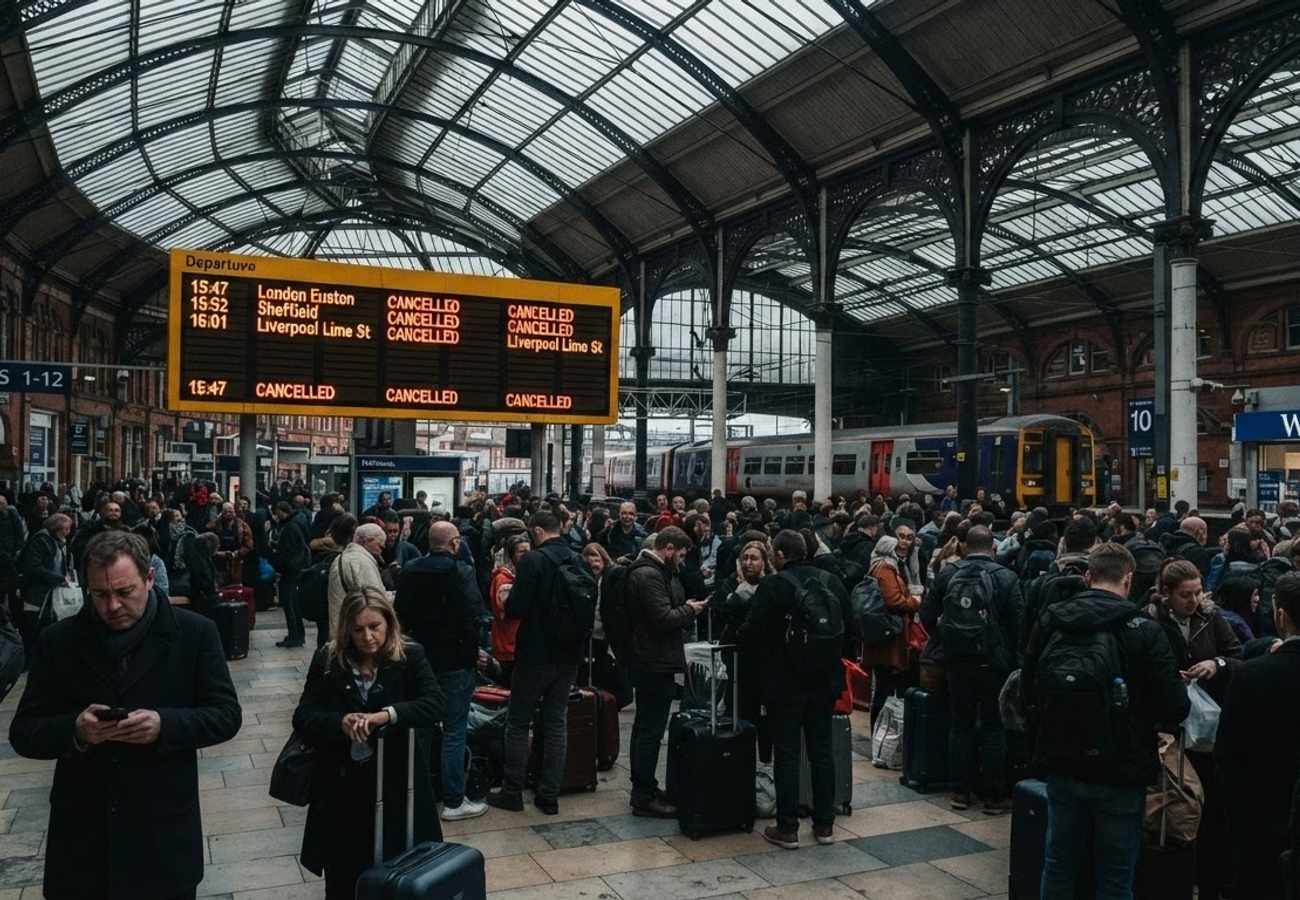
Image generated by AI
Thousands of passengers across the UK Midlands and North West were left stranded on August 10, 2026, after a critical power failure at the Manchester Rail Operating Centre paralyzed regional transport. The outage, compounded by the discovery of a wartime bomb near the tracks, forced major operators to cancel services and issue urgent warnings against non-essential travel.
The failure at the Manchester hub—a facility responsible for managing several of the UK's most vital rail corridors—exposed significant vulnerabilities in the nation's modernized transport infrastructure. Transport Secretary Heidi Alexander has already faced intense scrutiny as government officials demand immediate contingency plans to prevent a repeat of this systemic collapse.
Electricity Failure at Ashburys Station Triggers Regional Collapse
The root of the crisis was traced to an unexpected electricity supply failure located near Ashburys station in East Manchester. Because the Manchester Rail Operating Centre serves as a centralized node for the region, the loss of power immediately disabled signaling and communication systems across a vast geographic area.
This facility is one of 12 regional operating centres introduced in 2014. These hubs were designed to replace roughly 800 traditional, localized signal boxes to increase efficiency and streamline management. Under the current strategic roadmap, the UK aims to have the entire national rail network under centralized management by 2034. However, this incident demonstrates the "single point of failure" risk inherent in such a model; while traditional signal boxes limited failures to small areas, a hub failure now triggers a regional blackout.
Adding to the chaos, railway authorities discovered a wartime bomb near the tracks between Tamworth and Burton-on-Trent. This discovery created a secondary bottleneck, further complicating an already fragile recovery effort and blocking alternative routes for diverted trains.
Immediate Impact on Passengers and Rail Operators
The technological blackout resulted in an immediate halt of passenger services across Greater Manchester and the wider North West. Thousands of commuters found themselves trapped at stations with virtually no immediate transit alternatives.
In response to the crisis, major operators including TransPennine Express and Northern issued strict advisories, urging the public to avoid all non-essential travel. The disruption was not merely a matter of delayed departures; the "displacement of resources" became a primary hurdle. Because trains and crews were halted in unplanned locations, they were far from their designated starting points, making it impossible to resume a normal timetable even after power was restored.
To mitigate the financial and logistical burden on travelers, rail operators implemented the following emergency measures:
| Measure | Detail | Application |
|---|---|---|
| Ticket Restrictions | Standard restrictions completely lifted | All impacted corridors for the full day |
| Advance Tickets | Permission to board any alternative service | No financial penalties applied |
| Status Verification | Real-time updates via National Rail Enquiries | Mandatory for Midlands/North West travel |
| Schedule Adjustments | Ongoing regional delays and modifications | Persistent during system restoration |
Engineering Response and Systemic Vulnerabilities
Engineering teams worked through the night to restore the damaged signaling systems. Reports indicate that critical digital communication systems suffered a total loss of power feeds, rendering it impossible to guarantee the safe movement of trains. In the rail industry, the absence of communication is a non-negotiable safety breach, meaning operations had to be grounded entirely across multiple sectors.
Industry observers point out that this is not an isolated event. Similar technological failures have previously occurred at Manchester Piccadilly, suggesting that the infrastructure is suffering from deep-seated vulnerabilities. The transition toward centralization, while aimed at modernization, has inadvertently increased the scale of potential disasters.
The Debate Over Centralization vs. Redundancy
The current crisis has reignited a fierce debate within the UK transport sector regarding the balance between efficiency and resilience. Historically, the fragmented nature of the rail network meant that a signal failure in one town rarely affected a city 50 miles away. Today, the interdependence of the 12 regional hubs means a localized power cut in East Manchester can stall the entire North West.
Government oversight is now focusing on whether the 2034 goal of full centralization is too risky. There are growing calls from industry experts for a rigorous reassessment of resilience standards, specifically demanding the implementation of decentralized redundancy—backup systems that can take over if a primary hub fails.
Why This Matters for the Traveler
For the everyday commuter or tourist, this event signals a shift in how travel risks must be managed in the UK. The era of "localized delays" is being replaced by "regional outages." When a hub fails, the ripple effect is instantaneous and total.
From a logistical standpoint, travelers can no longer rely on the assumption that a delay in one city won't affect their connection in another. The reliance on digital hubs means that a power surge or hardware failure in a distant operating centre can render a ticket useless. For those traveling through the Midlands or North West, the only reliable strategy is real-time verification via digital platforms immediately before departure, as the "knock-on" effect of these failures often lasts long after the primary technical issue is resolved.
The UK rail network now stands at a crossroads between the efficiency of the future and the reliability of the past.
Related Travel Guides
Disclaimer
This article is for informational and educational purposes only. It does not constitute legal, financial, or professional advice. While we strive to provide accurate and up-to-date information, travel policies, regulations, and conditions change rapidly. Always verify information with official sources before making travel decisions. Nomad Lawyer makes no representations about the accuracy, reliability, completeness, or suitability of the information provided. Readers should consult qualified professionals for advice specific to their circumstances. The views expressed in this article are those of the author and do not necessarily reflect the views of Nomad Lawyer.
Preeti Gunjan
Contributor & Community Manager
A passionate traveller and community builder. Preeti helps grow the Nomad Lawyer community, fostering engagement and bringing the reader experience to life.
Learn more about our team →