
UK and Netherlands Spearhead Global Airport Security Shift with 3D CT Scanners and Somatometric Portals
The UK and Netherlands spearhead a global shift in airport security, deploying 3D volumetric CT scanners and biometric portals to rigidify checkpoint defenses.

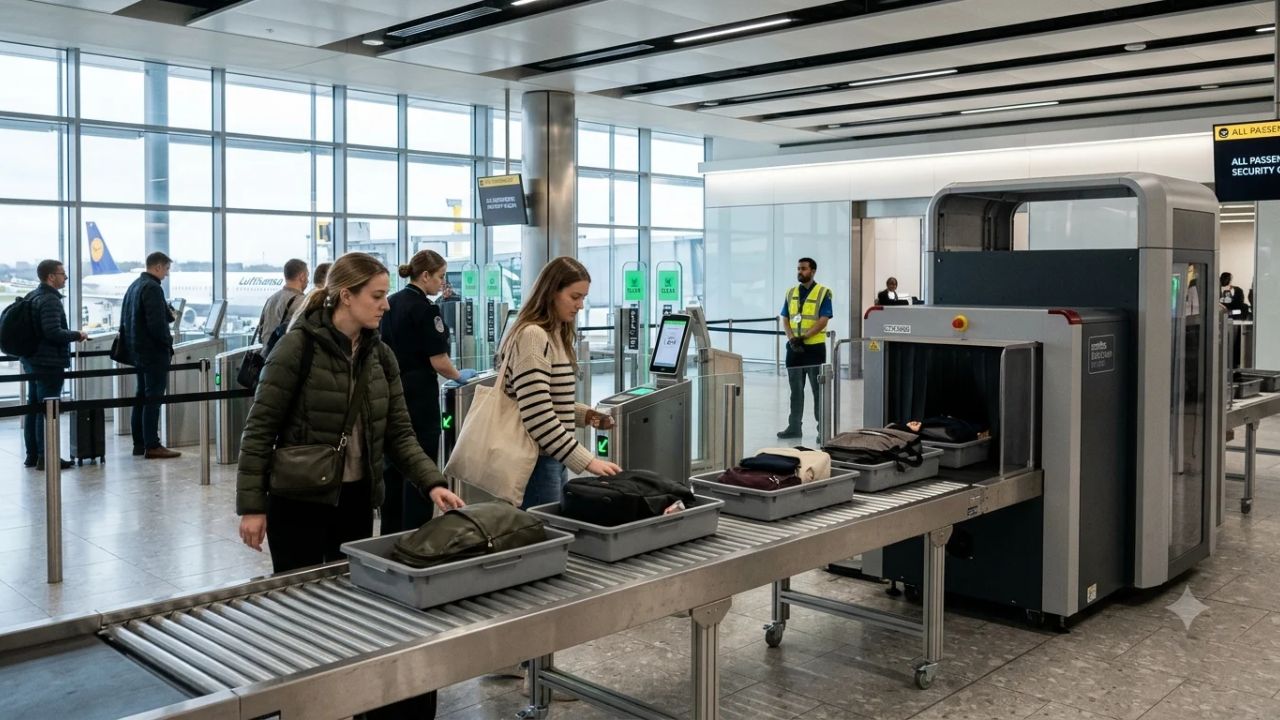
Image generated by AI
The United Kingdom and the Netherlands are spearheading the most comprehensive transformation of global civil aviation security since the post-9/11 era, replacing legacy two-dimensional checkpoint X-rays with stereoscopic Computed Tomography (CT) scanners and somatometric body surveillance portals. While air travelers celebrate the consumer convenience of leaving laptops, tablets, and compliant liquids inside carry-on luggage, the underlying operational objective represents an exponential rigidification of checkpoint defenses. By shifting the burden of inspection from fatigued human screeners to deterministic explosive-detection algorithms and volumetric material density physics, international aerodromes are constructing automated defense fortresses capable of identifying non-metallic blades, liquid binary explosives, and concealed contraband at unprecedented speeds.
The transition, led by British hubs under mandates from the UK Department for Transport (DfT) and Dutch authorities operating through Amsterdam Airport Schiphol, establishes a shared technical doctrine rapidly expanding across the United States, Singapore, the United Arab Emirates, India, and continental Europe.
The Dual Technological Pillars: Volumetric Tomography and Somatometric Surveillance
The architecture of modern airport checkpoints is grounded in two revolutionary imaging disciplines: volumetric Computed Tomography (CT) and somatometric bodily detection.
Stereoscopic Volumetric Computed Tomography (3D CT)
Conventional airport checkpoints have historically relied on dual-energy transmission X-ray scanners that generate flat, two-dimensional projections. These legacy machines suffer from visual superimposition; if an electrical circuit or wire sits directly behind an organic mass, screeners must rotate the physical tray or unpack the bag to resolve the visual ambiguity.
Stereoscopic CT gantries eliminate visual occlusion entirely. Originating in diagnostic medical imaging, these systems rotate an X-ray source and sensor array hundreds of times per minute around a continuous-motion conveyor belt. The gantry captures thousands of attenuation measurements per luggage item, reconstructing an unoccluded, voxel-based 3D model in real time.
Crucially, the system calculates the precise physical mass density and effective atomic number ($Z_{\text{eff}}$) of every discrete object within the bag. Algorithmic software cross-references these molecular properties against known explosive compound libraries—including sheet explosives, liquid peroxides, and homemade formulations—automatically flagging threats without human intervention. Screeners can virtually unpack, rotate, slice, and isolate individual density layers on ultra-high-definition touchscreens.
Somatometric Body Screening Portals
Simultaneously, traditional metal detector arches are being superseded by active millimetre-wave body portals. These portals project harmless non-ionizing radio waves against the contours of the human body. By analyzing reflected radio wave interference patterns, the portal’s computational pipeline identifies any spatial anomaly between the traveler’s body surface and outer clothing, detecting ceramic knives, concealed powders, composite plastic weapons, and contraband sheets.
At boarding gates and perimeter border crossings, somatometric clearance is coupled with automated biometric identification gates that capture facial geometric vectors and iris topography, verifying identity against passenger manifests in fractions of a second.
Global Architecture Comparison: Regulatory Mandates Across Seven Sovereign Gateways
The deployment of volumetric CT and biometric portals varies across regulatory jurisdictions, reflecting differing national threat environments and passenger flow models:
| Sovereign Jurisdiction | Primary Carry-On Tech | Passenger Body Screening | Biometric Infrastructure | Liquid Policy Rule | Operational Mandate & Threat Doctrine |
|---|---|---|---|---|---|
| United Kingdom | Multislice 3D CT Gantries | Active Millimetre-Wave | Automated Border E-Gates | Up to 2L Container Cap | Mandatory vacuum flask ban; automated density reject diverters; random explosive swabs |
| Netherlands | Continuous-Motion 3D CT | Full-Body RF Portals | Biometric Boarding Gates | Up to 2L Container Cap | In-line vapor and particle sniffing sensors; complete elimination of plastic bags |
| United States | Dual-Energy 3D CT Units | Millimetre-Wave (AIT) | Facial CAT-2 Units | Strict 100ml (3-1-1) Rule | Mandatory REAL ID facial credentialing; strict container limits despite 3D CT rollout |
| Singapore | High-Definition Inline CT | Millimetre-Wave Imaging | Dual Facial & Iris Biometrics | Strict 100ml (ICAO Standard) | Tokenless FAST architecture from curbside to cabin; gate-level decentralized CT |
| United Arab Emirates | Volumetric Tomography | Contactless Smart Tunnels | Continuous Motion AI Biometrics | 100ml Baseline (Transits) | Walk-through smart tunnels (<15 sec verification); predictive behavioral video arrays |
| India | 3D CT & Dual-View X-Ray | Phased Millimetre-Wave | DigiYatra Facial Grid | Strict 100ml Rule | Decentralized self-sovereign digital identity; complete phase-out of paper boarding stamps |
| Germany & France | ECAC Std 3.1 3D CT Gantries | High-Precision RF Scanners | Automated Border Control (ABC) | Phased / Hybrid Approvals | Strict tray segregation; zero-tolerance automated alarms; deep explosive trace resolution |
National Implementations: Automated Density Reject Arms and Trace Sniffing Algorithms
The operational reality inside modernized terminals reveals how automated mechanics have superseded human discretion:
United Kingdom: Automated Reject Arms and the Vacuum Flask Prohibition
At London Heathrow (LHR), London Gatwick (LGW), and Manchester (MAN), conveyor systems feature automated mechanical divert arms. When the 3D CT scanner's algorithm detects an unresolvable density cluster, the tray is automatically shunted onto an isolated secondary rejection lane. Checkpoint operators cannot override the system’s decision; the bag must undergo secondary mechanical inspection or a manual unpack.
Furthermore, UK security regulations strictly mandate that all double-walled metal containers, vacuum flasks, and thermal bottles must be completely emptied prior to scanning. Because dual-walled stainless steel impedes X-ray photon penetration, any trapped fluid creates an opaque blind spot, triggering an automatic security hold.
The Netherlands: Schiphol's In-Line Trace Detection
Amsterdam Airport Schiphol pioneered continental volumetric checkpoint design by pairing continuous CT gantries with automated tray return systems (ATRS). Uniquely, Dutch screening lanes integrate automated vapor and particle sniffing sensors along the luggage conveyor, testing for volatile chemical signatures in parallel with tomographic imaging.
US Federal Biometrics and Singapore Changi's FAST Tokenless Corridors
Across the Atlantic and throughout the Asia-Pacific region, biometric somatometrics have transformed passenger tracking:
United States: TSA CAT-2 Biometric Gates
The Transportation Security Administration (TSA) has paired Smiths Detection and Analogic 3D CT units with Credential Authentication Technology (CAT-2) units across major hubs like Atlanta (ATL) and Chicago O'Hare (ORD). CAT-2 cameras match a traveler’s live facial geometry against passport and REAL ID databases, eliminating physical boarding passes. However, unlike British hubs, the TSA rigorously maintains the legacy 3-1-1 liquid rule (containers under 100ml), tuning scanners to flag oversized bottles for physical confiscation.
Singapore: Tokenless FAST Architecture at Changi Airport
At Singapore Changi (SIN), the Fast and Seamless Travel (FAST) framework integrates facial geometry and iris recognition across all terminals. Changi utilizes decentralized gate-level CT filtering at Terminals 1, 2, and 3, screening passengers directly inside departure holding lounges moments before aircraft boarding to eliminate terminal-wide contamination risks.
The Passenger Reality: Seamless Convenience Masking Exponential Defenses
The removal of the requirement to unpack liquids and remove laptops is frequently interpreted by the traveling public as a relaxation of rules. In reality, it marks the end of subjective human inspection.
Legacy X-ray screeners, burdened by cognitive fatigue after hours of monitoring 2D projections, could occasionally miss organic compounds concealed behind laptop motherboards. Modern stereoscopic CT software eliminates human oversight from the initial detection phase, mathematically isolating atomic densities and stopping the conveyor belt automatically if a molecular mismatch is identified. The result is an aviation security environment that is faster, frictionless, and exponentially more fortified.
Frequently Asked Questions
Why do some airports allow liquids over 100ml while others do not?
Airports equipped with advanced 3D CT scanners (like in the UK and Netherlands) can analyze the molecular density of liquids in cabin bags, allowing containers up to 2 liters. However, authorities like the US TSA continue to enforce the 100ml limit due to differing federal regulatory standards.
How do 3D CT scanners detect explosives inside luggage?
3D CT scanners rotate around cabin bags, capturing thousands of X-ray attenuation measurements to compute the exact mass density and effective atomic number ($Z_{\text{eff}}$) of every object, automatically cross-referencing them against explosive compound libraries.
Why must metal vacuum flasks and thermal bottles be empty at UK airport security?
Double-walled metal vacuum flasks and thermal bottles reflect and scatter X-ray and CT photons, creating opaque visual blind spots that prevent scanners from analyzing liquids inside, which triggers an automated security rejection.
What are somatometric body screening portals?
Somatometric portals use active millimetre-wave radio frequencies to detect concealed metallic and non-metallic objects (such as ceramic blades or powders) on the body without emitting ionizing radiation, replacing traditional metal detector arches.
Related Travel Guides
Disclaimer
This article is for informational and educational purposes only. It does not constitute legal, financial, or professional advice. While we strive to provide accurate and up-to-date information, travel policies, regulations, and conditions change rapidly. Always verify information with official sources before making travel decisions. Nomad Lawyer makes no representations about the accuracy, reliability, completeness, or suitability of the information provided. Readers should consult qualified professionals for advice specific to their circumstances. The views expressed in this article are those of the author and do not necessarily reflect the views of Nomad Lawyer.
Raushan Kumar
Founder & Lead Developer
Full-stack developer with 11+ years of experience and a passionate traveller. Raushan built Nomad Lawyer from the ground up with a vision to create the best travel and law experience on the web.
Learn more about our team →