
Uganda Targets Swiss Travellers With Zurich Tram And Rail Campaign To Boost Gorilla Tourism Growth
Uganda Targets Swiss Travellers With Zurich Tram And Rail Campaign To Boost Gorilla Tourism Growth

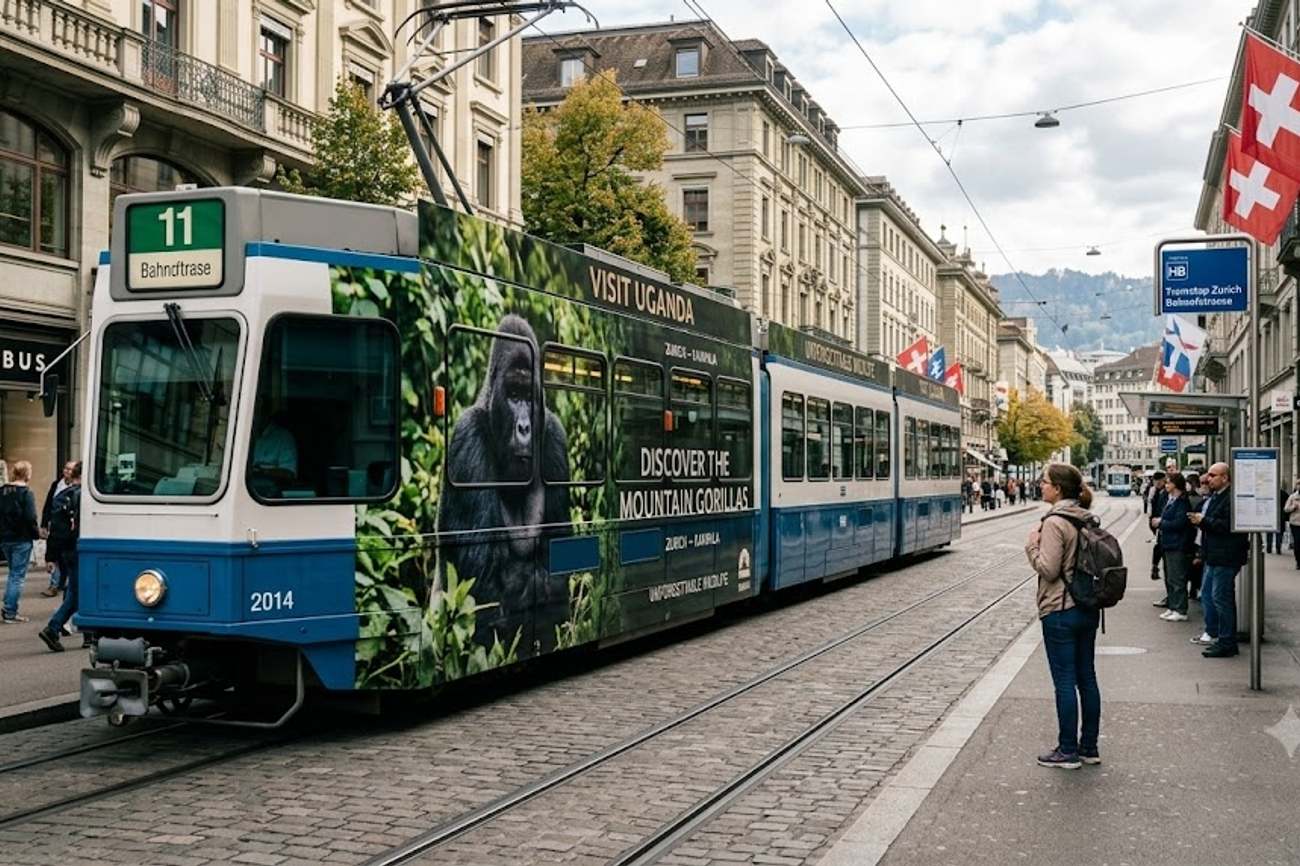
Image generated by AI
International visitor arrivals to Uganda climbed from 1,371,895 in 2024 to more than 1.6 million in 2025, representing a growth trajectory that has emboldened the Ministry of Tourism, Wildlife and Antiquities to pivot toward high-yield European markets. This surge in volume is mirrored by a significant increase in revenue, with 2025 tourism earnings reaching approximately UGX 5.8 trillion (USD 1.62 billion), providing the capital necessary for aggressive international brand positioning.
The Swiss Pivot in Numbers — High-Value Market Acquisition
Uganda is shifting its marketing calculus from general volume to "visitor value," specifically targeting the Swiss demographic through a precision-strike campaign in Zurich. By utilizing the city's tram and railway networks, Uganda is attempting to capture a segment of the European market known for high per-capita spending and a preference for conservation-led travel.
The strategic deployment of this campaign began in September 2026, with tram advertisements officially entering circulation on 17 September 2026. Simultaneously, high-definition video displays were installed at Zurich’s main railway station. This choice of medium is a calculated move to reach high-net-worth commuters and international transit passengers in one of Europe's most affluent transport hubs.
The data suggests that Uganda is no longer merely seeking recovery but is pursuing market diversification. The leap to 1.642 million arrivals in 2025 indicates a robust appetite for East African destinations, and by targeting Switzerland, Uganda is attempting to insulate its tourism economy from reliance on any single source market. This aligns with broader patterns observed by the World Tourism Organization (UNWTO), where developing destinations are increasingly prioritizing "quality over quantity" to minimize environmental impact while maximizing GDP contribution.
Comparative Market Trajectory — 2024 vs. 2025
The transition from 2024 to 2025 marks a critical inflection point for Uganda's tourism sector. The increase in arrivals is not merely a post-pandemic bounce-back but a structural growth trend. When comparing the 2024 baseline to the 2025 performance, the acceleration in both visitor counts and total earnings suggests a higher spend per visitor, likely driven by the promotion of premium experiences like gorilla trekking.
The following table outlines the shift in key performance indicators (KPIs) as reported by the Ministry of Tourism, Wildlife and Antiquities:
| Metric | 2024 Data | 2025 Data | Variance/Trend |
|---|---|---|---|
| International Arrivals | 1,371,895 | > 1.6 million (1.642M) | +19.5% approx. |
| Total Tourism Earnings | Not Specified | UGX 5.8 trillion (~USD 1.62B) | Upward Trend |
| Primary Market Focus | General Recovery | High-Value European (Swiss) | Strategic Pivot |
| Campaign Launch Date | N/A | September 17, 2026 | Market Expansion |
| Core Product Offer | Wildlife/Nature | Premium Conservation/Adventure | Value Upscaling |
This growth pattern places Uganda in a competitive position within the East African Community (EAC). While neighbors like Rwanda and Kenya have long established luxury safari circuits, Uganda is leveraging its specific biological assets—most notably the mountain gorillas—to carve out a niche in the "ultra-premium" wildlife sector. According to IATA data on global air traffic, long-haul travel from Europe to Africa has shown resilience, making the Zurich campaign a timely intervention to capture this returning demand.
Practical Traveler Advisory and Strategic Insights
For the individual traveler, the shift toward "high-value" tourism and the expansion of marketing into Switzerland signals a transition in how Uganda manages its tourism infrastructure. As the country targets wealthier demographics, travelers can expect a rise in luxury lodge developments and specialized, high-cost conservation packages.
If you are planning a trip to Uganda in 2026 or 2027, consider the following data-driven booking strategies:
- Anticipate Higher Permit Demand: With arrivals exceeding 1.6 million and a new push into the Swiss market, permits for gorilla trekking in Bwindi Impenetrable National Park will likely reach capacity faster. Booking 6-12 months in advance is now a necessity rather than a recommendation.
- Budget for Premiumization: The government's focus on "visitor value" often translates to a shift in the available accommodation inventory toward high-end boutiques. Mid-range travelers should secure their lodging early to avoid being priced out by the luxury pivot.
- Leverage the Diversified Itinerary: While the Zurich campaign emphasizes gorillas, the presence of 10 national parks and 12 game reserves suggests that "bundling" experiences (e.g., combining gorilla trekking with savanna safaris) will offer better value for money as the industry scales.
The Uganda Tourism Board has launched a strategic marketing campaign in Zurich, utilizing tram and rail advertisements to attract Swiss luxury travelers to the "Pearl of Africa." This initiative specifically aims to increase visitor numbers for mountain gorilla trekking and primate tourism through the Visit Uganda official portal.
Forward Projection — The 2027 Tourism Horizon
Based on the current trajectory from 1.37 million to 1.642 million arrivals, Uganda is on a path to potentially breach the 2 million visitor mark by 2027, provided the European expansion yields the expected conversion rates. The Zurich campaign is a litmus test for whether Uganda can successfully transition from a "budget adventure" destination to a "premium wildlife" hub.
The integration of transport-based marketing in Europe suggests a future where Uganda will likely expand similar campaigns into other high-GDP hubs such as Frankfurt, Geneva, or London. We can expect a corresponding increase in direct flight connectivity or chartered luxury services to accommodate the "high-value" clientele the Ministry is courting.
Furthermore, the emphasis on conservation-based tourism indicates that Uganda will likely implement stricter sustainability quotas. This means that while the number of tourists may rise, the number of permits for specific high-impact activities (like gorilla tracking) may remain capped to preserve the ecosystem, further driving up the price and exclusivity of these experiences. This strategy mirrors the luxury-conservation model used in other high-end African markets to ensure long-term environmental viability.
FAQ: Uganda Tourism Trends 2026
Will gorilla trekking permits become more expensive? Given the strategic shift toward "high-value" tourism and the increase in international arrivals to over 1.6 million, it is highly probable that permit prices will rise to manage demand and increase conservation funding.
Is 2026 a good time to visit Uganda? Yes, as the country has successfully scaled its infrastructure to handle 1.642 million visitors. However, the launch of the Zurich campaign suggests a coming wave of European demand, making early booking essential.
Which regions of Uganda are being prioritized for growth? While Bwindi Impenetrable National Park remains the primary draw for gorilla tourism, the government is promoting its broader network of 10 national parks and 12 game reserves to diversify the visitor experience.
How does the Zurich campaign affect non-European travelers? While the marketing is targeted at Switzerland, the resulting increase in tourism earnings (UGX 5.8 trillion) is being reinvested into national tourism infrastructure, which improves the overall travel experience for all international visitors.
As Uganda trades mass-market volume for Swiss-level value, the era of the 'hidden gem' is ending, replaced by a calculated, high-premium conservation economy.
Related Travel Guides
- Georgia Tops The List Followed By Texas and More With the Strongest Air Travel Markets as US Reach $9.8 Billion Air Ticket Sales
- Switzerland Follows Many More as Namibia Strengthens Noordoewer Border Training for Global Tourist Growth
- Asia GCC Tourism Boom Surges as Gulf Destinations Unlock Record Asian Visitor Growth With Connectivity Visa and Luxury Travel Expansion
Disclaimer
This article is for informational and educational purposes only. It does not constitute legal, financial, or professional advice. While we strive to provide accurate and up-to-date information, travel policies, regulations, and conditions change rapidly. Always verify information with official sources before making travel decisions. Nomad Lawyer makes no representations about the accuracy, reliability, completeness, or suitability of the information provided. Readers should consult qualified professionals for advice specific to their circumstances. The views expressed in this article are those of the author and do not necessarily reflect the views of Nomad Lawyer.
Preeti Gunjan
Contributor & Community Manager
A passionate traveller and community builder. Preeti helps grow the Nomad Lawyer community, fostering engagement and bringing the reader experience to life.
Learn more about our team →