
TSA Issues Checkpoint Security Alert for Costume-Carrying Travelers: Replica Weapons, Liquid Rules, and Civil Penalties

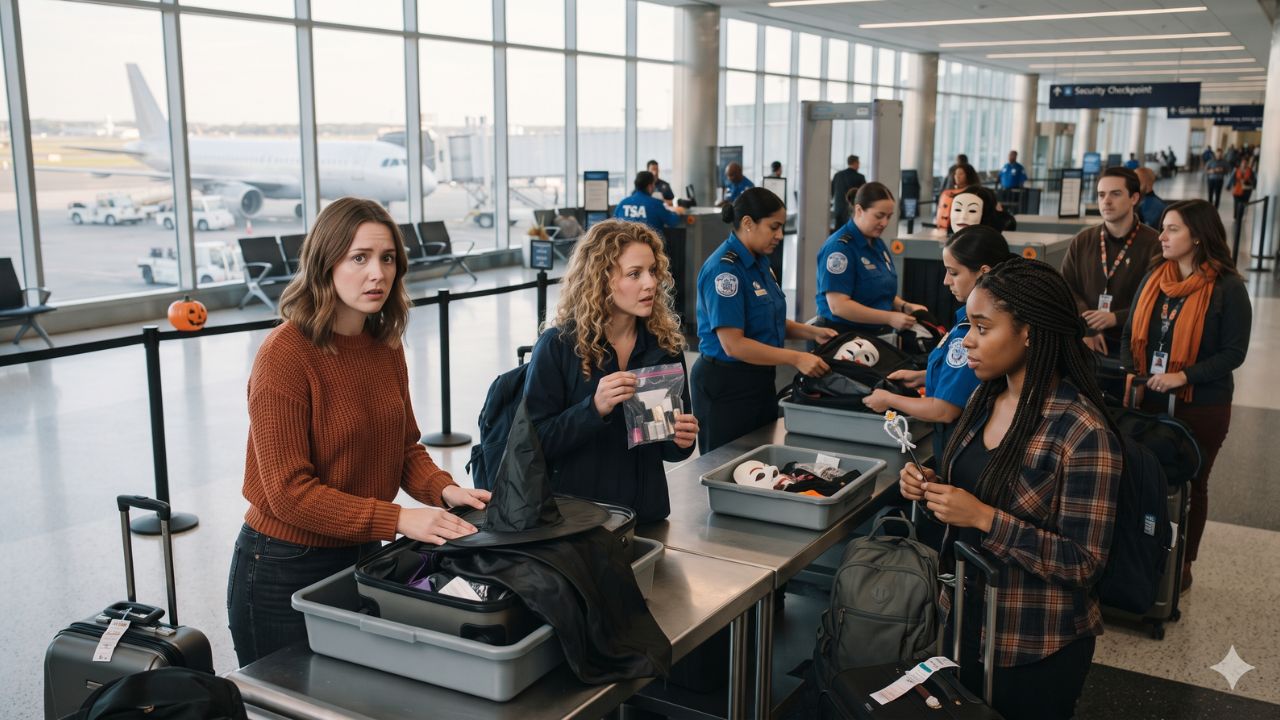
With Transportation Security Administration officers screening more than 2 million passengers daily across roughly 440 commercial airports—and peak holiday surges reaching 3,009,812 travelers in a single day—carrying realistic costume props, oversized liquid cosmetics, or metallic masquerade attire can trigger civil fines up to $2,570 alongside missed flights. Federal security advisories issued across primary aviation gateways—including John F. Kennedy International Airport, LaGuardia Airport, and Newark Liberty International Airport—warn travelers that seasonal holiday items remain subject to strict aviation safety statutes. Checkpoint screening mandates apply universally across major transit hubs such as Los Angeles (LAX), Chicago O'Hare (ORD), Hartsfield-Jackson Atlanta (ATL), Dallas/Fort Worth (DFW), Denver (DEN), Miami (MIA), Orlando (MCO), Harry Reid in Las Vegas (LAS), Boston Logan (BOS), Seattle-Tacoma (SEA), Ronald Reagan Washington National (DCA), Washington Dulles (IAD), Philadelphia (PHL), Charlotte Douglas (CLT), San Francisco (SFO), Phoenix Sky Harbor (PHX), and Salt Lake City (SLC).
The advisory addresses an annual operational vulnerability: passenger confusion regarding the legal boundary between festive accessories and prohibited security hazards. While ordinary clothing poses no barrier to travel, realistic firearm replicas, faux explosives, bladed weapons, and dense theatrical face coverings disrupt queue velocity and trigger statutory enforcement protocols. Understanding how federal screening guidelines classify these accessories allows travelers to avoid checkpoint confiscations, formal interrogations, and severe financial penalties.
Checkpoint Baseline: Firearm Interceptions and the Zero-Tolerance Threshold
To understand why security officers take a rigid approach to plastic firearms and theatrical props, travelers must examine the operational environment facing the Transportation Security Administration (TSA). Checkpoint officers intercepted 6,678 firearms at airport screening lanes nationwide in 2024, following a record detection of 6,737 firearms in 2023. Strikingly, federal data confirmed that 93% of the firearms intercepted at checkpoints in 2023 were fully loaded.
Because checkpoint personnel operate under constant threat vigilance, an X-ray operator cannot assume an object resembling a weapon is an inert plastic replica. When a monitor reveals the silhouette of a handgun, revolver, or assault weapon inside carry-on luggage, standard operating procedures dictate an immediate lane halt. Officers must isolate the bag, summon law enforcement support, and conduct physical verifications before allowing passenger screening to resume.
The regulatory hazard escalates dramatically with explosive and incendiary replicas. Federal aviation regulations strictly prohibit realistic explosive replicas—such as simulated hand grenades, inert dynamite sticks, or mock suicide vests—from both carry-on baggage and checked cargo. Introducing an explosive replica into an airport terminal can lead to terminal evacuations, perimeter lockdowns, and immediate criminal referral through the U.S. Department of Homeland Security.
Liquid cosmetics face equivalent regulatory boundaries under the longstanding 3-1-1 liquids directive. Theatrical makeup, fake blood vials, liquid adhesives for prosthetics, face paint jars, silicone gels, and liquid foundations are legally classified as liquids, aerosols, or gels. In cabin baggage, every cosmetic container must measure 3.4 fluid ounces (100 milliliters) or less and fit within a single clear, quart-sized, resealable bag per passenger. Larger quantities must travel in checked luggage regardless of whether the product was purchased at a specialty costume boutique.
| Item Category | Carry-On Cabin Allowance | Checked Luggage Allowance | Published Civil Penalty Range | Operational Screening Protocol |
|---|---|---|---|---|
| Realistic Firearm Replica | Prohibited (No) | Permitted (Generally yes) | $450 to $2,570 | Triggers mandatory bag inspection and law enforcement verification |
| Swords, Sabres & Machetes | Prohibited (No) | Permitted (Yes) | $450 to $2,570 | Must be securely sheathed and packed exclusively in checked cargo |
| Utility Knives & Daggers | Prohibited (No) | Permitted (Yes) | $450 to $2,570 | Barred from passenger cabin; subject to confiscation at checkpoint |
| Toy Guns & Plastic Replicas | Prohibited if realistic; restrictions apply | Permitted (Generally yes) | Subject to officer discretion | Evaluated based on physical appearance and visual threat profile |
| Explosive & Incendiary Replicas | Prohibited (No) | Prohibited (No) | Severe civil fine + criminal referral | Strictly barred from entire airport; can trigger terminal evacuations |
| Unloaded Real Firearm | Prohibited (No) | Permitted with strict declaration | $1,500 to $6,130 + legal referral | Must be declared, unloaded, and locked in a hard-sided container |
| Loaded Real Firearm | Prohibited (No) | Prohibited (No) | $3,000 to $12,210 + legal referral | Immediate checkpoint detention, weapon seizure, and arrest referral |
| Theatrical Makeup & Fake Blood | Permitted up to 3.4 oz (100 ml) | Permitted without volume cap | Non-compliant items surrendered | Governed by standard 3-1-1 rules; oversized containers confiscated |
This regulatory framework demonstrates that the legal standard governing checkpoint entry relies entirely on physical appearance and perceived risk rather than traveler intent.
Throughput Stress: Passenger Volumes and Biometric Match Requirements
The operational strain on airport screening infrastructure intensifies during high-demand seasonal travel windows. TSA regularly manages daily volumes approaching 3 million passengers across its 440 federalized airports. Documented records from 2025 illustrate this operational density:
- 23 May 2025: 3,009,812 passengers screened
- 22 May 2025: 2,959,287 passengers screened
- 18 May 2025: 2,929,439 passengers screened
- 12 June 2025: 2,887,807 passengers screened
- 15 June 2025: 2,885,745 passengers screened
When millions of passengers converge on security lanes, individual screening anomalies compound into widespread terminal delays. A passenger attempting to pass through security wearing an elaborate costume introduces multiple screening impediments simultaneously.
First, full-face masks, heavy theatrical paint, and silicone prosthetics disrupt identity verification. While biometric facial matching deployed at automated checkpoint lanes achieves greater than 99% accuracy—with an incorrect-match error rate of roughly 0.03% in published federal testing—obscured facial geometry causes automated scanners to fail. When biometric verification cannot be completed, passengers must step out of the automated lane for extended manual identity checks with supervisory officers.
Second, metallic costume elements—including decorative armor, heavy metal chains, studded leather, and oversized belt buckles—frequently trigger advanced imaging technology (AIT) millimeter-wave scanners and walk-through metal detectors. Resolving these alarms requires targeted pat-downs and explosive trace detection swabbing, diverting security resources away from the general passenger queue.
Expert Analysis: Biometric Friction, Legal Liability, and Passenger Queue Dynamics
For travelers booking flights through congested hubs like John F. Kennedy, LaGuardia, or Newark Liberty, the direct consequence of wearing elaborate seasonal attire into the screening queue is a compounding delay that jeopardizes flight boarding. Airport checkpoints are calibrated for rapid passenger throughput; introducing items that require supervisory manual intervention creates an operational bottleneck that ripples through the entire terminal.
The legal and financial risks are equally severe. Civil penalties assessed under Title 49 of the Code of Federal Regulations are not administrative warnings—they are binding federal sanctions. Bringing a realistic firearm replica or unapproved martial arts prop to a screening checkpoint exposes the passenger to civil penalties ranging between $450 and $2,570. In cases involving real weapons, penalties escalate from $1,500 to $6,130 for unloaded firearms, and from $3,000 to $12,210 for loaded weapons, accompanied by potential criminal charges from local port authority police.
Federal guidance issued alongside the Federal Aviation Administration (FAA) emphasizes that the final authority on item admissibility rests exclusively with the individual checkpoint officer. A passenger arguing that a realistic prop is an innocent theatrical accessory does not halt the civil enforcement process. To maintain schedule integrity and eliminate legal jeopardy, travelers must separate transit attire from entertainment wardrobe, ensuring all props, costume blades, and bulk cosmetic supplies remain stowed inside checked luggage prior to airport arrival.
Key Takeaways
- Substantial Civil Fines: Bringing realistic firearm replicas, swords, sabres, or throwing daggers to security checkpoints can incur civil penalties ranging from $450 to $2,570.
- Universal Prohibition on Explosive Props: Realistic explosive or incendiary replicas (including mock grenades and fake dynamite) are prohibited from both carry-on and checked luggage across all 440 US commercial airports.
- Strict Cosmetic Liquid Limits: Theatrical makeup, fake blood, adhesives, and facial paints in carry-on bags must comply with the 3-1-1 rule, limited to 3.4 ounces (100 ml) per container within a clear quart-sized bag.
- Biometric Matching Interference: Full-face masks and theatrical prosthetics obstruct facial matching systems that normally achieve over 99% accuracy, requiring manual identity verification and creating departure delays.
- High-Volume Screening Stress: With daily passenger traffic routinely surpassing 2 million travelers and reaching peaks over 3,009,812, checkpoint alarms create severe boarding bottlenecks at major hubs like JFK, LGA, and EWR.
FAQ: Airport Security Rules for Costumes and Replicas 2026
Can travelers wear costumes through airport security checkpoints?
Costumes are permitted, but masks and face coverings must be removed for identity checks. Heavy metallic accessories will trigger alarms, so travelers should wear ordinary clothing through screening and pack costumes.
Are prop swords and replica guns allowed in carry-on bags?
No. Realistic firearm replicas, swords, sabres, and utility knives are strictly barred from passenger cabins. Realistic firearm replicas must travel in checked baggage, while realistic explosive replicas are banned entirely.
What happens if fake blood or liquid makeup exceeds 3.4 ounces?
Oversized liquid cosmetics in carry-on baggage will be confiscated by screening officers. Any liquid, cream, or gel container larger than 3.4 ounces (100 ml) must be placed in checked luggage.
Can bringing a fake weapon result in a fine?
Yes. Bringing realistic firearm replicas or prohibited sharp props to a TSA checkpoint can result in federal civil penalties ranging from $450 to $2,570, regardless of whether the item is plastic.
By packing theatrical props into checked luggage and navigating security in standard attire, travelers protect both their departure schedules and their bank accounts.
Related Travel Guides
Disclaimer
This article is for informational and educational purposes only. It does not constitute legal, financial, or professional advice. While we strive to provide accurate and up-to-date information, travel policies, regulations, and conditions change rapidly. Always verify information with official sources before making travel decisions. Nomad Lawyer makes no representations about the accuracy, reliability, completeness, or suitability of the information provided. Readers should consult qualified professionals for advice specific to their circumstances. The views expressed in this article are those of the author and do not necessarily reflect the views of Nomad Lawyer.
Preeti Gunjan
Contributor & Community Manager
A passionate traveller and community builder. Preeti helps grow the Nomad Lawyer community, fostering engagement and bringing the reader experience to life.
Learn more about our team →