
Travelers Grounded at Vancouver International Airport as Pacific Coastal Airlines, Air Canada, and Jazz Cancel 11 Flights and Face Several Delays, Disrupting Major Routes Across the US, Canada, Germany, Japan, Hong Kong, and More, Including Vancouver, Winnipeg, Nanaimo, Yellowknife, Bella Bella, and Beyond
Travelers Grounded at Vancouver International Airport as Pacific Coastal Airlines, Air Canada, and Jazz Cancel 11 Flight

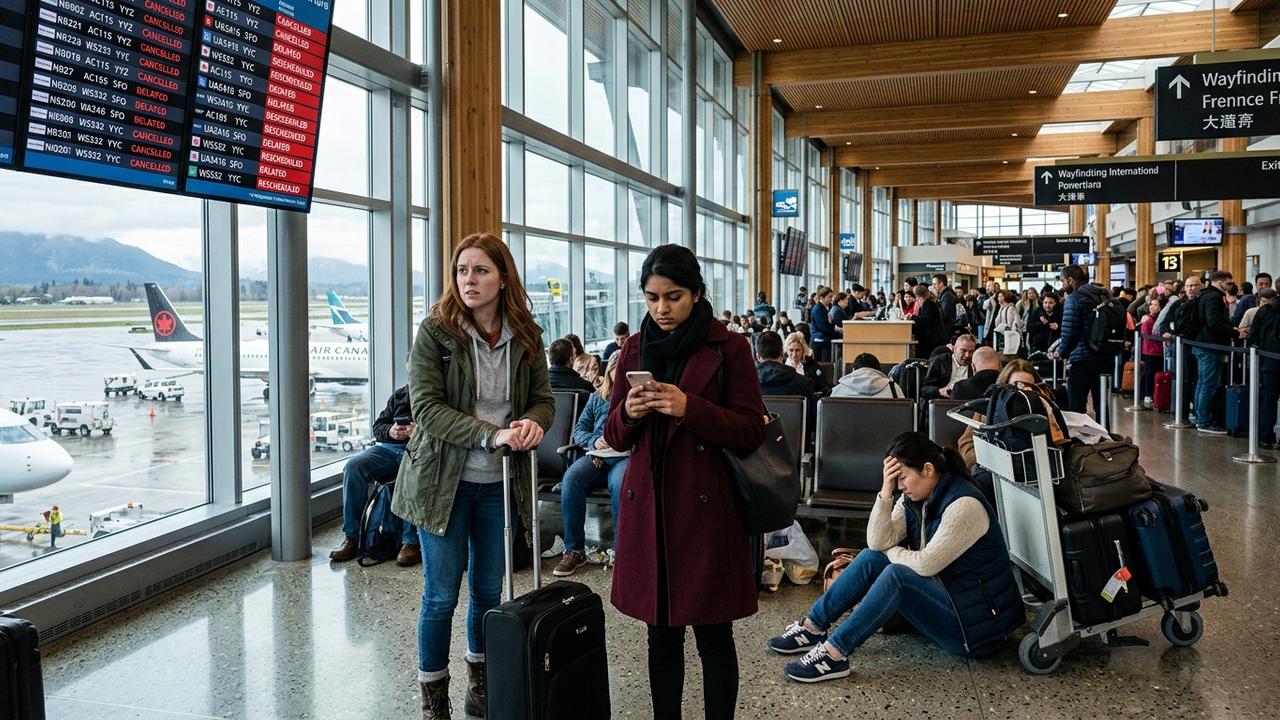
Image generated by AI
Pacific Coastal Airlines, Air Canada, and Jazz Cancel 11 Flights and Trigger Cascading Delays Across North American and Asian Routes Originating in Vancouver
Vancouver, June 22, 2026 — Pacific Coastal Airlines, Air Canada, and Jazz flight cancellations are currently grounding travelers and triggering widespread operational delays across multiple aviation networks. Eleven scheduled departures have been removed from the timetable today as carriers confront systemic scheduling pressures at a major western Canadian hub. The disruptions are rapidly reshaping travel itineraries for passengers bound for destinations spanning the United States, Canada, Germany, Japan, and Hong Kong. Industry observers confirm that the ripple effects are already straining connecting terminals and altering cross-border flight schedules.
Vancouver and Cross-Border Cities Face Widespread Travel Disruptions
Flight tracking data indicates that the operational strain extends far beyond the primary departure terminal. Canadian travelers face schedule adjustments across a dense network of domestic hubs and regional airports. Affected Canadian locations include Vancouver, Montreal, Toronto, Winnipeg, Nanaimo, Edmonton, Kelowna, Ottawa, Cranbrook, Prince George, Victoria, Yellowknife, Masset, Trail, Bella Bella, Bella Coola, Quesnel, Whitehorse, Calgary, and Powell River. The concentration of disruptions in western and central provinces is particularly notable, as these corridors serve as critical connectors for both commuter traffic and long-haul freight operations.
American passengers monitoring their itineraries are encountering similar turbulence at major transit points. Delays and schedule modifications are currently active in Sacramento, Boston, Denver, Dallas–Fort Worth, Houston, Las Vegas, Chicago, Phoenix, San Diego, Seattle, Portland, Cincinnati, Salt Lake City, and San Francisco. These United States entries function as essential transfer nodes for international itineraries, meaning that a single ground stop at the origin airport can cascade into multi-day schedule adjustments for passengers attempting to reach final destinations.
International carriers and cross-continental routing systems are also absorbing the shockwaves. Operational disruptions are actively impacting scheduled services toward Munich, Taipei, Tokyo, Seoul, Manila, Hong Kong, and Osaka. When a major regional airport experiences simultaneous cancellations across multiple carriers, connecting flights at these distant hubs frequently lose their inbound passengers. This creates a domino effect that forces airlines to reposition aircraft, adjust crew duty limits, and modify cargo manifests to maintain network balance.
Pacific Coastal Airlines and Air Canada Report Specific Flight Cancellation Metrics
Detailed breakdowns from official flight databases show that Pacific Coastal Airlines, Air Canada, and Jazz are managing the bulk of the current service reductions. Pacific Coastal Airlines recorded four cancellations, representing approximately six percent of its scheduled operations at the affected terminal. Air Canada matched that figure with four cancellations, which account for three percent of its overall network volume at the airport. Jazz, operating under contract for the major Canadian carrier, followed with three cancelled flights, equaling two percent of its scheduled services.
Beyond the primary hub, isolated service interruptions are appearing across secondary routes. Sacramento recorded one cancelled flight, while Montreal, Bella Bella, Toronto, Powell River, and Winnipeg each experienced one cancellation within their respective wider networks. These scattered removals demonstrate how localized operational constraints, whether stemming from air traffic control congestion, maintenance holds, or crew scheduling adjustments, can fracture connectivity across a broader system. Vancouver remains the epicenter of the disruption, absorbing the highest concentration of cancelled departures and highlighting the vulnerability of hub-and-spoke routing models during peak travel windows.
Passengers Navigate Rebooking Options During Cascading Schedule Disruptions
Aviation authorities and customer service teams are advising travelers to adopt structured response protocols when encountering these scheduling changes. Passengers should immediately monitor official communication channels, including registered email addresses, mobile phone notifications, and dedicated airline mobile applications. Carriers routinely push rebooking confirmations, gate change notifications, and alternative routing options through these digital platforms before physical terminal queues form.
Travelers are urged to remain calm and verify departure statuses directly on official carrier websites. Real-time operational dashboards provide the most accurate information regarding aircraft positioning, weather-related hold patterns, and ground handling capacity. When contacting airline representatives, passengers should utilize online chat systems or dedicated customer service telephone lines to bypass crowded terminal service desks. If immediate assistance is required at the airport, passengers should proceed directly to the airline’s designated operations counter, where ground staff can access inventory systems to secure alternate seating or hotel vouchers when necessary.
Industry guidelines emphasize that passengers should familiarize themselves with applicable carrier policies and regional consumer protection regulations. Many domestic and international carriers provide complimentary rebooking privileges or travel credits when cancellations fall within the airline’s operational control. In certain jurisdictions, including European member states, passengers may qualify for statutory compensation under established aviation passenger rights frameworks. When standard rebooking options prove insufficient, travelers should evaluate alternative routing strategies, including adjacent airport departures, high-speed rail connections, or intercity bus services, to maintain schedule continuity.
Vancouver International Airport Operations Trigger Regional Network Analysis
The current wave of cancellations and delays underscores the fragility of integrated aviation networks during high-volume travel periods. When multiple carriers experience simultaneous ground delays, terminal congestion increases, baggage handling systems face capacity limits, and ground transportation providers struggle to accommodate stranded passengers. The combination of these factors places sustained pressure on airport management teams, who must coordinate resource allocation across competing airline schedules.
While airline operations centers work to stabilize departing inventories and reassign ground crews, affected passengers continue to navigate itinerary modifications that extend across domestic and international borders. The latest disruption at Vancouver International Airport illustrates how localized operational challenges can quickly propagate across continents, impacting flight sequences, connection windows, and overall travel planning. Industry analysts note that modern aviation relies heavily on precise scheduling mathematics, and even minor deviations at a primary hub can require extensive recalibration across secondary airports and long-haul routing centers.
As ground operations gradually normalize and carriers process the backlog of rebooking requests, travel planners are expected to see incremental improvements in schedule predictability. The current situation serves as a reminder that aviation networks operate as interconnected systems, where a single delay can trigger cascading adjustments across thousands of passenger itineraries. Airlines are actively modifying departure windows and adjusting aircraft positions to restore network equilibrium. Passengers are advised to maintain flexible scheduling buffers, verify connection times with airline representatives, and monitor official flight status updates as operations stabilize.
| Airline | Cancelled | Delayed |
|---|---|---|
| Pacific Coastal Airlines | 4 | 6 |
| Air Canada | 4 | 16 |
| Jazz (ACA) | 3 | 16 |
Pacific Coastal Airlines, Air Canada, and Jazz flight cancellations will continue to influence routing availability across North American and Asian markets until ground operations fully recover. Network adjustments are expected to persist as carriers reallocate aircraft and crew resources to catch up on missed departure windows. Travelers should anticipate further schedule refinements over the next forty-eight hours as airlines process rebooking demands and restore standard departure cadences. Regulatory monitoring teams are tracking the disruption to ensure compliance with passenger protection standards while carriers work to minimize downstream scheduling impacts.
Related Travel Guides
Disclaimer
This article is for informational and educational purposes only. It does not constitute legal, financial, or professional advice. While we strive to provide accurate and up-to-date information, travel policies, regulations, and conditions change rapidly. Always verify information with official sources before making travel decisions. Nomad Lawyer makes no representations about the accuracy, reliability, completeness, or suitability of the information provided. Readers should consult qualified professionals for advice specific to their circumstances. The views expressed in this article are those of the author and do not necessarily reflect the views of Nomad Lawyer.
Kunal K Choudhary
Co-Founder & Contributor
A passionate traveller and tech enthusiast. Kunal contributes to the vision and growth of Nomad Lawyer, bringing fresh perspectives and driving the community forward.
Learn more about our team →