
Baltimore Airport Meltdown Triggers Travel Chaos as Severe Thunderstorms Force Ground Stop, Decimating Southwest Airlines Operations
Breaking airline news: A severe thunderstorm ground stop at Baltimore/Washington International Airport has paralyzed Southwest Airlines and triggered massive international travel chaos.

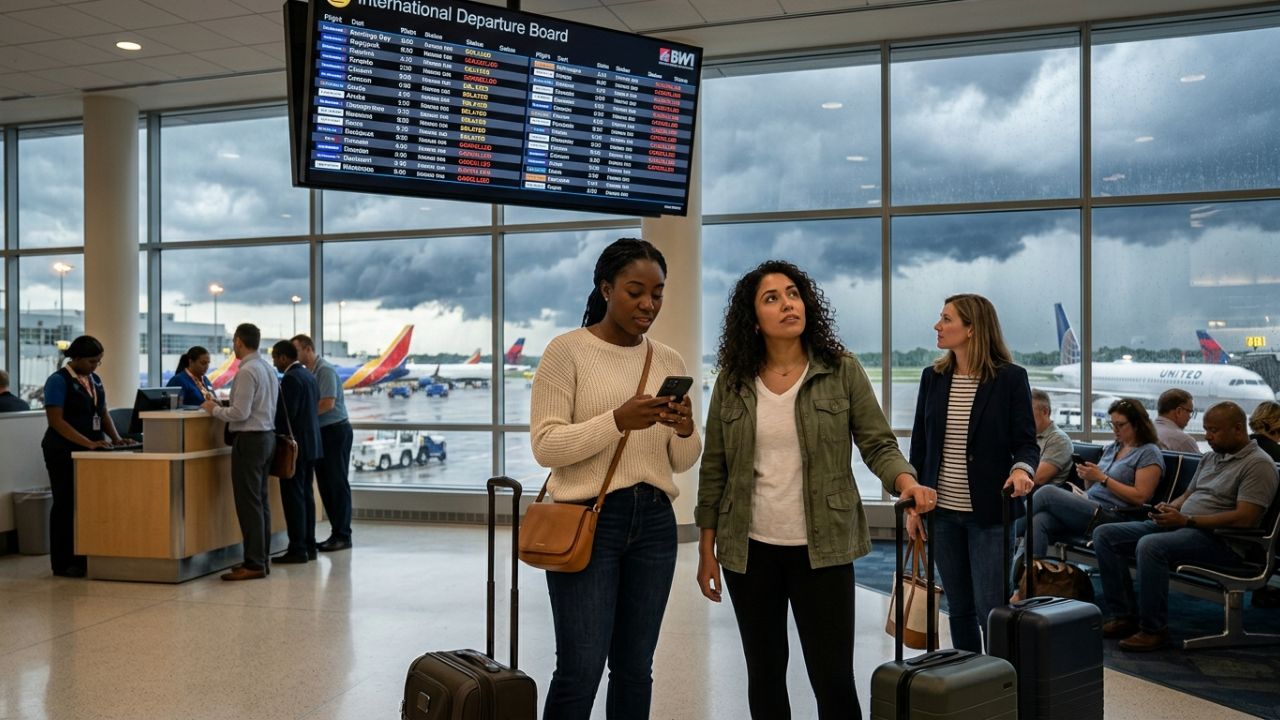
Image representing the massive, weather-driven operational meltdown at Baltimore/Washington International Thurgood Marshall Airport (BWI), where severe thunderstorms forced a ground stop advisory, completely paralyzing Southwest Airlines and generating epic travel chaos across the hemisphere. (Image Credit: Aviation Tracking Network)
Baltimore Airport Meltdown Triggers Travel Chaos as Severe Thunderstorms Force Ground Stop, Decimating Southwest Airlines Operations
Severe Convective Weather Paralyzes BWI, Sending Destructive Shockwaves Across the US, the Caribbean, and Iceland
The mid-Atlantic commercial aviation corridor is currently trapped in a massive, rapidly compounding logistical nightmare. According to the latest breaking airline news and critical aviation updates, severe and highly volatile thunderstorms have triggered an absolute operational meltdown at Baltimore/Washington International Thurgood Marshall Airport (BWI). To prevent catastrophic in-flight emergencies, federal air traffic authorities were forced to execute a total ground stop advisory, immediately freezing all aircraft movement across the highly congested regional airspace. This violent weather intervention has instantly generated epic travel chaos, severely paralyzing flight networks operated by major carriers including Southwest Airlines, Delta Air Lines, United Airlines, and Icelandair. As a direct result of this sudden airspace lockdown, airlines operating through the BWI hub are currently battling catastrophic schedule instability, resulting in 189 rolling flight delays and 26 absolute flight cancellations.
The sheer intensity of this ground stop has created a highly destructive ripple effect that extends far beyond the Maryland border. The massive airport disruptions are currently cascading across interconnected flight networks, severely impacting highly trafficked routes throughout the United States, Canada, Mexico, Jamaica, Iceland, and wider Caribbean destinations. Because Southwest Airlines utilizes BWI as one of its most critical fortress hubs on the East Coast, the low-cost giant has absorbed the absolute worst of the destruction, leaving thousands of desperate passengers physically trapped inside the terminal or stranded at upstream origin airports. As airlines frantically attempt to rebalance their severely damaged aircraft positioning matrices, the situation highlights the terrifying fragility of the modern aviation network when localized severe weather forces an immediate halt to all runway operations.
Section-Wise Breakdown: The Anatomy of the BWI Ground Stop
The highly detailed operational data exposes exactly how a localized thunderstorm system can rapidly destroy both domestic and international airline scheduling:
The Convective Ground Stop at BWI The absolute primary catalyst for this massive disruption is a highly aggressive thunderstorm system that violently encroached upon the airspace surrounding Baltimore/Washington International Thurgood Marshall Airport. The extreme weather conditions—specifically intense lightning activity physically striking near the highly sensitive approach and departure corridors, combined with severely reduced visibility—left federal air traffic control with absolutely no choice. To ensure baseline passenger safety, authorities immediately implemented a total ground stop and highly restrictive flow controls across the entire mid-Atlantic region. This meant inbound flights were violently held at their departure airports across the country, while outbound aircraft were frozen on the tarmac at BWI, completely unable to enter the active sequencing queue. This instantaneous suspension generated rolling delays that quickly breached the operational windows required to complete scheduled turnarounds, ultimately forcing the airlines to initiate absolute cancellations.
Southwest Airlines Absorbs the Destruction As the dominant mega-carrier at the BWI hub, Southwest Airlines is bearing the absolute brunt of this terrifying disruption. The operational tracking data explicitly confirms that Southwest recorded a staggering 149 active delays and 24 absolute cancellations, representing the overwhelming majority of the total disruption at the airport. Because Southwest relies heavily on high-frequency, point-to-point aircraft utilization, this massive ground stop means that dozens of their Boeing 737s are physically trapped out of sequence. This is not an airline-specific operational failure, but rather the devastating mathematical reality of operating a massive hub during severe airspace constraints. Delta Air Lines also suffered notable damage, recording 12 delays and 2 cancellations, while United Airlines and American Airlines reported multiple severe delays without crossing the cancellation threshold. Smaller regional and low-cost operators, including Frontier, Avelo, Republic Airways, and Contour Airlines, were also dragged into the rolling delays.
Domestic and International Spillover The BWI lockdown immediately transmitted severe shockwaves across the broader US and international aviation network. Because BWI relies heavily on feeder traffic, the ground stop forced highly frustrating upstream ground delays at massive origin hubs including Hartsfield–Jackson Atlanta International Airport, Chicago O’Hare, Dallas–Fort Worth, Denver, and Boston Logan. The destruction was equally severe at the destination level. The localized thunderstorms in Maryland completely severed connectivity to massive domestic and international gateways, severely delaying or cancelling flights bound for Orlando, Miami, Tampa, Los Angeles, San Francisco, Chicago Midway, and Detroit. Furthermore, the crisis violently crossed international borders, crippling high-yield international schedules connecting BWI to Cancún (Mexico), Montego Bay (Jamaica), and Keflavík (Iceland), demonstrating how a single ground stop can instantly generate global travel chaos.
Flight Details: The BWI Ground Stop Disruption Matrix
To provide exact, factual clarity on the immense scale of this logistical failure, aviation analysts have mapped the specific operational metrics reported out of BWI. The following factual matrix details the precise breakdown of the absolute cancellations and active delays by the primary affected carriers:
Factual Baltimore/Washington (BWI) Disruption Matrix
| Airline Carrier | Cancelled Flights | Delayed Flights |
|---|---|---|
| Southwest Airlines | 24 | 149 |
| Delta Air Lines | 2 | 12 |
| United Airlines & American Airlines | 0 | Multiple Delays Reported |
| Total BWI Airport Metrics (All Carriers) | 26 | 189 |
Data reflects the extreme operational failures recorded at Baltimore/Washington International Airport. Additional delays impacted Icelandair, Frontier, Avelo, Republic Airways, and Contour Airlines. (Source: FlightAware)
Passenger Impact: Trapped in the Mid-Atlantic Congestion
For the traveling public, the sudden implementation of a severe ground stop represents an inescapable nightmare. Passengers desperately attempting to reach the Caribbean for vacations, or secure critical international connections to Iceland, are currently enduring excruciatingly long terminal delays. The high volume of flight cancellations forces airlines to aggressively attempt to re-accommodate passengers, but because the entire network is congested by the weather system, standby availability is nearly non-existent. The psychological stress of the travel chaos is compounded by the fact that airlines are generally not obligated to provide compensation for hotels or meals during severe weather disruptions. Passengers stranded at BWI, or trapped at upstream hubs like Atlanta and Chicago, are strongly advised to constantly monitor official airline applications, as these digital platforms provide the fastest access to alternative, albeit limited, rebooking options.
Industry Analysis: The Cascading Danger of Flow Restrictions
Aviation analysts closely monitoring the BWI meltdown emphasize that this crisis perfectly illustrates the systemic vulnerability of the highly interconnected US aviation corridor. When severe thunderstorms force the FAA to implement ground stops and strict flow restrictions at a major East Coast hub, the resulting congestion acts like a localized stroke within the national airspace system. Air traffic control is forced to increase the physical spacing between aircraft, which brutally degrades runway sequencing efficiency. The fact that the disruption extended from Los Angeles to Iceland highlights the reality that high-frequency carriers like Southwest cannot easily isolate a localized delay; the trapped aircraft completely destroys the downstream schedule for the remainder of the day, forcing airlines to cancel flights purely because the operational window has expired.
Conclusion: A Global Network Paralyzed by Local Lightning
The intense operational collapse at Baltimore/Washington International Thurgood Marshall Airport serves as a highly visible, definitive warning regarding the incredible fragility of modern aviation routing. With a staggering 189 severe delays and 26 absolute cancellations, the violent thunderstorms over Maryland have effectively paralyzed Southwest Airlines, Delta, and Icelandair, resulting in undeniable, global travel chaos. As the FAA slowly lifts the ground stop and airlines frantically struggle to clear the massive backlog, passengers attempting to reach destinations from Cancún to Keflavík must brace for severe, ongoing airport disruptions. Moving forward, travelers heavily reliant on the BWI hub must maintain extreme flexibility and strategically avoid tight connection windows to successfully navigate the highly volatile reality of summer convective weather. (Source: FlightAware via Nomad Lawyer)
Key Takeaways
- Massive BWI Ground Stop: Severe thunderstorms, lightning, and reduced visibility forced the FAA to implement a severe ground stop at Baltimore/Washington International Airport (BWI).
- Massive Cancellation Totals: The extreme weather intervention triggered 189 massive rolling delays and 26 absolute flight cancellations.
- Southwest Airlines Devastated: As the dominant hub operator, Southwest Airlines absorbed the absolute worst of the crisis, suffering 149 delays and 24 cancellations.
- International Destruction: The BWI lockdown completely severed connectivity across the hemisphere, crippling flights bound for Canada, Mexico, Jamaica, Iceland, and the Caribbean.
- Domestic Gridlock: The disruption infected major US origin hubs, violently holding flights on the ground at Atlanta, Chicago O'Hare, Dallas-Fort Worth, Denver, and Boston Logan.
✈️ Frequently Asked Questions (Factual Aviation & Disruption Data)
What specific airport served as the primary epicenter for this massive operational breakdown? The severe disruption and resulting ground stop were heavily concentrated at Baltimore/Washington International Thurgood Marshall Airport (BWI) in Maryland.
Exactly how many total cancellations and delays were recorded at BWI during this severe weather event? According to reported operational figures, the airport suffered a staggering 189 flight delays and 26 absolute cancellations.
Which major airline absorbed the heaviest volume of delays and cancellations at BWI? Southwest Airlines was the most severely affected carrier by a massive margin, recording an incredible 149 active delays and 24 absolute cancellations.
What specific environmental factors forced federal authorities to implement the ground stop? The ground stop was triggered by severe thunderstorms, specifically intense lightning activity near approach and departure corridors, and heavily reduced visibility.
Which other major domestic US carriers were directly impacted by the BWI ground stop? In addition to Southwest, Delta Air Lines suffered 12 delays and 2 cancellations, while United Airlines and American Airlines reported multiple delays.
Which international regions and countries suffered delays due to the massive backlog at BWI? The global ripple effect severely disrupted international schedules connecting through BWI, heavily impacting flights bound for Canada, Mexico (Cancún), Jamaica (Montego Bay), Iceland (Keflavík), and the wider Caribbean.
Which major US domestic origin airports experienced severe ground holds linked to the BWI chaos? Flights were violently held on the ground at massive upstream hubs, including Hartsfield–Jackson Atlanta, Chicago O’Hare, Dallas–Fort Worth, Denver, and Boston Logan.
Which major US domestic destination airports suffered from the BWI spillover? Destination airports severely impacted by the delays included Orlando, Miami, Tampa, Los Angeles, San Francisco, Chicago Midway, and Detroit.
🌍 Related Travel Guides & Flight Resources
- Navigate Airport Disruptions Like a Pro Master the art of surviving unexpected travel chaos with our expert strategies.
- Breaking Airline News & Evasion Routes Stay ahead of the delays with our real-time aviation updates and route intelligence.
- Global Flight Cancellation Defense Grid Essential legal rights and compensation tactics when your flight goes down.
⚖️ Disclaimer
The flight cancellation statistics, delay metrics, and airline operational overviews provided in this report are for informational purposes only. The specific aviation variables regarding the severe weather ground stop at Baltimore/Washington International Airport (BWI)—including the exact cancellation and delay figures for Southwest Airlines, Delta, United, and Icelandair, as well as the cascading delays affecting international routes to Jamaica and Iceland—are highly volatile and subject to rapid, real-time adjustments by federal air traffic controllers and corporate airline dispatchers. All data has been officially sourced from FlightAware as of June 15, 2026. NomadLawyer does not guarantee the absolute accuracy or current validity of the information provided and assumes no liability for sudden schedule changes, rolling domestic delays, agonizing missed connections, or any financial consequences resulting from the use of this content. Passengers trapped in the current BWI disruption are strongly advised to utilize their airline’s official mobile applications for emergency rebooking updates.
Disclaimer
This article is for informational and educational purposes only. It does not constitute legal, financial, or professional advice. While we strive to provide accurate and up-to-date information, travel policies, regulations, and conditions change rapidly. Always verify information with official sources before making travel decisions. Nomad Lawyer makes no representations about the accuracy, reliability, completeness, or suitability of the information provided. Readers should consult qualified professionals for advice specific to their circumstances. The views expressed in this article are those of the author and do not necessarily reflect the views of Nomad Lawyer.
Kunal K Choudhary
Co-Founder & Contributor
A passionate traveller and tech enthusiast. Kunal contributes to the vision and growth of Nomad Lawyer, bringing fresh perspectives and driving the community forward.
Learn more about our team →