
Niuafo’ou Isolation: Monthly Grass Strip Flights Leave Tonga’s Remotest Island Vulnerable Ahead of Cyclone Season
Niuafo’ou relies on a single monthly Lulutai Airlines flight to Vava’u. Discover how infrastructure gaps and cyclone risks impact Tonga's remotest island.
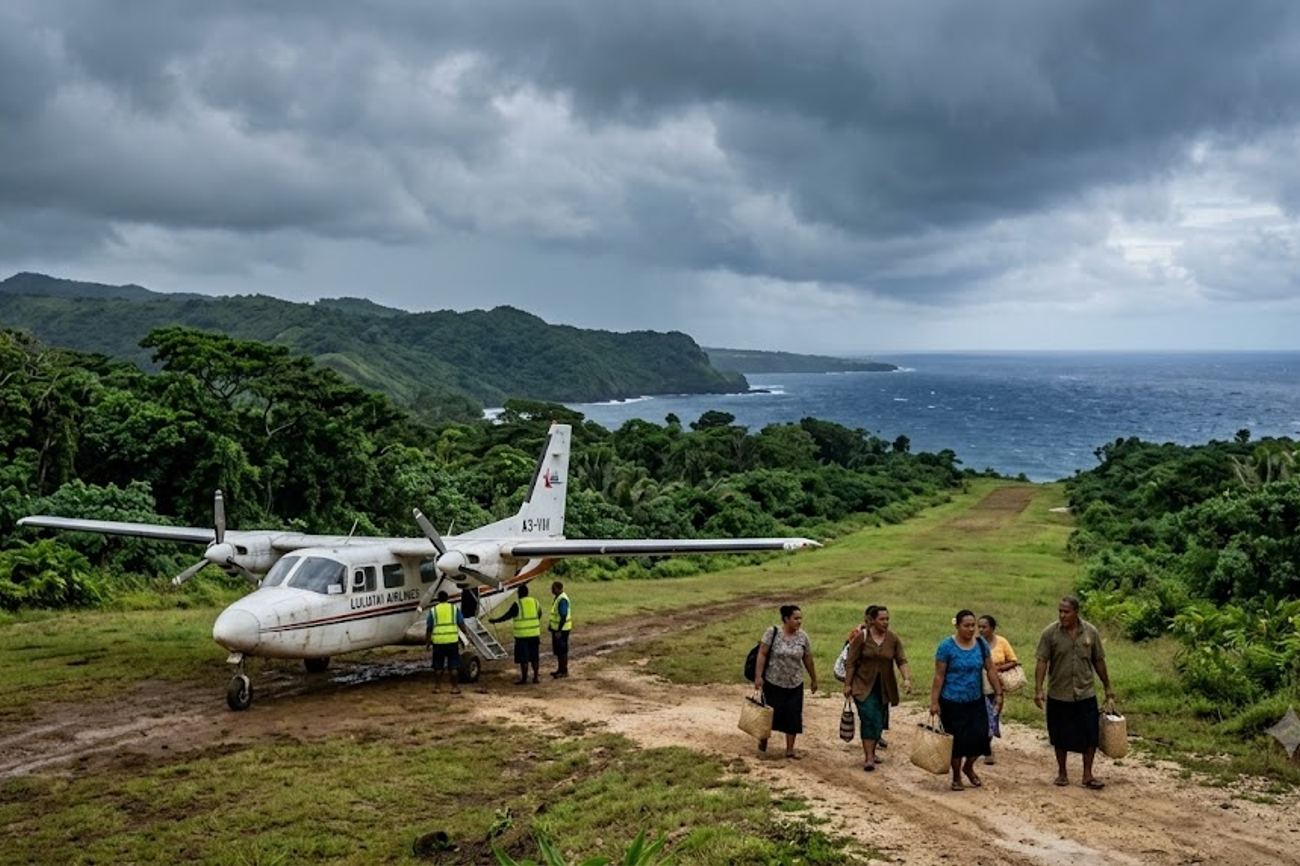
Image generated by AI
Niuafo’ou’s precarious aerial lifeline
[Nuku’alofa, September 6, 2026] — The connectivity of Tonga’s most isolated inhabited island is currently tethered to a fragile aviation link that operates only once every 30 days. Lulutai Airlines provides the sole air bridge between Vava’u and Niuafo’ou, a 90-minute journey that terminates at the grass-surfaced Queen Lavinia Airport. As the November-to-April cyclone season approaches, the lack of operational redundancy for this route has become a primary concern for logistics and travel planning.
While the Tongan government has committed TOP3.2 million in subsidies for Lulutai Airlines for the 2027 fiscal year and pledged asset management for regional airports through 2029, these financial injections do not address the physical limitations of the Niuafo’ou runway. Official records indicate that while aviation equipment is earmarked for the island, runway resurfacing projects are prioritized for Kaufana Airport on ‘Eua, leaving Niuafo’ou dependent on a weather-sensitive grass strip.
Operational fragility of the Vava’u-Niuafo’ou corridor
The primary challenge facing Niuafo’ou is not merely the scarcity of flights, but the total absence of fallback options. Lulutai Airlines confirms that the service from Vava’u to Niuafo’ou operates once per month. Because Queen Lavinia Airport utilizes a grass strip, the airline explicitly warns that adverse weather conditions frequently lead to total cancellations.
For passengers, this creates a high-stakes booking environment. Industry data indicates that flights are often fully committed months in advance. Unlike other domestic routes where a cancellation might result in a delay of a few days, a disruption on the Niuafo’ou route can leave travelers stranded or delayed by an entire month.
Lulutai Airlines notes that several variables can trigger these disruptions, including air traffic control restrictions, unscheduled aircraft maintenance, and general operational volatility. In a network where the margin for error is non-existent, these factors transform a simple flight delay into a significant logistical crisis.
Niuafo’ou Aviation Status Report (Verified September 6, 2026)
| Aviation Measure | Current Verified Position | Travel-Trade Significance |
|---|---|---|
| Niuafo’ou Route | Vava’u–Niuafo’ou | Vava’u serves as the sole air gateway |
| Published Frequency | Once monthly | Extreme lack of schedule redundancy |
| Approx. Flying Time | 1 hour 30 minutes | Remote sector, not a short hop |
| Airport | Queen Lavinia Airport | One of six Tonga Airports Limited sites |
| Surface Type | Grass strip | Infrastructure limits weather resilience |
| Weather Exposure | High (Cancellations likely in bad weather) | Requires highly flexible itineraries |
| Booking Pressure | Full months in advance | Limited reaccommodation options |
| Cyclone Season | November–April | Critical risk window starting Q4 2026 |
Comparing Niuafo’ou to Tonga’s broader aviation network
To understand the severity of the isolation, one must examine the disparity between Niuafo’ou and other domestic hubs. Lulutai Airlines operates its primary base in Nuku’alofa on the island of Tongatapu. The connection from Tongatapu to Vava’u’s Lupepau’u Airport is robust, with two to three flights operating daily.
However, the transition from the Vava’u hub to Niuafo’ou represents a dramatic collapse in service frequency. The contrast is stark when compared to other regional destinations:
| Domestic Sector | Published Lulutai Frequency | Relative Connectivity |
|---|---|---|
| Tongatapu–Vava’u | 2–3 daily | Highest connectivity |
| Tongatapu–Ha’apai | Twice daily | Regular daily access |
| Tongatapu–‘Eua | Once daily, six days weekly | Near-daily access |
| Vava’u–Niuatoputapu | Twice weekly | Thin but recurring weekly service |
| Vava’u–Niuafo’ou | Once monthly | Most limited frequency in the network |
This data confirms that Niuafo’ou does not simply share the characteristics of a "remote" destination; it exists in an entirely different category of connectivity than the rest of the Tongan archipelago.
Government subsidies and the energy crisis
The Tongan government is attempting to stabilize the domestic aviation sector through direct financial intervention. The FY2027 Budget Statement outlines a TOP3.2 million subsidy for Lulutai Airlines, intended to mitigate the impact of global fuel and energy price volatility. This is mirrored by a TOP3.7 million allocation for domestic shipping.
The broader economic context is severe, with the government estimating the total national budget impact of the energy crisis to be between TOP40 million and TOP50 million. While these subsidies ensure that Lulutai Airlines remains solvent and capable of flying, they are not earmarked for capacity expansion.
Crucially, there is no evidence in the FY2027 budget that these funds will be used to increase the frequency of flights to Niuafo’ou or to upgrade the infrastructure at Queen Lavinia Airport. The subsidy is a tool for continuity, not for growth or resilience.
Infrastructure gaps and climate resilience
The physical state of Niuafo’ou’s landing strip remains a critical vulnerability. The World Bank’s Tonga Climate Resilient Transport Project II (TCRTP II), a US$38 million initiative approved in December 2021, aims to enhance transport safety and climate resilience across the nation. The project is scheduled to conclude on June 30, 2029.
Despite the overarching goals of TCRTP II, there is a notable gap in the current execution regarding Niuafo’ou. While the project provides essential aviation equipment for the island, the high-priority runway resurfacing projects have been allocated to Kaufana Airport on ‘Eua. This leaves the Niuafo’ou grass strip exposed to the elements, particularly as the region enters the high-risk cyclone window.
Why This Matters: The Real-World Impact
For the traveler or resident, the reliance on a monthly grass-strip flight creates a "single point of failure" scenario. From a logistical standpoint, this means that any medical emergency, urgent supply shortage, or travel disruption cannot be solved via aviation in a timely manner.
The lack of a paved runway means that larger, more resilient aircraft cannot land at Queen Lavinia Airport, and current aircraft are at the mercy of the soil's saturation levels during the rainy season. When a flight is cancelled due to weather, the "next available" seat may not exist for another 30 days, effectively cutting the island off from the rest of the country. This creates a precarious dependency where the arrival of a single aircraft becomes the most significant event of the month for the entire community.
Related Travel Guides
Disclaimer
This article is for informational and educational purposes only. It does not constitute legal, financial, or professional advice. While we strive to provide accurate and up-to-date information, travel policies, regulations, and conditions change rapidly. Always verify information with official sources before making travel decisions. Nomad Lawyer makes no representations about the accuracy, reliability, completeness, or suitability of the information provided. Readers should consult qualified professionals for advice specific to their circumstances. The views expressed in this article are those of the author and do not necessarily reflect the views of Nomad Lawyer.