
Tokyo Mount Takao Bear Sighting Triggers Safety Alert: Silver Week Hiking Guide 2026

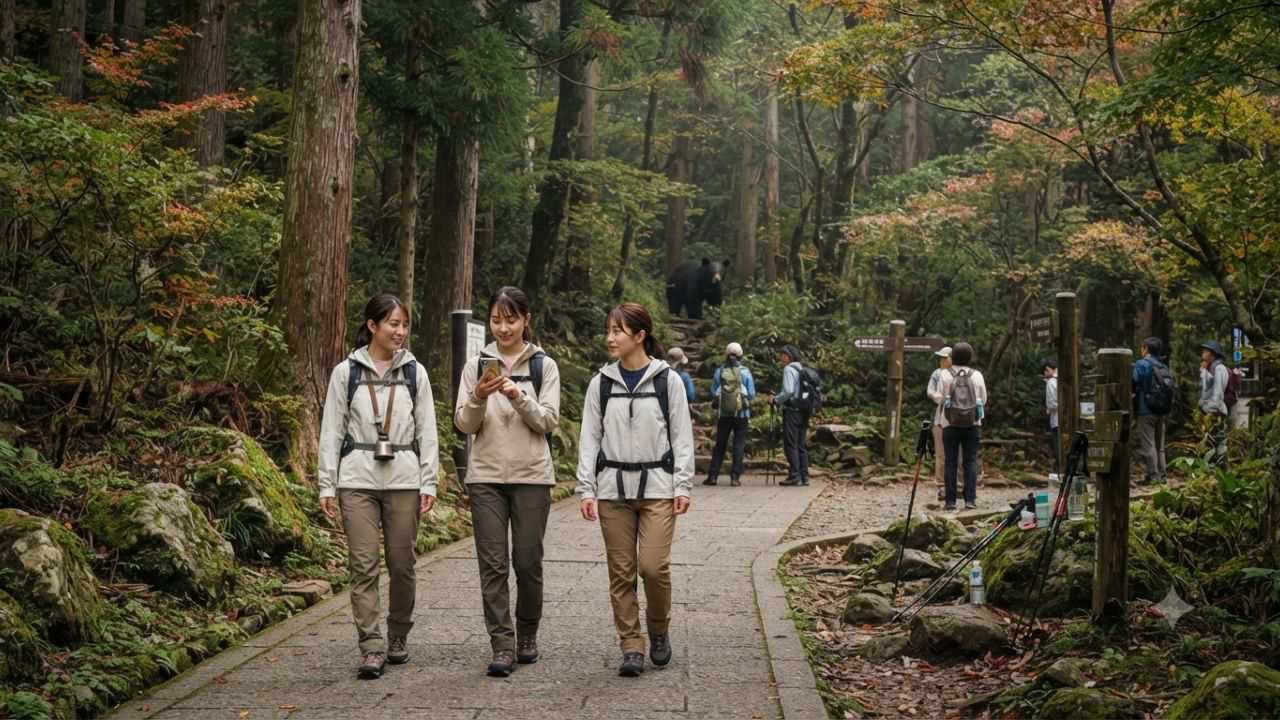
Image generated by AI
An expanding population of 120 to 378 Asiatic black bears documented in the Tama forests of western Tokyo has intersected directly with metropolitan holiday transit following a camera-confirmed sighting roughly 70 meters from Mount Takao’s paved Trail No. 1. Recorded at approximately 11:00 p.m. on August 20 just north of the Shiromidai observation area, the predator's proximity to the capital's most heavily traversed mountain corridor has prompted municipal safety alerts immediately preceding Japan’s five-day Silver Week autumn travel surge.
Urban-Wildland Convergence: The Ecological Forces Driving Bears into Greater Tokyo
Mount Takao, administered within Hachioji City, ranks among the most visited mountain summits globally, drawing an estimated three million domestic and overseas trekkers annually. Its premier route, Trail No. 1, features paved pathways, historic shrines, and cable car access designed to accommodate casual day-trippers. However, the mountain forms the eastern terminal ridge of the broader Kanto mountain range, connecting directly into the deep, contiguous forests of the Tama region.
According to ecological surveys conducted by the Tokyo Metropolitan Government for fiscal year 2025, the resident Asiatic black bear population in western Tokyo ranges between 120 and 378 animals, with wildlife biologists tracking an upward demographic trajectory. The municipality’s public digital mapping portal confirms that verified tracks, camera traps, and direct sightings have concentrated heavily along the Tama district's perimeter ridges.
The timing of the animal’s descent toward populated tourist trails reflects acute seasonal feeding behaviors analyzed by wildlife biologists. Takayoshi Yamauchi, an associate professor specializing in bear ecology within the Faculty of Agriculture at Iwate University, notes that August routinely presents a severe caloric deficit as mountain berry supplies dry up, forcing bears into peripheral foothills. By September, as wild acorns and fruit ripen, bears enter hyperphagia—a biological state of relentless foraging ahead of winter denning. When natural food sources are located near cultivated areas, the animals establish temporary stationary feeding ranges, creating an immediate geographic overlap with holiday hikers, nature photographers, and autumn mushroom foragers.
The phenomenon is not isolated to the capital. Nationwide alerts issued in coordination with the Japan National Tourism Organization (JNTO) and the Ministry of the Environment Japan confirm widespread September incidents: an orchard raid in Miyoshi, Hiroshima Prefecture on September 3 where a bear was filmed carrying off ripe pears; an emergency police firearms deployment in Maizuru, Kyoto Prefecture on September 3 following two bears invading a residential property; and road closures in Tendo, Yamagata Prefecture on September 7 after a bear roamed residential blocks.
Incident Breakdown and Municipal Defensive Protocols: From Trail No. 1 to Yamagata
Municipal governments, regional event coordinators, and trailside merchants are implementing rapid deterrent protocols to secure recreational corridors.
In Hachioji City, park rangers emphasize that the August 20 animal appeared during late-night hours. Authorities have advised the public to avoid trailheads during periods of low visibility, specifically early dawn and post-dusk hours when crepuscular and nocturnal animal movements peak. Along Mount Takao’s commercial strip, hospitality operators are eliminating potential attractants. Daichi Usui, deputy manager of the flagship Takao Coffee store, confirmed that commercial establishments have instituted rigorous protocols prohibiting outdoor garbage accumulation and securing food waste in airtight indoor storage.
In northern Japan, similar wildlife pressures prompted aggressive preventative measures ahead of the mass-attendance Imoni Festival in Yamagata City on September 20. Following the nearby residential sightings in Tendo, festival organizers launched nightly pyrotechnic deterrent campaigns between September 16 and September 19, discharging firecrackers and handheld fireworks across peripheral hillsides. Additionally, officials arranged the emergency deployment of the "Monster Wolf"—a robotic, sensor-activated deterrent equipped with flashing LED eyes and an acoustic synthesizer capable of projecting over 50 distinct predatory sounds—stationing the device near the festival grounds on September 18.
| Region / City | Date of Encounter | Location & Nature of Incident | Operational & Defensive Response |
|---|---|---|---|
| Tokyo (Hachioji City) | August 20 (11:00 p.m.) | 70m north of Shiromidai, Trail No. 1, Mount Takao | Night hiking advisories issued; commercial food waste secured by local cafes |
| Hiroshima (Miyoshi) | September 3 | Agricultural fruit orchard; bear observed eating ripe pears | Agricultural perimeter surveillance; damage assessments to fruit crops |
| Kyoto (Maizuru) | September 3 | Two bears sighted adjacent to residential property | Emergency firearms deployment by authorized local wildlife control teams |
| Yamagata (Tendo) | September 7 | Bear wandering through suburban residential streets | Temporary road closures; neighborhood school security patrols activated |
| Yamagata City | September 16–19 (Prep) | Mountains surrounding Imoni Festival (Sept 20 event) | Pyrotechnic firecracker sweeps; "Monster Wolf" robotic sound deterrent installed Sept 18 |
Expert Analysis: Silver Week Congestion, Canopy Hazards, and Traveler Risk Management
The intersection of record autumn holiday bookings and active wildlife foraging creates unique logistical friction for international and domestic travelers.
For travelers booking this route, the direct consequence is that casual city hiking on Mount Takao can no longer be treated as an extension of urban Tokyo sightseeing. Trail No. 1 is widely promoted as a paved, stroller-accessible path suitable for sneakers and light clothing. However, because the confirmed sighting occurred just 70 meters off this primary thoroughfare, hikers face genuine exposure to territorial wildlife. During the five-day Silver Week holiday, tens of thousands of visitors pack the trail simultaneously, creating dense crowd bottlenecks that eliminate rapid retreat routes if an animal approaches.
The pricing pressure this creates means outdoor retailers across Shinjuku, Shibuya, and Hachioji are experiencing run-on demand for personal protective equipment, driving up costs for specialized bear bells, high-decibel whistles, and capsicum-based bear deterrent sprays. Travel gear stores report inventory shortages as holidaymakers purchase acoustic deterrents, with some hikers resorting to makeshift noise makers, air horns, and maritime conch shells to signal their presence along wooded switchbacks.
A primary technical hazard emphasized by ecological researchers is canopy foraging. Asiatic black bears frequently climb mature oak and beech trees to feed on mast branches, creating vegetative platforms known as bear nests ("kuma-dana"). Unsuspecting hikers who focus solely on the paved path beneath their feet risk walking directly beneath an active 100-kilogram bear feeding in the overhead canopy. If startled, a descending animal will react aggressively to defend its food cache.
Consequently, tour operators and independent travelers must adjust their hiking itineraries: restricting ascents strictly to mid-day sunlight hours, moving in vocal groups, eliminating heavily scented lotions or food snacks that project scent plumes into the forest, and checking official municipal bear sighting maps before departing central Tokyo terminals.
Key Takeaways
- Mount Takao Sighting: An Asiatic black bear was confirmed by observation camera at 11:00 p.m. on August 20, roughly 70 meters north of Shiromidai along Trail No. 1.
- Population Census: Tokyo Metropolitan Government’s fiscal 2025 survey estimates between 120 and 378 bears inhabit the western Tama forest corridor, with numbers expanding.
- Seasonal Foraging Overlap: Food scarcity in August transitions to intense pre-hibernation feeding in September, driving bears to remain near fruit and nut trees along human trails.
- Nationwide Encounters: Parallel September incidents across Hiroshima, Kyoto, and Yamagata have prompted emergency firearms operations, road closures, and robotic "Monster Wolf" acoustic deployments.
- Silver Week Precautions: Hikers navigating Mount Takao must avoid dawn and dusk trekking, carry bear bells, travel in groups, scan tree canopies, and eliminate scented cosmetics.
FAQ: Tokyo Mount Takao Bear Alert Silver Week 2026
Where was the bear sighted on Mount Takao?
The Asiatic black bear was photographed by an automated camera at 11:00 p.m. on August 20, approximately 70 meters north of the Shiromidai observation platform along Trail No. 1 in Hachioji City, western Tokyo.
Is Mount Takao still safe for hiking during Silver Week?
Mount Takao remains open, but authorities urge heightened vigilance. Hikers should strictly travel during broad daylight between 9:00 a.m. and 4:00 p.m., stay in groups, carry bear bells, and avoid hiking at dawn or after sunset when wildlife activity peaks.
How many wild bears live in the Tokyo metropolitan area?
A Tokyo Metropolitan Government fiscal 2025 survey estimates the bear population in the western Tama region between 120 and 378 animals. The population is expanding, with digital maps showing sightings concentrated along forested western mountain ridges.
What should I carry to deter bears while hiking in Japan?
Hikers should carry audible deterrents such as brass bear bells or loud whistles to signal their presence, carry certified bear deterrent spray, wear non-scented personal products, and store all food in airtight sealed bags to prevent odor plumes.
[As wilderness boundaries blend with metropolitan transit corridors, vigilant trail preparation and situational awareness remain the hiker’s best defense during Japan’s autumn trekking season.]
Related Travel Guides
Disclaimer
This article is for informational and educational purposes only. It does not constitute legal, financial, or professional advice. While we strive to provide accurate and up-to-date information, travel policies, regulations, and conditions change rapidly. Always verify information with official sources before making travel decisions. Nomad Lawyer makes no representations about the accuracy, reliability, completeness, or suitability of the information provided. Readers should consult qualified professionals for advice specific to their circumstances. The views expressed in this article are those of the author and do not necessarily reflect the views of Nomad Lawyer.
Preeti Gunjan
Contributor & Community Manager
A passionate traveller and community builder. Preeti helps grow the Nomad Lawyer community, fostering engagement and bringing the reader experience to life.
Learn more about our team →