
State Railway of Thailand Approves 106.8 Billion Baht Southern Double-Track Rail Expansion Connecting Chumphon, Surat Thani, Hat Yai, and Malaysia
Thailand approves a 106.8 billion baht double-track railway expansion from Chumphon to Padang Besar. View project budgets, timelines, and cross-border rail guides.

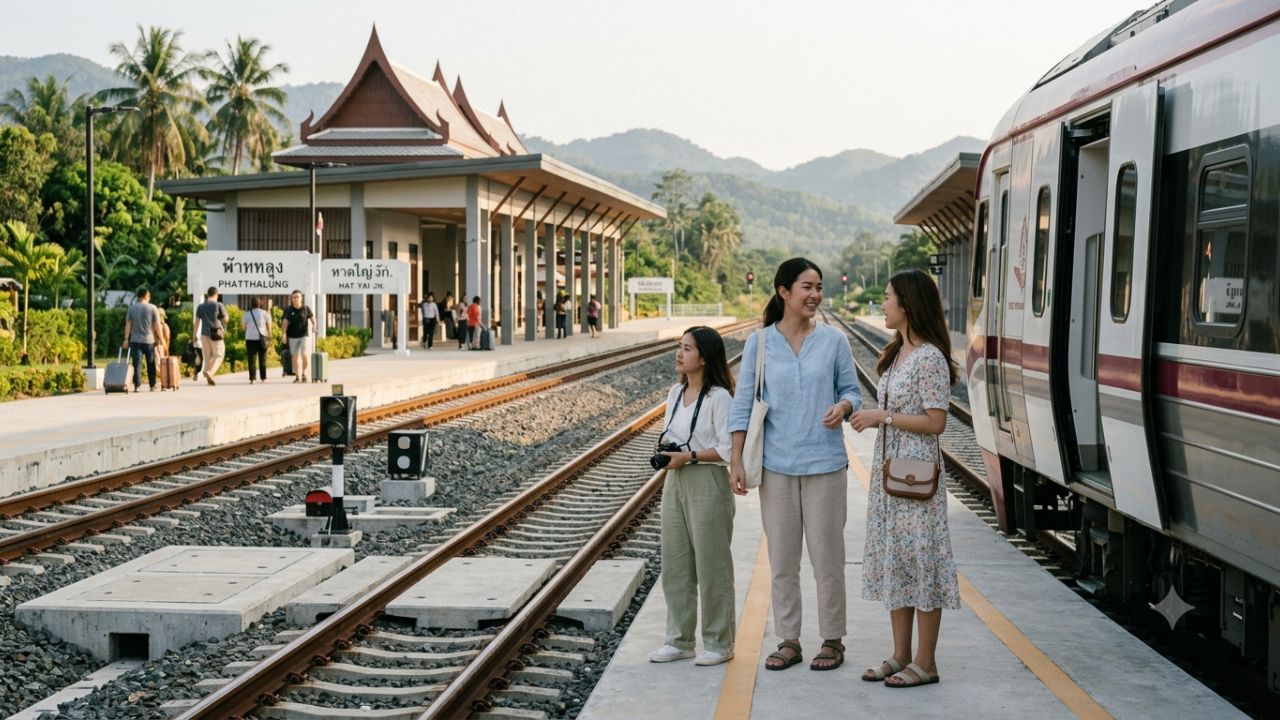
Image generated by AI
The Cabinet of Thailand has approved a 106.8 billion baht double-track railway expansion across its southern corridor, upgrading single-track operations between Chumphon and Padang Besar to accelerate passenger transit and strengthen cross-border rail links with Malaysia.
BANGKOK, Thailand — The State Railway of Thailand (SRT) has secured approval for a major infrastructure project valued at approximately 106.8 billion baht to construct a continuous double-track railway corridor across southern Thailand. Formally integrated into the nation's broader Double-Track Railway Expansion Programme, the initiative replaces aging single-track bottlenecks between Chumphon, Surat Thani, Hat Yai Junction, and the Padang Besar border checkpoint.
The investment aims to modernize long-distance passenger travel, reduce transit times for tourists traveling to Gulf of Thailand island gateways, and expand international rail freight capacity connecting Thailand with Malaysia and the wider ASEAN transit network.
Core Transit Update: 106.8 Billion Baht Investment Eliminates Rail Bottlenecks
Under Thailand's existing single-track configuration, passenger and freight trains traveling in opposing directions are required to stop at sidings and regional stations to allow oncoming traffic to pass. The transition to dual-track infrastructure enables simultaneous bidirectional train movements, eliminating prolonged operational delays and increasing daily line capacity.
The project budget reflects engineering upgrades designed to enhance long-term network resilience. Cost adjustments from earlier proposals account for updated structural designs, advanced flood prevention drainage along low-lying southern coastal tracks, upgraded automated level crossings, and land acquisition compensation. Additionally, project supervision fees were adjusted from 2.25% to 2.75% of total construction expenses.
Contract signing by the State Railway of Thailand is scheduled to commence in 2027, with annual government budget allocations and state financial loans backing construction through to target completion in 2033.
Southern Double-Track Project Breakdown and Capital Allocations
The approved expansion comprises three main railway sections spanning southern Thailand to the Malaysian border, alongside additional regional study corridors.
| Railway Expansion Project | Approved Budget (Baht) | Construction Period | Key Destinations & Operational Purpose |
|---|---|---|---|
| Chumphon–Surat Thani Double-Track | 36.9 Billion | 7 Years (Starts FY2026) | Connects northern Gulf coastal towns to island ferry gateways at Surat Thani |
| Surat Thani–Hat Yai Junction Double-Track | 61.5 Billion | 8 Years | Mainline southern corridor upgrade linking major commercial and tourism hubs |
| Hat Yai Junction–Padang Besar Double-Track | 8.37 Billion | 6 Years | Cross-border international rail connection linking Thailand to Malaysia's KTMB network |
| Hat Yai Junction–Songkhla Route (Pending) | 15.9 Billion (29.22 km) | Under Review | Coastal extension delayed pending resolution of land occupation requirements |
Additional National Rail Expansion Corridors
Alongside the primary southern investment, Thai transport authorities have granted in-principle approval for feasibility studies across three additional northern and northeastern rail routes:
- Pak Nam Pho–Den Chai double-track corridor
- Den Chai–Chiang Mai double-track northern line upgrade
- Thanon Chira Junction–Ubon Ratchathani eastern corridor project
Furthermore, the Ministry of Transport is accelerating engineering studies for a future double-track extension connecting Hat Yai Junction to Sungai Kolok on the eastern Malaysian border.
Traveler Logistics Guide: Cross-Border Rail and Island Ferry Connections
The double-track upgrade directly impacts how international travelers navigate southern Thailand and cross into Peninsular Malaysia.
1. Padang Besar Cross-Border Rail Interchange
Padang Besar serves as the primary international railway station operating joint customs, immigration, and quarantine (CIQ) facilities for Thailand and Malaysia:
- Thailand Side (SRT): Connects to Hat Yai Junction, Surat Thani, Hua Hin, and Krung Thep Aphiwat Central Terminal in Bangkok via diesel express and sleeper trains.
- Malaysia Side (KTMB): Connects directly to the Keretapi Tanah Melayu (KTMB) Electric Train Service (ETS) high-speed network, offering direct rail travel to Butterworth (Penang), Ipoh, and KL Sentral in Kuala Lumpur.
- Border Transit Logistics: Travelers transferring between SRT and KTMB services at Padang Besar should allow a minimum 90 to 120-minute layover to complete Malaysian and Thai immigration checks, clear baggage customs, and purchase onward rail tickets.
2. Surat Thani Gateway to Gulf Islands (Koh Samui, Koh Phangan, Koh Tao)
Surat Thani Railway Station (located in Phunphin) is the main overland transit node for travelers visiting Gulf of Thailand islands:
- Donsak Pier Transfer: Combined train-and-ferry tickets (Joint Tickets) cover bus transfers from Surat Thani Station directly to Donsak Pier (approx. 60–90 minute drive).
- Ferry Operators: High-speed catamarans and ferries operated by Lomprayah, Seatran, and Raja Ferry connect Donsak Pier to Koh Samui (45–90 min), Koh Phangan (90 min), and Koh Tao (2.5–3 hours).
- Schedule Planning: Overnight sleeper trains from Bangkok arrive at Surat Thani early in the morning, aligning with morning ferry departures from Donsak Pier.
3. Digital Ticketing and Booking Systems
- SRT D-Ticket System: Foreign travelers can book State Railway of Thailand long-distance express and sleeper tickets online via the official D-Ticket portal or mobile app up to 30 to 180 days in advance depending on train class.
- Baggage Allowances: Standard SRT passenger tickets include 40 kg for First Class, 30 kg for Second Class, and 20 kg for Third Class passengers.
Regional Infrastructure and Economic Impact Assessment
Converting southern Thailand's rail spine into a double-track network transforms regional passenger logistics and supply chain efficiency. By allowing trains to travel continuously without waiting at passing loops, commercial rail speed will increase substantially, making passenger rail competitive with short-haul domestic flights along the Bangkok–Hat Yai travel axis.
Additionally, enhanced rail connectivity reinforces the ASEAN Master Plan on ASEAN Connectivity (MPAC), facilitating seamless overland tourism from Singapore and Malaysia up through Thailand. Reduced travel friction along the Padang Besar corridor is projected to stimulate cross-border overland tourism, supporting local hospitality industries across southern Thai provinces.
FAQ: Thailand Double-Track Railway Expansion 2026
What is the approved budget for Thailand's southern double-track railway project? The Thai government approved an investment package totaling 106.8 billion baht, covering three major double-track projects between Chumphon and the Malaysia border at Padang Besar.
How will the double-track railway improve travel to Malaysian border points? The Hat Yai Junction–Padang Besar section (8.37 billion baht) will double track capacity to the Malaysian border, reducing travel delays and providing seamless connections to Malaysia's KTMB ETS electric train network at Padang Besar.
When will construction of the southern double-track railway be completed? Contract signing by the State Railway of Thailand is targeted for 2027, with construction phased across project sections and final network completion scheduled for 2033.
Related Travel Guides
Disclaimer
This article is for informational and educational purposes only. It does not constitute legal, financial, or professional advice. While we strive to provide accurate and up-to-date information, travel policies, regulations, and conditions change rapidly. Always verify information with official sources before making travel decisions. Nomad Lawyer makes no representations about the accuracy, reliability, completeness, or suitability of the information provided. Readers should consult qualified professionals for advice specific to their circumstances. The views expressed in this article are those of the author and do not necessarily reflect the views of Nomad Lawyer.
Raushan Kumar
Founder & Lead Developer
Full-stack developer with 11+ years of experience and a passionate traveller. Raushan built Nomad Lawyer from the ground up with a vision to create the best travel and law experience on the web.
Learn more about our team →