
Thailand’s 4-Level Saraburi High-Speed Rail Station Reaches 29% Completion for 2031 Opening
Thailand’s 4-level elevated Saraburi high-speed rail station reaches 29.30% completion on the 250.77 km Bangkok–Nakhon Ratchasima line targeted for 2031.

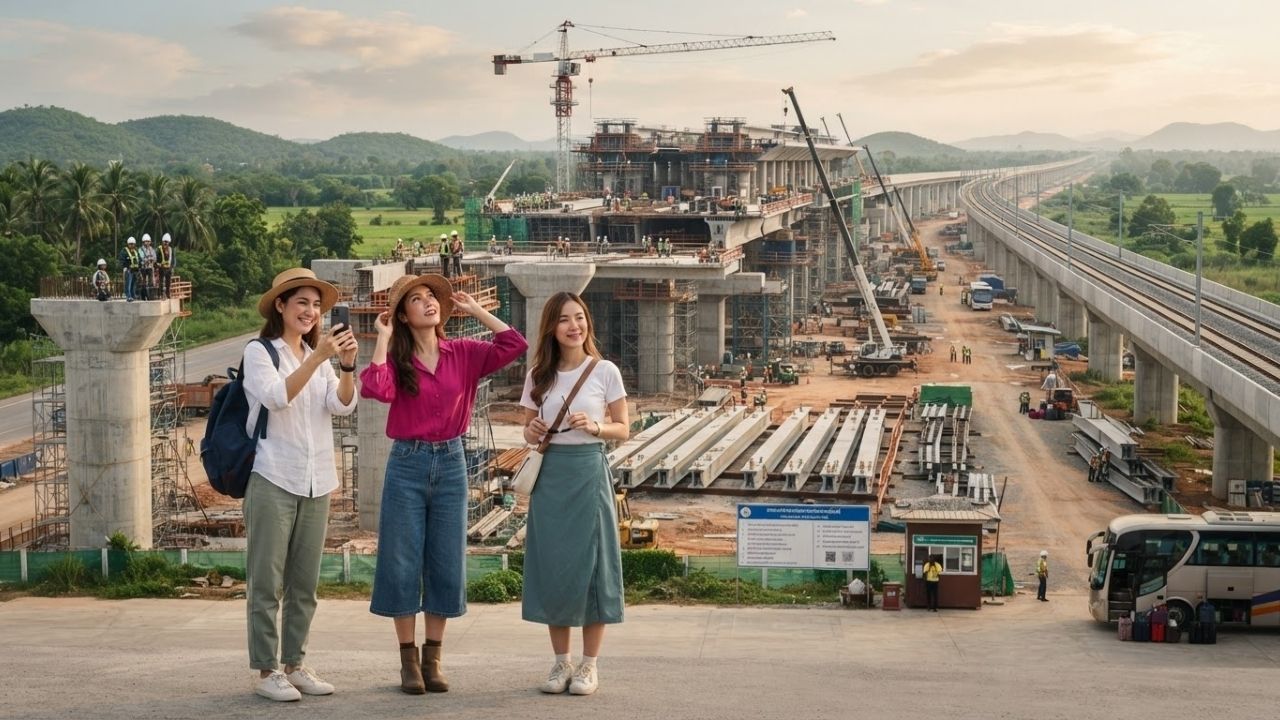
Image generated by AI
Construction on Thailand’s four-level elevated Saraburi high-speed rail station has reached 29.30% completion as part of the 250.77-kilometer Bangkok–Nakhon Ratchasima rail corridor targeted for 2031.
[SARABURI, Thailand] — Engineering updates from the Thai Ministry of Transport and the State Railway of Thailand confirm progress on the Thai–Chinese high-speed railway project. The overall 250.77-kilometer high-speed line linking Bangkok with Nakhon Ratchasima has achieved 55.978% construction completion. Situated in Takut subdistrict, Mueang Saraburi district, the four-level Saraburi station is being developed as a primary transport interchange connecting central Thailand with the northeastern Isan region ahead of a planned 2031 operational launch.
Contract 4-7 Progress: Saraburi–Kaeng Khoi 12.99-KM Section
The Saraburi station is being built under Contract 4-7, which encompasses the 12.99-kilometer Saraburi–Kaeng Khoi railway section.
Civil engineering data indicates Contract 4-7 has achieved 73.25% overall section completion:
- Precast Segment Installation: 86% complete.
- Switch-Beam Construction: 68% complete.
- Balance-Beam Construction: 33% complete.
Concurrently, the Saraburi station structure itself stands at 29.30% completion against a scheduled progress target of 47.22%.
Contract 4-7 & Station Construction Metrics:
├── Corridor Scope: Bangkok to Nakhon Ratchasima (250.77 km; 55.978% overall progress)
├── Contract 4-7 Length: 12.99 km Saraburi–Kaeng Khoi section (73.25% completed)
├── Structural Milestones: Precast segments 86%; Switch-beams 68%; Balance-beams 33%
└── Saraburi Station Building: 29.30% complete (Targeted for full line opening in 2031)
| Engineering Category | Construction Metric / Value | Strategic Transport Advantage |
|---|---|---|
| Total Route Length | 250.77 Kilometers | High-speed link between Bangkok & Isan region |
| Overall Line Completion | 55.978% Complete | Comprehensive civil engineering progress |
| Target Operational Date | 2031 | Full passenger & freight service launch |
| Contract 4-7 Distance | 12.99 Kilometers | Saraburi-to-Kaeng Khoi civil engineering segment |
| Contract 4-7 Progress | 73.25% Complete | Elevated guideway & track bed completion |
| Precast Segment Assembly | 86% Complete | Prefabricated concrete viaduct placement |
| Station Building Progress | 29.30% (vs 47.22% target) | Four-level elevated interchange structure |
| Station Location | Takut subdistrict, Saraburi | Primary transit hub for Saraburi Province |
| Platform Dimensions | 2 Platforms (450 meters each) | Accommodation for full-length high-speed trains |
| Track Infrastructure | 4 Railway Tracks | Supports express & stopping train bypasses |
Architectural Layout: Four-Level Elevated Station Interchange
Designed as a multi-modal transport hub, the Saraburi station features a four-level elevated structure separating passenger flows and operations:
- Level 1 (Ground Level): Station entrance halls, parking access, and platforms for conventional long-distance rail lines.
- Level 2 (Concourse Level): Ticketing facilities for high-speed and conventional services, security gates, and interchange concourses.
- Level 3 (Mezzanine Level): Passenger waiting lounges, commercial retail spaces, and service amenities.
- Level 4 (Elevated Track Level): Four railway tracks and two 450-meter-long dedicated high-speed rail platforms.
Saraburi Station 4-Level Architectural Profile:
├── Level 1: Entrance concourse & conventional long-distance platforms
├── Level 2: Integrated ticketing halls, security gates & transfer concourses
├── Level 3: Passenger waiting lounges & station commercial retail facilities
└── Level 4: 4 railway tracks & 2 high-speed platforms (450 meters length each)
Strategic Regional Mobility and Freight Corridor Integration
Saraburi functions as a transit bridge between the Chao Phraya river basin and northeastern Thailand.
Replacing road transit along crowded highways, the high-speed rail line will shorten travel times for domestic commuters, corporate travelers, and international tourists exploring inland destinations.
Additionally, the route forms part of the broader Pan-Asia rail network connecting Thailand through Laos to China, expanding regional freight throughput and international trade logistics.
Pan-Asian Transport Corridor Linkage:
├── Regional Integration: Connects Bangkok ➔ Saraburi ➔ Nakhon Ratchasima ➔ Laos ➔ China
├── Economic Function: Dual-use high-speed passenger transit & regional freight logistics
└── Tourism Advantage: Fast access to Saraburi's cultural, natural & religious landmarks
Frequently Asked Questions (FAQ)
Q1: When will the Saraburi High-Speed Rail Station open for passenger service?
A: Saraburi station is scheduled to open in 2031 alongside the full Bangkok–Nakhon Ratchasima high-speed rail line.
Q2: What are the dimensions and capacity of Saraburi station?
A: The four-level elevated station includes four railway tracks and two passenger platforms measuring 450 meters in length each.
Q3: How much of the Bangkok–Nakhon Ratchasima project is completed?
A: Overall line construction stands at 55.978%, while the Saraburi–Kaeng Khoi contract section (Contract 4-7) is 73.25% complete.
Why This Matters for Passengers, Urban Planners, and Trade Logistics
Analyzing the Saraburi high-speed rail development highlights key transport insights:
- For International Tourists: Fast rail connections from Bangkok encourage travel beyond traditional coastal resorts to northeastern Thailand.
- For Railway Civil Engineers: Constructing 450-meter platforms on a four-level elevated viaduct creates a multi-modal transport hub.
- For Southeast Asian Trade Logistics: Integrating Saraburi into the Thai-Chinese rail network strengthens cross-border trade corridors with Laos and China.
Related Travel Guides
Disclaimer
This article is for informational and educational purposes only. It does not constitute legal, financial, or professional advice. While we strive to provide accurate and up-to-date information, travel policies, regulations, and conditions change rapidly. Always verify information with official sources before making travel decisions. Nomad Lawyer makes no representations about the accuracy, reliability, completeness, or suitability of the information provided. Readers should consult qualified professionals for advice specific to their circumstances. The views expressed in this article are those of the author and do not necessarily reflect the views of Nomad Lawyer.
Raushan Kumar
Founder & Lead Developer
Full-stack developer with 11+ years of experience and a passionate traveller. Raushan built Nomad Lawyer from the ground up with a vision to create the best travel and law experience on the web.
Learn more about our team →