
SpiceJet Kochi Bad Weather Advisory Challenged by Cochin Airport as CIAL Reports Zero Cancellations
SpiceJet's bad weather advisory for Kochi flights has been publicly challenged by Cochin International Airport Limited, which confirmed normal operations and zero weather-related cancellations, raising fresh questions about disruption classification, passenger compensation rights, and airline reliability during India's monsoon season.

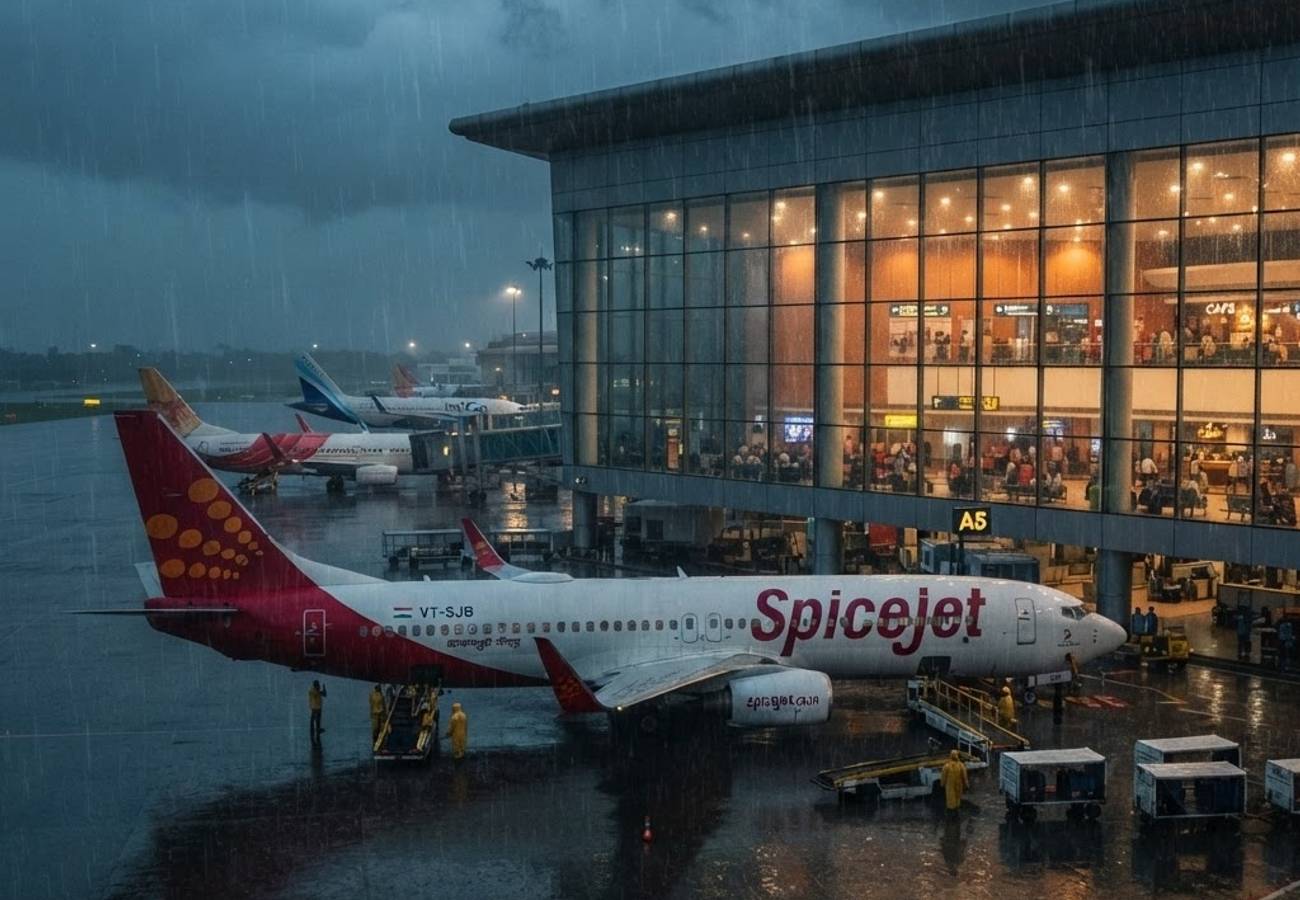
Image generated by AI
A SpiceJet travel advisory blaming bad weather for possible flight disruptions at Kochi has triggered a rare public rebuttal from Cochin International Airport, which insists operations remained normal and that no weather-related cancellations occurred.
SpiceJet's Kochi Advisory Meets a Public Rebuttal
SpiceJet published the advisory on social media, warning of possible disruptions to services in and out of Kochi. The airline cited bad weather conditions as the factor. Passengers were urged to check updated schedules before heading to the airport.
The message landed hard because Kochi is one of the carrier's key gateways in Kerala. Travelers booked on its domestic and international routes from the city were left guessing.
Cochin International Airport Limited (CIAL) then did something uncommon in Indian aviation. It publicly contested the airline's explanation. The airport operator stated there were no cancellations at Kochi attributable to bad weather during the period referenced. Overall operations, including those of other carriers, were functioning normally at the time.
Local reports indicate CIAL went further. The airport described the weather attribution as misleading, since meteorological conditions did not warrant that characterization. It reportedly framed the airline's communication as misinformation. Passengers were urged to verify flight status before traveling, particularly those booked on SpiceJet services.
Key Facts at a Glance
- SpiceJet's advisory cited bad weather and directed customers to its website and customer channels for delay or cancellation updates.
- CIAL confirmed zero cancellations at Kochi attributable to bad weather during the referenced period.
- Other carriers at Cochin International Airport showed no comparable weather disruption. Public schedules reflected a largely regular pattern of arrivals and departures.
- The clash broke into public view in late August 2026, during India's monsoon season, when weather advisories are routine across Indian hubs.
- On Aug 19, 2026, reports emerged of passenger protests after a SpiceJet cancellation on the Kozhikode–Dubai route.
- SpiceJet has acknowledged salary payment delays, citing challenging industry conditions, stretched resources, and financial constraints.
- India's aviation regulator has previously initiated special audits and checks on SpiceJet following a series of technical and operational issues.
The Two Accounts, Side by Side
The gap between the airline's message and the airport's clarification is stark. Here is what each party has put on record:
| Question | SpiceJet Advisory | CIAL Clarification |
|---|---|---|
| Stated cause | Bad weather conditions affecting Kochi services | Meteorological conditions did not warrant the characterization |
| Cancellations | Passengers warned of possible disruptions | No cancellations attributable to bad weather |
| Airport-wide operations | Implied weather impact | Operations normal, including other carriers |
| Passenger guidance | Check website and customer channels for updates | Verify flight status before traveling |
| Airport's assessment | — | Advisory described as misleading; local reports cite misinformation |
Monsoon Reality at Cochin International Airport
Cochin International Airport is a major hub for traffic between Kerala and the Gulf region, with domestic links to cities such as Delhi, Mumbai, and Ahmedabad.
Publicly accessible flight-status tools and airport data show day-to-day delays do occur. But most airlines at Kochi have kept operating through the monsoon without large-scale weather-linked cancellations in recent days.
That context matters. An airport-wide weather event typically grounds every carrier. Here, the disruption narrative sat with one airline while competitors flew regular patterns. Industry observers note this divergence is precisely what forced the airport's hand.
The episode also lands amid wider turbulence for the low-cost carrier. Recent coverage highlights multiple cancellations across SpiceJet's domestic and international network. Aviation forums carry repeated accounts of last-minute changes and long delays, particularly on routes connecting Kerala and the Gulf.
In a recent corporate communication, SpiceJet said it is accommodating affected passengers on alternative flights where possible. It has offered full refunds or changes of date or destination without additional charges in certain disruption scenarios.
Why This Matters
The wording of a travel advisory is not public-relations filler. It is a liability signal.
Under India's Civil Aviation Requirements, an airline's obligations to compensate or assist travelers depend on cause. Disruptions within the carrier's control, such as operational decisions or resource constraints, carry different obligations than extraordinary circumstances like severe weather or airspace closures.
SpiceJet's own passenger rights documentation mirrors this framework. When cancellations or delays stem from adverse weather or events beyond the airline's control, the carrier says it will "make efforts" to help customers reach their destination. Its financial liability in those cases is limited compared with operational or commercial cancellations.
For travelers on this route, the real impact is concrete. A weather classification can mean the difference between a compensation claim and a rebooking-only outcome. When the airport operator publicly disputes the weather premise, it raises a hard question about how disruptions are being classified behind the scenes.
Our analysis of the route map suggests the stakes run higher at Kochi than at a typical domestic station. This is Gulf-heavy traffic. Missed departures cascade into lost workdays and costly rebooked family travel for Kerala's expatriate workforce. A vague advisory is not a minor inconvenience here. It is a financial event.
From a logistical perspective, CIAL's intervention resets the information hierarchy. Passengers now hold two conflicting official narratives. Treat the airport's operational status and the airline's flight-specific status as separate data points — and check both.
Passenger Rights: The Documentation Playbook
Travel advocates consistently advise one habit during disruption season: keep evidence.
- Screenshot the airline's advisory and any schedule-change notifications.
- Capture the airport's live flight-status page for your departure or arrival.
- Retain all written communication from both the airline and the airport.
This documentation becomes leverage when seeking redress under applicable passenger-rights rules. It matters most when the stated cause of a disruption appears to shift over time — precisely the scenario now in public view at Kochi.
If a disruption framed as weather-related is later shown to be operational, the passenger's entitlement position strengthens. The gap between "make efforts" and full liability is where claims are won or lost.
What Kochi Travelers Should Do Now
For passengers flying to or from Kochi on SpiceJet in the coming days, publicly available information points to a few practical steps. Check the airline's website and customer channels for flight-specific updates. Cross-reference the airport's own advisories before leaving for the terminal. Screenshot everything from the moment a schedule looks uncertain.
Gulf-bound travelers should build buffer time into onward plans. Rebooking options exist, but seats on alternative flights tighten quickly during monsoon disruption windows.
Industry Outlook
Public disputes between Indian airports and airlines over the stated cause of a disruption are uncommon. The system typically handles delays and cancellations through bilateral communication between carriers, airports, and the regulator. When that norm breaks, it signals deeper strain.
Market trends suggest three developments to watch. First, expect closer regulatory attention on how SpiceJet classifies disruptions in passenger communications, given the regulator's earlier special audits. Second, other airport operators may follow CIAL's lead when advisories mischaracterize local conditions; airports carry their own reputational exposure. Third, pressure will grow for real-time, standardized disruption reporting that passengers can verify independently.
For SpiceJet, the immediate test is operational rather than rhetorical. The airline is managing acknowledged financial constraints through the most weather-sensitive stretch of the Indian aviation calendar. Every advisory it publishes between now and the monsoon's end will be read against CIAL's rebuttal.
For Kochi flyers, the forecast that matters is no longer meteorological — it is whether the published schedule actually holds.
Related Travel Guides
Disclaimer
This article is for informational and educational purposes only. It does not constitute legal, financial, or professional advice. While we strive to provide accurate and up-to-date information, travel policies, regulations, and conditions change rapidly. Always verify information with official sources before making travel decisions. Nomad Lawyer makes no representations about the accuracy, reliability, completeness, or suitability of the information provided. Readers should consult qualified professionals for advice specific to their circumstances. The views expressed in this article are those of the author and do not necessarily reflect the views of Nomad Lawyer.
Kunal K Choudhary
Co-Founder & Contributor
A passionate traveller and tech enthusiast. Kunal contributes to the vision and growth of Nomad Lawyer, bringing fresh perspectives and driving the community forward.
Learn more about our team →