
Southwest Flight WN759 Aborts Las Vegas Departure: What Landing Gear Smoke Means for Chicago Midway Travelers

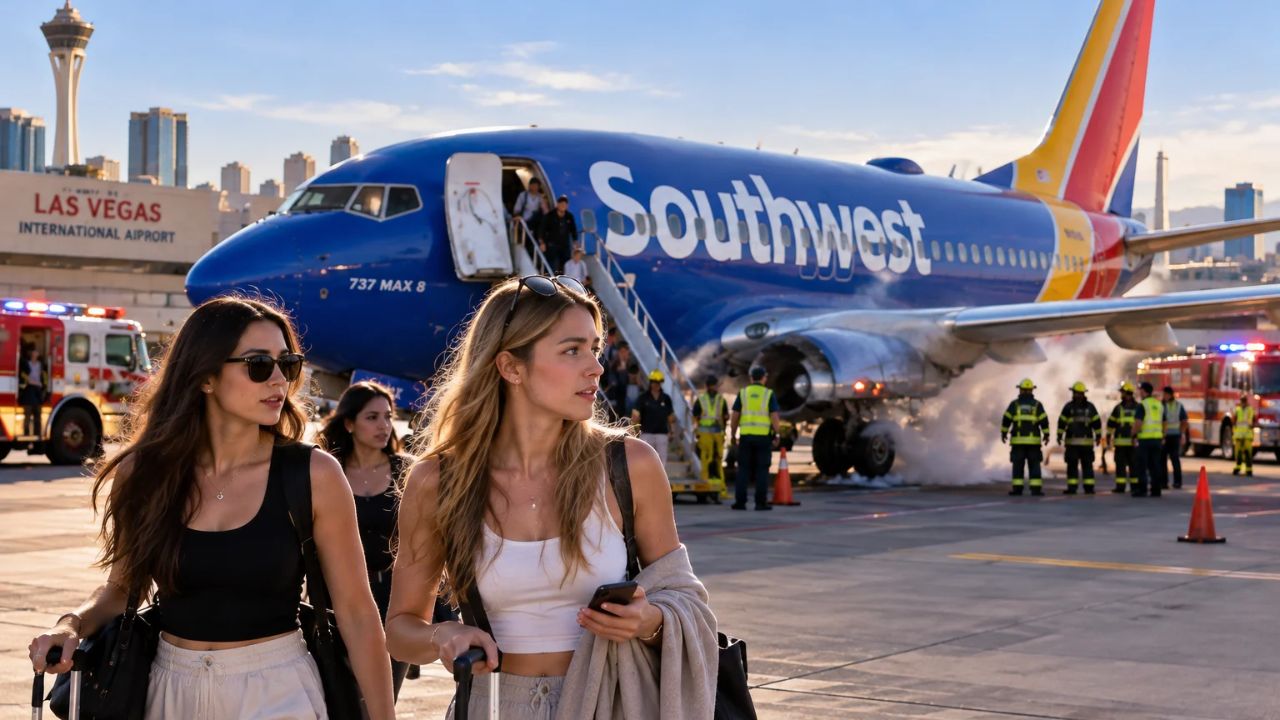
Southwest flight WN759 returned to the gate at Harry Reid International Airport on 9 October 2026 following landing gear smoke observations.
An aircraft's departure safety check does not always originate from its own cockpit; sometimes it comes from the watchful eyes of another crew taxiing behind it. On 9 October 2026, Southwest Airlines flight WN759 was preparing for departure from Harry Reid International Airport in Las Vegas, bound for Chicago Midway International Airport, when pilots aboard a trailing aircraft—flight WN334 heading to Houston's William P. Hobby Airport—spotted heavy smoke and what appeared to be flames coming from WN759's right main landing gear. The Houston crew immediately alerted air traffic control, requested emergency fire apparatus, and reported seeing fluid and loose brake material along the taxiway pavement. Pilots aboard the Boeing 737 MAX 8 promptly aborted their departure preparations, returning to the terminal before the twinjet ever reached an active runway.
Desert Taxiway Ground Abort: What Unfolded on the Las Vegas Tarmac
While trailing pilots described visible fire and debris, Southwest Airlines later clarified that it had received no internal reports of an active blaze, instead identifying a potential hydraulic system issue as the primary operational concern. The aircraft had not yet begun its high-speed takeoff roll, ensuring that all ground maneuvers occurred at low taxiing speeds. Ground crews marshaled the aircraft back to the gate, where passengers disembarked safely without any reported injuries.
The Boeing 737 MAX 8 involved in the incident seats up to 175 passengers in standard Southwest single-class layouts, though the carrier did not disclose the precise passenger load on this specific run. To prevent stranded travelers from enduring an open-ended maintenance hold, Southwest operations teams mobilized a substitute Boeing 737 MAX 8 from their regional fleet.
The ripple effect on passenger schedules was immediate and severe. Originally scheduled to push back at 12:15 pm local time, the replacement aircraft did not take off until 4:44 pm—imposing a departure delay of four hours and 29 minutes. Across the Midwest corridor, flight tracking records confirmed the substitute flight touched down at Chicago Midway at 9:40 pm, nearly four hours after its scheduled 5:45 pm arrival slot.
The Federal Aviation Administration maintains precise guidance for ground movements under FAA Advisory Circular AC 120-74B, emphasizing rigorous standard operating procedures during taxi runs to mitigate hazards before an aircraft transitions to takeoff power. Independent incident assessments by bodies like the National Transportation Safety Board monitor such events when mechanical failures or fluid leaks present wider fleet risks.
Flight Timetable and Delay Breakdown: Las Vegas to Chicago Midway
A four-hour ground substitution completely shifts travel economics for passengers connecting between Nevada and Illinois. The data below illustrates the full operational timeline recorded during the 9 October 2026 disruption:
| Operational Metric | Scheduled Timetable | Actual Reported Record | Variance & Traveler Impact |
|---|---|---|---|
| Flight Identifier | Southwest WN759 | Southwest WN759 (Replacement) | Same flight designation maintained |
| Aircraft Model | Boeing 737 MAX 8 | Boeing 737 MAX 8 (Substituted) | Standard fleet configuration (up to 175 seats) |
| Origin Station | Las Vegas (LAS) | Las Vegas (LAS) | Harry Reid Terminal 1 departure |
| Destination Station | Chicago Midway (MDW) | Chicago Midway (MDW) | South Side Chicago terminal arrival |
| Gate Pushback | 12:15 pm PDT | 4:44 pm PDT | Departure delay of 4 hours 29 minutes |
| Touchdown Time | 5:45 pm CDT | 9:40 pm CDT | Arrival delay of 3 hours 55 minutes |
| Reported Injuries | None | 0 injuries reported | Precautionary ground abort executed |
| Alerting Party | Flight Crew / ATC | Crew of trailing flight WN334 | Radio call reported smoke, fluid, and brake debris |
What Makes Harry Reid and Chicago Midway Different
Flying between Las Vegas and Chicago Midway connects two entirely different aviation environments, each presenting distinct challenges when mechanical delays occur.
Harry Reid International Airport sits directly adjacent to the Las Vegas Strip, hemmed in by desert topography and extreme daytime heat. In this arid Mojave basin, midday tarmac temperatures frequently surge past 120 degrees Fahrenheit. For heavy transport category aircraft, taxiing across sunbaked asphalt places immense thermal strain on carbon brake packs, tires, and pressurized hydraulic lines. When a braking component binds or a hydraulic fitting drips onto a hot wheel hub, smoke forms rapidly. Because Terminal 1 handles high banks of domestic flights, an aborted takeoff run requires air traffic controllers to rearrange taxi queues across tight apron connectors.
Chicago Midway, managed under the Chicago Department of Aviation, occupies a compact one-square-mile footprint nestled directly inside dense residential South Side neighborhoods. Unlike sprawling O'Hare, Midway features shorter intersecting runways (Runway 4R/22L and 13C/31C) and a single main terminal building. Landing at 5:45 pm allows travelers to catch the Chicago Transit Authority (CTA) Orange Line into the Loop for dinner or connect smoothly to evening regional commuter trains. Pushing an arrival past 9:40 pm transforms an easy trip into a late-night scramble, when public transit frequency drops and suburban hotel shuttles reduce service hours.
Visitor Insider Tips: Navigating Las Vegas Delays and Late Midway Arrivals
Experienced travelers handle domestic flight disruptions by understanding terminal geography and airline operational rules:
- Harry Reid Waiting Strategies: If your Southwest flight faces an extended ground hold at Harry Reid, base yourself in the C Gates concourse near the central rotunda rather than waiting at cramped departure gates. You will find better charging access, quieter seating zones, and multiple dining options.
- Midway Late-Night Ground Transport: When landing at Midway after 9:30 pm, skip long curbside taxi queues by heading straight down to the CTA Orange Line station via the enclosed pedestrian walkway. Trains run directly into downtown Chicago in roughly 25 minutes, bypassing heavy traffic on the Stevenson Expressway (I-55).
- Documenting Out-of-Pocket Expenses: While airlines generally view unconfirmed mechanical issues as operational interruptions, retain all meal and beverage receipts accrued during airport delays exceeding three hours. Keep digital photos of revised flight status boards and save your boarding pass stubs for customer relations submissions.
- Baggage Tracking Hacks: When an aircraft is swapped at the gate, checked luggage must be manually transferred between cargo holds. Track your bags through the carrier's smartphone app immediately upon boarding the replacement plane to verify that your luggage tags were scanned into the new cargo bay.
- Flight Connections Safety Margin: If booking self-transfers or regional bus links out of Chicago, always allow a minimum four-hour buffer when flying out of Las Vegas during peak afternoon bank hours.
Cultural and Environmental Context: Desert Operations and Urban Aerodromes
Aviation operations in desert environments highlight the physical stresses placed on modern commercial fleets. In Las Vegas, ground operations must constantly contend with dust, intense ambient heat, and thermal cycling. Hydraulic systems operate under thousands of pounds of pressure per square inch; even a minor seal leak exposed to hot brake rotors can generate dense plumes of smoke. Ground crews are trained to treat any smoke report as a potential fire until cleared by airport rescue firefighters, illustrating the conservative safety culture embedded across commercial air travel.
At the destination end, Chicago Midway represents one of the nation's most historic urban airfields. Built in the 1920s and surrounded by neighborhood bungalows, Midway operates with strict noise monitoring and tight gate allocations. Late-arriving aircraft compress ground crew schedules, demanding swift turnaround times while neighborhood curfews restrict certain ground engine runs. These operational realities explain why a four-hour delay in Nevada causes cascading logistical adjustments across the Great Lakes transit grid.
FAQ: Visiting Chicago and Traveling via Southwest in 2026
What should passengers do if smoke is reported on an aircraft during taxi?
Remain seated, keep seatbelts fastened, and follow all instructions from the flight attendants. Pilots immediately halt the aircraft, coordinate with ground controllers, and summon airport fire rescue units to inspect the landing gear.
How do I get from Chicago Midway Airport to downtown Chicago late at night?
The CTA Orange Line operates directly from the Midway terminal station to the downtown Loop until approximately 1:00 am, offering a reliable, affordable 25-minute connection that bypasses highway congestion.
Does Southwest Airlines provide compensation for domestic mechanical delays?
Southwest typically provides meal vouchers during extended delays at the airport. For delays exceeding three hours caused by mechanical issues, travelers should contact customer relations online with boarding stubs to request travel credits.
Why do aircraft brakes produce smoke during taxiing?
Brake assemblies absorb significant friction energy during prior landings. In warm climates, residual heat combined with binding brake pads or small hydraulic fluid drips can produce noticeable smoke without an active structural fire.
Precaution on the runway tarmac will always inconvenience a travel schedule, but in aviation, an unexpected four-hour gate delay remains the best possible outcome when safety is on the line.
Related Travel Guides
US Flight Delays and Cancellations: How Storms and Mechanical Holds Impact Major Hubs
American Airlines Policy Shift: Eliminating Involuntary Bumping Across Domestic Routes
Chicago Midway Airport Transit Guide: Navigating CTA Links and Late Arrivals
Disclaimer
This article is for informational and educational purposes only. It does not constitute legal, financial, or professional advice. While we strive to provide accurate and up-to-date information, travel policies, regulations, and conditions change rapidly. Always verify information with official sources before making travel decisions. Nomad Lawyer makes no representations about the accuracy, reliability, completeness, or suitability of the information provided. Readers should consult qualified professionals for advice specific to their circumstances. The views expressed in this article are those of the author and do not necessarily reflect the views of Nomad Lawyer.
Raushan Kumar
Founder & Lead Developer
Full-stack developer with 11+ years of experience and a passionate traveller. Raushan built Nomad Lawyer from the ground up with a vision to create the best travel and law experience on the web.
Learn more about our team →