
Aviation Updates: Southwest Airlines Flight WN4241 Diverts to Kansas City Bypassing Wichita in Late-Night Operational Shift
Southwest Airlines Flight WN4241 from Chicago Midway to Wichita executes a sudden late-night diversion to Kansas City International Airport.

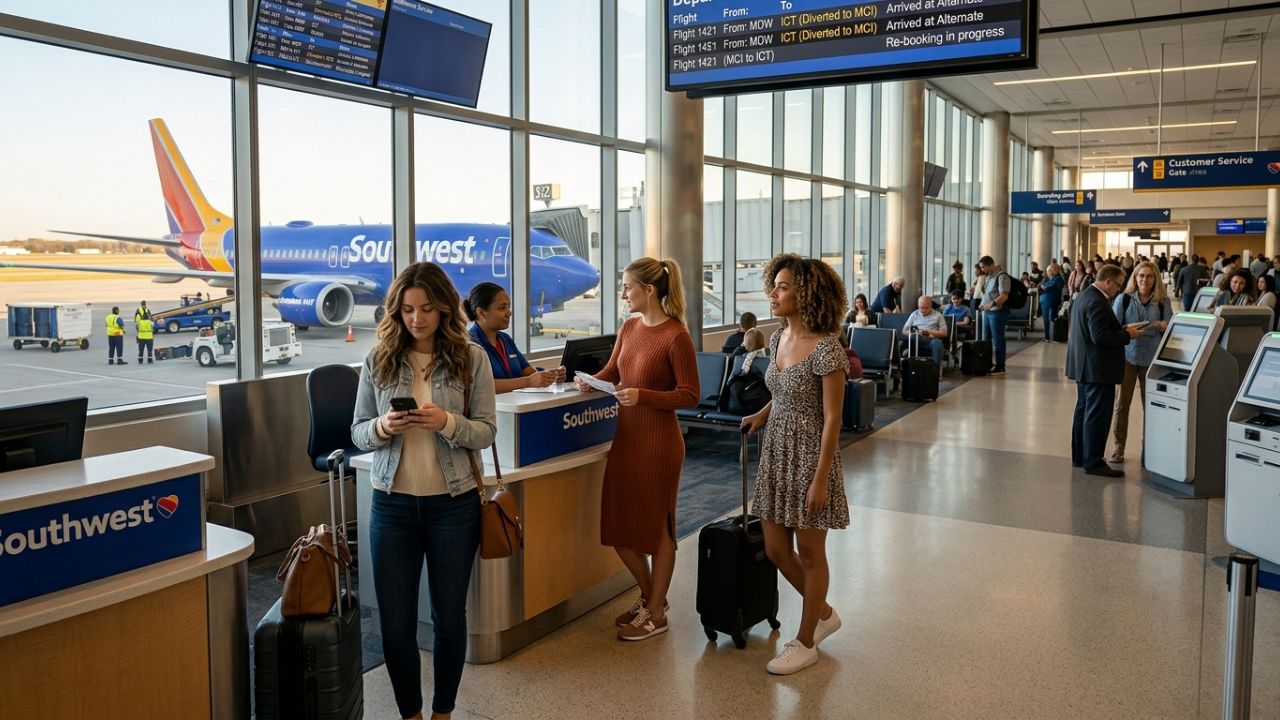
Image generated by AI
Aviation Updates: Southwest Airlines Flight WN4241 Diverts to Kansas City Bypassing Wichita in Late-Night Operational Shift
Demonstrating rigorous adherence to commercial safety protocols, the flight crew executed a controlled diversion, ensuring absolute passenger safety despite the unexpected rerouting.
Image generated by AI
In a rapidly developing incident closely monitored by industry analysts, Southwest Airlines Flight WN4241 encountered a sudden operational shift during a scheduled late-night service on June 25, 2026. According to the latest airline news, the Boeing 737-800 was operating a routine domestic sector from Chicago Midway International Airport to Wichita, Kansas, before unexpectedly altering its flight path. Rather than pressing onward to its original destination, the crew executed a safe and controlled diversion to Kansas City International Airport, prioritizing operational stability and bypassing potential localized airport disruptions.
Expanded Overview: A Calculated Operational Maneuver
While the sudden rerouting of a commercial aircraft often induces anxiety among travelers, mid-air diversions are a standard, highly regulated procedure within modern aviation. Flight WN4241 successfully avoided severe travel chaos by relying on Kansas City International Airport as a strategic alternate destination.
Although the airline has not officially disclosed the specific reason for this operational change, commercial aviation protocols dictate that pilots must divert whenever environmental, technical, or operational variables compromise safe landing confidence at the primary destination. The fact that the Boeing 737-800 landed safely just 37 minutes behind schedule proves that the airline's contingency frameworks functioned flawlessly, successfully averting the need for outright flight cancellations or emergency declarations.
Section-Wise Breakdown: The Chicago Midway Departure
Tracking data confirms that the initial phase of the journey was entirely routine. The Boeing 737-800 pushed back from Gate B23 at Chicago Midway International Airport and executed a standard takeoff at approximately 9:44 PM CDT. Initial telemetry indicated the aircraft was operating efficiently along its planned westbound trajectory toward Kansas. The decision to divert was not related to any departure anomaly; rather, it was a dynamic choice made mid-flight as the crew assessed evolving conditions ahead of their arrival in Wichita.
Section-Wise Breakdown: The Kansas City Diversion
Once the decision was made to abandon the Wichita approach, the crew swiftly coordinated with air traffic control to redirect the aircraft toward Kansas City International Airport. This airport frequently serves as a vital strategic diversion node due to its robust runway infrastructure, modern passenger facilities, and strong ground handling capabilities. The aircraft touched down safely in Kansas City at approximately 11:42 PM CDT. By utilizing this alternate hub, the crew successfully bypassed potential travel chaos and ensured the absolute safety of the aircraft and its occupants.
Section-Wise Breakdown: The Unknown Variables
As with many precautionary diversions, the exact trigger for the reroute remains officially unconfirmed within public flight tracking records. In commercial aviation, sudden operational shifts can be initiated by rapidly deteriorating localized weather, sudden air traffic flow management restrictions, precautionary technical assessments, or unexpected in-flight medical situations. Regardless of the specific catalyst, the safe landing in Kansas City underscores the fundamental principle of aviation: if the planned route presents unacceptable variables, the crew will instantly default to the safest available alternative.
Flight Details: WN4241 Operations Matrix
The precise operational telemetry regarding this late-night flight diversion has been consolidated into the mandatory matrix below, based on publicly verified flight tracking data.
Flight WN4241 Incident Summary Matrix
| Flight Indicator | Details |
|---|---|
| Airline | Southwest Airlines |
| Flight Number | WN4241 |
| Aircraft Type | Boeing 737-800 |
| Date | 25 June 2026 |
| Origin Airport | Chicago Midway International Airport |
| Departure Gate | Gate B23 |
| Departure Time | ~9:44 PM CDT |
| Scheduled Destination | Wichita, Kansas |
| Diversion Airport | Kansas City International Airport |
| Arrival Time | ~11:42 PM CDT |
| Delay | 37 minutes behind schedule |
Passenger Impact: Navigating the Disruption
For the passengers aboard Flight WN4241, the sudden diversion undoubtedly resulted in significant logistical frustration. Arriving in Kansas City rather than Wichita just before midnight meant that many travelers faced ruined hotel reservations and missed ground transportation connections.
However, by safely landing the aircraft rather than engaging in prolonged airborne holding patterns, the crew prevented a far worse scenario. When flights divert, airlines immediately deploy customer service teams to provide re-accommodation options, ground transport, or overnight hotel stays. While the delay caused immediate inconvenience, the 37-minute arrival deficit proves the diversion was executed efficiently, minimizing the overall severity of the disruption.
Industry Analysis: The Value of Operational Flexibility
Aviation analysts reviewing these aviation updates point to this incident as a prime example of systemic redundancy. Modern airlines maintain highly sophisticated operational control centers that continuously monitor every active flight.
When a situation arises that threatens to cause severe airport disruptions at the destination, these control centers work in tandem with the pilots to select an alternate airport. The ability of the Boeing 737-800 to rapidly pivot to Kansas City without incident demonstrates the immense flexibility built into the US aviation network. It confirms that the system is designed to gracefully handle irregularities, ensuring that safety always supersedes scheduled punctuality.
Conclusion: A Safe Conclusion to a Disrupted Night
Ultimately, the diversion of Southwest Airlines Flight WN4241 highlights the robust safety mechanisms inherent in modern commercial flight. By successfully abandoning the Wichita approach and executing a flawless landing in Kansas City, the flight crew prioritized the well-being of their passengers above all else. While the late-night reroute caused inevitable inconvenience, it stands as a testament to the fact that precautionary decision-making is the bedrock of aviation safety.
Key Takeaways
- Late-Night Diversion: Southwest Airlines Flight WN4241 diverted from its planned Chicago-to-Wichita route on June 25, 2026.
- Safe Landing: The Boeing 737-800 landed safely at Kansas City International Airport at approximately 11:42 PM CDT.
- Minimal Delay: Despite the diversion, the aircraft arrived at its alternate destination only 37 minutes behind schedule.
- Routine Departure: The flight departed Chicago Midway's Gate B23 normally at 9:44 PM CDT before the mid-air operational shift.
- Safety First: While the exact cause remains undisclosed, the diversion confirms the airline's commitment to bypassing potential hazards and avoiding severe travel chaos.
FAQ: Southwest Airlines Flight WN4241 Diversion
Why did Southwest Airlines Flight WN4241 divert to Kansas City? While public tracking data confirms the diversion, the official cause remains undisclosed. Diversions are typically triggered by weather changes, air traffic congestion, or precautionary operational assessments.
Where did Flight WN4241 originate? The Boeing 737-800 originated at Chicago Midway International Airport, departing from Gate B23 at approximately 9:44 PM CDT.
How late did the flight arrive due to the diversion? The aircraft landed safely at Kansas City International Airport at approximately 11:42 PM CDT, which was roughly 37 minutes behind its originally scheduled arrival time in Wichita.
Related Travel Guides
Southwest Airlines Flight SWA4752 Diversion St Louis Louisville 2026
Palma de Mallorca Airport Airlines Delays Travel Chaos 2026
Kansas City Airport Travel Disruption Survival Guide 2026
Disclaimer: This article is strictly for informational purposes. Flight tracking details, diversion causes, and operational reasoning are based on publicly available data from FlightAware and Flightradar at the time of reporting. Passengers are advised to follow official airline communications regarding specific flight delays and re-accommodation protocols.
Disclaimer
This article is for informational and educational purposes only. It does not constitute legal, financial, or professional advice. While we strive to provide accurate and up-to-date information, travel policies, regulations, and conditions change rapidly. Always verify information with official sources before making travel decisions. Nomad Lawyer makes no representations about the accuracy, reliability, completeness, or suitability of the information provided. Readers should consult qualified professionals for advice specific to their circumstances. The views expressed in this article are those of the author and do not necessarily reflect the views of Nomad Lawyer.
Kunal K Choudhary
Co-Founder & Contributor
A passionate traveller and tech enthusiast. Kunal contributes to the vision and growth of Nomad Lawyer, bringing fresh perspectives and driving the community forward.
Learn more about our team →