Southern France Railway Disruption: Heavy Rains and Floods Trigger Severe Travel Delays Across Marseille, Miramas, and Occitanie

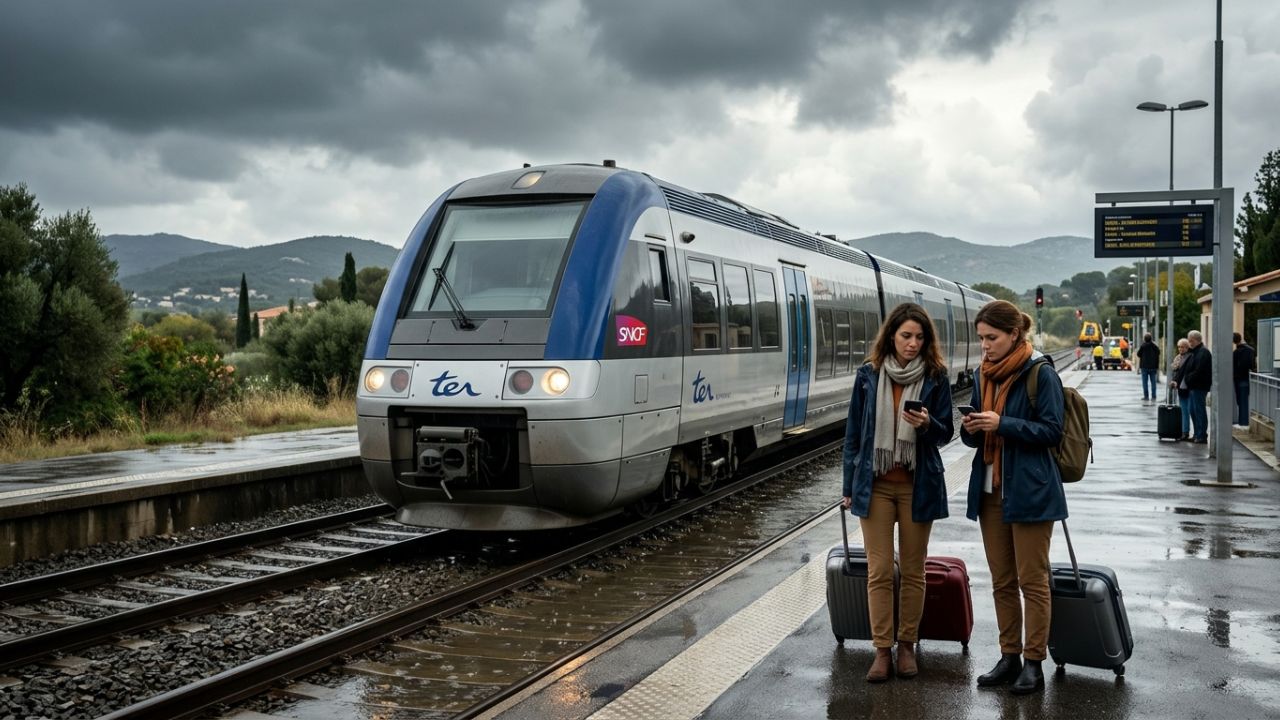
MARSEILLE, France — Weeks after historic Mediterranean storms inundated rail corridors across Provence-Alpes-Côte d'Azur and Occitanie, the railway network of southern France continues to grapple with severe operating restrictions, truncated high-speed services, and localized single-track bottlenecks. The catastrophic weather event of late October—which dropped record-shattering volumes of water across the Mediterranean coastline—inflicted widespread damage on trackbeds, electrical signaling boxes, and catenary power installations. While emergency repair teams from SNCF Réseau have successfully reopened several heavily damaged transit corridors, infrastructure repairs, strict temporary speed restrictions, and reduced train frequencies continue to affect regional commuters, holidaymakers, and trans-European rail freight operations.
The disruption is concentrated around the critical rail junction of Miramas, the transit gateway linking the metropolis of Marseille with the wider Rhône valley and the industrial maritime complex of Fos-sur-Mer. In particular, the vital passenger and freight corridor between Berre and Miramas suffered severe trackbed destruction, forcing the line to operate under single-track constraints that will require weeks of structural restoration. With direct regional services between Marseille and Occitanie remaining suspended and long-distance Intercités and TGV schedules altered, travelers across southern France face an extended period of logistical complexity that underscores the vulnerability of European transport corridors to extreme climate events.
========================================================================================
SOUTHERN FRANCE RAILWAY DISRUPTION SNAPSHOT: POST-FLOOD DAMAGE MATRIX (2026)
========================================================================================
  [INCIDENT TRIGGER]         --> Severe Mediterranean Storms & Flash Flooding (Oct 19–20)
  [PRIMARY BOTTLENECK]       --> Marseille–Miramas Corridor (Berre–Miramas Single-Track)
  [STRUCTURAL RESTORATION]   --> Second Track Restoration Estimated at 4–5 Weeks
  [OCCITANIE DIRECT LINK]    --> Marseille–Montpellier Direct TER Regional Trains Suspended
  [LONG-DISTANCE IMPACT]     --> TGV Truncations at Avignon; Bordeaux Intercités Halved
  [FREIGHT CHOKE POINT]      --> Mediterranean Rail Corridor to Fos-sur-Mer Heavily Rationed
========================================================================================
Strategic Key Indicators for the Southern France Railway Disruption
- Infrastructure Bottleneck at Berre–Miramas: Severe flood damage to the second track has reduced this critical junction corridor to single-track operations, restricting freight traffic to approximately one train per hour per direction and heavily curtailing TER ZOU! services.
- Extended Repair Horizon: Engineering evaluations by SNCF Réseau confirm that full restoration of the damaged trackbed between Berre and Miramas will require four to five weeks of intensive earthworks, extending repair activity into late November or early December 2026.
- Occitanie Regional Disconnection: Direct regional TER services between Marseille and major Occitanie destinations, including Montpellier and Nîmes, remain suspended, requiring passengers to execute transfers via Avignon-Centre.
- High-Speed and Intercity Reconfigurations: TGV services originating from Paris-Gare-de-Lyon toward Miramas have been shortened to terminate at Avignon-Centre, while Marseille–Bordeaux Intercités connections have been cut to two daily return services with extended running times.
- Overnight Service Suspensions: The Paris–Nice Intercités de Nuit overnight sleeper train remains canceled into early November due to rolling stock displacements and speed restrictions through the southern Rhône valley corridor.
The Meteorology of Chaos: Anatomy of the October Mediterranean Torrential Deluge
The railway crisis across southern France was precipitated by an intense meteorological phenomenon known regionally as an épisode méditerranéen. On October 19 and 20, 2026, an intense stationary low-pressure system stalled over the western Mediterranean basin, drawing immense volumes of warm, moisture-laden maritime air northward toward the rugged mountain topography of the Cévennes and the southern Alps. When this unstable air mass collided with the coastal mountain ranges, it triggered stationary convective thunderstorms that dropped over 300 millimeters of rainfall across the Bouches-du-Rhône, Gard, and Hérault departments in less than thirty-six hours—an amount equivalent to more than three months of normal autumn precipitation.
METEOROLOGICAL IMPACT PROFILE: AUTUMN 2026 MEDITERRANEAN STORM DELUGE
| Entity / Facility | Delays | Cancellations | Details |
|---|---|---|---|
| Department | Peak 24h Rainfall | River Basins | Primary Rail Asset |
| Bouches-du-Rhône | 240 – 280 mm | Arc, Touloubre, | Marseille–Miramas |
| Berre Lagoon | & Fos-sur-Mer Links | ||
| Gard | 290 – 330 mm | Vistre, Vidourle, | Nîmes–Lunel Trunk |
| Gardon Basins | & Le Grau-du-Roi | ||
| Hérault | 210 – 260 mm | Lez, Mosson, | Montpellier Access |
| coastal lagoons | & Coastal Plains | ||
| Vaucluse | 180 – 220 mm | Lower Durance | Avignon–Cavaillon |
| & Rhône confluence | & Arles Branches |
The sheer volume of water overwhelmed regional hydrological basins and drainage channels, turning tranquil streams into torrential debris flows. For railway infrastructure, the consequences of such inundation are destructive. Water does not merely submerge steel rails; it saturates the porous crushed-stone ballast that supports the trackbed, washing away stabilizing aggregates in a process known as ballast scour. As the structural subgrade liquefies beneath the weight of floodwaters, track sections become unsupported and sag, creating severe track geometry misalignments that make train operations impossible.
Simultaneously, floodwaters submerged trackside electronic signaling boxes, point-operating motors, and electrical relay cabinets. In coastal districts around the Étang de Berre and the Camargue wetlands, the brackish nature of floodwaters caused electrical short-circuits and rapid corrosion of sensitive automated switching components. Even after water levels receded, SNCF Réseau safety regulations prohibited train movements until every electrical circuit was inspected, dried, recertified, and dynamically tested under live voltage conditions.
The Epicenter of Disruption: The Marseille–Miramas Corridor and the Berre Bottleneck
Among all the damaged railway routes in southern France, the corridor connecting Marseille-Saint-Charles with the railway junction at Miramas has proven to be the most challenging to stabilize. Miramas represents one of the most important operational hubs in Provence, serving as the central distribution point where traffic from the Paris-Lyon-Marseille (PLM) mainline splits toward Arles, Cavaillon, the industrial port zone of Fos-sur-Mer, and the coastal lines into Marseille.
========================================================================================
THE MARSEILLE–MIRAMAS PASSENGER & FREIGHT DUAL-ROUTE CORRIDOR
========================================================================================
  [ROUTE 1: VIA ROGNAC]   --> Inland mainline along Étang de Berre; SEVERELY DAMAGED
                              Second track destroyed; single-track operations only
  [ROUTE 2: VIA MARTIGUES]--> Scenic coastal Côte Bleue railway; OPERATIONAL
                              Absorbing regional passengers with longer travel times
  [THE BERRE CHOKE POINT] --> Trackbed foundation undermined; 4–5 week repair schedule
  [JUNCTION ROLE]         --> Connects PLM mainline, Arles, Cavaillon, and Fos Port
========================================================================================
The inland line connecting Marseille and Miramas via Rognac sustained severe infrastructure damage. On the critical section between Berre-l'Étang and Miramas, rushing floodwaters undermined the railway embankment along the shores of the Étang de Berre, washing away the supporting subgrade and destroying the foundation beneath the second track (voie 2). While maintenance crews stabilized the adjacent first track (voie 1) to allow limited traffic, the second track suffered structural deformation that requires complete reconstruction.
Engineering assessments released by SNCF Réseau indicate that restoring the damaged second track between Berre and Miramas will require four to five weeks of intensive engineering work. The project requires driving structural steel sheet piles into the unstable lakeside embankment, rebuilding thousands of tons of compacted stone ballast, and laying entirely new track sections. This extended timeline pushes full capacity restoration into late November or early December 2026.
As a direct consequence, the regional rail operator, TER ZOU!, has been forced to operate a reduced timetable on the route via Rognac. In early November, only a handful of through trains were able to operate, creating severe travel difficulties for daily commuters traveling between Marseille, Vitrolles Aéroport Marseille Provence, Rognac, Berre, and Miramas.
To provide an alternative for stranded travelers, SNCF has routed passenger traffic over the secondary coastal line: the Marseille–Miramas route via Martigues, widely celebrated as the scenic Ligne de la Côte Bleue. Perched on limestone sea cliffs overlooking the Mediterranean, this picturesque railway avoided the catastrophic flooding that struck the low-lying inland lagoons. Most scheduled trains along the Côte Bleue have been maintained, allowing travelers to reach Miramas and intermediate coastal communities. However, because the Côte Bleue line features tight curves, single-track sections, and numerous tunnels that restrict operational speeds, passenger journeys take up to forty-five minutes longer than normal mainline schedules.
The Battle for the Rails in Gard and Hérault: The Nîmes–Lunel Reconstruction
West of the Rhône River in the Occitanie region, railway maintenance teams faced an equally formidable engineering challenge on the busy trunk line connecting Nîmes with Montpellier through Lunel. As the primary conventional railway artery linking Provence with southwestern France and the Spanish border, the Nîmes–Lunel line carries heavy volumes of regional TER passenger trains, long-distance Intercités, and cross-border freight traffic.
During the height of the storm on October 20, flash floods from the swollen Vistre and Vidourle rivers breached protective embankments along the trackbed. In the low-lying section between Nîmes and Lunel, rushing floodwaters gouged out four major breaches in the railway foundation, leaving sixty meters of track suspended in mid-air with the underlying ballast completely washed away. An additional six hundred meters of track sustained severe structural damage, with electrical signal cabling severed by floating debris.
EMERGENCY RECONSTRUCTION METRICS: NÎMES–LUNEL REPAIR CAMPAIGN
| Entity / Route | Metrics | Operational Status |
|---|---|---|
| Engineering Element | Damage Assessment Benchmark | SNCF Réseau Technical Solution |
| Washed-Out Track | 60 Meters of completely suspended | Total excavation, subgrade |
| steel rails and ties | stabilization & new ballast | |
| Damaged Trackbed | 600 Meters of compromised, | Ballast cleaning, dynamic |
| contaminated crushed stone | tamping, and alignment tests | |
| Structural Breaches | 4 Major hydraulic cuts through | Reinforced rock revetments and |
| protective earth embankments | enlarged drainage culverts | |
| Labor Deployment | Around 50 specialized railway | Continuous 24/7 rotating shifts |
| engineers and contractors | with heavy track machinery | |
| Speed Restriction | Normal 140–160 km/h line speed | Reopened Oct 25 at 100 km/h; |
| Staging | suspended during recovery | gradual return to full speed |
In response to the emergency, SNCF Réseau mobilized fifty specialized track engineers, civil contractors, and heavy earthmoving machinery to execute a rapid restoration campaign. Working around the clock, crews placed thousands of tons of heavy stone riprap to rebuild the collapsed embankments, replaced damaged wooden and concrete ties, laid fresh granite ballast, and re-strung fiber-optic signaling cables.
Through these intensive efforts, the Nîmes–Lunel line was reopened to passenger and freight traffic on October 25, just five days after the disaster. However, to ensure safety while newly laid ballast settles under live traffic loads, trains initially operated under a mandatory temporary speed restriction of 100 kilometers per hour. By late October, dynamic track measurements confirmed that stability had improved, allowing engineers to begin lifting restrictions.
On the nearby branch line connecting Nîmes with the coastal Mediterranean port of Le Grau-du-Roi, floodwaters inundated sensitive interlocking signaling equipment near Aigues-Mortes. With manual flag signaling required across several unmonitored road crossings, service was suspended until electrical signal technicians completed safety recertifications, allowing passenger railcars to resume operations on October 23.
To maintain passenger mobility during the disruption, SNCF diverted long-distance high-speed TGV services onto the Contournement Nîmes-Montpellier (CNM). Constructed as a modern high-speed bypass line elevated above the surrounding floodplain on viaducts and raised embankments, the CNM provided a reliable route for national passenger trains, allowing travelers between Paris, Lyon, and Montpellier to bypass the damaged conventional tracks.
Long-Distance and Cross-Country Disruptions: TGV, Intercités, and Night Trains
The operational impacts of the southern French railway flooding extended far beyond local regional commuter services, causing widespread disruptions across national and cross-country passenger networks.
On the high-speed network, TGV services departing from Paris-Gare-de-Lyon toward Miramas were significantly affected. Because damaged infrastructure around Miramas limited terminal platform access and track capacity, several daily TGV departures were shortened to terminate at Avignon-Centre. Passengers booked to travel through to Miramas or onward to regional destinations were forced to disembark at Avignon, where they faced long waits for connecting regional buses or limited local train connections.
========================================================================================
LONG-DISTANCE PASSENGER IMPACTS ACROSS SOUTHERN FRANCE
========================================================================================
  [PARIS–MIRAMAS TGV]        --> Shortened to terminate at Avignon-Centre
  [MARSEILLE–BORDEAUX]       --> Intercités service halved to two daily return runs
  [PARIS–NICE NIGHT TRAIN]   --> Intercités de Nuit canceled through early November
  [MARSEILLE–OCCITANIE TER]  --> Direct regional connections completely suspended
  [TRANSFER MANDATE]         --> Avignon-Centre serves as primary transfer interchange
========================================================================================
Cross-country passenger travel across the southern tier of France was equally constrained. The historic Intercités route connecting Marseille-Saint-Charles with Bordeaux-Saint-Jean—an indispensable transit link linking the Mediterranean coast with the Atlantic seaboard via Montpellier and Toulouse—faced severe timetable reductions. Under the early November operating plan, service was reduced to just two daily roundtrips, with journeys experiencing extended travel times due to temporary speed restrictions and single-track congestion.
The popular overnight rail service, the Intercités de Nuit connecting Paris-Austerlitz with Nice-Ville via Marseille and the French Riviera, experienced complete cancellation. The combination of localized infrastructure damage, displaced rolling stock, and track capacity bottlenecks through the lower Rhône valley forced SNCF to suspend the overnight sleeper train through the early days of November. Travelers who relied on the night train to avoid air travel were compelled to book daytime TGV services or arrange alternative hotel accommodations along their route.
Perhaps the most disruptive change for regional travelers was the suspension of direct regional TER trains between Marseille and Occitanie. Prior to the storm, travelers could board direct regional trains connecting Marseille with Montpellier, Narbonne, and Perpignan. Under the post-flood operating plan, these direct links were halted. To travel between the two regions, passengers were required to take a train north from Marseille to Avignon, change platforms, and board an Avignon–Occitanie regional train that had returned to normal operating schedules. This mandatory transfer added substantial journey time and complicated travel for passengers with heavy luggage.
The Industrial and Maritime Impact: Freight Choke Points at Fos-sur-Mer
While passenger disruptions drew significant public attention, the impact on rail freight infrastructure created severe challenges for France’s industrial and logistics sectors. The industrial and maritime zone around Fos-sur-Mer, situated along the Gulf of Fos west of Marseille, is home to the deep-water container terminals and industrial facilities of the Grand Port Maritime de Marseille (GPMM)—the largest commercial seaport in France.
The port depends heavily on freight rail to transport shipping containers, refined petroleum products, chemicals, and manufactured goods between ocean container ships and inland European markets along the Mediterranean Rail Freight Corridor (RFC 6). When the storms struck, flash flooding severely damaged rail connections serving the port complex, including the L'Estaque–Lavalduc and Lavalduc–Fos-sur-Mer lines.
MARITIME FREIGHT RAIL DISRUPTIONS: PORT OF FOS-SUR-MER LOGISTICS
| Railway Corridor | Infrastructure Status | Logistics Consequences |
|---|---|---|
| Berre–Miramas Trunk | Single-track constraint; 1 freight | Container train throughput cut |
| Line (Mixed Traffic) | train per hour per direction cap | by more than 60% into port |
| L'Estaque–Lavalduc | Embankment destabilization; | Gradual return to service on |
| (Coastal Freight) | signal cabling water damage | October 29 with severe limits |
| Lavalduc–Fos-sur-Mer | Ballast fouling and trackbed | Essential container shuttles |
| (Terminal Branch) | scouring near industrial docks | restricted to low speeds |
| Modal Shift Impact | Thousands of containers diverted | Severe traffic congestion on |
| to heavy diesel trucks | regional A7 and A55 motorways |
The primary freight bottleneck centered on the Berre–Miramas section. With the second track destroyed, rail traffic controllers were forced to share a single track between passenger TER trains and heavy freight convoys. To maintain safety, freight traffic was capped at approximately one train per hour in each direction.
This throughput cap created immediate operational backlogs. Intermodal container trains carrying imported goods destined for distribution centers in Lyon, Paris, and Germany were delayed for days in port rail yards. Logistics operators were forced to transfer time-sensitive cargo onto thousands of heavy diesel trucks, causing traffic congestion and air pollution along the A7 and A55 motorways. Industrial facilities, including petrochemical plants and steel manufacturing centers in Fos, had to adjust production schedules due to delays in raw material deliveries, demonstrating how railway infrastructure damage can disrupt national supply chains.
The Physics of Railway Recovery: Why Rebuilding Takes Weeks After Floodwaters Recede
For travelers inconvenienced by canceled trains and delayed schedules, a common question arises: why do railway repairs take so many weeks to complete after storm clouds have cleared and floodwaters have receded?
The answer lies in the engineering physics of modern railway trackbeds. A standard railway track is a complex civil engineering structure composed of subgrade soil, geotextile membranes, sub-ballast sand, crushed granite ballast, wooden or concrete ties, and continuous-welded steel rails. Each component must meet strict technical tolerances to safely support trains weighing hundreds of tons traveling at high speeds.
========================================================================================
THE FIVE PHASES OF RAILWAY FLOOD INFRASTRUCTURE REHABILITATION
========================================================================================
  [PHASE 1: GEOTECHNICAL SURVEY] --> Ultrasonic and core drilling to assess subgrade voiding
  [PHASE 2: EMBANKMENT SHORING]  --> Driving steel sheet piles and placing rock revetments
  [PHASE 3: BALLAST STABILIZATION]--> Excavating contaminated stone; laying crushed granite
  [PHASE 4: DYNAMIC TAMPING]     --> High-precision tamping machines restoring track geometry
  [PHASE 5: SPEED STAGING]       --> Initial 10 km/h limits scaling gradually to line speed
========================================================================================
When floodwaters submerge a railway track, fine silt and clay penetrate the angular spaces between crushed ballast stones in a process known as ballast fouling. Fouled ballast loses its angular friction and drainage capacity, behaving like grease under heavy loads. If a train were to pass over fouled ballast at full speed, the track could shift laterally or vertically, leading to a catastrophic derailment. Consequently, SNCF maintenance teams must use specialized ballast-cleaning machinery to excavate contaminated stone, screen out silt, and replace missing material with fresh granite ballast.
Once fresh ballast is placed, the track must undergo dynamic tamping and lining. Heavy track maintenance machines lift the rails and ties, vibrate the ballast stones into an interlocked structure, and align the track geometry to millimeter tolerances.
Even after dynamic tamping is complete, newly laid trackbeds require time to settle under live traffic loads. This explains why railway authorities implement temporary speed restrictions upon reopening damaged lines. For example, when the Arles–Miramas line reopened on October 29, trains were restricted to a cautious speed limit of just ten kilometers per hour over the repaired section. As hundreds of train axles pass over the track, sensors measure track settlement. Only after the track proves stable are speed limits gradually increased to normal operating velocities.
Impact on Regional Tourism, Commuters, and Airport Connections
The lingering railway disruption has introduced significant complications for tourists exploring southern France during the autumn travel season. Marseille serves as the primary transportation hub for international travelers visiting Provence, the French Riviera, and the Mediterranean coastline. Under normal conditions, visitors rely on the regional rail network for day trips to historic Roman monuments in Arles, the Papal Palace in Avignon, the coastal fishing villages of the Côte Bleue, and the Camargue nature reserves.
TOURIST & PASSENGER IMPACT MATRIX ACROSS PROVENCE DESTINATIONS
| Entity / Route | Metrics | Operational Status |
|---|---|---|
| Destination Hub | Transit Impact | Practical Traveler Solution |
| Arles | Extended travel times on Miramas | Use direct TGV services from |
| (Roman Heritage) | line; 10 km/h speed zones | Paris or connect via Avignon |
| Avignon | Acts as primary transfer hub; | Allow at least 30 minutes for |
| (Palais des Papes) | crowded platforms during peaks | platform connections to Lyon |
| Côte Bleue Coast | Scenic line operational via | Expect 30–45 minute longer |
| (Martigues, Carry) | Martigues; higher passenger load | journeys; enjoy coastal views |
| Marseille Provence | Vitrolles station rail service | Utilize airport bus shuttles |
| Airport (MRS) | curtailed on Rognac corridor | to Marseille Saint-Charles |
With direct regional services between Marseille and Miramas via Rognac curtailed, tourists heading to Arles and Avignon face longer journeys and crowded passenger cars on the Côte Bleue route. Travelers visiting Arles must plan for extended travel times as trains slow through the ten-kilometer-per-hour speed restriction zone south of the city.
For international passengers arriving at Marseille Provence Airport (MRS), the disruption has created onward transit hurdles. The airport’s dedicated railway station, Vitrolles Aéroport Marseille Provence, is located directly along the damaged Rognac–Miramas corridor. With train frequencies severely curtailed, arriving air travelers who intended to take the train into Marseille or north toward Avignon have encountered canceled departures and crowded platforms, forcing many to wait in long taxi lines or take regional bus shuttles into the city center.
Commuters living in suburban communities like Miramas, Rognac, and Berre-l'Étang who work in downtown Marseille have faced daily travel challenges. With train services reduced, many commuters have shifted to private vehicles, causing traffic jams along the A7 and A55 motorways during morning and evening rush hours. Regional bus services operated by the Metropole Aix-Marseille-Provence have added supplementary coach departures, but highway congestion has extended commuting times across the metropolitan area.
Comparative Disruption Matrix: Service Status Across Southern French Rail Corridors
To provide travelers with a clear assessment of regional rail operations, the following comparative matrix details the operational status, service categories, and recovery projections across all affected corridors:
SOUTHERN FRANCE RAILWAY OPERATIONAL STATUS & RECOVERY MATRIX (NOVEMBER 2026)
| Route Corridor | Service Category | Infrastructure | Operational Status | Estimated Full |
|---|---|---|---|---|
| Damage Profile | Benchmark | Recovery Window | ||
| Marseille–Miramas | TER ZOU! Regional | Subgrade washout; | Severely curtailed; | Late November to |
| (via Rognac) | Passenger Line | track 2 destroyed | few through trains | early December |
| Marseille–Miramas | TER ZOU! Regional | Minor drainage | Mostly maintained; | Operational now |
| (via Martigues) | & Scenic Coast | issues; clear track | +30-45m journey | with speed limits |
| Miramas–Avignon | TER ZOU! Regional | Trackbed scouring; | Line open; initial | Progressive speed |
| (via Arles) | Trunk Connection | re-ballasted | 10 km/h speed zone | recovery underway |
| Miramas–Avignon | TER ZOU! Regional | Ballast shifting; | Canceled runs and | Mid-November 2026 |
| (via Cavaillon) | Secondary Branch | signaling faults | diverted schedules | |
| Nîmes–Lunel | Conventional Main- | 60m track washout; | Reopened Oct 25; | Operating at |
| (Languedoc Line) | line & Freight | 4 major breaches | 100 km/h speed cap | full speeds soon |
| Marseille–Bordeaux | Intercités Long- | Corridor-wide | Halved to 2 daily | Dependent on |
| Cross-Country | Distance Service | capacity limits | return services | Berre restoration |
| Paris–Miramas | TGV High-Speed | Platform limits | Shortened; ends at | Mid-November 2026 |
| High-Speed Line | Passenger Run | at Miramas station | Avignon-Centre | |
| Paris–Nice | Intercités de Nuit | Stock displacement | Suspended through | Mid-November 2026 |
| Overnight Run | Sleeper Train | & route limits | early November |
This comprehensive operational overview illustrates that while southern France’s railway network has avoided a total shutdown, the system is operating under constrained capacity. Understanding the operational differences between specific routes—such as traveling via Martigues instead of Rognac, or transferring at Avignon instead of seeking direct Marseille–Occitanie connections—is essential for travelers planning journeys through the region.
Passenger Field Guide: Operational Advice for Traveling Through Southern France
For holidaymakers, business travelers, and regional commuters planning railway travel across southern France during November 2026, thoughtful preparation can help minimize delays. The following operational protocols provide practical guidance for managing your journey:
PRACTICAL FIELD PROTOCOL: RAILWAY TRAVEL IN SOUTHERN FRANCE
| Category / Entity | Details / Impact |
|---|---|
| Planning Factor | Operational Guidance |
| Schedule Checking | Check the SNCF Connect app or TER ZOU! regional portal on the |
| evening before travel and again two hours prior to departure. | |
| Transfer Buffers | When booking itineraries that require changing trains at Avignon |
| or Miramas, allow a minimum connection buffer of 35–45 minutes. | |
| Alternative Routes | For travel between Marseille and Miramas, prioritize departures |
| via the Côte Bleue (Martigues) rather than the Rognac corridor. | |
| Luggage Planning | Travel with manageable luggage in case you need to navigate bus |
| replacement shuttles or change platforms quickly at Avignon. | |
| Passenger Rights | If your train is delayed by more than 60 minutes, submit for |
| compensation under European Union rail passenger rights rules. |
Travelers should distinguish between an infrastructure reopening and a return to regular timetable frequencies. Just because a line like Arles–Miramas has reopened does not mean all scheduled trains are running. Speed restrictions reduce overall line capacity, meaning operators must cancel some departures to prevent traffic jams on the tracks.
If you are traveling from Marseille to Montpellier, avoid waiting for suspended direct regional trains. Instead, book an early morning regional train to Avignon-Centre, where you can transfer to a regular regional TER service toward Montpellier-Saint-Roch. Similarly, if your TGV from Paris has been truncated to end at Avignon-Centre rather than Miramas, check whether SNCF has organized a dedicated replacement bus shuttle (autocar de substitution) from the station forecourt.
Under European Union Regulation 2021/782 on rail passenger rights, travelers facing delays of sixty minutes or more are entitled to complimentary refreshments, meals when available, and reimbursement or re-routing options. For delays exceeding sixty minutes, passengers can claim compensation amounting to 25% of the ticket price, rising to 50% for delays exceeding 120 minutes. Keep all digital tickets and delay certificates generated through the SNCF app to facilitate compensation claims.
The Strategic Roadmap: Building Climate Resilience for Mediterranean Rail Infrastructure
The extensive disruption across southern France provides a clear warning regarding the increasing climate risks facing European transport infrastructure. As the Mediterranean basin warms at a rate twenty percent faster than the global average, intense precipitation events are becoming more frequent and severe, testing Victorian-era railway alignments constructed on coastal floodplains and along riverbanks.
To safeguard the future reliability of the regional transport network, SNCF Réseau and the French Ministry of Ecological Transition have initiated long-term climate adaptation planning. Long-term strategies include upgrading trackbed drainage systems, replacing aging brick culverts with reinforced concrete box structures capable of passing higher water volumes, and constructing protective rock revetments along railway embankments bordering the Étang de Berre and coastal lagoons.
In addition, rail planners are expanding remote sensing technologies, installing automated water-level sensors, soil moisture probes, and track tilt sensors that can detect embankment movement before structural failure occurs. By integrating advanced engineering with proactive climate adaptation, France aims to ensure that its Mediterranean railway corridors can withstand the storms of tomorrow, keeping passengers moving safely through one of Europe's most beautiful and economically dynamic regions.
Related Travel Guides and Analysis
- Amtrak Expands Thanksgiving 2026 Train Services Across the United States
- Brussels Travel Price Storm and European Energy Volatility
- Spain, France, Austria, and Thailand Top Global Winter Tourist Rankings
- Bolivia Emerges as a Global Corporate Incentive Powerhouse
- Indonesia Pioneers the Global Regenerative Tourism Revolution
- Cambodia Travel Industry Slowdown and Sustainable Recovery Push
- Ultra-Luxury World Cruises Economics and Land Travel Cost Comparison
This article is for informational purposes. Flight routes, passenger regulations, visa rules, and transit advisories are subject to change by airlines and aviation authorities. Readers are advised to verify schedules and travel documentation with relevant carriers and border agencies before departure.
Related Stories

France's SNCF Connect Real-Time Disruption Intelligence Transforms Paris & Lyon Rail Travel

UK Launches Everitt Transport Review as European Rail Networks Struggle with Regional Coordination in 2026