
How Instagram, TikTok, and Algorithmic Discovery Are Sending Millions of Travelers to Australia's Wild Destinations
Tourism Australia's digital marketing campaigns integrated with Instagram and TikTok have increased international holiday consideration by 10%, with algorithmic content delivery now redirecting travelers beyond Sydney and the Great Barrier Reef toward Tasmania, Western Australia, the Nullarbor Plain, Kangaroo Island, the Daintree Rainforest, and remote Indigenous cultural sites at Uluru and Kakadu National Park.

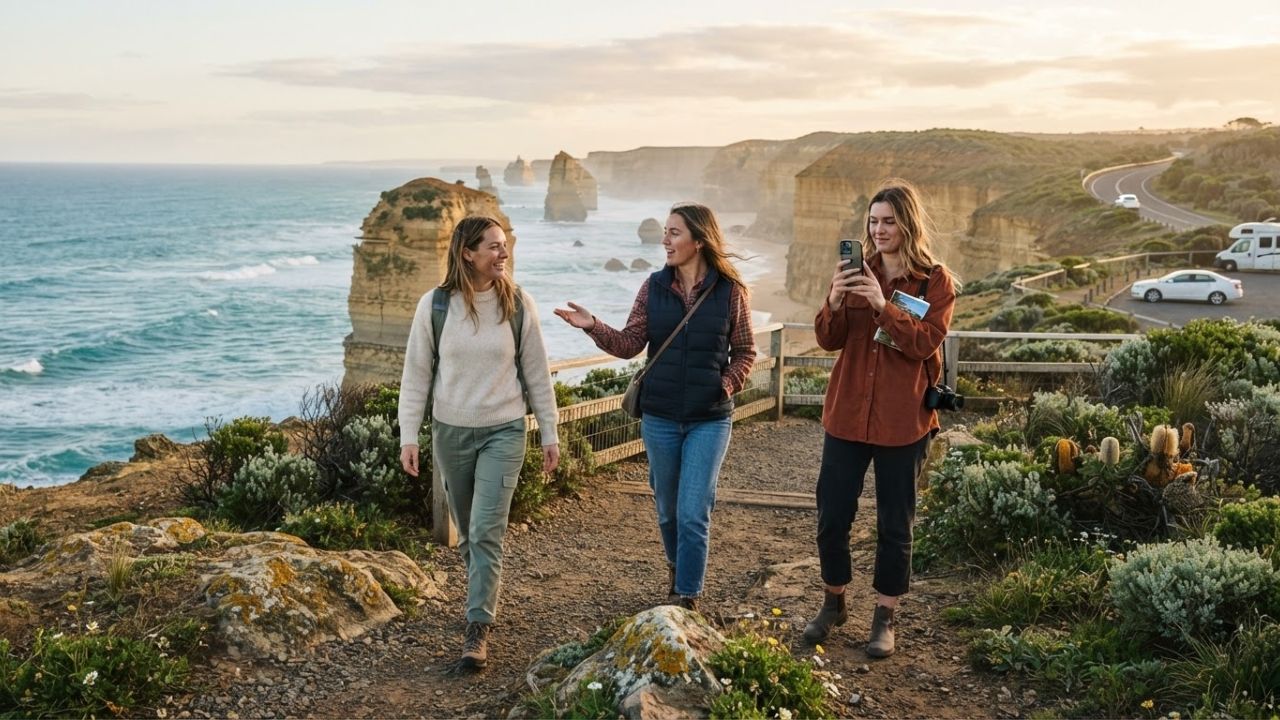
Image generated by AI
Tourism Australia's digital campaigns — built across Instagram, TikTok, and algorithmic discovery platforms — have increased international holiday consideration for Australia by a documented 10%, with social media content now functioning as the primary mechanism through which millions of travelers are discovering not just Sydney and the Great Barrier Reef, but Tasmania, Western Australia, Kangaroo Island, the Daintree Rainforest, and Indigenous cultural corridors at Uluru and Kakadu National Park.
The scale of that behavioral shift is visible in booking data, search trend analysis, and destination marketing intelligence across Australia's inbound tourism sector. What began as a supplementary channel for destination promotion has become the dominant pipeline through which international travel demand for Australia is being generated, shaped, and converted into actual trips — with consequences for which destinations benefit, which demographics travel, and how long visitors stay.
Tourism Australia's 10% Consideration Lift Confirms Social Media as the Primary International Booking Driver
Official insights from Tourism Australia's global marketing strategies confirm that campaigns deeply integrated with digital platforms increased international holiday consideration by 10% — a figure that carries commercial weight when set against the scale of Australia's inbound tourism economy.
Holiday consideration, as a marketing metric, measures the proportion of a target audience that has moved Australia from passive awareness into active trip planning — the stage at which destination research, flight searching, and accommodation browsing begin. A 10% increase across that metric across international source markets represents a substantial expansion of the qualified prospect pool from which actual bookings ultimately flow.
The mechanism producing that shift is algorithmic content delivery at scale. When footage of Sydney Harbour, Uluru at sunrise, or Great Barrier Reef dive sequences appears in a user's Instagram or TikTok feed without a paid advertising designation — surfaced instead by the platform's recommendation engine based on behavioral signals — it registers with audiences differently than conventional advertising. Research in tourist decision-making consistently confirms that platform-native content generates higher engagement and stronger booking intent than equivalent content in display or search advertising formats.
How Instagram and TikTok Are Redirecting Travelers Beyond Sydney to Tasmania and Western Australia
The most commercially significant consequence of algorithmic content delivery for Australian tourism is not what it does for Sydney and the Great Barrier Reef — both already operating at high international awareness levels. It is what it does for Tasmania, Western Australia, regional Victoria, and remote South Australia: destinations that previously required active research effort to discover and that now surface organically in the feeds of travelers who have never typed their names into a search engine.
Algorithmic serendipity — the platform mechanism that introduces users to destinations they were not actively searching for — is proving to be the most effective distribution channel that secondary Australian destinations have ever had access to. A traveler in São Paulo or Seoul who has never consciously considered a road trip along the Great Ocean Road or a wildlife encounter in Kangaroo Island can encounter compelling visual content for either destination within seconds of interacting with Australia-related posts, and the platform will continue surfacing related content at increasing frequency as engagement signals accumulate.
For Tasmania specifically, this dynamic is generating a visitor profile that the island's relatively small tourism infrastructure has not historically been built to handle — high-intent, experience-driven international travelers arriving with specific expectations set by the content they have consumed, often including locations, experiences, and seasonal conditions that demand careful advance planning.
Gen Z and Millennials Aged 18–29 on TikTok vs. Older Travelers Aged 44–79 on Facebook: How the Generational Split Shapes Australia's Visitor Mix
Research mapping contemporary tourist behavior identifies a pronounced generational divide in the platforms and content formats driving Australian travel demand — with direct implications for which destinations, price points, and travel styles are being amplified into international markets.
Generation Z and younger millennials aged 18 to 29 are overwhelmingly concentrated on TikTok and Instagram, where short-form visual content, viral destination trends, and aesthetic travel documentation dominate. This demographic responds to content that frames destination experiences as personal identity statements — the hidden beach, the off-grid campsite, the café that only locals know — rather than landmark checklist tourism. For Australia, this means that platforms are actively directing younger international travelers toward destinations like Tasmania's east coast, the Whitsundays' less-photographed islands, and regional Western Australia's Cape Range National Park.
Older demographics aged 44 to 79 engage primarily through Facebook and structured online travel communities, where peer validation, detailed group reviews, and community-sourced itinerary advice govern decision-making. This group approaches long-haul Australian travel — often representing a significant discretionary expenditure from savings or retirement funds — through a research process that prioritizes trusted social proof over algorithmic discovery. The content formats they find persuasive are extended narrative trip reports, group Q&A threads, and personal testimonials from travelers in comparable life stages.
The commercial significance of this polarization is that neither segment is being served well by tourism products designed for the other. A destination marketing campaign that performs strongly with the 44–79 cohort on Facebook may generate no traction with the 18–29 segment on TikTok, and vice versa. Tourism Australia and state tourism bodies are increasingly building platform-specific content strategies that address both audiences through formats native to each platform rather than repurposing single campaigns across channels.
Micro-Influencers and User-Generated Content Lowering the Planning Barriers for Long-Haul Australian Travel
Academic research in tourist decision-making confirms that user-generated content — unedited travel reels, raw vlogs, and organic peer reviews — functions as a higher-trust input for travel decisions than professionally produced advertising, regardless of the production quality gap between the two.
The practical mechanism is credibility transfer. When an independent creator documents a 12-day campervan route through Western Australia — including the logistical details of fuel stops, campsite bookings, and mobile connectivity across remote sections — they are providing information that a tourism board campaign cannot replicate: verifiable, experiential proof that an intimidating-sounding itinerary is actually executable by an ordinary traveler.
Destination marketing organizations across Australia's state tourism sectors are formalizing this dynamic through advocacy programs that embed micro-influencers in experiential journeys across ecotourism destinations and Indigenous cultural sites in Western Australia and Tasmania. Micro-influencers — creators with audiences typically between 10,000 and 100,000 followers in clearly defined travel interest communities — generate engagement rates that consistently exceed those of large-scale influencer campaigns, with research indicating that smaller audiences tend to perceive the creator as a peer rather than a celebrity, producing stronger booking intent from content consumption.
Uluru and Kakadu: How Indigenous Communities Are Using Social Media to Lead Their Own Tourism Narratives
Digital storytelling platforms have created a genuinely new channel through which Indigenous communities across Australia can present their heritage, protocols, and cultural sites directly to international audiences without institutional intermediaries controlling the message.
Traditional custodians of iconic locations including Uluru and Kakadu National Park are using social media to communicate the significance, spiritual context, and visitor protocols of their country in ways that reshape how international travelers prepare for and approach those experiences. The result is a shift in visitor behavior that predates arrival — travelers who have consumed authentic Indigenous-created content about Uluru arrive with an understanding of why certain areas are restricted from photography or entry, reducing conflicts and supporting the respectful visit practices that Anangu traditional owners have long requested.
This direct cultural exchange also functions as a corrective to historical tourism narratives about Australia that centered European discovery and settlement at the expense of 65,000 years of continuous Indigenous presence. When creators from First Nations communities document their own country — its landscapes, ceremonies, languages, and food systems — on platforms that reach global audiences, the international perception of what an Australian travel experience can include shifts meaningfully.
Kangaroo Island and the Daintree Rainforest: Eco-Conscious Content Driving Conservation Accountability
The relationship between social media content and conservation at Kangaroo Island and the Daintree Rainforest operates in both directions simultaneously.
Influential content creators broadcasting from fragile protected habitats expose real environmental conditions to audiences that dwarf the reach of any conventional conservation campaign. A single widely-shared video documenting fire recovery at Kangaroo Island or water quality concerns affecting Great Barrier Reef coral coverage reaches millions of viewers who would never engage with a conservation organization's newsletter or grant report. That exposure creates public accountability for how eco-resorts, tour operators, and regional councils manage visitor traffic in sensitive ecosystems.
At the same time, the same platforms are directing growing volumes of traveler attention toward those same fragile locations — creating a tension between the conservation awareness that content generates and the visitor pressure that the resulting tourism interest produces. The destinations navigating this tension most successfully are those that use social media visibility not just to attract visitors but to communicate clearly what responsible behavior within the destination looks like, pre-loading traveler expectations before arrival rather than attempting to correct behavior on-site.
The Nullarbor Plain and Great Ocean Road: How Campervan Vlogs Are Creating Australia's Slow Travel Movement
A measurable counter-trend to the rapid-checklist tourism that dominated pre-social media Australian itineraries is emerging through long-form video content on YouTube and TikTok: slow travel, documented by overland van-life creators driving routes including the Nullarbor Plain and the Great Ocean Road over weeks rather than days.
These multi-week journey documentaries serve a specific market function: they demystify the logistics of extended Australian road travel for audiences in source markets where self-drive touring is not culturally embedded as a holiday format. A traveler in Japan or Germany who is unfamiliar with Australia's road infrastructure, campsite booking systems, or vehicle rental options can watch a creator navigate all of those decisions in real time, reducing the perceived complexity of an itinerary that might otherwise feel inaccessible.
The commercial result is a growing segment of long-stay visitors who extend their Australian trip duration significantly beyond what a standard packaged itinerary would produce — with corresponding increases in local economic impact through accommodation, food, fuel, and regional activity spending spread across destinations far removed from the major gateway cities.
Viral Discovery and Regional Victoria and South Australia's Sudden Tourism Surges
Algorithmic content delivery has demonstrated the capacity to redirect thousands of visitors toward previously overlooked destinations with minimal warning — producing sudden surges in local commercial activity that small regional towns and their infrastructure are rarely positioned to absorb smoothly.
Small country towns across regional Victoria and remote South Australia have experienced rapid, algorithm-driven increases in visitor interest when a single piece of content — a drone shot of a coastal cliff, a review of a heritage bakery, a dawn photograph of a wildflower field — achieves viral distribution. The commercial upside for local hospitality businesses, accommodation operators, and food producers is real and often transformative. The infrastructure management challenge — parking, waste, water, accommodation capacity — is equally real and requires advance planning that the speed of algorithmic virality makes difficult to anticipate.
What Australia's Social Media Tourism Shift Means for Travelers Planning Their Visit in 2026
For the international traveler building an Australian itinerary now, the social media-driven landscape creates both opportunity and practical considerations.
Destinations that trend virally on TikTok and Instagram attract visitor volumes that can strain capacity at the specific locations, times, and experiences featured in the content. Travelers who research beyond the viral frame — using the initial social media discovery as an entry point but then investigating surrounding areas, alternative seasons, and comparable experiences with lower visitor density — consistently report higher satisfaction than those who arrive expecting to replicate the exact scenario they saw on a 60-second video.
The 10% international holiday consideration increase that Tourism Australia's campaigns have generated represents a larger pool of informed, motivated travelers entering the Australian market. For travelers who act on that consideration thoughtfully — building itineraries that connect Sydney or Melbourne arrivals with the lesser-discovered destinations that algorithmic content is now making visible — Australia offers a travel proposition that rewards time investment and regional exploration with experiences that remain genuinely distinct from what any other destination can provide.
FAQ: Social Media and Australia Tourism in 2026
How much has social media increased Australia's international tourism consideration? Tourism Australia's global marketing campaigns deeply integrated with digital platforms increased international holiday consideration for Australia by 10%, according to official strategy insights from the tourism body. This metric measures the proportion of target international audiences who moved Australia into active trip-planning consideration.
Which Australian destinations are being discovered through social media in 2026? Beyond established gateways including Sydney and the Great Barrier Reef, algorithmic content delivery on Instagram and TikTok is directing international travelers toward Tasmania, Western Australia, Kangaroo Island, the Daintree Rainforest, Kakadu National Park, Uluru, the Nullarbor Plain, the Great Ocean Road, and towns across regional Victoria and South Australia.
Which age groups use which platforms to research Australia travel? Research identifies a clear generational split: travelers aged 18 to 29 rely primarily on TikTok and Instagram for Australia travel discovery and decision-making, while those aged 44 to 79 engage primarily through Facebook and structured online travel communities for peer validation and itinerary research.
How are Indigenous communities using social media for Australian tourism? Traditional custodians at destinations including Uluru and Kakadu National Park are using social media platforms to communicate cultural protocols, spiritual significance, and visitor guidelines directly to international audiences — shifting traveler behavior before arrival and presenting Indigenous heritage in First Nations-controlled terms rather than through institutional tourism marketing intermediaries.
Related Travel Guides
Disclaimer
This article is for informational and educational purposes only. It does not constitute legal, financial, or professional advice. While we strive to provide accurate and up-to-date information, travel policies, regulations, and conditions change rapidly. Always verify information with official sources before making travel decisions. Nomad Lawyer makes no representations about the accuracy, reliability, completeness, or suitability of the information provided. Readers should consult qualified professionals for advice specific to their circumstances. The views expressed in this article are those of the author and do not necessarily reflect the views of Nomad Lawyer.
Preeti Gunjan
Contributor & Community Manager
A passionate traveller and community builder. Preeti helps grow the Nomad Lawyer community, fostering engagement and bringing the reader experience to life.
Learn more about our team →