
Singapore Tourism Growth in 2026 Driven by Hotels and Regional Connections
Singapore welcomed 4.4 million visitors in Q1 2026, supported by high hotel room rates, regional connections to Fukuoka and Jeju, and cruise terminal upgrades.

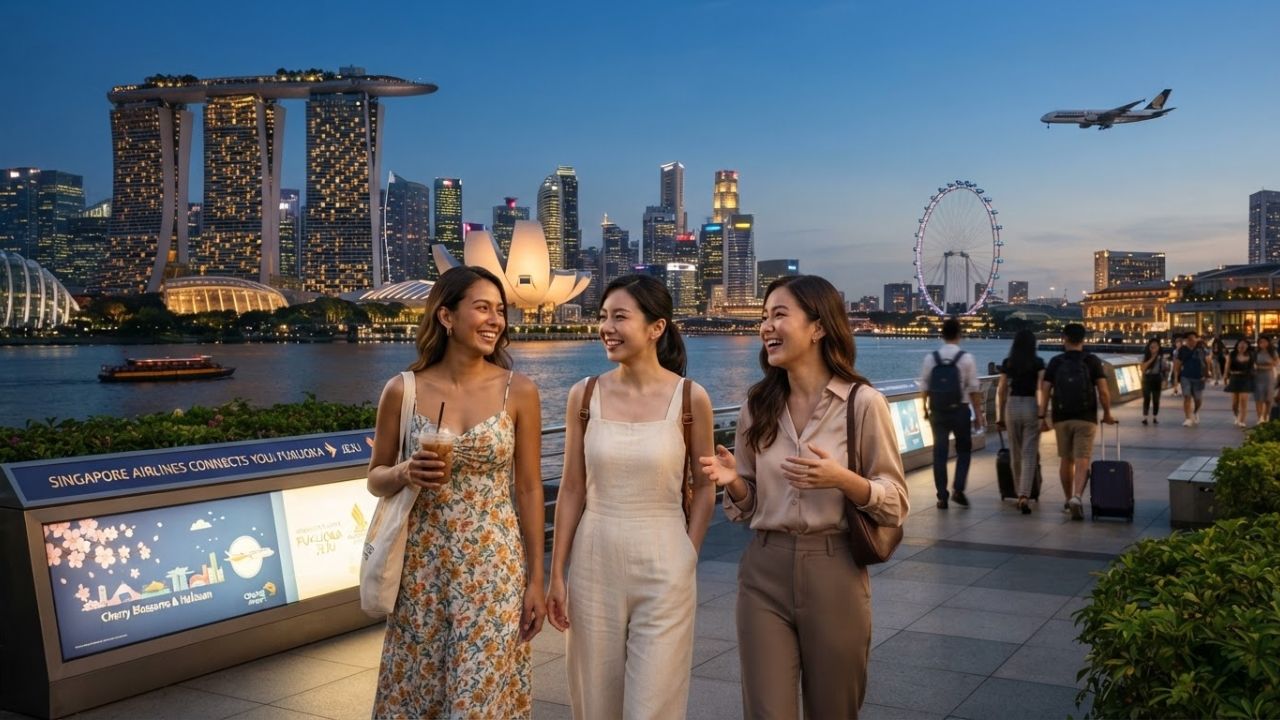
Image generated by AI
Singapore welcomed 4.4 million international visitor arrivals in the first quarter of 2026, marking a 2.8 percent year-on-year increase from 4.31 million in Q1 2025. Despite regional airspace disruptions, the country's strategic transition from tourist volume to high-yield value is generating record revenues for the hotel, retail, and maritime sectors.
The Local Trend Revealed
Following a record S$32.8 billion in tourism receipts in 2025, the Singapore Tourism Board (STB) is executing a "quality tourism" mandate. Rather than chasing raw arrival numbers, the focus has shifted to high-spending visitors through premium infrastructure upgrades and secondary market route expansions:
- S$740 Million Tourism Fund Boost: In May 2026, Minister-in-charge of Trade Relations Grace Fu announced a S$740 million injection into the Tourism Development Fund to be distributed over five years, building upon a S$300 million allocation from 2024.
- Visitor Statistics: Total visitor arrivals reached 7.00 million from January to May 2026, experiencing a minor 1.2 percent year-on-year contraction, but reaching 9.8 million year-to-date by July. Air travel remained the primary entry mode, accounting for 79.4 percent of arrivals facilitated by Changi Airport Group.
- Leading Source Markets: From January to May 2026, mainland China led with 1.34 million arrivals, followed by Indonesia (966,170), Malaysia (549,900), Australia (510,530), and India (498,110). Affluent professionals aged 25 to 34 and 35 to 44 formed the largest visitor demographics.
- Aviation Connectivity via Secondary Hubs: Direct routes are expanding to secondary cultural hubs. Singapore Airlines operates daily non-stop services to Fukuoka Airport in Japan using Boeing 787-10 aircraft, while carriers like Scoot and Jeju Air maintain routes to Jeju Island in South Korea.
- Cruise Infrastructure Relocation: To capture the maritime market, which exceeded 2 million passengers in 2025, the Singapore Cruise Centre at HarbourFront relocated to a new, purpose-built facility on 15 July 2026, featuring automated baggage handling and a premium VIP lounge.
Hotel Economy and AI Integration
According to the Singapore Tourism Analytics Network, average hotel room rates rose 2.0 percent year-on-year to S$273.97 between January and April 2026. Revenue Per Available Room (RevPAR) increased 4.2 percent to S$224.10, with occupancy averaging 81.8 percent. Luxury properties commanded average rates exceeding S$640 per night, while upscale hotels averaged above S$300.
To defend their positioning against regional competitors like Bangkok and Bali, hoteliers are investing in room renovations and digital upgrades. Supported by the STB's Smart Hotel Technology Roadmap, properties are integrating artificial intelligence for dynamic pricing, predictive maintenance, and contactless check-ins, improving staff productivity by up to 20 percent.
Cultural & Environmental Value
For the visitor, the real impact of Singapore's tourism strategy is the opportunity to engage with local communities and support cultural preservation. By dining at local hawker centres (which are UNESCO-listed cultural assets) rather than international hotel dining rooms, travelers directly support family-owned food stalls. Buying traditional Peranakan snacks and handmade crafts in heritage neighborhoods like Joo Chiat and Katong also keeps spending in the local economy.
In terms of environmental footprint, Singapore's Green Plan 2030 encourages low-impact urban exploration. Visitors can utilize the high-capacity, low-carbon Mass Rapid Transit (MRT) subway system, visit eco-attractions like Gardens by the Bay, and stay at hotels certified under the national Green Mark scheme.
Visitor Insider Tips for Singapore Travel
Local specialists recommend the following tips for visitors:
- Utilize Public Transit Pass: Purchase a Singapore Tourist Pass for unlimited travel on MRT trains and public buses. Taxis are reliable, but peak-hour surcharges (6:00 AM to 9:30 AM and 6:00 PM to midnight) and airport fees apply.
- Observe the Off-Peak Window: Visit during late July or the October-to-November window. Avoid the mid-September Formula 1 Grand Prix period, as hotel rates spike, and the year-end festive holidays when crowds peak.
- Observe Local Hawker Etiquette: To reserve a table at popular hawker centres, follow the local custom of "chopeing" by leaving a small packet of tissues on the table before ordering. Always queue in an orderly line at stalls. Littering and chewing gum are strictly illegal and fined.
- Sample Local Culinary Specialties: Try a plate of traditional Hainanese Chicken Rice at Maxwell Food Centre, or sample spicy Chilli Crab paired with a fresh Singapore Sling at the Raffles Hotel.
- Explore Under-the-Radar Spots: Skip the crowded Marina Bay Sands deck and walk along the scenic Henderson Waves bridge in the Southern Ridges for canopy-level views.
Tourism Outlook
The long-term impact of Singapore's high-yield strategy will solidify its brand as a resilient premium hub. Despite geopolitical conflicts in the Middle East causing flight reroutings and leading BMI Country Risk and Industry Research to lower projected arrival growth to 0.5 percent (approximately 17 million arrivals), the STB maintains a target of 17 to 18 million visitors and up to S$32.5 billion in receipts, pointing toward the S$50 billion Tourism 2040 master plan target.
FAQ: Singapore Tourism and Infrastructure
What is the Tourism Development Fund injection value? Singapore is injecting S$740 million into the Tourism Development Fund over the next five years to support innovation and sustainability.
When did the HarbourFront Cruise Centre relocate? The Singapore Cruise Centre at HarbourFront relocated to its new purpose-built facility on 15 July 2026.
What was the RevPAR and hotel occupancy in early 2026? Between January and April 2026, RevPAR reached S$224.10 (up 4.2 percent) and occupancy remained steady at 81.8 percent.
Which Japanese and Korean secondary hubs have direct flights to Singapore? Singapore maintains direct connections to Fukuoka in Japan and Jeju Island in South Korea.
Related Travel Guides
Disclaimer
This article is for informational and educational purposes only. It does not constitute legal, financial, or professional advice. While we strive to provide accurate and up-to-date information, travel policies, regulations, and conditions change rapidly. Always verify information with official sources before making travel decisions. Nomad Lawyer makes no representations about the accuracy, reliability, completeness, or suitability of the information provided. Readers should consult qualified professionals for advice specific to their circumstances. The views expressed in this article are those of the author and do not necessarily reflect the views of Nomad Lawyer.
Raushan Kumar
Founder & Lead Developer
Full-stack developer with 11+ years of experience and a passionate traveller. Raushan built Nomad Lawyer from the ground up with a vision to create the best travel and law experience on the web.
Learn more about our team →