Singapore Airlines Unveils S$2 Billion Long-Haul Fleet Cabin Redesign: Private First Class Suites, Sliding Doors, and Strategic A350 Fleet Retrofit

SINGAPORE — In the most consequential fleetwide passenger experience overhaul in its modern operational history, Singapore Airlines has unveiled a capital expenditure program exceeding 2 billion Singapore dollars to completely re-engineer and install next-generation cabin products across its flagship long-haul and ultra-long-range fleet.
The multi-year modernization initiative encompasses the comprehensive cabin refitting of 41 in-service Airbus A350-900 aircraft alongside establishing the baseline interior architecture for the carrier's future incoming Boeing 777-9 fleet. With commercial deployment scheduled to commence in the second half of 2027, the ambitious project introduces fully enclosed First Class suites featuring double-bed conversion capabilities, sliding privacy doors throughout Business Class, intelligent cabin environmental controls, and thoroughly redesigned seating across Premium Economy and Economy Class.
The strategic timing of this capital commitment underscores Singapore Airlines' determination to maintain its preeminent ranking in global commercial aviation amid intensifying competition from Gulf and Asia-Pacific carriers. By retrofitting its active twin-engine long-haul backbone while simultaneously preparing for Boeing's next-generation widebody flagships, the Singaporean flag carrier is fortifying its premium yield defense, addressing delivery timeline bottlenecks, and establishing a new benchmark for passenger comfort on non-stop flights exceeding eighteen hours.
+----------------------------------------------------------------------------------------------------+ | SINGAPORE AIRLINES S$2 BILLION FLEET RETROFIT PROGRAM SUMMARY | +----------------------------------------------------------------------------------------------------+ | Capital Investment Total | > S$2,000,000,000 (Approx. $1.52 Billion USD) | | Fleet Scope | 41 Airbus A350-900 (Long-Haul & ULR) + Future Boeing 777-9 Fleet | | Phased Commercial Rollout | Second Half of 2027 (H2 2027) through 2030 | | Engineering Facility | SIA Engineering Company (SIAEC) Hangars, Changi International (SIN) | | Core First Class Innovation | Curved sliding privacy doors, convertible companion double bed | | Core Business Class Feature | Enclosed sliding privacy doors, center-pair companion beds, smart IoT| | Main Cabin Upgrades | 4K HDR IFE, ergonomic under-seat storage, high-output USB-C power | | Primary Route Deployments | London Heathrow, New York JFK, Newark, Los Angeles, Tokyo, Sydney | +----------------------------------------------------------------------------------------------------+
The S$2 Billion Capital Investment: Fleet Scope, Architecture, and Phased Rollout
The S$2 billion financial commitment represents one of the largest self-funded interior transformation programs ever initiated by an Asian international airline. Rather than limiting the scope to routine cosmetic refurbishments or seat fabric replacements, Singapore Airlines is stripping 41 existing Airbus A350-900 airframes down to their structural cabin walls, re-routing underlying electrical wiring, updating environmental control ducting, and integrating advanced digital bus architectures capable of supporting next-generation seat actuation and passenger interface systems.
The retrofit initiative directly addresses two distinct operational sub-fleets within the carrier's Airbus A350 inventory. The first encompasses Singapore Airlines' standard three-class long-haul A350-900 airframes, which currently feature Business Class, Premium Economy, and Economy Class cabins operated on intercontinental routes across Europe, Australasia, and North America. The second comprises the carrier's specialized seven Airbus A350-900ULR (Ultra-Long-Range) airframes, configured exclusively with premium seating (Business Class and Premium Economy) to operate the world's longest scheduled passenger flights, including the non-stop links connecting Singapore Changi (SIN) with Newark Liberty (EWR), New York John F. Kennedy (JFK), and Los Angeles International (LAX).
                 SIA LONG-HAUL CABIN RETROFIT ROLLOUT TIMELINE

   [2024 - 2026]                     [H1 2027]                      [H2 2027 - 2030]
+--------------------+        +--------------------+        +-------------------------------+
| Ergonomic Research | =====> | Aircraft Downtime  | =====> | Commercial Flight Operations   |
| & Mock-Up Testing  |        | & SIAEC Hangars    |        | Phased A350 Retrofit In-Service|
| 5,000+ Participants|        | First Airframe Fit |        | Boeing 777-9 Line-Fit Deliveries|
+--------------------+        +--------------------+        +-------------------------------+
The phased installation schedule is structured to begin during the second half of 2027. Aircraft will enter dedicated maintenance bays at SIA Engineering Company (SIAEC) facilities adjacent to Singapore Changi Airport during planned heavy maintenance intervals (C-checks and D-checks). This strategic alignment minimizes unscheduled operational disruptions across the airline's active flight schedule, ensuring that spare airframe capacity maintains scheduled frequencies while individual aircraft undergo weeks of intensive cabin reconstruction.
In parallel with the A350 retrofit, the newly designed cabin architecture will serve as the factory line-fit specification for Singapore Airlines' impending fleet of Boeing 777-9 widebody aircraft. By standardizing interior aesthetics, spatial ergonomics, and technological systems across both the Airbus A350 and Boeing 777-9 fleets, the airline ensures a unified passenger brand experience across its entire intercontinental network, preventing the product fragmentation that often challenges legacy carriers operating mixed-fleet long-haul networks.
First Class Reimagined: The Economics of Airborne Privacy and Double Beds
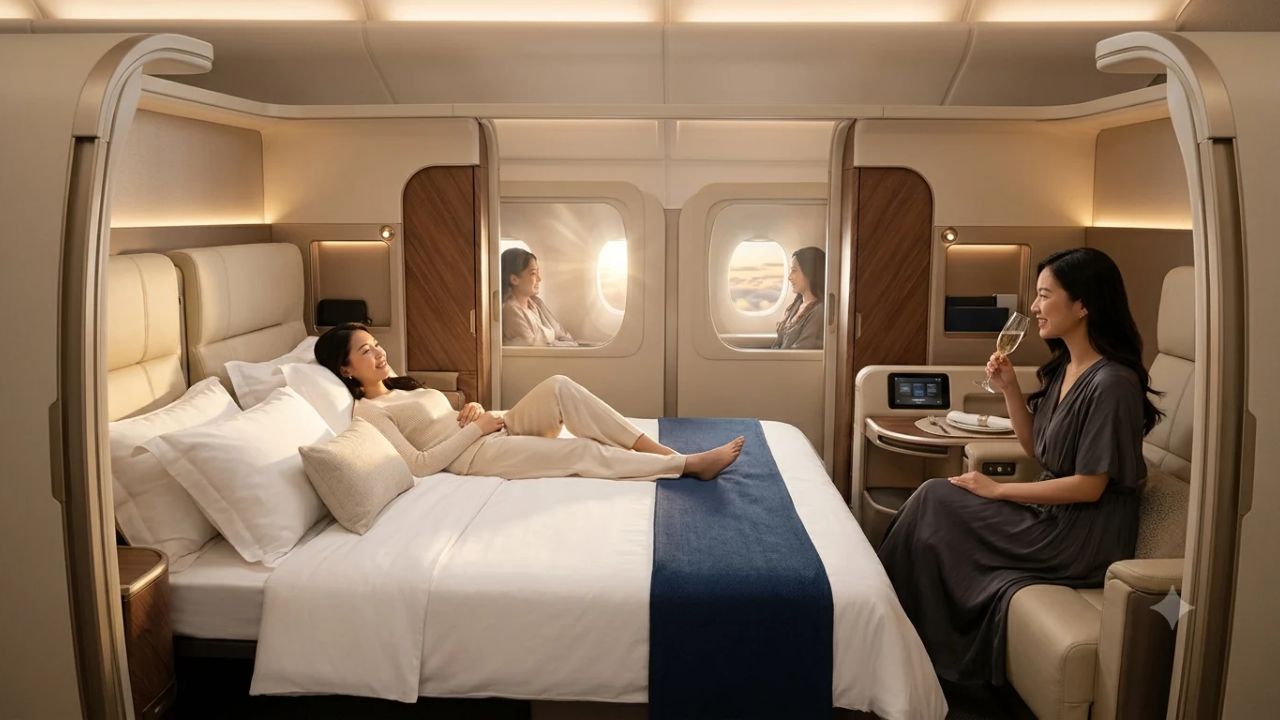
At the pinnacle of the cabin hierarchy, Singapore Airlines is unveiling an entirely redesigned First Class suite that reasserts the carrier's historical leadership in luxury commercial aviation. Since pioneering the double-bed concept aboard its Airbus A380 Superjumbos in 2007, the airline has faced fierce competition from Middle Eastern carriers deploying lavish enclosed suites and shower spas. The new First Class product engineered for the long-haul fleet translates that legacy into a lighter, technologically refined architecture tailored for modern twin-engine airframes.
The signature architectural innovation of the new First Class suite is its elegantly curved full-height sliding privacy door. Engineered using lightweight acoustic-dampening composite panels, the door glides effortlessly along precision tracks, providing absolute visual seclusion from the center aisle while optimizing ambient airflow. Inside the suite, travelers encounter a flexible spatial layout that reconfigures dynamically according to their activities throughout an intercontinental flight.
                  FIRST CLASS SUITE SPATIAL ARCHITECTURE

       +--------------------------------------------------------------+
       | [Sliding Curved Acoustic Privacy Door]                       |
       +---\ \--------------------------------------------------------+
       |    \ \                                                       |
       |     |  +--------------------+        +--------------------+  |
       |     |  | Ultra-Wide Armchair|        | Companion Armchair |  |
       |     |  | (Ergonomic Support)|        | (Center-Pair Mode) |  |
       |     |  +--------------------+        +--------------------+  |
       |     |            ||                            ||            |
       |     |            \/                            \/            |
       |     |  +--------------------------------------------------+  |
       |     |  |     CONVERTIBLE TWO-PERSON SOFA / FULL DOUBLE BED|  |
       |     |  |      (Full-Flat Cotton Linens & Dual Duvelettes) |  |
       |     |  +--------------------------------------------------+  |
       |     |                                                        |
       |     |  +--------------------------------------------------+  |
       |     |  | Companion Dining Table & Dual 32" 4K HDR Monitors|  |
       |     |  +--------------------------------------------------+  |
       |     |  | Wardrobe Storage | Vanity Mirror | Ottoman Hold  |  |
       +-----+--+--------------------------------------------------+--+
For solo executives, the suite functions as a private office and sanctuary, equipped with an ultra-wide ergonomic leather armchair, a generously proportioned dining and work table, dedicated vanity compartments lined in hand-stitched leather, and an integrated full-length wardrobe. When traveling as a couple or family, the motorized dividing partition between adjoining center suites retracts completely. The seats then articulate electronically into an expansive two-person sofa or lower into what Singapore Airlines characterizes as the largest double bed in the sky.
Sleep ergonomics receive meticulous attention. When passengers request turndown service, dedicated cabin crew members prepare the sleeping surface using hypoallergenic, 100 percent natural cotton bed linens, plush memory-foam mattress overlays, down-filled duvets, and an expansive selection of specialized pillows designed to relieve spinal pressure during long-haul rest cycles.
Companion dining is fully integrated into the suite's physical footprint. The main table mechanism accommodates dual place settings, allowing traveling companions to share multi-course meals prepared by the airline's International Culinary Panel, served course-by-course on bespoke fine bone china.
+----------------------------------------------------------------------------------------------------+ | FIRST CLASS SUITE SPECIFICATIONS & DESIGN METRICS | +----------------------------------------------------------------------------------------------------+ | Privacy Mechanism | Motorized, curved sliding acoustic composite privacy doors | | Bed Configuration | Independent single bed or contiguous double bed for center pairs | | Seating Surface | Premium full-grain leather with multi-zone lumbar pneumatic bladders| | In-Flight Entertainment | 32-inch to 43-inch 4K HDR displays with Bluetooth audio pairing | | Dining Capacity | Integrated companion dining table certified for dual place settings | | Storage Amenities | Personal hanging wardrobe, under-ottoman rollaboard bag compartment | | Sleep Enhancements | 100% natural cotton linens, specialized pillow menu, ambient dimming | +----------------------------------------------------------------------------------------------------+
This deliberate commitment to First Class comes at an analytical inflection point in global aviation. Over the past decade, dozens of international airlines—including American Airlines, Delta Air Lines, United Airlines, LATAM, and Malaysia Airlines—have systematically dismantled their First Class cabins. Those carriers cited the rapid improvement of lie-flat Business Class seats, rising corporate travel governance policies forbidding First Class bookings, and the unfavorable revenue-per-square-foot yield of spacious luxury suites.
Singapore Airlines has chosen the opposite strategic path. By preserving and elevating First Class on its flagship fleet, the carrier captures ultra-high-yield corporate executives, family offices, and sovereign wealth leaders commuting along lucrative financial corridors connecting Singapore with London, Zurich, Tokyo, New York, and Sydney. The limited inventory of exclusive suites generates outsized profit margins while casting a halo effect over the airline's broader commercial brand.
Business Class Evolution: Sliding Privacy Doors, Companion Flexibility, and Smart IoT
While First Class serves as the brand's luxury pinnacle, Business Class represents the economic engine of Singapore Airlines' long-haul profitability. In this cabin, the S$2 billion investment introduces a profound design paradigm shift: the deployment of fully enclosed sliding privacy doors across every individual Business Class seat.
Historically, Singapore Airlines resisted installing privacy doors on its long-haul aircraft. While competitors like Qatar Airways pioneered the Qsuite and British Airways introduced the Club Suite, SIA's engineering leadership argued that enclosed cubicles restricted passenger shoulder room, increased maintenance complexity, and introduced unnecessary weight penalties. However, intensive consumer research revealed that international corporate travelers increasingly prioritize uninterrupted acoustic and visual privacy above almost all other cabin attributes.
                 BUSINESS CLASS CENTER-PAIR CONFIGURATION MODES

   [SOLO EXECUTIVE COCOON MODE]                 [SHARED COMPANION SUITE MODE]
+--------------------------------+           +--------------------------------+
| [Closed Door]    [Closed Door] |           | [Closed Door]    [Closed Door] |
| +------------+  +------------+ |           | +------------+  +------------+ |
| | Seat 11D   |  | Seat 11F   | |           | | Seat 11D   |  | Seat 11F   | |
| | (Private)  |  | (Private)  | |           | | (Shared)   |  | (Shared)   | |
| +------------+  +------------+ |           | +------------+  +------------+ |
|        |              |        |           |        \            /          |
|        v              v        |           |         \          /           |
| +----------------------------+ |           | +----------------------------+ |
| | Full-Height Solid Divider  | |           | | Fully Retracted Divider    | |
| | Complete Acoustic Isolation| |           | | Contiguous Companion Bed   | |
| +----------------------------+ |           | +----------------------------+ |
+--------------------------------+           +--------------------------------+
The newly designed Business Class mini-suite resolves previous spatial trade-offs through advanced ergonomic sculpting. The sliding privacy doors feature precision-milled aluminum tracks and magnetic latching mechanisms designed to prevent operational rattling during turbulent atmospheric conditions. The seat shell contours maximize personal space at the elbows and knees, eliminating the restrictive sensation often encountered in enclosed airline suites.
A central element of the Business Class redesign is the versatile center-pair seating arrangement. In solo executive configuration, an electronically actuated privacy divider extends vertically between the center seats, providing complete acoustic and visual isolation from the neighboring passenger.
When traveling as a couple, companions can lower the partition completely via a single touchscreen command. The center seats articulate forward and flatten synchronously, creating a contiguous companion sleeping surface that enables couples to rest side by side on intercontinental overnight flights.
Complementing the mechanical enhancements is an advanced suite of intelligent cabin Internet of Things (IoT) technologies:
- Predictive Environmental Memory: The seat control processor communicates directly with passenger KrisFlyer profiles via the in-flight entertainment system. Travelers can save their preferred seat recline angles, reading light intensity, and lumbar support firmness, which the aircraft seat automatically restores upon boarding.
- Circadian Bio-Lighting: Overhead and ambient footwell LED lighting fixtures synchronize with flight navigation computers to dynamically adjust color temperatures and lux levels, assisting passenger circadian rhythms and mitigating jet lag during long-haul crossings.
- Proactive Crew Service Interfaces: Digital service displays outside each suite door provide cabin attendants with discreet visual cues regarding passenger status, including "Do Not Disturb" requests, wake-up calls for meal services, or specialized dietary orders.
- Wireless Device Ecosystem: Each suite incorporates dual Qi-certified fast-charging inductive pads, multiple 100-watt USB-C Power Delivery ports capable of charging high-power laptops without bulky AC adapters, and seamless Bluetooth audio pairing for personal noise-canceling headphones.
The Strategic Countermeasure: Mitigating Boeing 777-9 Program Delivery Delays
To thoroughly appreciate the operational urgency of the S$2 billion A350 retrofit, aviation analysts must examine the complex industrial backdrop of the Boeing 777-9 development program. When Singapore Airlines originally placed its landmark orders for the Boeing 777-9 in 2017, the aircraft was anticipated to enter commercial service between 2020 and 2021 as the natural successor to the carrier's aging Boeing 777-300ER fleet.
However, compounding structural delays, extended Federal Aviation Administration (FAA) certification scrutiny, supply chain bottlenecks, and developmental pause orders have pushed the entry into commercial service of the 777-9 to late 2026 or 2027 at the earliest. This multi-year industrial postponement created a critical strategic dilemma for Singapore Airlines:
                   FLEET MODERNIZATION STRATEGIC PIVOT

    ORIGINAL FLEET PLAN                         REVISED STRATEGIC PIVOT

  +-------------------------+                 +-------------------------+
  | New Flagship 777-9      |                 | Existing A350-900 Fleet |
  | Cabin Product Launch    |                 | S$2B Major Retrofit     |
  | (Originally 2020-2021)  |                 | (41 In-Service Aircraft)|
  +-------------------------+                 +-------------------------+
               |                                           |
      Severe Delivery Delays                       Decouples Product
     Pushed to 2026 - 2027+                        from Boeing Timelines
               |                                           |
               v                                           v
  +-------------------------+                 +-------------------------+
  | Risk of Outdated A350   |                 | Fleetwide Standardization|
  | Cabins vs Rivals        |                 | Unified Brand Experience |
  +-------------------------+                 +-------------------------+
Had Singapore Airlines reserved its next-generation cabin architecture exclusively for the Boeing 777-9, its active long-haul backbone—the Airbus A350 fleet—would have continued flying with cabin products conceived in 2013 and introduced in 2015. Over a twelve-year lifecycle, premium consumer expectations have advanced significantly. Without this comprehensive retrofit, SIA's A350s would have faced acute competitive pressure from newer flagship offerings introduced by European and Middle Eastern rivals.
By committing S$2 billion to rebuild the interiors of 41 in-service A350-900s, Singapore Airlines effectively insulates its commercial strategy from ongoing aerospace manufacturing disruptions. The airline takes direct control over its passenger product lifecycle. When the Boeing 777-9 airframes eventually enter the fleet, they will join an A350 fleet that already features an identical, cutting-edge cabin standard, eliminating passenger frustration over equipment swaps and product inconsistencies across international trunk routes.
Global Benchmarking: The Premium Long-Haul Cabin Arms Race
The launch of Singapore Airlines' next-generation cabin suite occurs within an aggressive global investment cycle across the premium aviation sector. As global corporate travel budgets stabilize and leisure travelers demonstrate sustained willingness to pay premium fares for enhanced space and privacy, international legacy carriers are investing billions to capture high-margin passenger segments.
+-----------------------------------------------------------------------------------------------------------------------------+ | GLOBAL FLAGSHIP LONG-HAUL CABIN COMPARISON (2026–2027) | +-----------------------------------------------------------------------------------------------------------------------------+ | Airline | Flagship Product | Cabin Enclosure | Companion Double Bed | Primary Fleet Platform | +--------------------+-----------------------+----------------------+-----------------------+----------------------------------+ | Singapore Airlines | Next-Gen Suites & Bus | Full Sliding Doors | Yes (First & Business)| Airbus A350 & Boeing 777-9 | | Qatar Airways | Qsuite & Qsuite Next | Full Sliding Doors | Yes (Business Class) | A350-1000 & Boeing 777-9 | | Emirates | Game Changer & Retro | Virtual/Floor Doors | First Class Only | Boeing 777-300ER & Airbus A380 | | Cathay Pacific | Aria Suite | Full Sliding Doors | No (Individual Pods) | Boeing 777-300ER & Boeing 777-9 | | British Airways | Club Suite | Full Sliding Doors | No (Solo Alignment) | A350-1000 & Boeing 777-200ER/300| | Lufthansa | Allegris Suite Plus | Ceiling-High Doors | Yes (Select Center) | Airbus A350-900 & Boeing 787-9 | | Qantas | Project Sunrise Suite | Full Sliding Doors | First Class Separate | Airbus A350-1000 ULR | +-----------------------------------------------------------------------------------------------------------------------------+
In evaluating this competitive terrain, Qatar Airways has historically held a commanding advantage in Business Class through its Qsuite, which popularized the quad-seating social configuration and double-bed layout in commercial Business Class. Singapore Airlines' upcoming product matches this capability with sliding doors while introducing refined companion seating that avoids the complex, backward-facing layouts required by some competitor designs.
Similarly, Cathay Pacific's introduction of the Aria Suite aboard its Boeing 777-300ER fleet brought sliding privacy doors and wireless charging to regional Asian long-haul routes. Meanwhile, European legacy operators like Lufthansa have faced operational hurdles rolling out the complex multi-tiered Allegris seating system, which features seven distinct seat variations within Business Class alone.
Singapore Airlines' approach prioritizes architectural consistency: every Business Class passenger receives direct aisle access, complete sliding door privacy, and standard smart-storage ergonomics, eliminating passenger uncertainty during seat assignment.
Main Cabin Ergonomics: Enhancing Premium Economy and Economy Class
While First and Business Class cabins generate substantial public attention, Singapore Airlines recognized that passenger satisfaction across its broader customer base requires proportional investment in the main cabin. Approximately 80 percent of passengers boarding an Airbus A350 travel in Premium Economy or Economy Class, where physical discomfort during sixteen-to-nineteen-hour non-stop journeys presents significant physiological challenges.
                  MAIN CABIN ERGONOMIC ENHANCEMENTS

     +-------------------------------------------------------------+
     | Integrated High-Resolution 4K HDR Touchscreen Monitor       |
     | Multi-Angle Tilt Mechanism & Bluetooth Headphone Audio      |
     +-------------------------------------------------------------+
     | Multi-Function Device Holder (Smartphones & Tablets)        |
     | Dedicated Coat Hook & Articulated Retractable Cupholder     |
     +-------------------------------------------------------------+
     | Dual 65W High-Output USB-C Fast-Charging Ports               |
     +-------------------------------------------------------------+
     | Contoured Backrest with Integrated 6-Way Adjustable Headrest|
     | Breathable Custom Fabric Upholstery & Multi-Density Foam    |
     +-------------------------------------------------------------+
     | Enhanced Under-Seat Storage Cavity (Maximizes Shin Clearance)|
     | Redesigned Ergonomic Calf & Footrest Assemblies             |
     +-------------------------------------------------------------+
The redesigned Premium Economy Class seat incorporates several practical passenger-centric features:
- Optimized Legroom and Shell Geometry: By utilizing composite seat-back shells with sculpted knee cutouts, the new design delivers significant gains in living space without reducing overall cabin seat count.
- Advanced Calf and Foot Support: Enhanced calf-rests articulate through wider angles, supporting lower-limb circulation and reducing muscular fatigue on ultra-long-haul sectors.
- Dedicated Living Amenities: In-seat amenities include articulated dual-position cocktail tables, dedicated cupholders that function independently of the main meal tray, and specialized storage pockets designed to securely hold passports, eyeglasses, and smartphones.
In Economy Class, the redesign focuses on maximizing spatial efficiency and entertainment immersion. Seats feature slimline backs engineered with variable-density foam cushions that distribute passenger body weight evenly, reducing lumbar pressure points during extended periods of sitting.
The personal in-flight entertainment monitors are upgraded to ultra-thin 4K HDR displays with high-contrast anti-reflective coatings. The screens tilt dynamically to preserve viewing angles even when the passenger ahead reclines their seat.
Additionally, Singapore Airlines has completely redesigned the under-seat structural support frame. By eliminating bulky central electronic boxes and relocating cabling inside structural spars, passengers gain unobstructed floor space beneath the seat in front of them, accommodating standard carry-on bags while providing ample room for foot movement.
Aerospace Engineering Realities: Tare Weight, Fuel Burn, and SAF Targets
Executing an ambitious cabin overhaul across 41 widebody aircraft presents major aerospace engineering and performance considerations. In commercial airline operations, cabin interior components represent a substantial portion of an aircraft's Operating Empty Weight (OEW). Installing motorized privacy doors, electrical actuators, structural suite bulkheads, larger 4K displays, and companion bed mechanics adds significant physical mass.
              AEROSPACE WEIGHT MANAGEMENT & EFFICIENCY BALANCE

     +-----------------------+              +-------------------------+
     |  Added Interior Mass  |              | Structural Compensations|
     | - Sliding Door Tracks |              | - Carbon-Fiber Shells   |
     | - Motorized Actuators | <==========> | - Titanium Fasteners    |
     | - Larger 4K Displays  |              | - Lightweight Honeycomb |
     | - Double-Bed Frames   |              | - Micro-Optic Cabling   |
     +-----------------------+              +-------------------------+
                                 ||
                                 \/
               +------------------------------------+
               | Net Payload & Range Equilibrium    |
               | Zero Operational Range Degradation |
               | Compliant with Changi SAF Targets  |
               +------------------------------------+
Every additional kilogram carried aboard an aircraft operating non-stop across the Pacific Ocean translates into incremental fuel consumption. On Singapore Airlines' flagship ultra-long-range flights between Singapore and New York (covering over 15,300 kilometers), aircraft operate near their maximum structural takeoff weight limits. Any uncontrolled increase in empty aircraft weight risks triggering payload restrictions, forcing the airline to leave revenue-generating cargo or passengers behind to carry mandatory fuel reserves.
To neutralize these weight penalties, Singapore Airlines collaborated closely with premier aerospace seating manufacturers and interior engineering specialists, including Safran Seats, Collins Aerospace, Jamco Corporation, and Recaro Aircraft Seating. The design teams employed advanced composite engineering solutions:
- Carbon-Fiber Honeycomb Core Structures: Partition walls and sliding suite doors are fabricated using aerospace-grade carbon-fiber skins bonded to aramid honeycomb cores, reducing component weight by up to 35 percent compared to traditional aluminum-framed assemblies.
- Generative Structural Design: Metal structural brackets and seat track attachment fittings were re-engineered using generative algorithmic modeling and titanium additive manufacturing (3D printing), placing structural metal only along direct stress pathways while removing excess unneeded material.
- Fiber-Optic Data Networks: The legacy copper wiring used for in-flight entertainment distribution and seat power management has been replaced with lightweight fiber-optic bus lines and distributed solid-state power switching units, saving hundreds of kilograms across each airframe.
Through these rigorous weight optimization disciplines, Singapore Airlines aims to achieve net-neutral or near-neutral weight impacts across its retrofitted A350 fleet. This technical balance ensures that the aircraft preserve their non-stop operational range to eastern North America without degrading fuel burn performance or conflicting with the airline's environmental commitments under Singapore's Sustainable Air Hub Blueprint, which mandates progressive adoption of Sustainable Aviation Fuel (SAF) across departures from Changi Airport.
Hub Synergies: Changi Terminal 5 and High-Yield Transit Connectivity
The S$2 billion cabin investment operates in direct synergy with the ongoing infrastructure expansion of Singapore Changi Airport. Long regarded as one of the world's most efficient transit hubs, Changi Airport is constructing Terminal 5 (T5), a massive mega-terminal scheduled to become operational in the mid-2030s, capable of handling an additional 50 million passengers annually.
                   CHANGI AIRPORT GLOBAL TRANSIT MATRIX

    WESTERN MARKETS                                            EASTERN & SOUTHERN MARKETS
+---------------------+                                       +--------------------------+
| Europe (LHR/CDG/FRA)| \                                   / | Australasia (SYD/MEL/AKL)|
+---------------------+  \                                 /  +--------------------------+
| North America (JFK) | ---\                             /--- | East Asia (HND/ICN/PVG)  |
+---------------------+     \                           /     +--------------------------+
                             ===> [ CHANGI HUB (SIN) ] <===
+---------------------+     /   [ Next-Gen Lounges  ]   \     +--------------------------+
| South Asia (DEL/BOM)| ---/    [ Seamless Transit  ]    \--- | Southeast Asia (DPS/BKK) |
+---------------------+  /                                 \  +--------------------------+
| Middle East (DXB)   | /                                   \ | Southwest Pacific        |
+---------------------+                                       +--------------------------+
Singapore Airlines functions as the anchor tenant and operational foundation of Changi Airport, accounting for approximately half of all passenger movements. The carrier's commercial strength relies on its ability to aggregate high-yield transfer passengers connecting between distinct global economic regions:
- The Kangaroo Route: High-yield premium passengers traveling between London, Paris, Frankfurt, and Australian gateways (Sydney, Melbourne, Brisbane, Perth) connecting through Singapore.
- Trans-Pacific Corridors: Travelers journeying between Southeast Asia, the Indian subcontinent, and the East Coast of the United States.
- Intra-Asia Corporate Links: High-frequency business travel linking Tokyo, Seoul, Shanghai, and Hong Kong with Southeast Asian commercial centers like Jakarta, Kuala Lumpur, and Bangkok.
By upgrading its long-haul cabins to world-class standards, Singapore Airlines ensures that travelers experiencing its award-winning ground hospitality—including the renowned Private Room and SilverKris Lounges at Changi Terminal 3—experience uninterrupted luxury when stepping aboard their connecting flights. The cabin upgrade eliminates the risk that high-spending corporate travelers might defect to rival Gulf hubs in Doha, Dubai, or Abu Dhabi, which actively market state-of-the-art transit amenities and enclosed premium suites.
Strategic Guide for Corporate Travel Planners and Premium Passengers
As Singapore Airlines advances toward the commercial debut of its retrofitted cabins in the second half of 2027, corporate travel coordinators, travel management companies (TMCs), and loyalty program members should incorporate several practical considerations into their travel planning strategies.
Identifying Retrofitted Aircraft on Flight Schedules
When the phased rollout begins in H2 2027, retrofitted Airbus A350-900 aircraft will initially be introduced on selected high-yield trunk routes. Historically, Singapore Airlines concentrates flagship cabin products on premier competitive routes:
- Singapore (SIN) to London Heathrow (LHR): The carrier's most prestigious European business route, regularly chosen to showcase flagship product debuts.
- Singapore (SIN) to New York (JFK and EWR): The signature ultra-long-range services requiring optimal passenger sleeping comfort.
- Singapore (SIN) to Sydney (SYD) and Melbourne (MEL): Core trunk links anchoring the lucrative Australasian corporate market.
Travel planners can identify retrofitted aircraft within Global Distribution Systems (GDS) and the Singapore Airlines booking engine by examining cabin seat maps. The presence of enclosed First Class suites and a modified Business Class seat numbering matrix indicating sliding-door center companion suites will confirm the deployment of next-generation interiors.
Maximizing KrisFlyer Loyalty Redemptions
Members of Singapore Airlines' KrisFlyer program should prepare for heightened competition for award seat redemptions upon the introduction of the new cabin products:
- Saver vs. Advantage Award Availability: When new premium suites enter service, KrisFlyer typically restricts Saver-level award space on debut routes, releasing inventory primarily under Advantage awards or waitlists. Loyalty members aiming to experience the new First Class double bed should monitor redemption availability 355 days in advance of their planned travel dates.
- First Class Award Upgrades: Passengers holding confirmed commercial Business Class tickets on eligible fare classes (J, C, U) can utilize KrisFlyer miles to upgrade into First Class suites, provided upgrade inventory is cleared prior to departure.
- Spontaneous Escapes Restrictions: Promotional monthly redemption discounts (KrisFlyer Spontaneous Escapes) rarely include newly debuted flagship cabin products during their initial twelve to eighteen months of service.
                      PASSENGER SEATING STRATEGY

  PASSENGER PROFILE         OPTIMAL SEAT SELECTION        KEY CABIN ADVANTAGE
+-------------------------+-----------------------------+------------------------------------+
| Solo Executive Traveler | Window Suites (A / K)       | Direct aisle access, maximum quiet |
|                         | Business Class              | Full privacy sliding door          |
+-------------------------+-----------------------------+------------------------------------+
| Traveling Couples       | Center Pair (D / F)         | Fully retractable divider partition|
|                         | First or Business Class     | Contiguous companion double bed    |
+-------------------------+-----------------------------+------------------------------------+
| Premium Economy Flyers  | Bulkhead Rows               | Maximum knee and calf extension    |
|                         | Front of Cabin              | Early priority meal selection      |
+-------------------------+-----------------------------+------------------------------------+
| Ultra-Long-Haul Economy | Forward Center Section      | Smoother ride during turbulence,   |
| Passengers              | Direct Under-Seat Clearance | Rapid deplaning at destination     |
+-------------------------+-----------------------------+------------------------------------+
Strategic Seating Guidance
When booking flights aboard retrofitted A350-900 aircraft:
- Solo Executives in Business Class: Target single window suites along the outer fuselage (A and K seats). These suites provide total independence from other travelers, optimal exterior views, and complete privacy from aisle foot traffic when the sliding door is engaged.
- Couples in Business Class: Select center-pair seating (D and F seats). These positions allow full lowering of the privacy divider, enabling conversational comfort and the option to convert the space into a companion bed for overnight rest.
- Passengers in Premium Economy: Reserve forward bulkhead seats to take full advantage of articulating leg-rests and extra forward knee clearance, while avoiding seats immediately adjacent to galley preparation areas or lavatories where light and noise can interrupt sleep.
Related Travel Guides
- Singapore Changi Airport Terminal 2 Expansion and Stopover Lounge Guide
- Top Luxury First Class Cabins Compared: Double Beds and Private Suites in the Sky
- Ultra-Long-Haul Flight Health Guide: Managing Sleep and Jet Lag on Non-Stop Routes
- KrisFlyer Miles Redemption Masterclass: Maximizing Premium Cabin Upgrades
This article is for informational purposes. Flight routes, passenger regulations, visa rules, and transit advisories are subject to change by airlines and aviation authorities. Readers are advised to verify schedules and travel documentation with relevant carriers and border agencies before departure.