Singapore Airlines Prepares Airbus A380 Return on Hong Kong Route for Winter 2027 Schedule

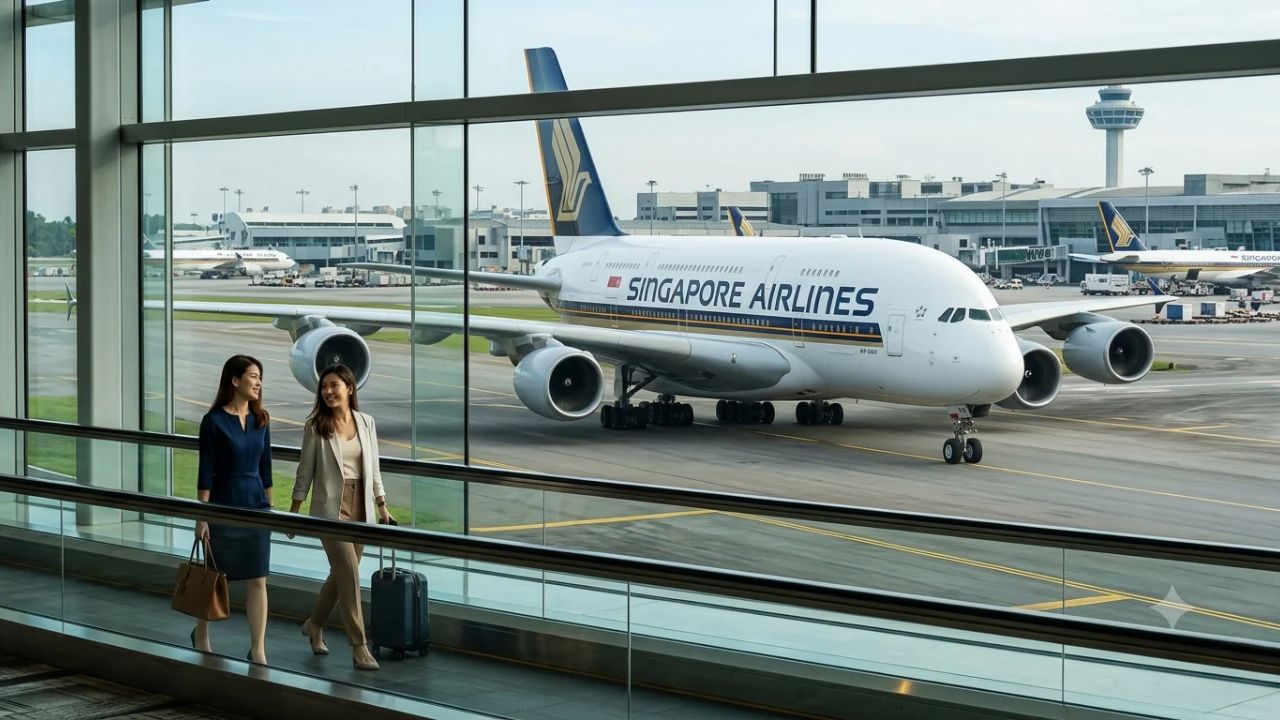
Singapore Airlines provisionally schedules its flagship Airbus A380 on daily flights between Singapore Changi and Hong Kong International Airport for December 2027 and January 2028.
SINGAPORE, Nov 1 (Nomad Lawyer) — Singapore Airlines (SIA) has provisionally scheduled its flagship Airbus A380 superjumbo to return to the high-density Singapore–Hong Kong corridor for the upcoming Winter 2027/2028 operational season, marking a significant potential capacity surge across one of Asia's most lucrative commercial aviation trunks. According to preliminary schedule filings revealed by airline schedule monitoring networks, the Star Alliance carrier plans to deploy the double-decker aircraft on daily flights SQ882 and SQ883 between Singapore Changi Airport (SIN) and Hong Kong International Airport (HKG) from December 1, 2027, through January 31, 2028, restoring its celebrated first-class Suites product to regional travelers following earlier schedule retractions.
[!NOTE] Provisional Schedule Intelligence: The planned Airbus A380 operation covers flights SQ882 (outbound) and SQ883 (inbound) during the peak two-month holiday window from December 1, 2027, to January 31, 2028, replacing the currently scheduled Airbus A350-900. In addition, Singapore Airlines has slated Boeing 777-300ER widebody aircraft to operate flights SQ874 and SQ875 between October 31 and November 27, 2027. All allocations remain subject to operational adjustment and fleet availability prior to ticket issuance.
SINGAPORE AIRLINES SINGAPORE-HONG KONG FLEET DEPLOYMENT ARCHITECTURE
| Column 1 |
|---|
| [Route Specifications] ----------> Singapore Changi (SIN) <-> Hong Kong (HKG) |
| +------------------------------------------------+------------------------+ |
| v v |
| [Late Autumn Transition Phase] [Winter Peak Superjumbo Revival] |
| October 31 – November 27, 2027 December 1, 2027 – January 31, 2028 |
| Flights: SQ874 (SIN-HKG) / SQ875 (HKG-SIN) Flights: SQ882 (SIN-HKG) / SQ883 |
| Aircraft: Boeing 777-300ER (264 seats) Aircraft: Airbus A380-800 (471) |
| Features: 4 First Class, 48 Business, Features: 6 Suites (Double Bed), |
| 28 Premium Economy, 184 Economy 78 Business, 44 Premium, |
| 343 Economy (Main Deck) |
| \ / |
| \ / |
| v v |
| [NET CAPACITY SURGE OVER A350-900 BASELINE] |
| Current A350-900: 253 to 303 seats |
| A380-800 Deployment: +168 to +218 additional seats per flight |
| A massive ~55% to 85% single-frequency passenger volume lift |
| v |
| [Commercial Strategic Objective] |
| Capture Year-End Corporate Executive & Luxury Holiday Travel Demand |
| Establish Singapore Airlines as the Premier Regional Superjumbo Flagship |
Strategic Fleet Realignment: Analyzing the Winter 2027/2028 Schedule Filing
The provisional scheduling of the Airbus A380 on Singapore Airlines' Hong Kong route represents an important tactical maneuver in regional widebody capacity management. Airline scheduling data published through international aviation distribution monitoring platforms indicates that the Singaporean flag carrier has loaded the double-decker aircraft for operations commencing on December 1, 2027, and running through January 31, 2028.
The specific flight pair designated for this widebody upgrade consists of flight SQ882, which departs Singapore Changi Airport for Hong Kong International Airport, and the return rotation, flight SQ883, which operates southbound back to Changi. On standard operational timetables, flight SQ882 departs Singapore mid-morning, arriving in Hong Kong in the early afternoon, while flight SQ883 departs Hong Kong in the late afternoon, arriving back at Changi in the evening. This operational window aligns perfectly with major inbound transfer banks at Changi Airport, allowing passengers connecting from long-haul European, South African, and Australian arrivals to seamlessly connect onto the Hong Kong flagship service.
Upgrading this specific frequency to the double-decker A380-800 introduces an unprecedented volume of premium and economy capacity. While the airline's three-class long-haul A350-900 accommodates 253 passengers, and its medium-haul regional variant accommodates 303 passengers, the four-class Airbus A380 accommodates a total of 471 passengers. This adjustment delivers between 168 and 218 additional seats on every single flight, representing a capacity expansion of roughly 55% to 85% on that specific daily frequency. Over the sixty-two days of the planned two-month operational window, the deployment injects more than 26,000 additional seats into the corridor, creating significant commercial revenue opportunities during the busiest travel period of the Asian calendar.
Aviation network analysts emphasize that forward schedule filings posted twelve months in advance remain provisional. In commercial aviation planning, airlines frequently file tentative aircraft assignments to establish schedule slots, evaluate distribution algorithms, and position airframes prior to finalizing crew rosters and heavy maintenance checks. Singapore Airlines has not yet confirmed whether the superjumbo will remain on the route beyond January 31, 2028, or whether the allocation represents a targeted holiday deployment designed to absorb peak year-end traffic.
Preceding Aircraft Transitions: The Boeing 777-300ER Autumn Deployment
The anticipated winter return of the A380 is preceded by another notable aircraft transition across the Singapore–Hong Kong corridor earlier in the autumn calendar. Preliminary schedule filings indicate that Singapore Airlines will deploy its long-range Boeing 777-300ER on flights SQ874 and SQ875 between October 31 and November 27, 2027.
The Boeing 777-300ER represents the backbone of Singapore Airlines' long-haul intercontinental fleet, featuring a four-class cabin architecture that includes four ultra-exclusive First Class open suites, forty-eight lie-flat Business Class seats in a 1-2-1 layout, twenty-eight Premium Economy seats, and one hundred and eighty-four Economy Class seats. Deploying this long-range workhorse on a regional route enables Singapore Airlines to introduce dedicated international first-class seating weeks before the arrival of the A380, catering directly to senior corporate executives traveling for major international financial events, including Hong Kong FinTech Week and global banking symposiums held annually in November.
| Flight Number & Route | Operational Date Range | Assigned Aircraft Type | Cabin Product Classes | Key Operational Focus |
|---|---|---|---|---|
| SQ874 (SIN -> HKG) / SQ875 (HKG -> SIN) | October 31 – November 27, 2027 | Boeing 777-300ER | First Class, Business, Premium Economy, Economy | Absorbs late autumn commercial corporate demand and business banking travel |
| SQ882 (SIN -> HKG) / SQ883 (HKG -> SIN) | December 1, 2027 – January 31, 2028 | Airbus A380-800 | Suites, Business Class, Premium Economy, Economy | Captures peak holiday leisure surge and luxury family travel with 471 seats |
| Standard Baseline Schedule (Year-Round) | Regular Operational Timetable | Airbus A350-900 | Business Class, Premium Economy, Economy | High-efficiency twin-engine widebody operations connecting regional hubs |
The sequential introduction of the Boeing 777-300ER in November, followed immediately by the Airbus A380 in December, reveals a deliberate strategy of testing premium seat absorption during the high-demand fourth-quarter corporate and holiday travel cycle. While both aircraft introduce first-class inventory, they serve separate operational blocks.
The Boeing 777-300ER on flights SQ874 and SQ875 provides a mid-sized capacity bridge tailored to corporate travelers attending year-end financial summits in Hong Kong and Singapore throughout November. In contrast, the arrival of the A380 on flights SQ882 and SQ883 in December directly targets the massive surge in leisure holiday traffic, multi-generational family getaways, and luxury winter shoppers traveling between the two financial centers.
Historical Context: Unpacking the July 2026 Schedule Retraction
To understand the broader significance of the prospective A380 deployment, one must examine the complex history of Singapore Airlines' superjumbo operations on the Hong Kong trunk line. The route has historically been one of the carrier's primary testing grounds for high-capacity aircraft, dating back to the earliest commercial introduction of the A380 in the late 2000s.
However, operational priorities shifted substantially in July 2026, when Singapore Airlines executed a comprehensive schedule revision that removed planned A380 flights from Hong Kong that had been previously filed for June and July 2027. That mid-year withdrawal disappointed aviation enthusiasts and luxury travelers who had anticipated booking the carrier's flagship Suites on a short-haul regional corridor during the northern hemisphere summer.
Following that cancellation, Dubai-based Emirates remained the sole carrier operating scheduled Airbus A380 services into Hong Kong International Airport, deploying its double-deckers on fifth-freedom routes connecting Bangkok and Dubai to Hong Kong. Singapore Airlines' withdrawal left its Hong Kong schedule reliant on twin-engine Airbus A350-900 and Boeing 787-10 Dreamliner aircraft.
The emergence of the December 2027 schedule filing demonstrates that Singapore Airlines never intended to permanently abandon the A380 on regional trunk routes. Instead, the airline appears to have refined its deployment strategy, reserving its twelve operational A380 aircraft for long-haul intercontinental routes to London Heathrow, Sydney, Melbourne, and Frankfurt during the northern summer, while reallocating airframes to high-yield Asian regional sectors during the northern winter when leisure holiday demand peaks.
The Economics of Short-Haul Superjumbo Operations: A 2,560-Kilometer Power Corridor
The commercial logic of operating an ultra-heavy, four-engine superjumbo on a flight distance of only 2,560 kilometers (1,382 nautical miles) runs contrary to standard airline fleet planning. The Airbus A380 was engineered by European planemakers primarily as an ultra-long-haul hub-to-hub aircraft capable of flying fifteen hours nonstop while carrying more than five hundred passengers.
On short-haul sectors with block flight times of three hours and fifty minutes, such as Singapore to Hong Kong, four-engine widebody aircraft incur disproportionately high operating expenses. Every takeoff and landing cycle places heavy thermal and mechanical stress on the airframe, landing gear, and four Rolls-Royce Trent 900 turbofan engines, accelerating engine shop visits and maintenance reserves compared to long-haul cruising hours. Additionally, carrying the structural weight of four engines and massive double-deck fuselages burns substantially more fuel per nautical mile than modern twin-engine aircraft like the Airbus A350-900 or Boeing 787-10. This economic penalty explains why airlines globally retired quad-engine aircraft in favor of ultra-efficient twin-engine alternatives over the past decade.
SHORT-HAUL AIRBUS A380 ROUTE COMPARISON MATRIX
| Category / Entity | Details / Impact |
|---|---|
| [Singapore to Hong Kong (SIA)] ----> 2,560 km (1,382 nm) | Block Time: ~3h 50m |
| [Dubai to Muscat (Emirates)] ------> 349 km (188 nm) | Block Time: ~1h 10m |
| [Dubai to Doha (Emirates)] --------> 378 km (204 nm) | Block Time: ~1h 15m |
| [Singapore to Kuala Lumpur (SIA)] -> 296 km (160 nm) | Block Time: ~1h 00m |
| [London to Paris (Air France)] ----> 344 km (186 nm) | Block Time: ~1h 15m |
Despite these cost penalties, short-haul A380 operations can prove highly lucrative under specific market conditions. Singapore and Hong Kong represent slot-constrained aviation hubs where runway movements are strictly limited during peak daylight hours. When an airline cannot secure additional takeoff and landing slots to meet escalating passenger demand, the only viable commercial mechanism to increase revenue is "up-gauging"—deploying a substantially larger aircraft onto an existing slot.
In addition, because the Singapore–Hong Kong corridor generates extraordinary volumes of premium business and high-wealth banking traffic, Singapore Airlines can charge premium fares for its six upper-deck Suites and seventy-eight Business Class seats. The revenue generated from high-yield front-cabin bookings effectively subsidizes the operational fuel costs of the four engines, making the A380 economically viable during high-season holiday surges. Premium leisure passengers readily pay premium cash and mileage surcharges to experience world-class first-class luxury on an accessible four-hour daylight journey.
Cabin Product Architecture: The 471-Seat Configuration and Flagship Suites
For the international traveling public, the primary appeal of Singapore Airlines deploying the Airbus A380 to Hong Kong lies in the unparalleled luxury of its cabin products. Following an extensive multi-year retrofit program, all twelve active A380 aircraft in the Singapore Airlines fleet feature the carrier's latest 2017 cabin interior architecture.
The crown jewel of this configuration is the Singapore Airlines Suites cabin, located at the forward section of the upper deck. Limited to just six private enclosed suites, the cabin offers an extraordinary level of personal space and seclusion. Each suite features a plush, hand-stitched leather armchair upholstered by Poltrona Frau that swivels 270 degrees, paired with a completely separate full-flat bed that stows vertically into the dividing wall when not in use.
| Cabin Class & Deck Location | Total Seat Count | Seat Configuration | Key Product Dimensions & Luxury Amenities |
|---|---|---|---|
| Suites (Upper Deck Forward) | 6 Private Enclosed Suites | 1-1 Single Aisle Layout | Swivel Poltrona Frau armchair, separate 76-inch flat bed, 32-inch touchscreen monitor; double bed in 1A/2A & 1F/2F |
| Business Class (Upper Deck) | 78 Lie-Flat Seats | 1-2-1 Direct Aisle Access | 25-inch seat width, 78-inch full-flat bed, carbon-fiber composite shell, personal cocktail console, center double beds |
| Premium Economy (Main Deck Forward) | 44 Recliner Seats | 2-4-2 Transverse Layout | 19.5-inch seat width, 38-inch pitch, calf rest, footrest, dedicated reading lights, noise-canceling headsets |
| Economy Class (Main Deck) | 343 Ergonomic Seats | 3-4-3 Standard Layout | 18.5-inch seat width, 32-inch pitch, six-way adjustable headrest, 11.1-inch touchscreen personal entertainment monitor |
For couples traveling together, the two forward suites on either side of the center aisle (Suites 1A/2A and 1F/2F) feature privacy dividers that can be fully retracted, allowing the two individual beds to merge into a luxurious double bed. The Suites cabin is served by two expansive private lavatories, one of which includes a sit-down sit-and-dress vanity station with luxury Lalique toiletries. In-flight culinary service in Suites mirrors Michelin-starred dining, featuring the carrier's signature "Book the Cook" pre-ordering program with selections such as classic Lobster Thermidor, prime beef fillet, and authentic Singaporean chicken rice, accompanied by vintage Champagne pours including Dom Pérignon and Krug Grande Cuvée served in crystal flutes.
Directly behind the Suites on the upper deck sits the expansive Business Class cabin, housing seventy-eight lie-flat seats arranged in a forward-facing 1-2-1 configuration, ensuring that every passenger enjoys direct, unobstructed aisle access. Engineered with lightweight carbon-composite shells, each seat reclines into a full-flat bed measuring seventy-eight inches in length. Center-aisle seat pairs feature movable privacy partitions that can be lowered flush with the armrests, creating double beds for traveling partners. Business Class travelers enjoy dedicated noise-canceling headsets, multi-course dining menus designed by international culinary panel chefs, and complimentary high-speed satellite Wi-Fi throughout the flight.
The main deck is dedicated entirely to high-capacity travel, accommodating forty-four Premium Economy seats in a spacious 2-4-2 layout, followed by three hundred and forty-three Economy Class seats in a 3-4-3 configuration. Premium Economy passengers benefit from extra legroom, leather calf rests, power ports, and advance main meal selection through Book the Cook. With wide cabin cross-sections, high ceilings, advanced humidification systems, and whisper-quiet cabin acoustics, the A380 provides an exceptionally comfortable passenger experience across all four travel classes.
Airport Infrastructure and Turnaround Logistics at Changi and Chek Lap Kok
Operating a massive commercial aircraft carrying nearly five hundred passengers requires specialized ground handling infrastructure and disciplined airport logistics at both Singapore Changi Airport and Hong Kong International Airport.
At Singapore Changi, A380 flights are handled primarily from Terminal 3, which was engineered from its inception to accommodate ultra-large aircraft. Changi's dedicated A380 gates feature specialized dual-level aerobridges that dock simultaneously with the lower main deck and upper premium deck, allowing four hundred and seventy-one passengers to embark and disembark in parallel, drastically reducing cabin congestion.
DUAL-HUB AIRBUS A380 GROUND HANDLING ARCHITECTURE
| [Singapore Changi Airport (SIN)] [Hong Kong International (HKG)] |
|---|
| - Terminal 3 Superjumbo Contact Gates - Terminal 1 Dedicated A380 Piers |
| - Dual-Level Aerobridge Boarding - Dual-Level Passenger Boarding |
| - High-Speed Automated Baggage Sorting - Three-Runway System (3RS) Slots |
| - The Private Room & SilverKris Lounges - Renovated SilverKris Lounge |
| \ / |
| \ / |
| v v |
| [TWO-HOUR RAPID GROUND TURNAROUND PROTOCOL] |
| - Parallel upper and lower deck passenger offloading |
| - Simultaneous four-engine refueling and potable water replenishment |
| - Multi-truck catering replenishment for 471 meal services |
| - Rapid-cycle cabin sanitization and fresh linen distribution |
At Hong Kong International Airport (Chek Lap Kok), A380 operations are accommodated at specialized widebody contact piers in Terminal 1. The operational viability of adding high-capacity A380 frequencies to Hong Kong is greatly enhanced by the commissioning of the airport's Three-Runway System (3RS). The multi-billion-dollar infrastructure expansion adds an entire third runway, modernized taxiway systems, and expanded terminal concourses, significantly alleviating the severe airspace and ground congestion that previously restricted flight movements at HKG.
Ground handling teams at both airports must execute rapid two-hour aircraft turnarounds. Within a tightly synchronized 120-minute window, ground crews must offload hundreds of passenger bags, conduct security sweeps across two expansive passenger decks, replenish multi-thousand-gallon fuel tanks, restock hundreds of multi-course catering carts for four distinct travel classes, and complete deep cabin cleaning before boarding the outbound flight.
Commercial Competition on the Singapore–Hong Kong Trunk Route
The potential reintroduction of the A380 by Singapore Airlines intensifies the high-stakes commercial rivalry between the two dominant legacy carriers anchoring the corridor: Singapore Airlines and Cathay Pacific.
The Singapore–Hong Kong market is one of the most fiercely contested business routes in the global airline industry. Both cities serve as preeminent financial capitals, housing regional corporate headquarters, international investment banks, global consulting practices, and technology enterprises. Consequently, corporate demand between the two hubs remains consistently strong throughout the working week, complemented by massive leisure demand over weekends and public holidays.
| Airline Operator | Primary Aircraft Deployed | Flight Strategy & Schedule Density | Key Commercial Competitive Advantage |
|---|---|---|---|
| Singapore Airlines (Star Alliance) | Airbus A350-900, Boeing 787-10, B777-300ER, Airbus A380 (Provisional) | High-capacity widebody operations; flagship product prestige | 4-class luxury with Suites; seamless Star Alliance connections to Australia & Europe |
| Cathay Pacific (oneworld) | Airbus A350-900, Airbus A350-1000, Boeing 777-300ER | High-frequency "shuttle" schedule with multi-daily departures | Dominant market presence in Hong Kong; extensive oneworld network across Greater China |
| Emirates (Fifth-Freedom) | Airbus A380-800 | Single daily service routing Dubai -> Bangkok -> Hong Kong | Competitive pricing on fifth-freedom sector; alternative luxury A380 product |
Cathay Pacific operates a high-frequency "air shuttle" model on the route, offering numerous daily flights spaced evenly throughout the morning, afternoon, and evening. Cathay deploys modern twin-engine widebodies, including the Airbus A350-900, the stretched A350-1000, and Boeing 777-300ER aircraft, catering to corporate travelers who prioritize schedule flexibility and departure frequency over sheer aircraft size.
By deploying the A380 on flights SQ882 and SQ883, Singapore Airlines adopts a differentiated capacity strategy. Rather than attempting to match Cathay flight for flight, SIA utilizes its superjumbo to capture massive market share on a single premier midday frequency. The presence of the A380 provides Singapore Airlines with an unmatched marketing advantage, attracting affluent vacationers and aviation enthusiasts who intentionally book flight SQ882 specifically to experience the iconic double-decker aircraft.
Actionable Traveler Guide: Booking Strategies, Suites Availability, and Schedule Volatility
For frequent flyers, luxury travelers, and aviation enthusiasts hoping to secure a seat aboard Singapore Airlines' A380 to Hong Kong, navigating schedule volatility and booking channels requires strategic planning:
First, maintain realistic expectations regarding schedule stability. Because the December 2027 and January 2028 A380 deployment currently represents a provisional forward schedule filing, travelers should recognize that Singapore Airlines reserves the legal right to substitute aircraft types at any point prior to departure. Fleet maintenance requirements, delivery timelines for newer aircraft, or shifts in passenger demand could prompt the carrier to swap the A380 back to an Airbus A350-900 or Boeing 777-300ER.
Second, monitor KrisFlyer loyalty award inventory proactively. For points collectors, short-haul A380 flights represent one of the most accessible opportunities to redeem miles for the world-renowned Singapore Airlines Suites. While long-haul Suites redemptions to London or Frankfurt require substantial mileage balances and face extreme waitlist competition, regional Suites awards to Hong Kong require significantly fewer KrisFlyer miles. Travelers should monitor award availability on flight SQ882 and SQ883 as the schedule becomes officially open for booking, looking for "Saver" award space.
Third, verify seat maps carefully when booking. To ensure that an itinerary is scheduled on the retrofitted 2017 A380 configuration, examine the interactive seat map during the booking process. The upper deck should display exactly six Suites in a 1-1 layout at the front, followed by seventy-eight Business Class seats in a 1-2-1 layout. If the seat map shows twelve first-class suites on the lower main deck, the flight is assigned to an older, unretrofitted airframe layout.
Fourth, take full advantage of airport lounge access. Passengers holding confirmed Suites bookings on flight SQ882 departing Singapore Changi enjoy exclusive access to The Private Room, Singapore Airlines' ultra-exclusive first-class lounge sanctuary within the SilverKris Lounge complex in Terminal 3. Featuring fine à la carte dining, private resting cabanas, and vintage Champagne service, The Private Room provides a seamless prologue to a luxury flight experience.
By staying informed on schedule filings and understanding aircraft allocation dynamics, travelers can maximize their opportunities to experience one of aviation's most celebrated aircraft along Asia's most dynamic commercial flight corridor.
Related Travel Guides
- Europe Overhauls Corporate Travel Rules with Biometric Borders and Rail Mandates
- Nepal and Indonesia Forge Landmark Mountaineering Partnership
- Barcelona Leads European Clampdown with Heavy Tourist Tax Hikes
- Air New Zealand Delays Skynest Sleep Pods to May 2027
- Alaska Airlines Expands Anchorage Nonstop Routes to Dallas, Austin, and Nashville
This article is for informational purposes. Flight routes, passenger regulations, visa rules, and transit advisories are subject to change by airlines and aviation authorities. Readers are advised to verify schedules and travel documentation with relevant carriers and border agencies before departure.
Related Stories
Ultra-Comfortable Budget Flights: How Singapore, Japan, Malaysia, and Spain Are Redefining Long-Haul Low-Cost Air Travel
Alaska Airlines Connects Anchorage with Dallas, Austin, and Nashville in Summer 2027 Domestic Network Expansion