
Breaking Airline News: Severe Travel Chaos Hits Orlando International as Southwest and JetBlue Trigger 196 Flight Disruptions
Breaking airline news: Amidst catastrophic operational fragility, Orlando International Airport suffered massive flight cancellations and delays, plunging thousands of domestic and international passengers into severe travel chaos.

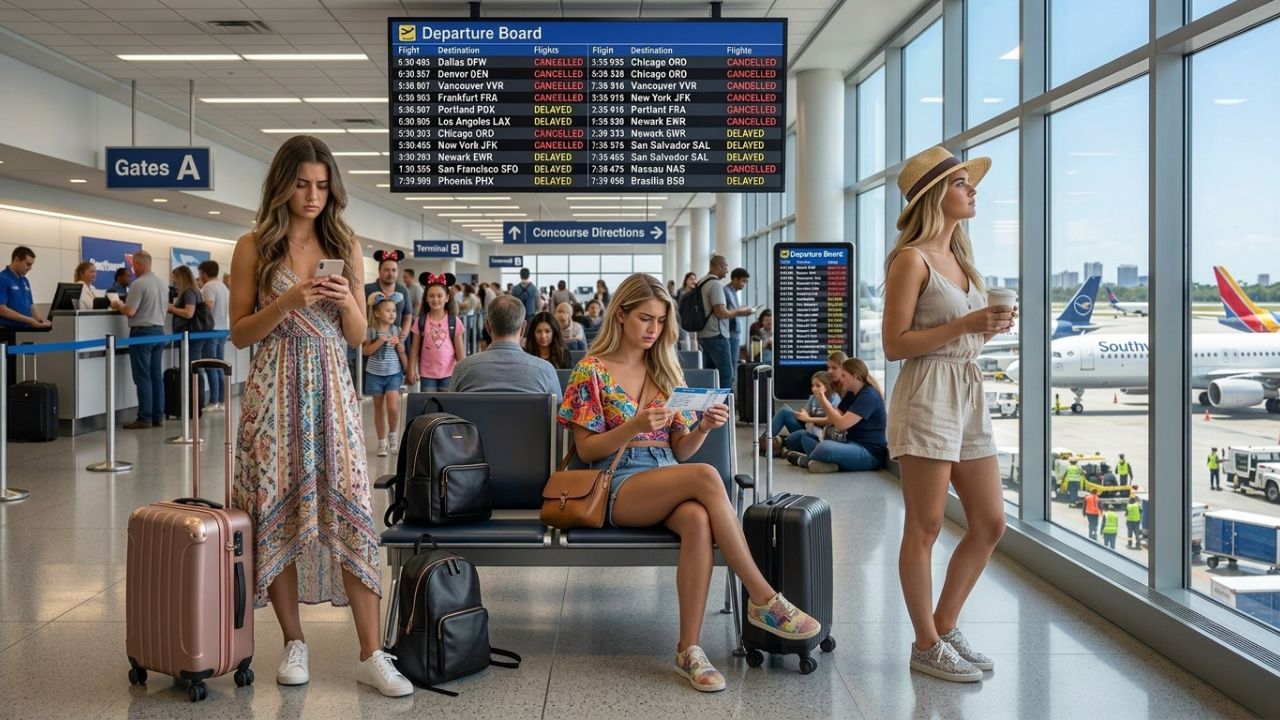
Image representing the intense infrastructural collapse at Orlando International Airport, where sudden flight disruptions driven heavily by Southwest Airlines and JetBlue have completely shattered global transit schedules, trapping thousands of passengers in a terrifying surge of travel chaos.
Breaking Airline News: Severe Travel Chaos Hits Orlando International as Southwest and JetBlue Trigger 196 Flight Disruptions
As paralyzing terminal bottlenecks, severe airspace congestion, and catastrophic operational fragility violently transform global transit into a grueling endurance test, a massive operational failure has just crippled one of the most critical tourism gateways in the United States. On June 12, 2026, Orlando International Airport suffered an absolute infrastructural meltdown, plunging thousands of unsuspecting domestic and international passengers into a terrifying wave of travel chaos. Driven heavily by severe, cascading scheduling failures heavily concentrated among Southwest Airlines, JetBlue Airways, and American Airlines, the massive Florida hub recorded an astonishing 186 massive flight delays alongside 10 hard flight cancellations. This localized logistical collapse has violently severed critical routes connecting Orlando to massive global destinations including Chicago, New York, Dallas, Nassau, and Brasília, transforming terminal concourses into overcrowded holding zones and leaving desperate travelers stranded without immediate recourse.
In a brutal demonstration of how highly vulnerable the interconnected aviation network remains to sudden operational shocks, this localized crisis instantly radiated outward, severely fracturing both domestic and international flight schedules. Orlando International, heavily relied upon to efficiently process massive volumes of tourism-heavy traffic into Florida, was completely overwhelmed by the concentrated severity of these disruptions. Passengers attempting to navigate the resulting gridlock faced violently extended wait times at check-in counters and boarding gates, while exhausted airline personnel struggled frantically to manage the massive influx of desperate rescheduling requests. This terrifying incident underscores the absolute necessity for aggressive contingency planning, proving that escaping global travel chaos now requires intense operational discipline from every single passenger navigating the international transit grid.
Expanded Overview: The Anatomy of a High-Density Hub Collapse
The terrifying reality of overwhelming passenger stress currently testing Orlando brutally exposes the extreme consequences of fragile airline schedules. Serving as a critical connection point for both domestic and international travel, Orlando functions as a massive interchange. When an airport of this capacity experiences a sudden slowdown in aircraft turnaround, gate availability, and scheduled departure sequencing, the 10 cancellations instantly intensify disruption pressure, forcing massive reallocations of passengers across alternate flights and reducing overall travel efficiency for the entire US aviation network.
Section-Wise Breakdown: Decoding the Orlando Gridlock
To fully comprehend the massive logistical challenges facing the aviation industry, corporate travel planners and stranded passengers must rigorously review exactly how this explosive disruption tore through the network.
Orlando International: The Systemic Bottleneck To understand the absolute severity of this demand shock, one must look at the exact operational telemetry at the airport. Orlando bore the full, violent brunt of these localized disruptions. The concentration of cancellations among domestic leisure carriers strongly suggests that severe network adjustments, a catastrophic lack of aircraft availability, brutal crew scheduling challenges, or severe operational constraints played a critical role in collapsing the day's schedule across multiple airline networks.
The Severed Routes: From Chicago to Brasília The 10 absolute cancellations and widespread 186 massive delays ruthlessly targeted critical global corridors. The outright cancellations violently severed links to massive domestic hubs including Chicago, New York, and Dallas.
The massive delay footprint entirely paralyzed the domestic US network. Flights heading to Albany, Atlanta, Austin, Nashville, Buffalo, Baltimore, Charlotte, Columbus, Washington, Denver, Dallas–Fort Worth, Newark, Fort Lauderdale, New Castle, Wilmington, Indianapolis, Las Vegas, Los Angeles, Kansas City, Memphis, Manchester, Milwaukee, New Orleans, Norfolk, West Palm Beach, Philadelphia, Phoenix, Pittsburgh, Warwick, Raleigh–Durham, Richmond, Seattle, San Francisco, Salt Lake City, Sacramento, St. Louis, Trenton, and Tulsa were violently delayed.
Crucially, the gridlock did not stop at the US border. International corridors were violently impacted, destroying itineraries heading to San Salvador, Nassau, Brasília, Providenciales, Montego Bay, St. Thomas, San Juan, and Ottawa. The fact that delays spread across key business, leisure, and connecting markets proves that the operational failure in Orlando created massive scheduling difficulties on a global scale.
Operational Failure Matrix: Airline Disruption Data
To guarantee that travelers can aggressively track the specific carriers triggering this massive operational meltdown, the following matrix details the exact, verified disruption data recorded across the airport on June 12, 2026.
| Airline | Cancellations | Cancellation % | Delays | Delay % |
|---|---|---|---|---|
| Southwest | 3 | 0% | 99 | 30% |
| JetBlue | 3 | 2% | 19 | 13% |
| American Airlines | 2 | 1% | 20 | 17% |
| Frontier | 1 | 0% | 11 | 8% |
| Delta Air Lines | 1 | 0% | 13 | 11% |
| British Airways | 0 | 0% | 1 | 50% |
| Aer Lingus | 0 | 0% | 1 | 33% |
| GOL Linhas Aéreas Inteligentes | 0 | 0% | 1 | 20% |
| Breeze Airways | 0 | 0% | 5 | 12% |
| Porter Airlines | 0 | 0% | 1 | 25% |
| Avianca El Salvador | 0 | 0% | 1 | 50% |
| LATAM Brasil | 0 | 0% | 1 | 25% |
| United | 0 | 0% | 11 | 13% |
| Virgin Atlantic | 0 | 0% | 1 | 16% |
| Avelo Airlines | 0 | 0% | 1 | 25% |
Data reflects the monumental logistical collapse severely impacting Orlando International Airport.
Passenger Impact and Industry Analysis
The widespread impact across domestic, regional, and international carriers created an incredibly complex, chaotic operational scenario heavily skewed toward a few major operators. Southwest Airlines triggered the absolute largest volume of pure gridlock, recording an astonishing 99 delayed flights alongside 3 cancellations.
JetBlue Airways also experienced severe operational strain with 3 cancellations and 19 delays. American Airlines followed closely behind in terms of outright network failure, grounding 2 flights alongside 20 delays.
However, the disruption footprint dragged down international and regional carriers as well. Elite European operators like British Airways, Aer Lingus, and Virgin Atlantic suffered massive delay percentages. Major Latin American operators, including LATAM Brasil and GOL Linhas Aéreas Inteligentes, also suffered delays, proving that no carrier is immune to the cascading effects of interconnected hub scheduling. For the passengers trapped within the Orlando terminals, the effect was devastating, resulting in ruined luxury holidays, missed international connections, and massive uncertainty.
Conclusion: Surviving the Chaos
As the extremely critical domestic transit network braces for further instability, the collapse at Orlando International represents a massive warning. Travelers affected by flight cancellations must immediately execute aggressive survival strategies:
- Bypass the Queue: If your flight is canceled, bypass the physical service desk. Immediately call the airline or use their online chat system to secure a seat on the next available flight.
- Demand Compensation: In cases of extended disruption, carriers such as Southwest Airlines, JetBlue Airways, and American Airlines may provide accommodation or meal vouchers depending on operational policies and delay classification. Aggressively request this.
- Buffer Your Itinerary: Passengers are generally advised to artificially inject longer connection windows when travelling through high-traffic US hubs such as Orlando.
- Luggage Retrieval: Be warned: checked baggage is typically rerouted or held by airline ground services during cancellations. You may be forced to collect and recheck baggage, further extending your wait.
This intelligence proves that surviving the modern era of commercial aviation relies entirely on absolute operational readiness, proving that anticipating travel chaos is the only defense against a failing transit grid.
Key Takeaways
- Massive Network Failure: Orlando International Airport suffered 10 absolute flight cancellations and an astonishing 186 massive delays.
- Carrier Meltdown: Southwest Airlines triggered the massive delay volume (99 delays, 3 cancellations), while JetBlue and American Airlines also suffered severe cancellations.
- International Impact: European carriers (British Airways, Aer Lingus) and Latin American operators (LATAM, GOL) were dragged into the operational gridlock.
- Global Severed Routes: Flights heavily connecting Orlando to Chicago, New York, Nassau, San Salvador, and Brasília were violently disrupted.
- Passenger Survival: Stranded travelers must utilize digital rebooking tools immediately and aggressively demand alternative routing and compensation to bypass the massive terminal gridlock.
Related Travel Guides
Disclaimer
This article is for informational and educational purposes only. It does not constitute legal, financial, or professional advice. While we strive to provide accurate and up-to-date information, travel policies, regulations, and conditions change rapidly. Always verify information with official sources before making travel decisions. Nomad Lawyer makes no representations about the accuracy, reliability, completeness, or suitability of the information provided. Readers should consult qualified professionals for advice specific to their circumstances. The views expressed in this article are those of the author and do not necessarily reflect the views of Nomad Lawyer.
Kunal K Choudhary
Co-Founder & Contributor
A passionate traveller and tech enthusiast. Kunal contributes to the vision and growth of Nomad Lawyer, bringing fresh perspectives and driving the community forward.
Learn more about our team →