
Severe Travel Chaos Erupts as Delta Air Lines Flight DL1600 Abandons Fort Myers Route and Diverts Back to Cincinnati Amid Airport Disruptions
Breaking airline news: Severe travel chaos intensifies as Delta Air Lines Flight DL1600 abruptly diverts back to Cincinnati after departing for Fort Myers, causing massive airport disruptions and stranded passengers.

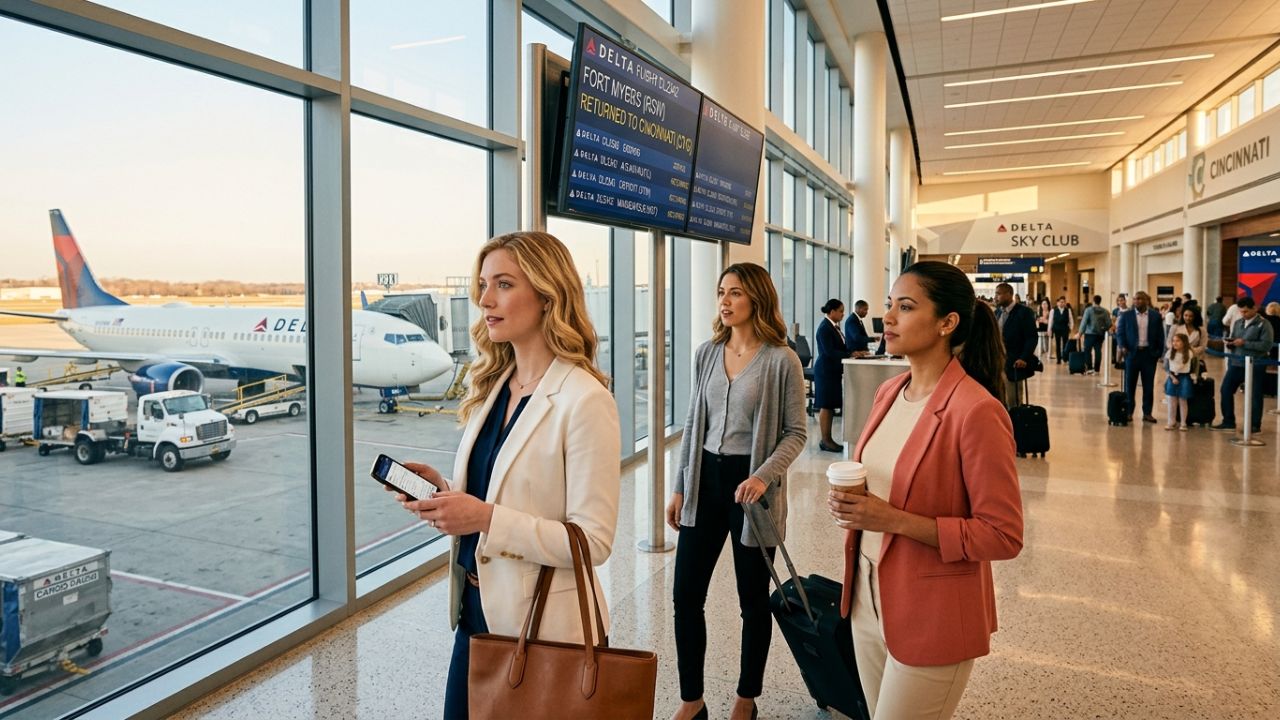
Image representing the intense operational meltdown caused by an unexpected flight return. As Delta Air Lines Flight DL1600 abruptly abandons its route to Fort Myers and diverts back to Cincinnati, passengers are plunged into severe travel chaos amid escalating airport disruptions.
Severe Travel Chaos Erupts as Delta Air Lines Flight DL1600 Abandons Fort Myers Route and Diverts Back to Cincinnati Amid Airport Disruptions
A sudden wave of severe travel chaos has struck the national transit network after Delta Air Lines Flight DL1600 executed a highly unexpected "U-turn" diversion, abruptly returning to its departure point in Ohio rather than completing its scheduled journey to Florida. Operating on Saturday, June 13, 2026, the Boeing 737-800 was supposed to transport summer travelers from Cincinnati/Northern Kentucky International Airport (CVG) directly to Southwest Florida International Airport (RSW) in Fort Myers. Instead, the flight suffered an immediate operational breakdown, resulting in a swift return to Cincinnati, massive airport disruptions, and deeply frustrated passengers suddenly trapped at their origin point.
This abrupt mid-air reversal serves as a stark reminder of the extreme fragility of modern commercial aviation. For passengers expecting a seamless arrival in Florida, the sudden diversion translated into instant travel chaos, blown hotel reservations, and a frantic scramble to secure alternative flights. As breaking airline news began circulating regarding the grounded Boeing 737, the situation quickly escalated into a complex logistical nightmare for Delta's operational teams. While precautionary returns are standard procedure to ensure absolute safety, the downstream impact on travelers attempting to navigate the volatile 2026 summer travel season is incredibly severe, requiring travelers to adopt aggressive survival strategies to salvage their itineraries.
Expanded Overview: The Breakdown of a Florida Connection
The sudden failure of the Cincinnati-to-Fort Myers route violently fractures the carefully laid plans of hundreds of passengers heading toward a major vacation and business hub. When an aircraft successfully departs but is subsequently forced to abandon its route and return to the origin airport, the disruption is twofold. Not only are the passengers aboard physically returned to square one, but the destination airport is instantly deprived of the incoming aircraft required for its next scheduled rotation. This cascading failure fuels severe airport disruptions across multiple states, transforming a single technical or operational anomaly into widespread travel chaos.
Section-Wise Breakdown: Navigating the U-Turn Diversion
To fully comprehend the operational shockwaves generated by this incident, it is essential to analyze the specific airports caught in this sudden logistical breakdown.
Cincinnati/Northern Kentucky International (CVG): The False Start and Return The crisis originated in Cincinnati. After pushing back from Gate B2 and departing heavily delayed at approximately 9:10 a.m. EDT (roughly 1 hour and 35 minutes behind schedule), the Boeing 737-800 became airborne. However, instead of proceeding south, the aircraft initiated a sudden diversion protocol. It reversed course and landed safely back at CVG, arriving at Gate C8. For passengers, this meant deplaning exactly where they started, facing an indefinite wait and immediate rebooking challenges.
Southwest Florida International (RSW): The Empty Arrival Gate Hundreds of miles away in Fort Myers, the sudden diversion created immediate chaos for ground operations. Scheduled to receive the inbound Delta aircraft, RSW was left with an empty gate and a massive crowd of outbound passengers whose subsequent flight was instantly obliterated by the lack of hardware. The failure of DL1600 to arrive triggered severe downstream flight cancellations and forced Florida-based travelers to scramble for alternative routes northward.
Flight Details: The Diversion Matrix
To provide absolute clarity on this specific aviation event, the following verified flight telemetry details the exact aircraft, timeline, and routing data regarding the sudden "U-turn" diversion.
| Flight Element | Verified Operational Data |
|---|---|
| Airline & Flight Number | Delta Air Lines DAL1600 (DL1600) |
| Aircraft Type | Boeing 737-800 (737-832) |
| Aircraft Registration | N3761R |
| Origin Airport | Cincinnati/Northern Kentucky International Airport (CVG) |
| Intended Destination | Southwest Florida International Airport (RSW), Fort Myers |
| Diversion Airport | Returned to Origin (CVG) |
| Date of Incident | June 13, 2026 |
| Actual Departure Time | Approx. 9:10 a.m. EDT (1 hr 35 min delayed) |
Data reflects the verified flight tracking telemetry for the sudden diversion of Delta Air Lines Flight DL1600.
Passenger Impact: Trapped at Square One
The abrupt return of DL1600 to Cincinnati created an absolute nightmare for the passengers onboard. Instead of a smooth arrival in sunny Fort Myers, travelers were thrust into immediate travel chaos, facing the grueling reality of starting their journey completely over. Because this route heavily serves the summer vacation market, a sudden grounding like this causes catastrophic downstream financial damage—lost cruise connections, forfeited hotel deposits, and destroyed rental car reservations. Passengers disembarking at Gate C8 were forced into emergency scrambling—aggressively battling over limited customer service agents, hunting for scarce seats on alternative carriers out of CVG, or resigning themselves to massive overnight delays while awaiting a rescue aircraft.
Industry Analysis: Anatomy of a Precautionary Return
While Delta Air Lines has not publicly disclosed the precise mechanical, technical, or operational trigger that forced the return of DL1600, severe travel chaos of this nature is an inherent risk within highly regulated aviation systems. Flight crews operating complex hardware like the Boeing 737-800 maintain an absolute zero-tolerance policy for in-flight anomalies. Whether the issue involved a sudden technical warning indication, a pressurized system irregularity, or an acute operational constraint, the protocol remains identical: immediately abort the route and return the aircraft to a major maintenance hub. Returning to the origin (CVG) provides the airline with immediate access to engineering support, replacement aircraft, and operational infrastructure. While this guarantees passenger survival and safety, the resultant operational breakdown absolutely demolishes schedule integrity and fuels massive airport congestion.
“Safety remains the foundation of modern aviation, and the return of Delta Airlines Flight DAL1600 to Cincinnati demonstrates how established procedures are designed to protect passengers and crew," noted Anup Kumar Keshan, Founder and Editor-in-Chief of Travel And Tour World. "While the diversion naturally raises questions, the aircraft’s safe landing highlights the industry’s commitment to caution, operational discipline, and passenger wellbeing above all else.”
Conclusion: A Highly Volatile Recovery Outlook
The sudden and dramatic return of Delta Air Lines Flight DL1600 to Cincinnati is a stark testament to the extreme fragility of modern air travel. What began as a delayed but routine departure to Florida rapidly devolved into severe travel chaos, highlighting how vulnerable passengers are to the intense operational realities of the aviation industry. While the aircraft landed safely—proving the absolute effectiveness of commercial safety protocols—the resulting airport disruptions have inflicted immense logistical pain on everyone involved. As airlines continue to navigate these high-stress scenarios, travelers must remain exceptionally vigilant, highly flexible, and physically prepared to execute alternative travel strategies at a moment's notice to prevent total itinerary collapse.
Key Takeaways
- Sudden U-Turn Diversion: Delta Flight DL1600 violently aborted its route to Fort Myers, returning unexpectedly to its origin in Cincinnati.
- Aircraft Involved: The flight was operated by a Boeing 737-800 registered as N3761R.
- Instant Chaos: The diversion triggered massive airport disruptions, destroying passenger itineraries and causing missed onward connections in Florida.
- Safety Protocol: While highly disruptive, the diversion to a maintenance hub underscores the aviation industry's zero-tolerance policy for mid-air operational risks.
- Passenger Vulnerability: Travelers were forced to scramble for emergency rebooking and alternative transportation after returning to square one.
Related Travel Guides
Disclaimer
This article is for informational and educational purposes only. It does not constitute legal, financial, or professional advice. While we strive to provide accurate and up-to-date information, travel policies, regulations, and conditions change rapidly. Always verify information with official sources before making travel decisions. Nomad Lawyer makes no representations about the accuracy, reliability, completeness, or suitability of the information provided. Readers should consult qualified professionals for advice specific to their circumstances. The views expressed in this article are those of the author and do not necessarily reflect the views of Nomad Lawyer.
Kunal K Choudhary
Co-Founder & Contributor
A passionate traveller and tech enthusiast. Kunal contributes to the vision and growth of Nomad Lawyer, bringing fresh perspectives and driving the community forward.
Learn more about our team →